

A paycheck shows up, and the dates printed on the stub don’t match the day it landed. That gap confuses a lot of people. Once you see how the schedule actually works, your bills get easier to plan.
Every job runs on a set rhythm. Some pay every Friday. Some pay twice a month. A few pay once a month and leave you stretching a single deposit across thirty days. The rhythm you’re on decides how many checks you get in a year, how big each one is, and which bills land before the next one arrives.
This guide covers the four common schedules and the difference between when you work and when you’re paid. It also explains what a benefits form means by “per pay period.” The math is shown at every step, so you can check it against your own stub. By the end, you’ll have one number to plan from between now and your next payday.
What is a pay period? The one-paragraph definition
A pay period is the span of days of work that one paycheck covers. The pay date is the day the money is actually paid. That’s usually some days after the period ends, which is called being paid in arrears.
That’s the whole definition. Two dates matter:
- Period start and end: the days you worked that this check pays for.
- Pay date: the day the deposit hits your account.
Your pay stub usually prints both. Find them once, and the rest of this guide will make sense against your own numbers.
The four common pay periods, with a full-year example
Most US employers pick one of four schedules. Each one produces a different number of checks per year.
| Schedule | How often | Checks per year | Example of one period |
|---|---|---|---|
| Weekly | Every week | 52 | Monday through Sunday of a single week |
| Biweekly | Every two weeks | 26 | Mon Oct 5 to Sun Oct 18, 2026 |
| Semi-monthly | Twice a month | 24 | The 1st to the 15th, then the 16th to the last day |
| Monthly | Once a month | 12 | The full calendar month |
Weekly pay is the most work for an employer. It means running payroll, withholding, and benefits 52 times a year, compared with 26 for biweekly and 24 for semi-monthly. That’s one reason biweekly is so common.
Biweekly and semi-monthly look close but behave differently. Biweekly checks always fall on the same weekday. Semi-monthly checks fall on fixed dates, so the weekday moves around. If you’re on a biweekly schedule, this plan for 26 paychecks a year walks through the bill side in detail.
Pay period vs pay date: why most jobs pay in arrears
Employers need time to finish the work before they can pay for it. They collect hours, approve timesheets, calculate overtime, and run withholding. So the check for a period usually arrives after that period closes.
Here’s a real example on a biweekly schedule:
- Period: Monday, Oct 5 to Sunday, Oct 18, 2026
- Pay date: Friday, Oct 23, 2026
- Lag: five days after the period ends
The check you get on Oct 23 pays for work you already did. It doesn’t cover the days you’re working that week. Those belong to the next period and the next check.
States put limits on how long that lag can be. In Washington, an employer using a period shorter than a month must set a regular payday no later than ten calendar days after the period ends[1]. Your state may have its own rule.
What this means for you is simple. Plan from the pay date, not the period end. The money isn’t spendable until it lands.
What ‘per pay period’ means on a benefits form
Benefits forms often list a cost “per pay period.” That number is taken out of each check. To see the yearly cost, multiply it by your number of checks.
Take a $50 per-pay-period premium:
- Biweekly: 26 × $50 = $1,300 a year
- Semi-monthly: 24 × $50 = $1,200 a year
Same line on the form. Different yearly total, because you get a different number of checks.
It works the other way too. Some plans set the annual cost first and divide it across your checks. In that case, the yearly cost is identical on both schedules, but the amount taken from each check isn’t. A biweekly worker splits the cost across 26 checks, so each deduction is smaller. A semi-monthly worker splits it across 24, so each deduction is a bit larger.
Before you enroll, check two things. Is the figure per check or per year? And how many checks do you get? That takes about two minutes and saves a surprise on your first stub.
What it changes for your bills and budget
Your schedule changes how bills line up with cash. Rent and most bills are monthly. Your pay may not be.
On a monthly schedule, one deposit has to cover everything for a full month. The early days feel roomy. The last week can feel tight.
On semi-monthly pay, you get two checks on fixed dates. That’s the easiest match for monthly bills. A common approach is to assign each bill to the check before its due date. This half-month bill plan shows how to split bills between the 15th and the last day.
On biweekly pay, most months bring two checks. A couple of months a year bring three. Those extra checks are a nice cushion, but only if your regular budget runs on two.
Weekly pay gives you the smallest checks but the shortest wait. Weekly earners often match one or two bills to each check rather than splitting a monthly budget in half.
None of these is better. Each just needs its own small system.
Common mix-ups
These three words cause most of the confusion:
- Biweekly: every two weeks. Usually 26 checks a year, same weekday each time.
- Semi-monthly: twice a month on set dates. Always 24 checks a year.
- Bimonthly: technically means every two months. Some people use it to mean twice a month. If you see it on a job offer, ask which they mean.
Then there’s the check count. Biweekly is usually 26 checks. Semi-monthly is fixed at 24. But because a year is slightly longer than 52 weeks, some years hold 27 biweekly paydays. It depends on where your first payday falls. If your employer pays a set annual salary, a 27-check year can mean slightly smaller individual checks. If you’re hourly, it usually means one extra check.
Don’t guess on this one. Count your paydays on a calendar for the year. This count for 2027 covers weekly, biweekly, semi-monthly, and monthly schedules for next year.
Planning paydays around bills: the lowest point before payday
Every pay cycle has a low point. It’s the moment just before the next check lands, after bills have come out. That’s the number to plan from, not your current balance.
Finding it takes three steps:
- List the bills due before your next check. Only those. Later bills don’t count yet.
- Add them up.
- Subtract that total from your current balance.
What’s left is your lowest point before payday. If it’s comfortably above zero, you have room. If it’s close to zero, you know now, while there’s still time to move a bill or hold off on a purchase.
The math is ordinary arithmetic. Say you have $1,400 in checking and three bills due before Friday. If they total $900, your low point is $500. That’s the real figure for this cycle. The $1,400 was never all yours to spend.
Redo this each payday. It takes a few minutes, and it turns a vague feeling into one honest number.
More on pay periods and paydays
Related guides, each built on the same verified 2026 and 2027 pay calendars:
- Biweekly vs. Semi-Monthly Pay: The Difference, With a Full-Year Example
- Biweekly Pay Schedule 2026: Every Remaining Payday This Year, and the 2027 Dates
- Pay Period Calculator: How to Count Your Paychecks and Pay Dates by Hand
- When Will I Get My First Paycheck? Weekly, Biweekly, and Paid in Arrears
- Biweekly Pay Calendar 2027: Every Friday Payday on Both Schedules
- Semi-Monthly Pay Dates 2027: The 1st and 15th, the 15th and Last Day
- How Many Paychecks in 2027? Counting Weekly, Biweekly, Semi-Monthly, and Monthly
- Does 2027 Have 27 Pay Periods? What Biweekly Workers Should Know
FAQ
What is a pay period on my pay stub?
It’s the date range of work that check covers. Look for “period start” and “period end.” The pay date is printed separately and usually comes a few days after the period ends.
Why didn’t my first paycheck cover my first week?
Most jobs pay in arrears. Your first check may arrive a week or more after you start, and it only covers the period that already closed. Plan for a longer gap at the start of a new job.
Is biweekly the same as twice a month?
No. Biweekly is every two weeks, usually 26 checks a year. Twice a month is semi-monthly, which is 24 checks. Those two extra biweekly checks are real money.
How do I figure out the yearly cost of a “per pay period” deduction?
Multiply the amount by your number of checks. A $50 deduction is $1,300 a year on biweekly pay and $1,200 on semi-monthly pay.
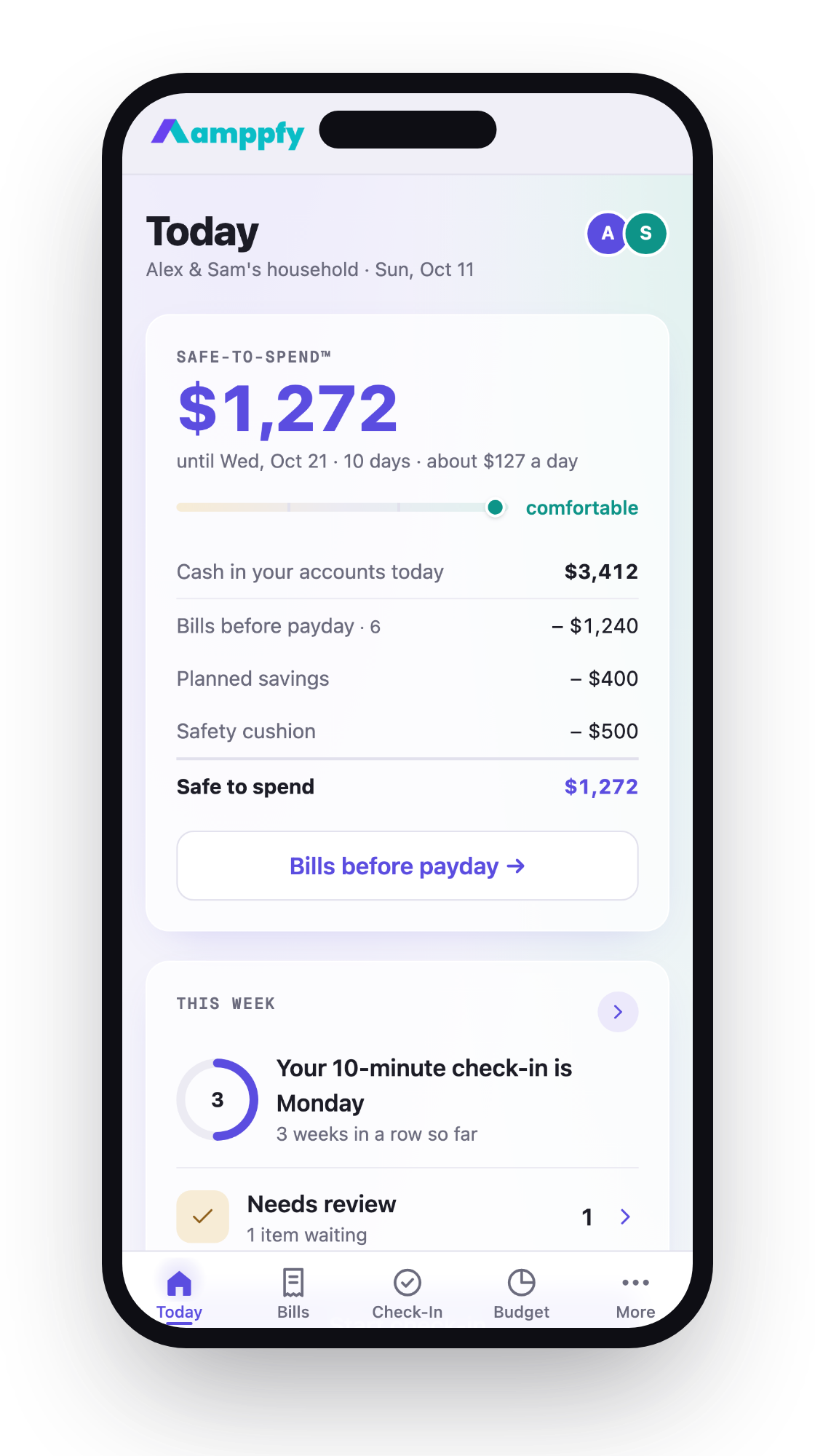
Your pay period tells you which work a check covers. Your pay date tells you when you can use it. Between them sits the number that matters most: your balance minus the bills due before the next check. If you’d like that low point worked out for you, Amppfy marks it on a month calendar from the balances, bills, and paydays you type in. You can set up your bills and paydays here. Take ten minutes this week to try it against your next check.