

If you’ve ever counted Fridays on a wall calendar to figure out when the next paycheck lands, you’re not alone. Pay schedules look simple until a holiday moves a deposit or a month quietly brings a third check.
The good news is that this is ordinary arithmetic. You need one known payday, your pay frequency, and a calendar. There’s no interactive tool on this page, and you don’t need one. Every method below works by hand, on a paper calendar, or in any spreadsheet.
Once you can see the dates, you can see the money. You’ll know which months run tight and which months give you breathing room. You’ll also know how much cash has to last until the next deposit. The rest is a few minutes of counting.
The short answer: what a pay period calculator actually does
A pay period calculator does two jobs. It counts how many paychecks you’ll get in a year. It also lists the dates those checks arrive.
Behind the screen, the logic is plain:
- Weekly: add 7 days to a known payday.
- Biweekly: add 14 days to a known payday.
- Semi-monthly: use two fixed dates each month.
- Monthly: use one fixed date each month.
Then it applies one rule. If a payday lands on a weekend or a bank holiday, the deposit usually moves to the prior business day.
That’s the whole machine. Online versions list your upcoming pay dates from a start date and frequency, and you can do the same thing with a pen. The benefit of doing it yourself is trust. When you’ve counted the dates, you know exactly why a check moved. You won’t be guessing whether the calendar or your employer changed something.
Counting your paychecks by hand, frequency by frequency
Start with your frequency. Then count. Here’s the method for each one, with the counts for 2026.
| Frequency | How to count | Checks in 2026 | Watch for |
|---|---|---|---|
| Weekly | Count the Fridays (or your payday weekday) in the year | 52 | 2027 has 53 Fridays but only 52 deposits |
| Biweekly | Start from one known payday, add 14 days, repeat | 26 in a normal year | 27 when the first payday is Jan 1 or 2 of a 53-Friday year |
| Semi-monthly | Two fixed dates each month | 24 | Moves to the prior business day on weekends and holidays |
| Monthly | One fixed date each month | 12 | Same weekend and holiday shift |
The weekly quirk deserves a sentence. 2027 has 53 Fridays. But Friday, January 1, 2027 is a holiday, so that check pays Thursday, December 31, 2026. It lands in 2026’s count, and 2027 ends up with 52 deposits.
For a full year ahead, the 2027 paycheck counts for every frequency are laid out in one place. If you’re paid weekly, the weekly 2027 calendar with its five-Friday months shows each date.
Finding your pay dates: start from one known payday
You only need one confirmed payday. Pull it from your last pay stub or your bank app’s deposit history. Everything else follows from that single date.
Here’s a worked example on a biweekly Friday schedule, Schedule A. Your known payday is Friday, October 9, 2026. Add 14 days at a time:
- October 23
- November 6
- November 20
- December 4
- December 18
- December 31
That last one is the exception. Fourteen days after December 18 is Friday, January 1, which is a holiday. So the check moves back one day to Thursday, December 31.
In a spreadsheet, put your known payday in cell A1. In A2, type =A1+14 and drag down. Then scan the list for weekends and holidays and adjust by hand. It takes about five minutes, and you’ll have every date through year-end.
Biweekly Friday paydays come in two flavors, Schedule A and Schedule B, one week apart. If you need the next year, the 2027 biweekly calendar for both Friday schedules lists them side by side.
Common mix-ups
These three words cause most of the confusion. They sound alike. They aren’t.
Biweekly means every two weeks. That’s 26 checks in a normal year, always on the same weekday. Semi-monthly means twice a month on fixed dates, like the 1st and 15th. That’s 24 checks, and the weekday changes each time. Bimonthly is the tricky one. People use it for both “twice a month” and “every two months,” so ask your payroll team which they mean.
The 26 versus 24 gap matters for your budget. Two extra biweekly checks a year means each one is a little smaller than a semi-monthly check on the same salary. If you switch jobs between the two, your per-check amount will change even if your salary doesn’t.
Then there’s 27. A biweekly schedule produces 27 checks when the first payday falls on January 1 or 2 of a 53-Friday year. Some employers handle this by keeping each check the same size. Others pro-rate salaries by dividing annual pay by 27 instead of 26, which makes each check slightly smaller. Your HR team can tell you which approach applies to you. If they divide by 27, your per-check budget should shrink a bit to match.
Months with an extra check, and the holiday shifts
On a biweekly schedule, most months get two checks. Two months a year get three. In 2026, Schedule A has three checks in January and July. Schedule B has three in May and October.
Those third checks are useful because your monthly bills don’t grow to match. Pick a job for them before they arrive. Common choices are topping up savings, paying down a card, or prefunding a big bill coming next month. Deciding early keeps the money from blending into ordinary spending.
Holidays shift dates in the other direction. Direct deposits run through the ACH network, and the Federal Reserve Banks that settle them are closed on weekends and federal holidays[1], so settlement moves to the preceding banking day. That’s why a January 1 payday shows up on December 31. Semi-monthly and monthly dates follow the same logic on weekends.
If you’re paid on the 1st and 15th or the 15th and last day, the semi-monthly pay dates for 2027 show where each weekend shift lands.
Planning paydays around bills: the lowest point before payday
Knowing your pay dates is half the picture. The other half is what has to come out before the next one arrives.
Your balance is highest right after payday. It drops as bills clear. The lowest point usually comes just before the next deposit. That low point is the number that matters, not today’s balance.
Here’s the math, step by step:
- Write down today’s balance. Say it’s $2,400.
- List every bill due before your next payday. Rent $1,350, phone $85, car insurance $140.
- Add them up. $1,350 + $85 + $140 = $1,575.
- Subtract. $2,400 − $1,575 = $825.
That $825 is your low point. It’s what you actually have to work with until the next check. Bills due after payday don’t count yet, because that check will cover them.
Do this once per pay period and it takes about ten minutes. If you share bills with a partner, do it together. You’ll both be looking at the same number and making plans from the same facts.
More on pay periods and paydays
Related guides, each built on the same verified 2026 and 2027 pay calendars:
- Biweekly vs. Semi-Monthly Pay: The Difference, With a Full-Year Example
- What Is a Pay Period? Weekly, Biweekly, Semi-Monthly, and Monthly, Explained
- Biweekly Pay Schedule 2026: Every Remaining Payday This Year, and the 2027 Dates
- When Will I Get My First Paycheck? Weekly, Biweekly, and Paid in Arrears
- Biweekly Pay Calendar 2027: Every Friday Payday on Both Schedules
- Semi-Monthly Pay Dates 2027: The 1st and 15th, the 15th and Last Day
- How Many Paychecks in 2027? Counting Weekly, Biweekly, Semi-Monthly, and Monthly
- Does 2027 Have 27 Pay Periods? What Biweekly Workers Should Know
FAQ
How many paychecks will I get in 2026?
Weekly pay gives you 52 checks in 2026. Biweekly gives 26 in a normal year. Semi-monthly gives 24, and monthly gives 12.
Why does 2027 have 53 Fridays but only 52 weekly deposits?
Friday, January 1, 2027 is a holiday, so that check pays Thursday, December 31, 2026. It counts toward 2026 instead. That leaves 2027 with 52 deposits.
Do I need an online tool to find my pay dates?
No. A pay period calculator just adds 7 or 14 days to a known payday and adjusts for holidays. You can do the same thing on paper or in any spreadsheet using one confirmed date from your pay stub.
Which months give me a third paycheck?
On a biweekly Friday schedule in 2026, Schedule A gets three checks in January and July. Schedule B gets three in May and October. Find your schedule by checking whether your known payday matches the Schedule A example dates above.
Counting paychecks isn’t hard once you see the pattern. Start from one known payday. Add the right number of days. Move anything that lands on a weekend or holiday to the business day before. That’s the core of every calculator you’ll find, and you can do it in a few minutes.
The dates only matter because of what they protect. So finish with the low point. List the bills due before your next check. Subtract them from your balance. What’s left is the number to plan from, and it’s calmer to know it than to guess.
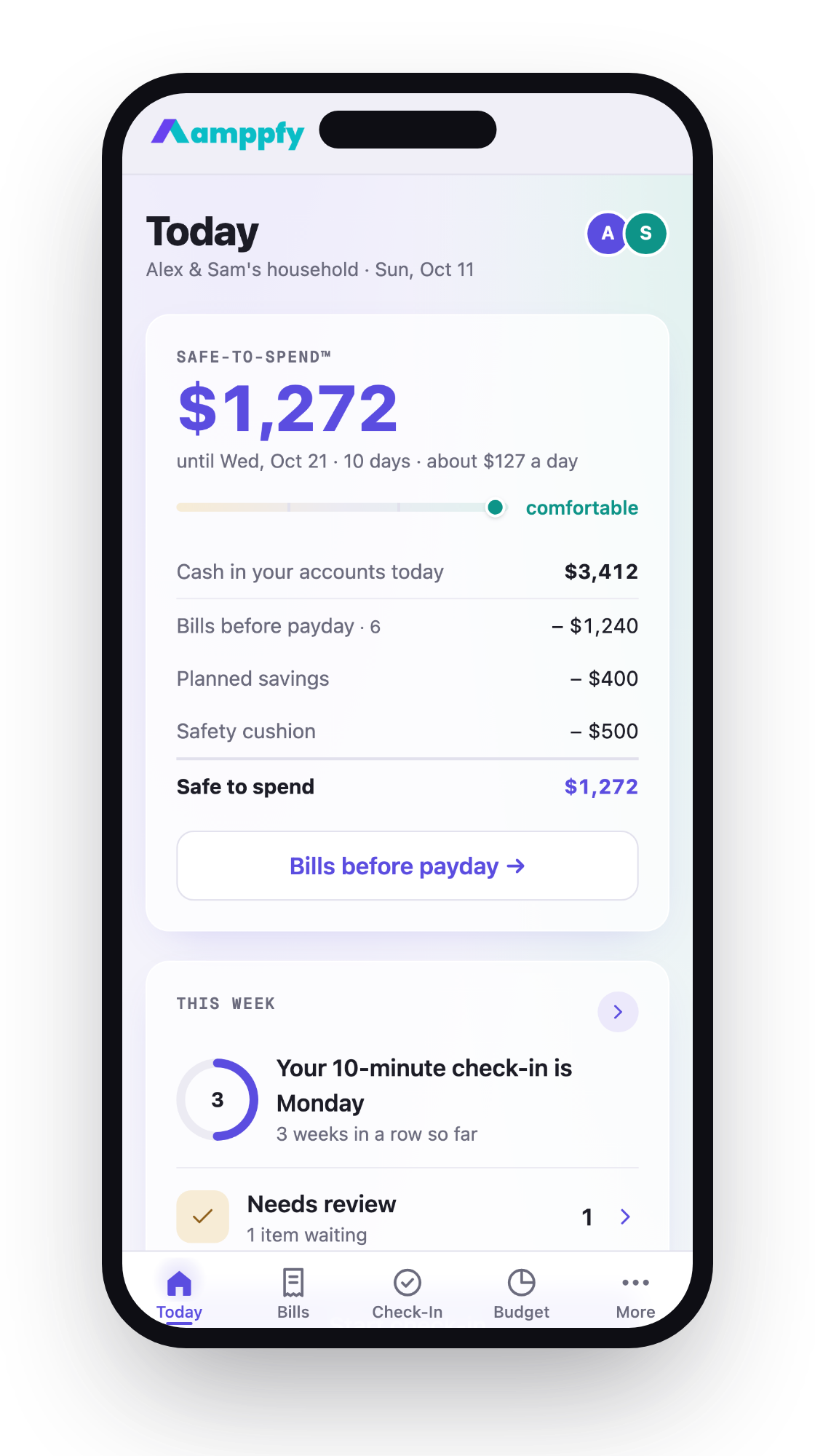
If you’d rather not redo that subtraction every week, Amppfy’s bills calendar marks your lowest point before each payday for you. You type in your balances, and it shows the math. Set up your bills and paydays here and take ten minutes this week to see your next low point.