Should You Open a Second Checking Account at the Same Bank? A Beginner’s Honest Guide
You have one checking account, and everything flows through it: rent, groceries, subscriptions, that impulse coffee order, your paycheck. It works, sort of, until you check your balance mid-month and can’t tell whether you’ve already covered your car insurance.
Opening a second checking account at the same bank is one of the simplest fixes for this exact problem, and most banks will let you do it in about ten minutes. Here’s what you actually need to know before you pull the trigger.
Why People Open a Second Checking Account in the First Place
The core reason is surprisingly boring: clarity. When all your money sits in one account, every dollar has to serve multiple purposes at once. Your rent money mingles with your fun money, and your brain has to do mental accounting every time you swipe your card.
A second account lets you physically separate different jobs your money needs to do. Think of it like having two envelopes in a desk drawer: one for bills, one for spending. The money doesn’t mix, so you always know where you stand.
» Set up your personal bank account online quickly with a simple step-by-step process: How To Setup Personal Bank Account Online 5 Simple Steps
Common setups people use with two accounts:
-
Bills account + spending account: Paycheck gets split via direct deposit. Fixed expenses auto-pay from one account, and discretionary spending comes from the other.
-
Personal + shared expenses: Couples who keep some financial independence but split rent and utilities through a joint second account.
-
Business-adjacent spending: Freelancers who aren’t ready for a full business account but want to keep client payments separate from personal spending.
-
Goal-based saving through checking: Some people park short-term savings (vacation fund, holiday gifts) in a second checking account rather than a savings account to avoid transfer limits.
The Real Advantages of Keeping Both Accounts at One Bank
Splitting your checking accounts across two different banks has its fans, but there’s a strong case for keeping both under one roof. Here’s why the single-bank approach works well for beginners.
|
Benefit |
Why It Matters |
|---|---|
|
Instant internal transfers |
Moving money between your two accounts happens immediately, usually within seconds. No waiting 1-3 business days for ACH transfers to clear. |
|
One login, one app |
You see both balances on a single dashboard. No toggling between apps or remembering separate passwords. |
|
Easier to qualify for fee waivers |
Many banks waive monthly fees if your combined balances or total direct deposits hit a threshold. Two accounts at one bank often count together. |
|
You can typically link your second account as a backup funding source, so if one account runs short, the other covers it automatically. |
|
|
One customer service relationship |
If something goes wrong, you make one call. You’re not explaining your situation to two separate institutions. |
The friction reduction here is real. Every extra login, every extra app, every extra customer service number adds a small barrier to managing your money well. For beginners, especially, reducing that friction matters more than chasing a slightly better perk at a second bank.
» Optimize your finances by using the right number of checking accounts: How Many Checking Accounts Should You Have Optimize For Bills Spending Income Streams
The Downsides Nobody Mentions Until It’s Too Late
Two checking accounts at one bank isn’t a perfect setup. Some of these drawbacks are minor annoyances, others could actually cost you money.
Monthly fees can double
If your bank charges $12/month per checking account and you don’t meet the waiver requirements on both, you’re now paying $24/month, or $288/year, just for the privilege of having two accounts. Before opening that second account, get the fee schedule in writing.
Quick fee checklist to review:
-
Monthly maintenance fee for each account
-
Minimum balance requirements for fee waivers
-
Whether combined balances across accounts count toward waiver thresholds
-
ATM fees (some banks charge differently for secondary accounts)
-
Paper statement fees (if applicable)
» Understand checking accounts and manage your money with confidence: What Is A Checking Account And Understanding The Basics
FDIC coverage doesn’t double the way you think
This trips people up. FDIC insurance covers $250,000 per depositor, per bank, per ownership category. Two individual checking accounts at the same bank share that $250,000 limit. If you have $200,000 in each account (lucky you), only $250,000 of that $400,000 total is insured.
For most people, this isn’t a practical concern. But if you’re holding significant cash, it’s worth knowing.
You might spread yourself too thin
If your monthly take-home is $3,500 and you split it between two checking accounts, both balances will look smaller. That can trigger minimum balance fees, and it can also create a psychological effect where you feel like you have less money than you do. Some people find this motivating; others find it stressful.
» Find the best checking account to match your financial needs and habits: Ultimate Guide To Finding The Best Checking Account
All your eggs, one basket
A bank outage, a security breach, or an account freeze affects both accounts simultaneously. If Chase goes down for six hours on a Saturday (which has happened), you can’t access either account. Having a backup account at a separate institution, even a small one, provides a safety net that two accounts at the same bank simply can’t.
» Switch your checking account smoothly without disrupting your finances: Switching Checking Accounts A Step By Step Guide
A Smart Setup That Actually Works for Beginners
Here’s a concrete example. Say your monthly take-home pay is $4,000.
Account A: The Bills Account
-
Receives 70% of your direct deposit ($2,800)
-
Auto-pays rent/mortgage ($1,400)
-
Auto-pays utilities, insurance, subscriptions ($600)
-
Auto-pays minimum debt payments ($400)
-
Keeps a $400 buffer for billing fluctuations
Account B: The Spending Account
-
Receives 30% of your direct deposit ($1,200)
-
Covers groceries, gas, dining out, and entertainment
-
Linked debit card is the only one in your wallet
-
When it hits zero, discretionary spending stops for the month
This setup works because Account B becomes your real-time budget gauge. You don’t need to check a budgeting app or do mental math. If there’s $300 left in Account B, you have $300 to spend. Period.
Pro tip: Most employers let you split direct deposit across two accounts. Set this up through your HR or payroll portal so the split happens automatically. If your employer doesn’t offer split deposits, set up an automatic recurring transfer from Account A to Account B on payday. Automating this on payday removes the temptation to skip the transfer or adjust the amounts when you’re feeling spendy.
How to Decide If This Strategy Is Right for You
Not everyone needs two checking accounts. Here’s a quick way to figure out if you’re a good candidate.
This setup probably helps you if:
-
You regularly lose track of how much is “available” vs. already committed to bills
-
You’ve overdrafted more than once in the past year
-
You share expenses with a partner but want to keep personal spending separate
-
You’re a freelancer with irregular income who needs to separate tax money from spending money
This setup probably doesn’t help you if:
-
You already budget effectively with one account and a tracking tool
-
Your bank charges fees you can’t waive on a second account
-
You tend to forget about accounts you don’t check daily
-
Your total monthly income is low enough that splitting it creates minimum balance problems
One thing worth flagging: if you do open a second account and later stop using it, don’t just forget about it. Dormant accounts can trigger inactivity fees, and after a period of inactivity (typically 3-5 years, depending on your state), the bank may be required to escheat your funds to the state. Keep your contact information current with your bank so you receive any required notices before that happens.
Comparing Your Options Side by Side
|
Factor |
Two Accounts, Same Bank |
Two Accounts, Different Banks |
|---|---|---|
|
Transfer speed |
Instant |
1-3 business days (ACH) |
|
Convenience |
Single app/login |
Two apps, two logins |
|
FDIC coverage |
Shared $250K limit |
Separate $250K limits per bank |
|
Outage risk |
Both accounts affected |
Only one bank affected |
|
Fee waivers |
Combined balances may help |
Each bank evaluates independently |
|
Best for |
Budgeting simplicity, beginners |
Larger balances, risk diversification |
If you’re just getting started with this approach, same-bank is the easier path. You can always open an account at a second bank later if your needs grow.
Tools That Make Managing Multiple Accounts Easier
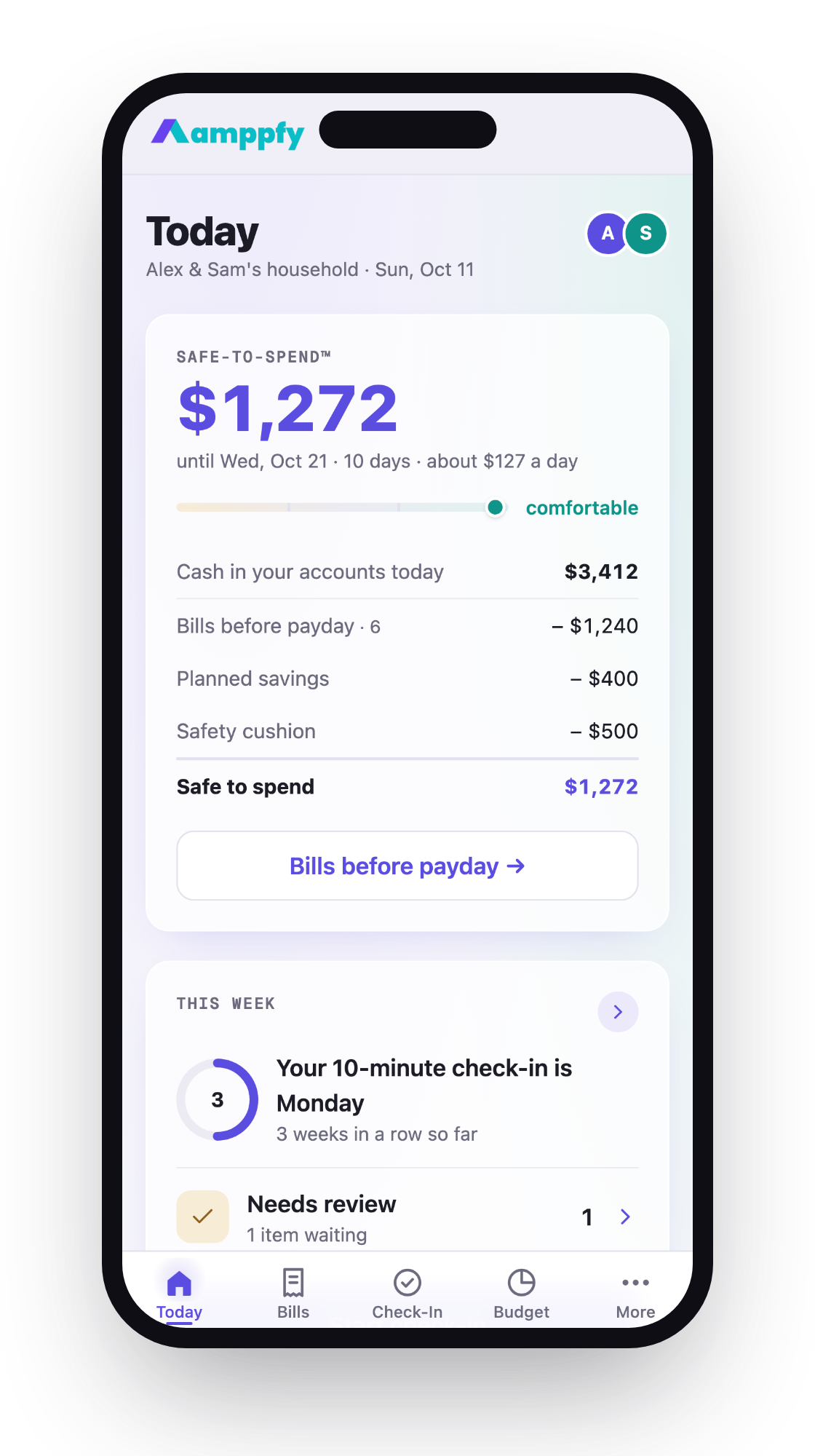
Tracking two accounts manually gets old fast. A tool like Ampffy can help you see both accounts in context, compare your fees, and make sure your setup is actually saving you money rather than costing you more. It’s especially useful when you’re evaluating whether your bank’s fee structure makes a second account worthwhile, or whether a different bank would serve you better.
Beyond aggregation tools, your bank’s own app usually handles dual-account management well. Look for these features:
-
Custom account nicknames (rename “Checking 2” to “Bills Only” so you don’t mix them up)
-
Scheduled internal transfers (automate your payday split)
-
Low balance alerts (set a notification when either account drops below your buffer amount)
-
Overdraft linking (designate one account as a backup for the other)
Frequently Asked Questions
Yes, most major banks allow customers to hold multiple checking accounts. Some banks, like Chase and Bank of America, let you open a second account through their mobile app in minutes. There’s typically no hard limit, though each account may have its own fee structure and minimum balance requirements. Check with your specific bank, as credit unions and smaller community banks occasionally have different policies.
Generally, no. Most banks don’t perform a hard credit inquiry for a standard checking account. They’ll run a ChexSystems report, which tracks your banking history (bounced checks, unpaid fees, account closures), but this is separate from your credit report. The exception: if you’re opening a checking account with an overdraft line of credit, it may involve a hard pull.
A common starting point is the 70/30 split: 70% of your income goes to bills and obligations, 30% goes to discretionary spending. Adjust based on your actual expenses. If your fixed costs eat up 80% of your income, use an 80/20 split. The exact ratio matters less than the principle of separating committed money from flexible money. Review your split every 3-6 months as your income or expenses change.
It depends on your goal. If you want to control daily spending and separate bills from fun money, two checking accounts work better because you can freely make transactions from both. Savings accounts may limit you to 6 outgoing transfers per month (though some banks have relaxed this since 2020). If your goal is building an emergency fund you won’t touch, a savings account with a higher interest rate is a better second account. Many people eventually end up with both: two checking accounts for cash flow management and a savings account for longer-term goals. A financial advisor can help you figure out the right combination based on your specific situation and income level.