Every November, your gift list gets all the attention. But the smaller holiday expenses: tips for your mail carrier, a dish for the office potluck, a $25 Secret Santa gift you forgot about: those are the ones that quietly drain your checking account. A 2024 Bankrate holiday spending survey found that 31% of respondents expected to take on debt from seasonal spending, and those “little” costs are a big reason why. Setting a holiday tipping budget alongside your gift budget keeps you from reaching January with a mystery shortfall. The trick isn’t to skip generosity. It’s to plan for it the same way you plan for everything else.
The costs that are not gifts
Holiday spending has two layers. The first is obvious: wrapped presents under a tree. The second is a cloud of smaller expenses that nobody writes down. Tips for service workers. Contributions to office parties. Potluck ingredients. Secret Santa draws. Teacher gifts. Charitable donations prompted by end-of-year appeals. A bottle of wine for the neighbor’s open house.
None of these feel expensive alone. A $20 tip here, a $15 contribution there. But stack them up and they can easily total $200 to $400 in a single pay period. That’s real money, especially if it lands between paychecks and catches you off guard.
The problem isn’t the spending itself. It’s that most people budget for gifts but treat everything else as an afterthought. You plan $500 for presents, then spend another $300 on tips, parties, and extras without adjusting the number.
A simple fix: before December starts, list every non-gift holiday expense you can think of. Assign a dollar amount to each one. Add them up. That total is just as important as your gift budget, and it deserves its own line in your plan.
Here’s what a typical list might look like:
| Category | Example items | Estimated cost |
|---|---|---|
| Service worker tips | Mail carrier, hair stylist, dog walker, house cleaner | $80 – $200 |
| Office contributions | Party fund, potluck dish, Secret Santa | $30 – $75 |
| Teacher/coach gifts | Gift cards, classroom supplies | $20 – $50 |
| Social events | Host gifts, wine, appetizer plates | $30 – $60 |
| Charitable giving | End-of-year donations | Varies |
Write it down. Total it up. That’s your starting point.
Tips for service workers: setting your amounts
Tipping during the holidays is one of those traditions where the “rules” feel vague. You want to be generous, but you also don’t want to guess wrong or blow past what you can afford. A clear budget for holiday tips removes the guesswork.
Who to tip and how much
Start by listing every service worker you interact with regularly. Then assign a range based on common norms. Here’s a practical guide:
| Service provider | Typical holiday tip |
|---|---|
| House cleaner | Cost of one session |
| Dog walker / pet sitter | One week’s pay or $20 – $50 |
| Hair stylist / barber | Cost of one visit |
| Mail carrier | Up to $20 (USPS gift policy caps cash at $20) |
| Garbage/recycling crew | $10 – $30 per person |
| Nanny or regular babysitter | One day’s to one week’s pay |
| Lawn care / landscaper | $20 – $50 |
These are guidelines, not obligations. Your actual amounts depend on your relationship, how often you use the service, and what your finances allow.
Adjusting to what you can afford
If the total feels too high, scale everything proportionally. Drop each tip by 20% rather than cutting one person entirely. A $16 tip instead of $20 still communicates appreciation. You can also pair a smaller cash amount with a handwritten note. People remember the note.
One more thing: set the total before you start handing out envelopes. If your tip budget is $150, divide it across your list and stick to the plan. Winging it almost always costs more than planning it.
Office parties, exchanges, and potlucks
Work-related holiday spending is sneaky. It arrives as a series of small asks: $10 for the party fund, a $25 Secret Santa gift, ingredients for a potluck dish, a card for the boss. Each one is modest. Together, they can hit $75 to $100 without much effort.
Secret Santa and gift exchanges
Most office exchanges set a spending cap, usually $15 to $25. Stick to it. Going over the limit doesn’t make you more generous; it makes the person who stuck to $15 feel awkward. Good options at this price point: a quality candle, a coffee shop gift card, a small kitchen gadget, or a book. Skip anything too personal.
If your office runs multiple exchanges (team exchange, department party, manager gift), it’s fine to participate in one and politely pass on the rest. Nobody’s tracking your participation rate.
Potlucks and party contributions
Potluck dishes don’t need to be expensive. A slow-cooker dip, a batch of cookies, or a simple pasta salad costs $8 to $15 and feeds a crowd. The goal is participation, not a cooking competition.
For cash contributions to office parties, ask what the money covers before you commit. If it’s for decorations and plates, $5 to $10 is reasonable. If it’s covering catered food and drinks, $15 to $20 makes more sense. Knowing what you’re paying for makes it easier to decide.
Here’s a quick way to think about your total work holiday spending:
- Pick a single number you’re comfortable with (say, $60)
- Divide it across the events you actually want to join
- Decline the rest with a simple “I’ll sit this one out”
Folding small costs into one number
The real power move is combining all of these scattered expenses into one line item. Not “tips” and “office stuff” and “potluck groceries” tracked separately. One number. Your total holiday extras budget.
How the math works
Add up every non-gift holiday cost from the categories above. That’s your number. Here’s an example:
$120 tips + $50 office events + $30 teacher gifts + $40 social events = $240 total
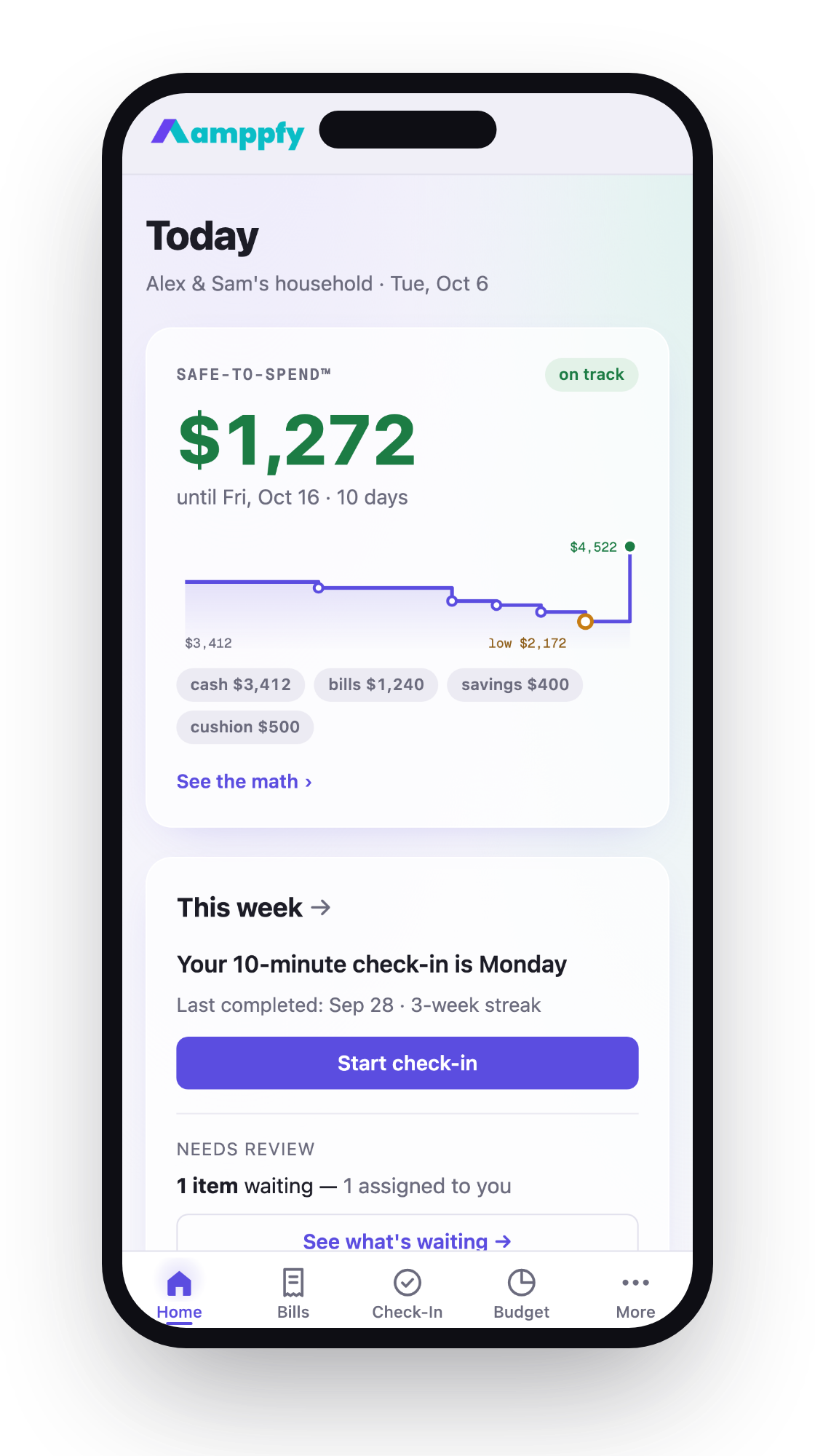
Now compare that $240 against what you actually have available. If you use a tool like Amppfy, your Safe-to-Spend™ number already accounts for bills, savings goals, and a cushion. Subtract your gift budget and this $240 from what’s left. If the result is negative, something needs to shrink.
Spreading the cost across paychecks
You don’t have to fund everything from one paycheck. If you get paid biweekly and December has two pay periods, split the $240 in half. Set aside $120 from each check. This keeps any single paycheck from taking an outsized hit.
Some people start even earlier. Setting aside $40 per paycheck starting in October means $240 is fully funded by mid-December. No scramble. No credit card float.
The key is treating these costs like a bill with a due date, not like a surprise. Because they’re not a surprise. The holidays come every year.
When to say no without awkwardness
Not every holiday expense deserves a yes. You don’t need to tip every person you’ve interacted with once. You don’t need to join every office exchange. You don’t need to bring a $40 charcuterie board to a casual potluck.
Saying no is a skill, and the holidays are a good time to practice it. Here are a few scripts that work:
- “I’m keeping things simple this year, but I appreciate the invite.”
- “I’ll skip the exchange this time, but I’m in for the party.”
- “We’re focusing our holiday budget on family this year.”
None of these require an apology or a detailed explanation. Short and warm is enough.
Recognizing pressure versus genuine generosity
There’s a difference between wanting to tip your house cleaner (genuine appreciation) and feeling guilted into a group gift for a manager you barely know (social pressure). Sort your list into “want to” and “feel like I should.” Fund the first category fully. Cut or reduce the second.
This isn’t about being stingy. It’s about directing your money where it actually reflects your values. A heartfelt $10 gift card for your kid’s teacher matters more than a reluctant $25 thrown into a group collection you didn’t want to join.
Couples and shared decisions
If you share finances with a partner, talk about these costs together before December. Decide on a combined holiday extras budget. Split up who handles which tips and contributions. This avoids the classic problem of both partners tipping the same person or neither tipping anyone because each assumed the other would.
Amppfy makes this simpler: both partners see the same Safe-to-Spend™ number, so when one person hands out tip envelopes, the other sees the impact right away without a text thread or spreadsheet update.
Frequently asked questions
Is there a standard amount I should budget for holiday tips?
There’s no universal standard. A reasonable range for most households is $100 to $300 total, depending on how many service providers you tip regularly. The USPS limits gifts to mail carriers at $20 in cash or cash equivalents. For other providers, one session’s cost or one week’s pay is a common benchmark. Start with what you can afford and adjust from there.
Should I tip in cash or is a gift card okay?
Cash is almost always preferred. It’s flexible, and the recipient can use it however they want. If you’d rather give a gift card, choose a widely accepted option like Visa, Amazon, or a local grocery store. Avoid niche retailers unless you know the person’s preferences well.
How do I handle Secret Santa if the spending limit feels too high?
Talk to the organizer. Most people are relieved when someone suggests lowering the cap. A $10 or $15 limit works just as well as $25 and takes pressure off everyone. If the group won’t budge, opt out politely. A kind note explaining you’re sitting this one out is perfectly acceptable.
What if I can’t afford to tip everyone on my list this year?
Scale back across the board rather than cutting specific people. A smaller tip paired with a handwritten thank-you note carries more weight than you’d expect. You can also bake cookies or make a small homemade gift. The gesture matters more than the dollar amount.
Make your holiday extras budget stick
The small holiday costs aren’t small when you add them up. Tips, parties, potlucks, exchanges, and host gifts can quietly consume an entire paycheck if you don’t plan ahead. Write the list. Set the total. Fund it across your remaining paychecks before December arrives.
If you want to see exactly how much room you have for holiday extras, try building your plan around a single number. Get Amppfy free on iPhone or the web: enter your balances, bills, and payday once (about ten minutes), and you’ll always know what’s safe to spend before your next check hits. That clarity turns holiday generosity from a source of stress into something you can actually enjoy.