The holidays are over. Your wallet holds two or three plastic gift cards, maybe a digital one buried in email. Together they might add up to $200 or more, money that’s yours to spend. But most people treat gift cards like loose change: easy to forget, easy to waste. A simple plan to fold your gift card balance into your budget turns those cards into real purchasing power instead of dusty drawer clutter.
According to a 2023 Federal Reserve Bank of Richmond report, billions of dollars in gift card value go unredeemed each year in the United States. That’s real money left on the table. You can do better with about ten minutes of effort.
Gift cards are money: treat them that way
A $50 Visa gift card and a $50 bill buy the same things. The difference is psychological. Cash feels urgent. A gift card feels like a bonus, something separate from your “real” money. That mental separation is the problem.
Once you start treating gift cards as part of your available cash, they stop collecting dust. They start covering expenses you’d pay for anyway: groceries, gas, streaming subscriptions, a drugstore run. That frees up the cash you would have spent on those items.
The mental shift
Think of each card as a small, temporary checking account. It has a balance. It has rules (where you can use it, when it expires). It belongs in your spending plan just like any other account.
Here’s a quick comparison of how most people handle gift cards versus what actually works:
| Habit | What happens |
|---|---|
| Toss the card in a drawer | Balance forgotten, fees chip away, card expires |
| Spend impulsively on extras | No budget benefit, money gone on things you didn’t need |
| Log the balance and assign it to a real expense | Cash freed up for savings or bills |
The third option is the one that helps your bottom line. You don’t need a spreadsheet. You need a list and a plan.
Listing every card and balance
Before you can use gift cards strategically, you need to know exactly what you have. Gather every physical card from wallets, drawers, and holiday gift bags. Check your email for digital gift cards too.
Check each balance
Most cards print a website or phone number on the back for balance inquiries. Retailer apps (Target, Amazon, Starbucks) show balances instantly when you add the card. For general-purpose Visa or Mastercard gift cards, the issuer’s website is usually the fastest route.
Write down every card with three details:
- Store or card network (e.g., Amazon, Visa, Olive Garden)
- Current balance
- Expiration date, if any
A simple tracking table
A table keeps things visible. Here’s an example:
| Card | Balance | Expiration | Planned use |
|---|---|---|---|
| Amazon | $75.00 | None | Household supplies |
| Visa prepaid | $50.00 | 12/2027 | Groceries |
| Starbucks | $25.00 | None | Weekly coffee |
| Target | $40.00 | None | Toiletries, cleaning products |
| Total | $190.00 |
That $190 is real money. If you spend it on things already in your monthly plan, you free up $190 in cash for savings, debt payments, or your safety cushion. This is the core idea behind building a gift card balance budget: count the cards, assign them to real expenses, and redirect the cash.
You can track these balances in a notes app, a sticky note on the fridge, or inside whatever tool you use for your spending plan. The format doesn’t matter. Visibility does.
Using cards for planned spending
Random spending burns through gift cards fast and gives you nothing to show for it. Planned spending turns them into a budget tool.
Match cards to categories you already spend in
Look at your normal monthly expenses. Where do these cards fit?
- A Target card covers toiletries or cleaning supplies you’d buy anyway
- A Visa prepaid card works at the grocery store
- A restaurant card replaces a meal you’d otherwise pay cash for
- An Amazon card handles household basics: paper towels, batteries, pet food
Every dollar you spend from a gift card on a planned expense is a dollar you keep in your checking account. If your monthly grocery run is $400 and you have $50 on a Visa gift card, your out-of-pocket grocery cost drops to $350 that pay period.
Work the math into your spending plan
Say your pay period looks like this before accounting for gift cards:
$3,200 paycheck – $1,400 bills – $300 savings – $400 cushion = $1,100 Safe-to-Spend™
Now apply $90 in gift cards to planned grocery and household spending. Your cash outflow for those categories drops by $90, but your Safe-to-Spend™ stays the same because those cards aren’t in your checking account. The practical result: you’ll have $90 more in your bank account at the end of the period than you expected. You can move that $90 toward a savings goal or let it pad your cushion for next month.
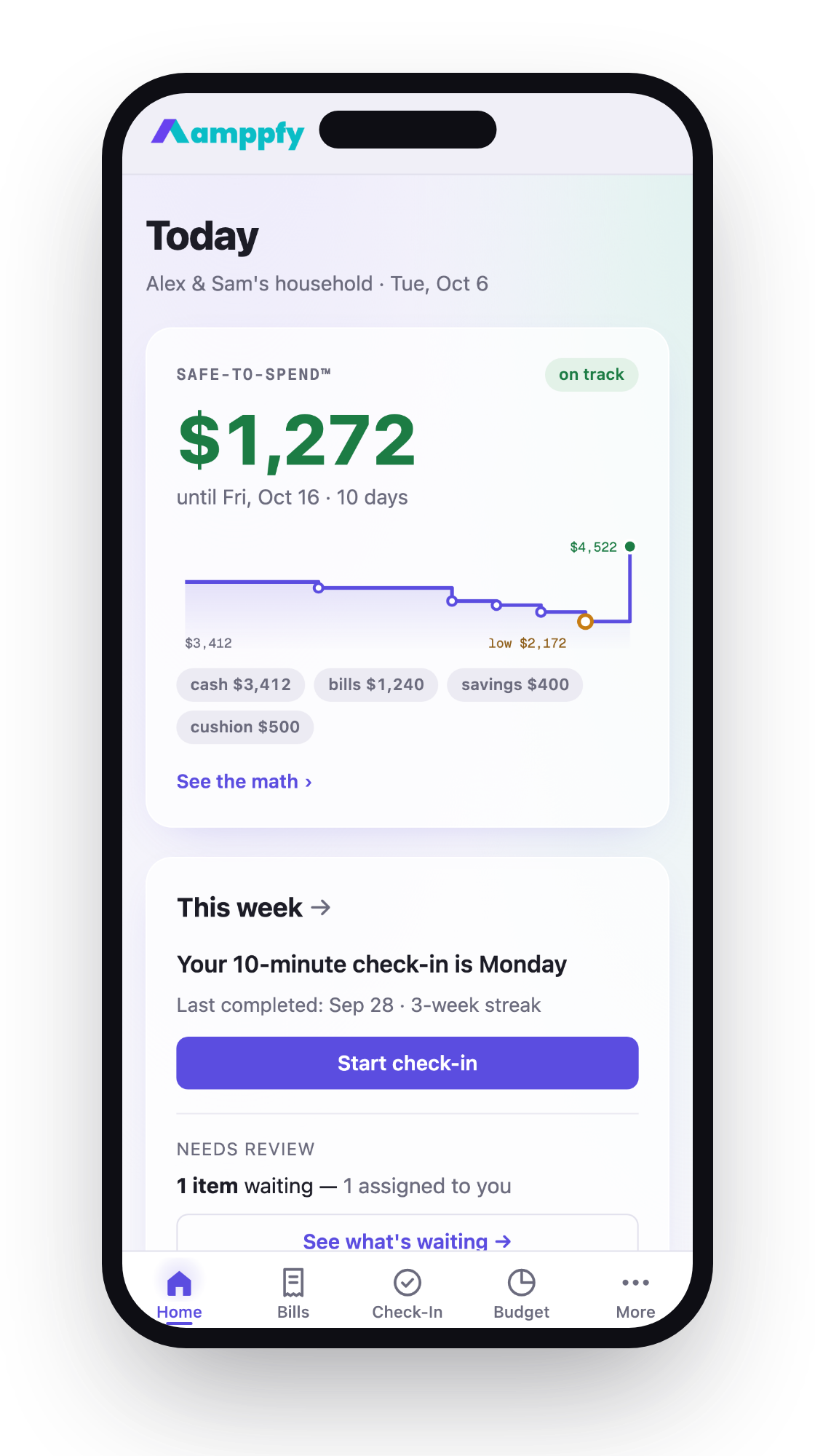
Amppfy’s Safe-to-Spend™ number already accounts for bills, savings, and your cushion. When gift cards reduce what you actually spend from checking, that leftover cash shows up naturally in your balance the next time you update: about 30 seconds per account during a weekly check-in.
Gift card expiration and fee rules
Not all gift cards play by the same rules. Federal law (the Credit CARD Act of 2009) sets a floor, but details vary by card type and state.
Federal protections
- Gift card funds can’t expire for at least five years from the date of purchase or the date money was last loaded
- Inactivity fees can’t kick in until at least 12 months of no activity
- Fee disclosures must be printed on the card or its packaging
Where it gets tricky
Store-branded cards (Target, Starbucks, Home Depot) often have no expiration and no fees at all. General-purpose prepaid cards from Visa, Mastercard, or Amex are more likely to carry monthly maintenance fees after the first year. Those fees can be $2 to $5 per month, slowly draining your balance if you forget about the card.
Here’s a quick reference:
| Card type | Typical expiration | Common fees |
|---|---|---|
| Store gift card | None (most retailers) | None |
| Visa/MC/Amex prepaid | 5-7 years (printed on card) | Monthly inactivity fee after 12 months |
| Restaurant gift card | None or 5+ years | Rare |
| Digital/e-gift card | Varies by issuer | Varies |
The takeaway: use general-purpose prepaid cards first. They’re the ones most likely to lose value over time. Store cards can wait a bit longer, but there’s no reason to delay. Money sitting idle doesn’t help you.
Some states (California, for example) require cash back on gift cards with balances under $10. Check your state’s rules. If you’re sitting on a card with $3.47 left, you might be able to walk into the store and get cash.
Turning cards into budget relief
Gift cards aren’t windfalls. They’re small, targeted tools. Used well, they create breathing room in your spending plan for a month or two after the holidays, exactly when budgets tend to feel tight.
A practical example
Suppose you received $190 in gift cards over the holidays (using the table from earlier). Your January and February spending plan might look like this:
- Week 1: Use the $75 Amazon card for household supplies you’d normally buy. Keep $75 in checking.
- Week 2: Use the $50 Visa card at the grocery store. Keep $50 in checking.
- Week 3: Use the $40 Target card for toiletries. Keep $40 in checking.
- Ongoing: Use the $25 Starbucks card for your weekly coffee instead of paying from your debit card.
Over about a month, you’ve redirected $190 in cash that would have left your checking account. That $190 can go toward a savings goal, cover an unexpected car repair, or simply stay in your account as a bigger cushion.
Don’t hoard them
The biggest mistake is saving gift cards “for something special.” Special never comes. The card sits in a drawer. Fees eat at prepaid cards. You forget the PIN. Use them within 60 days of receiving them, ideally on expenses already in your plan.
If you have a card for a store you never shop at, most cards can be sold through resale platforms (CardCash, Raise) for 70-90% of face value. You’ll lose a small percentage, but 80% of $50 is better than 0% of $50.
Pair cards with your weekly check-in
If you use Amppfy, your weekly check-in already takes about ten minutes. Add one step: update any gift card balances you’ve spent down. When a card hits zero, cross it off your list. This keeps your spending picture accurate without adding a separate chore.
Frequently Asked Questions
Should I count gift cards as income in my budget?
No. Gift cards aren’t income because they don’t increase your bank balance. Think of them as a temporary spending offset. They reduce what you need to pull from checking for specific categories. Log them separately from your cash accounts so you don’t inflate your available balance.
What’s the fastest way to check a gift card balance?
Flip the card over and look for a URL or phone number. Most retailers also let you check balances in their app by entering the card number. For Visa or Mastercard prepaid cards, the issuer’s website (printed on the back) is usually quickest. Avoid third-party balance-check sites: some are phishing scams designed to steal your card number.
Can gift cards actually expire even with federal protections?
The funds themselves can’t expire for at least five years under federal law. But the physical card can have a printed expiration date, after which the issuer may require you to request a replacement card to access remaining funds. This is an inconvenience, not a loss, but it’s easier to just spend the card before that date arrives.
Is it worth selling a gift card I won’t use?
Usually, yes. Resale platforms typically pay 70-90% of face value depending on the retailer. A $100 card for a store you never visit is worth more as $80 in cash than as $100 gathering dust. Just make sure you use a reputable platform and check the card balance right before selling to confirm it hasn’t been compromised.
Make your gift cards work before they fade
Those plastic and digital cards are a short-term advantage. Count them, assign them to real expenses, and spend them within a month or two. The cash they free up belongs in your checking account, your savings, or your cushion: wherever it helps most.
If you want one clear number showing what’s actually safe to spend before payday, Amppfy is free on iPhone and the web. Enter your balances, bills, and payday once, about ten minutes, and your Safe-to-Spend™ number is always there. Get Amppfy free and put those freed-up dollars where they count.