Getting paid on the 15th and the last day of each month puts you on a semi-monthly pay cycle. You receive 24 paychecks a year, and your bills need to land in one of two windows. The trick is sorting every recurring charge into the right half, then knowing what to do when a month throws you a curveball. If you’ve been winging it between paydays, a half-month bill plan gives each dollar a clear assignment before you spend it.
How semi-monthly differs from biweekly
These two pay schedules sound alike. They’re not. Biweekly means every two weeks: 26 paychecks a year. Semi-monthly means twice a month on fixed calendar dates: 24 paychecks a year. That two-paycheck difference adds up to real money over twelve months.
| Feature | Semi-monthly (15th & last) | Biweekly (every 2 weeks) |
|---|---|---|
| Paychecks per year | 24 | 26 |
| Pay dates | Fixed: 15th and last day | Shift through the calendar |
| Gross per check (on $60K) | $2,500 | $2,307.69 |
| “Bonus” months | None | Two months have 3 checks |
With a semi-monthly schedule, your paycheck amount stays the same every time. That consistency is your biggest advantage for planning. You always know what hits your account and when.
The downside: you never get a surprise third paycheck. Biweekly workers can treat those two extra checks as windfalls. You can’t. Your budget for someone paid on the 15th and last day needs to cover every expense across just two pay periods, every single month, with no bonus round.
One more detail worth knowing: the gap between checks isn’t always equal. The first half (1st through 15th) is always 15 days. The second half ranges from 13 to 16 days depending on the month. February’s second half is the shortest. July’s and December’s are among the longest. Your spending window stretches and shrinks, so your plan has to account for that.
Splitting bills into first-half and second-half piles
Start by listing every recurring bill you pay. Write down the due date, the amount, and whether it’s fixed or variable. Then sort each bill into one of two piles based on which paycheck covers it.
The sorting rule
If a bill is due between the 1st and the 14th, assign it to your last-day paycheck (the one that arrives before those dates). If it’s due between the 15th and the end of the month, assign it to your 15th paycheck.
Here’s a sample split:
| Last-day paycheck covers (due 1st-14th) | 15th paycheck covers (due 15th-31st) |
|---|---|
| Rent/mortgage – due 1st – $1,400 | Car payment – due 20th – $385 |
| Car insurance – due 5th – $142 | Electric – due 22nd – $130 |
| Phone – due 10th – $85 | Internet – due 18th – $65 |
| Streaming – due 8th – $23 | Student loan – due 28th – $290 |
| Total: $1,650 | Total: $870 |
Balancing the two halves
Notice the imbalance. The first-half pile is almost double the second. That’s common because rent or mortgage dominates early-month bills. You have two options:
- Call your car insurance or student loan servicer and ask to move the due date. Most lenders will shift it once for free.
- Keep the imbalance but allocate savings contributions to the lighter paycheck. If your 15th check has $870 in bills, you can push more toward goals that cycle.
The point isn’t perfect symmetry. It’s knowing exactly which check pays which bill so nothing falls through the gap.
The short February problem and long-month surprises
February is the month that trips up semi-monthly budgets. Your “last day” paycheck arrives on the 28th (or 29th in a leap year). That means the gap between your February 15th check and your February 28th check is only 13 days, but the gap between February 28th and March 15th stretches to 15 days. You’re funding a longer stretch with a shorter runway.
How to handle February
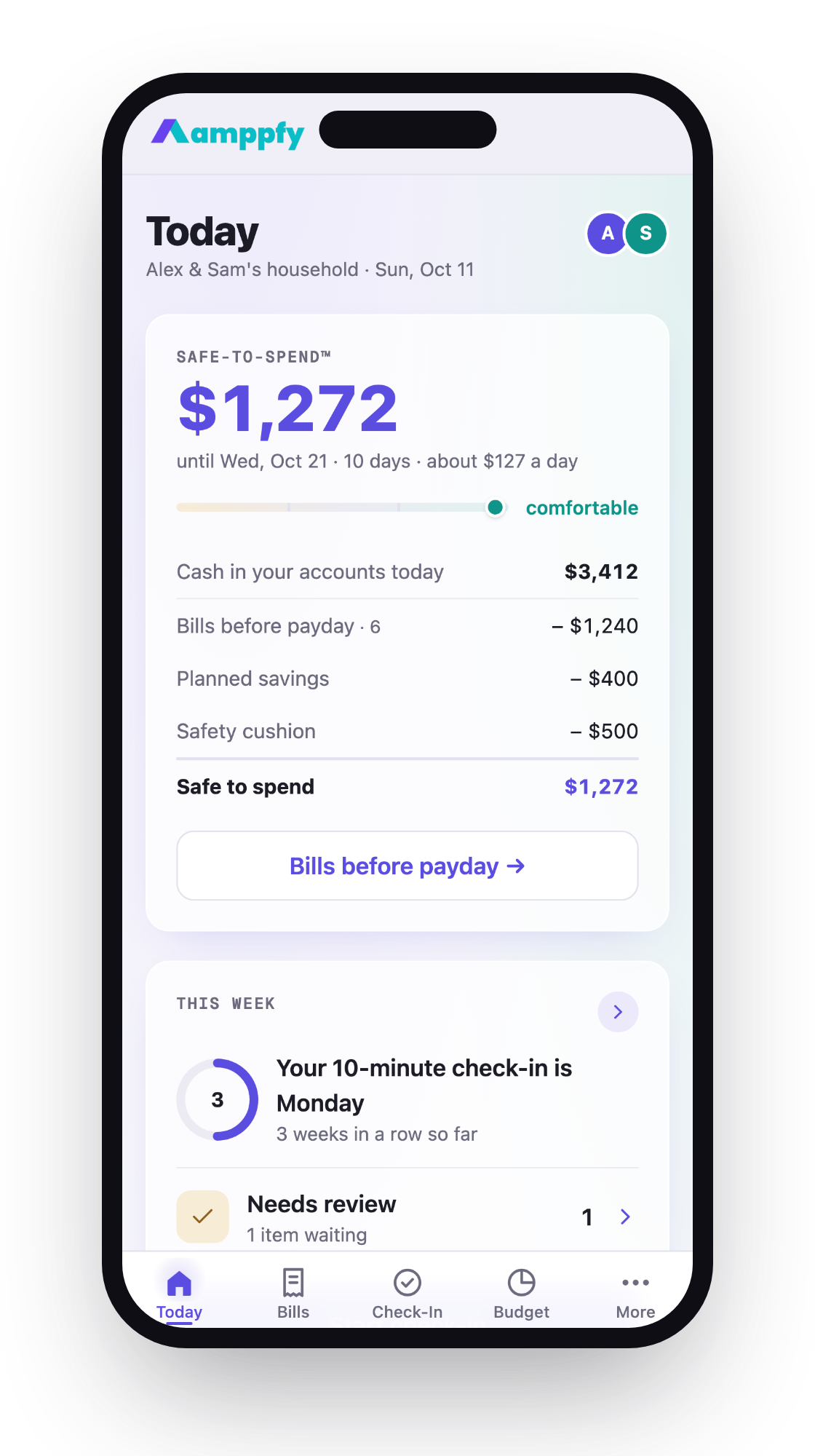
Set aside a small buffer in January. Even $75 to $100 carried forward covers the squeeze. If you use Amppfy, the month calendar marks your lowest-cash day, so you can spot February’s pinch point before it arrives.
Months with 31 days
The opposite problem shows up in January, March, May, July, August, October, and December. Your last-day paycheck lands on the 31st, giving you a 16-day window from the 15th to the 31st. That’s one extra day of groceries, gas, and random spending compared to a 30-day month.
One extra day sounds minor. Over a year, those seven extra days add up to a full week of unplanned spending. A practical fix: round your variable expenses (groceries, gas, household supplies) up by about 5% in 31-day months. If you normally budget $500 for groceries per half-month, bump it to $525 for the longer stretch.
Weekend and holiday shifts
When the 15th or the last day falls on a weekend or bank holiday, your deposit usually arrives the business day before. That’s good: money lands early. But if a bill’s auto-pay is set for the exact same day, the charge might still process on the original date. Check your bank’s posting rules once so you’re not caught off guard.
A worked half-month with rent, car, and utilities
Theory is fine. Numbers are better. Here’s a real-looking half-month plan for someone earning $62,000 a year, paid semi-monthly. Each gross paycheck is $2,583. After taxes, health insurance, and a 401(k) contribution, take-home is about $1,920 per check.
Last-day paycheck (covers bills due 1st-14th)
| Category | Amount |
|---|---|
| Rent | $1,400 |
| Car insurance | $142 |
| Phone | $85 |
| Subscriptions | $28 |
| Savings transfer | $100 |
| Cushion | $50 |
| Total committed | $1,805 |
That leaves $1,920 – $1,805 = $115 for groceries, gas, and discretionary spending during the first half.
15th paycheck (covers bills due 15th-31st)
| Category | Amount |
|---|---|
| Car payment | $385 |
| Electric | $130 |
| Internet | $65 |
| Student loan | $290 |
| Savings transfer | $150 |
| Cushion | $50 |
| Total committed | $1,070 |
That leaves $1,920 – $1,070 = $850 for groceries, gas, and spending during the second half.
Reading the math
The first half is tight. The second half has breathing room. You could move the $150 savings transfer to the first half to even things out, but honestly, having a tighter first half and a looser second half works for many people. It front-loads discipline and gives you a more relaxed back half.
The one-line version of your Safe-to-Spend™ for the second half: $1,920 cash – $1,070 bills – $150 savings – $50 cushion = $650. That’s what’s actually yours to use freely.
According to the Federal Reserve’s 2023 Survey of Household Economics and Decisionmaking, 37% of adults said they would struggle to cover an unexpected $400 expense. A half-month plan with a built-in cushion puts you on the other side of that statistic.
Updating the split when a bill moves
Bills change dates. You switch car insurance providers and the new due date is the 22nd instead of the 5th. Your landlord starts accepting rent on the 3rd instead of the 1st. A streaming service shifts its billing cycle after a plan change. Your budget for the 15th and last day pay schedule needs to flex with these shifts.
When to reassess
Do a quick audit every time one of these happens:
- A bill’s due date changes by more than three days
- You add or drop a recurring charge (new gym, canceled subscription)
- Your pay date shifts (some employers move from the 15th/last to the 1st/16th)
- You take on a new loan or pay one off
The five-minute rebalance
- Open your bill list. Move the changed bill to the correct half.
- Re-total each half.
- Compare the totals. If one half now exceeds 85% of your take-home, look for a bill you can shift to the other half.
- Update any auto-pay dates that need to match.
- Confirm your Safe-to-Spend number still looks right.
Amppfy handles steps 1 through 3 automatically when you update a bill’s date. The app recalculates your Safe-to-Spend in real time, so you see the impact before the next paycheck lands. You can try it free on iPhone or the web at amppfy.com/app/.
The biggest mistake people make: they set up a half-month plan once and never touch it. Bills shift. Subscriptions creep in. A plan that was balanced in January can be lopsided by June. A 10-minute check-in once a week catches drift before it becomes a problem.
Frequently Asked Questions
What if my employer pays on the 1st and the 15th instead of the 15th and the last day?
The same framework applies. Your first paycheck covers bills due from the 1st through the 14th, and your second covers the 15th through month’s end. The only difference is timing: your “first half” check arrives on the 1st, so bills due early in the month are covered by the check that lands the same day. Adjust your two piles accordingly and the rest of the plan works identically.
Should I pay bills the day my paycheck arrives or wait until the due date?
Pay fixed bills the same day your check deposits, or set auto-pay for the day after payday. Waiting until the due date leaves money sitting in your account looking “available,” which makes it easy to spend on something else. Get the committed money out of your checking account fast so what remains is genuinely yours.
How do I handle a bill that hits both halves, like a credit card with charges throughout the month?
Pick one paycheck to cover your credit card payment. Most people assign it to whichever half has more breathing room. If your statement closes on the 12th with a due date around the 5th of the following month, that payment belongs in your last-day paycheck pile. The key is consistency: always pay it from the same half so it doesn’t surprise you.
What happens if a paycheck is short because of unpaid time off or a holiday?
Reduce discretionary spending first, not bill payments. If the shortfall is larger than your cushion can absorb, pull from savings temporarily and replenish it with the next full paycheck. This is exactly why a cushion line exists in the plan: it absorbs small shocks without forcing you to skip a bill.
Making Your Half-Month Plan Stick
A semi-monthly paycheck is one of the easiest schedules to budget around. Fixed dates. Predictable amounts. Two clean windows per month. The work is in the initial sorting: once your bills land in the right pile, maintenance takes minutes, not hours.
Start this week. List your bills, sort them into two halves, and run the math for one pay period. If the numbers feel tight on one side, call a servicer and ask to move a due date. Small adjustments now save you from scrambling later. Amppfy can show you the full picture in about 10 minutes: your balances, your bills, and one number that tells you what’s safe to spend before your next paycheck.