You just got the offer letter. The salary looks real. Now you’re scanning apartment listings, doing mental math, and wondering how it all fits together. Building a budget around your first paycheck and first apartment is one of those things nobody teaches you, but everyone figures out the hard way. Here’s a way to figure it out before the hard way finds you. The goal is simple: know what’s safe to spend after your rent, bills, and savings are covered, starting from paycheck number one.
What actually lands in your account after taxes and benefits
Your offer letter says one number. Your bank deposit will say a smaller one. The gap between those two numbers catches most people off guard.
How the math actually works
Start with your gross annual salary and divide by the number of pay periods. If you’re paid biweekly, that’s 26 checks per year, not 24. A $52,000 salary means $2,000 per check before anything comes out.
Then subtract federal income tax, state income tax (if your state has one), Social Security (6.2%), and Medicare (1.45%). Add health insurance premiums, a 401(k) contribution if you elected one, and any other voluntary deductions. What remains is your net pay: the deposit that actually hits your checking account.
Here’s a rough example for someone earning $52,000 in a state with moderate income tax:
| Line item | Per paycheck (biweekly) |
|---|---|
| Gross pay | $2,000 |
| Federal income tax | −$180 |
| State income tax | −$80 |
| Social Security + Medicare | −$153 |
| Health insurance | −$95 |
| 401(k) at 4% | −$80 |
| Net deposit | $1,412 |
That’s roughly 70% of gross. According to the Bureau of Labor Statistics, the average effective tax rate for a single filer earning around $52,000 falls between 22% and 28% once all payroll deductions are included. Your first paycheck stub will confirm the exact split.
What to do before day one
Request a pay stub preview from HR or run your numbers through your employer’s payroll portal. Don’t plan rent around gross pay. Plan around net. Every dollar you commit before seeing your actual deposit is a guess, and guesses are expensive when a lease is involved.
Rent, deposit, and setup costs before the first full check
Your apartment budget starts before the first paycheck arrives. That timing mismatch is the part most people underestimate.
Upfront costs you’ll face at signing
Most landlords require first month’s rent, a security deposit (often equal to one month’s rent), and sometimes last month’s rent. If you’re renting a $1,200 apartment, you could owe $2,400 to $3,600 before you get your first key.
On top of that, expect these move-in costs:
- Renter’s insurance: $15 to $30/month, sometimes required before move-in
- Utility deposits: $50 to $200 per utility if you have no prior account history
- Basic furniture and supplies: $500 to $1,500 depending on what you already own
- Internet setup fee: $50 to $100
The rent-to-income ratio that actually works
A common guideline says rent should be 30% of gross income or less. On a $52,000 salary, that’s $1,300/month. But your actual constraint is tighter: 30% of gross is roughly 43% of net if you’re contributing to a 401(k) and paying for insurance.
A safer anchor is 25% to 30% of your net monthly income. For the example above ($3,060/month net on biweekly pay), that puts rent between $765 and $918. If your city’s rents are higher, you’ll need to adjust other categories, get a roommate, or negotiate a higher salary before signing.
| Approach | Monthly rent target |
|---|---|
| 30% of gross | $1,300 |
| 30% of net | $918 |
| 25% of net | $765 |
Use net pay as your anchor. Gross-based targets hide the real squeeze.
Assigning bills to paydays from day one
Getting paid doesn’t help if every bill lands on the wrong week. Aligning your bills with your pay cycle prevents the “money came in, money vanished” feeling.
Map your bills to your pay dates
Write down every recurring expense and its due date. Then sort them into two groups: bills due in the first half of the month and bills due in the second half. If you’re paid biweekly, assign each bill to the paycheck that arrives just before it’s due.
Here’s a sample split for someone paid on the 1st and 15th:
- Paycheck 1 (1st): Rent, renter’s insurance, internet, electric
- Paycheck 2 (15th): Phone, subscriptions, groceries restock, gas or transit pass
Most utility companies and subscription services let you change your billing date with a phone call or a settings change online. Call each one and pick a date that falls two to three days after your paycheck. That small buffer keeps you from accidentally spending bill money on Tuesday when the bill hits Wednesday.
The one-line check that keeps you honest
Before you spend anything discretionary after payday, do this quick subtraction:
$1,412 deposit − $1,050 rent − $120 bills − $100 savings goal − $50 cushion = $92
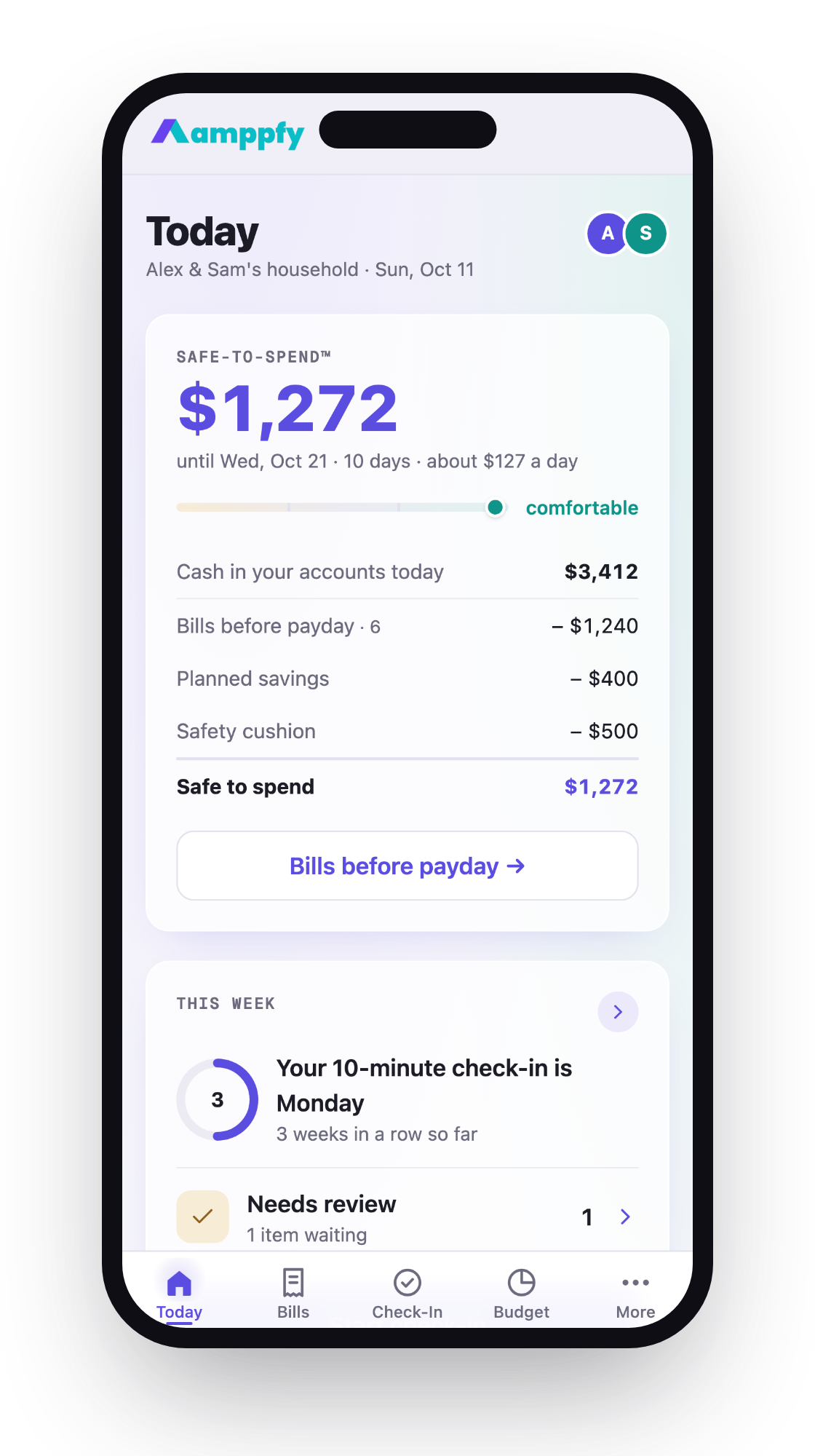
That remainder is what’s actually safe to spend until the next check. Amppfy calls this your Safe-to-Spend™ number: available cash minus bills due before payday, minus planned savings, minus a safety cushion you set. It takes about ten minutes a week to update, and it replaces the vague anxiety of checking your bank balance and hoping for the best.
If you’re paid biweekly, watch for the two-paycheck months
Biweekly pay gives you 26 checks a year. That means two months will have three paychecks instead of two. Don’t absorb those into regular spending. Flag them now and route the extra check toward your deposit fund, your emergency cushion, or a savings goal.
A cushion you can build in your first three months
You don’t need a full emergency fund on day one. You need a starting cushion and a plan to grow it.
Month-by-month savings targets
Set a realistic goal for each of your first three months. Here’s a sample progression for someone with $92 in weekly discretionary spending:
- Month 1: Save $150 total. Cut one category (eating out, new clothes, streaming trials). Redirect $35 to $40/week into a separate savings account.
- Month 2: Save $200. You’ve learned your actual spending patterns. Tighten the category that surprised you most.
- Month 3: Save $250. By now, your habits are forming. Automate a transfer on payday so the money moves before you see it.
After three months, you’ll have $600. That’s not a full emergency fund, but it covers a car repair, an urgent medical copay, or a gap if a paycheck is delayed. The 2023 Federal Reserve Survey of Household Economics found that 37% of U.S. adults couldn’t cover a $400 emergency expense with cash or its equivalent. Starting with $600 puts you ahead of that threshold.
Where to keep the cushion
Use a high-yield savings account separate from your checking. The physical separation matters. If your cushion sits in the same account as your spending money, it will get spent. A separate account with a one-day transfer delay creates just enough friction to protect the balance.
Don’t tie this money up in a CD or investment account. You need it liquid, available within 24 hours, and boring. Boring is the point.
The habits that stick if you start them now
The first three months of a new job set your financial defaults. What you do on autopilot at month four is whatever you practiced at month one.
Weekly ten-minute check-in
Pick a day. Sunday evening works for most people. Open your bank app, update your balances, and confirm your Safe-to-Spend number. That’s it. You’re not categorizing 47 transactions or reconciling receipts. You’re answering one question: how much can I actually spend before the next paycheck?
Amppfy is built around this exact check-in. You enter your balances yourself (about 30 seconds per account), and the app shows one number with the math printed underneath. If you have a partner splitting bills, they get their own login and see the same number without sharing private account details.
Pay yourself on payday, not at month’s end
Move savings money the same day your paycheck lands. If you wait until the end of the month, you’ll save whatever’s left, which is usually nothing. Automate a transfer of even $50 on payday. Treat it like a bill you owe yourself.
Review subscriptions every 90 days
Set a calendar reminder. Open your subscriptions list and check the next charge date for each one. Cancel anything you haven’t used in the past 30 days. A $14.99 streaming service and a $9.99 app you forgot about add up to $300 a year. That’s real money when you’re building a cushion.
Don’t upgrade your lifestyle for six months
Your first paycheck feels like a lot of money if you’ve been living on a student budget. Resist the urge to upgrade everything at once. Keep your old phone. Cook the meals you already know. Buy furniture secondhand. The lifestyle you maintain for the first six months becomes your baseline, and a lower baseline means more room for savings, goals, and actual choices later.
Frequently asked questions about your first paycheck and apartment budget
How much should I save before signing my first lease?
Aim for two and a half to three months of rent in cash before you sign. That covers first month’s rent, a security deposit, and a small buffer for move-in costs like utility deposits and basic supplies. If your rent is $1,200, target $3,000 to $3,600 in savings before apartment hunting. If you can’t hit that number, look for apartments with lower deposits or ask if the landlord accepts a deposit payment plan.
Should I contribute to my 401(k) right away or wait until I’m settled?
Contribute at least enough to get your employer’s full match from your very first check. That match is free money with an immediate 50% to 100% return. If your employer matches 4%, contribute 4%. You can increase later, but skipping the match costs you hundreds or thousands of dollars per year that you can never recover.
What if my rent is more than 30% of my net pay?
You have three options: find a roommate, reduce other spending categories, or look in a different neighborhood. If none of those work, you may need to delay moving out until your income increases. Stretching beyond 35% of net pay leaves almost no room for savings, emergencies, or any flexibility at all. Run the actual subtraction with your bills and see what’s left.
How do I budget when I don’t know my exact expenses yet?
Estimate high for the first two months. Overestimate utilities, groceries, and transportation by 15% to 20%. After eight weeks of real spending, you’ll have actual numbers to replace the estimates. Tools like Amppfy let you update balances and bills as you learn them, so your Safe-to-Spend number gets more accurate each week without requiring a full restart.
Start with one number, not a spreadsheet
Your first real paycheck and your first apartment don’t need a complicated system. They need one clear answer: what’s safe to spend before the next payday? Get that number right, protect a small cushion, and review it once a week. Everything else, the goals, the investments, the bigger plans, builds on that foundation. Take ten minutes this week to map your net pay against your bills. That’s the entire first step.