

Two paychecks a month sounds simple until you notice your coworker on a different schedule gets a “bonus” check twice a year. Nothing is wrong with either of you. You’re on different pay cycles, and the math behind each one is ordinary arithmetic.
The real question isn’t which schedule pays more. Over a year, the salary is the same. What changes is when the money lands, how big each deposit is, and which bills sit in the gap between paydays. Once you see that, the comparison stops being confusing and starts being useful.
Below you’ll find a plain definition of each, a full 2026 calendar on a $52,000 salary, and a simple way to plan your bills around whichever schedule your employer uses. Most of it comes down to one number: the lowest your balance gets before the next check arrives.
The short answer
Biweekly means every two weeks. You get paid on the same weekday, usually a Friday, every 14 days. That works out to 26 checks a year, and 27 in some years.
Semi-monthly means twice a month on fixed dates, often the 1st and 15th or the 15th and the last day. That’s exactly 24 checks a year. The dates stay put. The weekday moves.
Here’s the core difference:
- Biweekly: 26 checks (27 in some years), smaller each, same weekday every time, and three paychecks in two months of the year.
- Semi-monthly: 24 checks, slightly larger each, same calendar dates every month, never a third check.
Neither one pays you more over a year. The annual salary is identical. One splits it into 26 pieces, the other into 24. If you remember just one thing, remember that: the total doesn’t change, only the rhythm does.
Which one feels easier depends on how you budget. If you budget monthly and prefer predictability, semi-monthly is cleaner. Biweekly suits people who budget on a rolling basis or have expenses that vary month to month. Both are workable. You just plan them a little differently.
How biweekly and semi-monthly pay work, with a full-year example
Start with a $52,000 salary. On a biweekly schedule, each gross paycheck is $2,000. On a semi-monthly schedule, it’s about $2,167. Here’s the exact arithmetic:
- Biweekly: $52,000 ÷ 26 = $2,000.00 per check
- Semi-monthly: $52,000 ÷ 24 = $2,166.67 per check
Now turn that into months. A normal biweekly month has two checks, so $4,000.00. A three-check month brings $6,000.00. Semi-monthly is always two checks, so $4,333.33, every single month.
The table below uses 2026 Schedule A biweekly, which pays every other Friday and has three-check months in January and July. It sits next to a 1st-and-15th semi-monthly schedule.
| Month (2026) | Biweekly checks (Schedule A) | Biweekly gross | Semi-monthly dates | Semi-monthly gross |
|---|---|---|---|---|
| January | 3 | $6,000.00 | 1st, 15th | $4,333.33 |
| February | 2 | $4,000.00 | 1st, 15th | $4,333.33 |
| March | 2 | $4,000.00 | 1st, 15th | $4,333.33 |
| April | 2 | $4,000.00 | 1st, 15th | $4,333.33 |
| May | 2 | $4,000.00 | 1st, 15th | $4,333.33 |
| June | 2 | $4,000.00 | 1st, 15th | $4,333.33 |
| July | 3 | $6,000.00 | 1st, 15th | $4,333.33 |
| August | 2 | $4,000.00 | 1st, 15th | $4,333.33 |
| September | 2 | $4,000.00 | 1st, 15th | $4,333.33 |
| October | 2 | $4,000.00 | 1st, 15th | $4,333.33 |
| November | 2 | $4,000.00 | 1st, 15th | $4,333.33 |
| December | 2, plus an early deposit on Thu Dec 31 | $4,000.00 + early deposit | 1st, 15th | $4,333.33 |
| Year | 26 ($2,000.00 × 26) | $52,000.00 | 24 ($2,166.67 × 24) | $52,000.00 |
That December line needs a short explanation, and it’s covered in the mix-ups section below. For now, notice the pattern. Biweekly gives you ten “normal” months and two big ones. Semi-monthly gives you twelve identical months with a slightly bigger baseline.
What it changes for your bills and budget
Most bills are monthly. Rent, car payment, phone, insurance: they bill once a month on a fixed date. That’s the root of almost every budgeting difference between these two schedules.
On semi-monthly, your monthly income is $4,333.33 every month. You can split your bills into two halves, one paid from each check, and the plan repeats forever. It’s the calmer fit if you like a budget that looks the same in March as it does in October.
On biweekly, your baseline month is $4,000.00, not $4,333.33. That’s $333.33 less to work with in ten months of the year. The honest way to budget biweekly is to plan your monthly bills on two checks only. Then the third check in January and July becomes free money: savings, a debt payment, or a cushion.
The trap is budgeting biweekly as if every month were “26 divided by 12.” That averages to $4,333.33, which you don’t actually receive in a two-check month. Plan on what lands, not on the average.
A few practical adjustments help on either schedule:
- Semi-monthly: watch the weekday drift. Paydays stay fixed by the date, not the day of the week, so some land on weekends or holidays, which can shift a direct deposit.
- Biweekly: pick which check covers which bill, then keep that assignment even when the calendar wobbles.
- Both: assign every bill to a specific paycheck so you always know which deposit is responsible for it.
Common mix-ups: biweekly vs semi-monthly vs bimonthly, and 26 vs 24 vs 27 checks
Three words, three different schedules. Here’s the clean version of the biweekly vs semi monthly vocabulary, plus the one that trips everyone up.
- Biweekly: every two weeks. 26 checks, 27 in some years.
- Semi-monthly: twice a month on fixed dates. 24 checks.
- Bimonthly: every two months. Six times a year. Almost no employer pays this way, but people use the word loosely when they mean semi-monthly.
If someone says “bimonthly pay,” ask which dates. Their answer tells you which schedule they really mean.
Why some years have 27 checks
Biweekly is 26 checks of 14 days, which covers 364 days. A year has 365, or 366 in a leap year. The extra day or two drifts forward each year. Eventually a schedule picks up a 27th payday.
That only happens when a schedule’s first payday falls on Jan 1 or Jan 2 of a year with 53 Fridays. In 2026, Schedule A’s first payday is Friday, January 2. Its 27th deposit arrives on Thursday, December 31, 2026, because the next Friday, January 1, 2027, is a holiday, so that check is paid a day early.
In practice, that Dec 31 deposit is the first check of the 2027 pay cycle landing in 2026. Your salary didn’t grow. The calendar just moved one payday across New Year’s Eve.
If you want to check where your own schedule falls next year, see how many paychecks are in 2027 across every schedule, whether 2027 has 27 pay periods, and the 2027 biweekly pay calendar for both Friday schedules.
The 1st/15th collision and the three-paycheck months
Semi-monthly has one predictable pinch. If you’re paid on the 1st and rent is due on the 1st, both hit on the same day. The deposit and the withdrawal race each other. If rent pulls before the paycheck posts, your balance dips, even though the money is technically “there.”
It’s not a crisis. It’s a timing problem, and timing problems have calm fixes:
- Pay rent from the previous check, the one that landed on the 15th, so the money is already sitting in your account.
- Or set the rent payment for a day or two after the 1st, if your landlord allows it.
- Treat the 15th check as “next month’s rent check” in your head. That one relabel solves most of it.
For a full walkthrough, see how to stop the rent-on-the-1st collision. If your dates are the 15th and the last day instead, there’s a half-month bill plan for paid-on-the-15th-and-last-day schedules.
Biweekly has the opposite situation: two months a year with an extra check. In 2026 on Schedule A, that’s January and July, each bringing $6,000.00 instead of $4,000.00. Decide in advance what that third $2,000.00 does. Write it down before it lands.
A simple split works for most households. Part goes to savings, part goes to a goal or a debt, and a small part is genuinely yours to enjoy. Deciding ahead keeps the extra check from quietly disappearing into ordinary spending.
Planning paydays around bills: the lowest point before payday
Whatever your schedule, the most useful number isn’t your balance. It’s the lowest your balance will get before the next check arrives. That’s where any shortfall would show up, so that’s the number to plan from.
Finding it takes about ten minutes:
- Check your balance today. Use what’s actually in the account, not what’s pending in.
- List every bill due before your next paycheck. Rent, subscriptions, the car payment, anything with a date in that window. Bills due after payday don’t count yet.
- Subtract them. Balance minus those bills equals your lowest point before payday.
Here’s a quick example on semi-monthly. It’s the 15th, the $2,166.67 check just landed, and your balance is $2,600. Before the 1st you owe $1,450 in rent (paid early to avoid the collision), $120 for your phone, and $85 in subscriptions. That’s $1,655 total. Your lowest point is $2,600 − $1,655 = $945.
On biweekly, the window is 14 days instead of roughly half a month, so you count bills by date range, not by “first half” or “second half.” The method stays the same. Only the edges of the window move.
If that lowest point is comfortable, you’re fine. If it’s thin, you already know which bill to shift or which purchase to pause. No surprises, just arithmetic you can see.
More on pay periods and paydays
Related guides, each built on the same verified 2026 and 2027 pay calendars:
- What Is a Pay Period? Weekly, Biweekly, Semi-Monthly, and Monthly, Explained
- Biweekly Pay Schedule 2026: Every Remaining Payday This Year, and the 2027 Dates
- Pay Period Calculator: How to Count Your Paychecks and Pay Dates by Hand
- When Will I Get My First Paycheck? Weekly, Biweekly, and Paid in Arrears
- Biweekly Pay Calendar 2027: Every Friday Payday on Both Schedules
- Semi-Monthly Pay Dates 2027: The 1st and 15th, the 15th and Last Day
- How Many Paychecks in 2027? Counting Weekly, Biweekly, Semi-Monthly, and Monthly
- Does 2027 Have 27 Pay Periods? What Biweekly Workers Should Know
FAQ
Does semi-monthly pay more than biweekly?
No. On $52,000, both pay $52,000.00 a year. Semi-monthly checks are larger ($2,166.67 vs $2,000.00) because there are fewer of them: 24 instead of 26.
Why does my biweekly paycheck feel smaller than my monthly bills expect?
Because a normal biweekly month brings $4,000.00, not the $4,333.33 yearly average. Budget your monthly bills on two checks, and treat the three-check months as extra.
Do companies prefer one schedule?
It varies. Biweekly means 26 payroll runs a year compared to 24 for semi-monthly, which adds administrative work. Semi-monthly can be easier for salaried teams, while biweekly lines up neatly with weekly hours for hourly staff.
Is a 27-paycheck year a raise?
No. It happens only when a schedule’s first payday falls on Jan 1 or Jan 2 in a 53-Friday year. Your annual pay doesn’t change. One check simply lands in a different calendar year, like Schedule A’s Thursday, December 31, 2026 deposit.
The biweekly vs semi monthly choice usually isn’t yours to make. Your employer picks the schedule. What you control is how you plan around it. Semi-monthly gives you twelve matching months and one pinch point around the 1st. Biweekly gives you ten lean months and two generous ones.
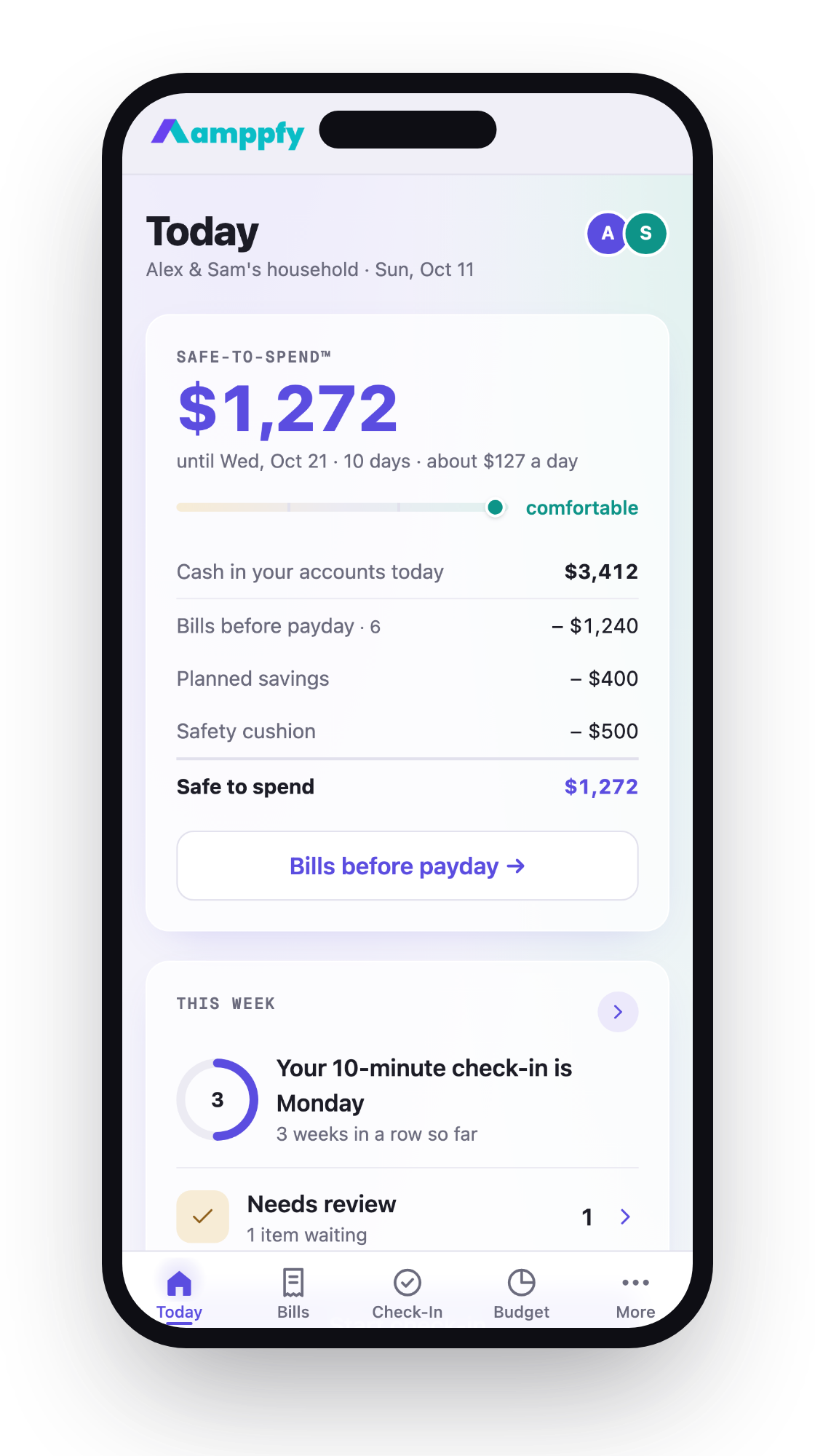
Either way, the plan comes back to one figure: list the bills due before the next check, subtract them from your balance, and plan from that lowest point. If you’d rather see it on a calendar than work it out by hand, Amppfy marks the lowest-cash day before each payday once you’ve entered your balances, bills, and paydays. Set up your bills and paydays this week. It takes about ten minutes, and your next payday will feel a lot less like a guess.