Most people know their car payment. Fewer know what they actually spend on transportation each month. The car payment is just one line. Insurance, fuel, oil changes, tires, registration, parking, tolls: they all add up to a single, real number. Getting that number right changes how you plan every paycheck. Your transportation budget is probably the second or third largest slice of your household spending, and it deserves to be treated as one whole category, not five scattered line items.
Everything that belongs in transportation
Start by listing every dollar that moves because you own, lease, or use a vehicle. Most people remember the big ones and forget the rest.
Here’s what belongs in the category:
- Car payment or lease payment: The average monthly payment on a new vehicle sits around $765 in mid-2026, while used vehicle payments average roughly $542.
- Auto insurance: Full-coverage car insurance is projected to average $2,242 annually[1] by the end of 2026, which works out to about $187 per month.
- Fuel or charging costs: Track what you actually spend, not what you think you spend. Pull up three months of gas station charges and average them.
- Maintenance and repairs: Oil changes, tires, brakes, filters, wiper blades, and the surprise stuff.
- Registration and inspection fees: These hit once or twice a year, but they’re still transportation costs.
- Parking and tolls: Monthly garage fees, meter charges, highway tolls, airport parking.
- Roadside assistance or extended warranty payments: If you pay for these, they belong here.
Add all of those together and divide by twelve. That’s your true monthly transportation cost. The total runs about $1,072 per month for a new vehicle[2] driven 15,000 miles a year, or roughly $12,863 annually. Your number might be higher or lower, but you won’t know until you add it up.
A quick table helps you see the pieces side by side:
| Category | Typical Monthly Range |
|---|---|
| Car payment (new/used) | $542 – $765 |
| Insurance | $140 – $230 |
| Fuel | $100 – $250 |
| Maintenance & repairs | $50 – $120 |
| Registration & fees | $10 – $30 (annualized) |
| Parking & tolls | $0 – $200+ |
Your job is to fill in your actual numbers, not averages.
Monthly vs. lumpy costs
Some transportation costs show up on the same day every month. Your car payment drafts on the 15th. Insurance might bill on the 1st. These are easy to plan around because they’re predictable and consistent.
Then there are the lumpy costs. Tires every three years. Registration once a year. A brake job that hits without warning. These expenses are real, but they don’t fit neatly into a monthly rhythm. That mismatch is where budgets break down.
Separating the Two
Split your transportation spending into two buckets:
- Fixed monthly costs: car payment, insurance premium, parking pass
- Irregular costs: repairs, tires, registration, inspection, annual AAA membership
For the irregular bucket, estimate the annual total and divide by twelve. If you expect $600 in registration, $400 in oil changes, and $800 in tires over the year, that’s $1,800 annually or $150 per month to set aside.
Why This Matters for Your Paycheck
A $600 registration bill in March feels like a crisis if you haven’t saved for it. It feels like nothing if you’ve been setting aside $50 a month since last April. The cost is identical. The stress is completely different.
Amppfy’s Budget page shows your month in four slices: Bills, Savings, Subscriptions, and Everyday spending. Your car payment and insurance land in Bills. Your monthly set-aside for repairs and registration can sit in Savings as a goal. That way, lumpy costs stop ambushing your checking account.
Setting aside for repairs and registration
A repair fund isn’t optional. It’s the difference between a minor inconvenience and a financial scramble. The question is how much to save.
A Simple Starting Point
If your car is under five years old with fewer than 60,000 miles, set aside $100 per month. If it’s older or has higher mileage, bump that to $150 or $175. These aren’t exact science. They’re guardrails.
Here’s a worked example for a 2020 sedan with 72,000 miles:
- Oil changes (2x): $140
- Tires (prorated): $200
- Brakes (prorated): $150
- Registration and inspection: $180
- Surprise repair cushion: $400
- Annual total: $1,070
- Monthly set-aside: $90
Round up to $100 and you’ve got a buffer. Keep this money in a separate savings account or tag it as a goal in your budgeting tool. The point is to make it invisible to your daily spending.
What Happens When You Skip This Step
You charge the repair to a credit card. You pay interest. The $800 brake job becomes $900 over six months. Or you pull from rent money and scramble to cover that gap. Neither outcome is necessary if you’ve been stashing $100 a month.
The cost per mile for a vehicle driven 15,000 miles annually has climbed to 86 cents in 2026[3], up from 77 cents the year before. Repairs and maintenance are a meaningful chunk of that increase. Planning for them keeps you ahead of the curve.
Transit, rideshare, and households with no car
Not everyone has a car payment. Some households rely entirely on public transit, rideshare, bikes, or a combination. Others are one-car families where a second adult uses transit for commuting. The budget for transportation still exists. It just looks different.
Public Transit
A monthly transit pass in a major U.S. city runs anywhere from $75 to $130. That’s your baseline. Add occasional rideshare trips for groceries, late nights, or bad weather, and the monthly total can climb into the hundreds. That’s a fraction of car ownership, but it still needs a line in your plan.
Rideshare-Only Households
If you rely on Uber or Lyft for most trips, pull your actual spending from the last three months. It’s easy to underestimate. A $15 ride twice a day, five days a week, adds up to $600 a month before tips. That’s more than a used car payment.
One-Car Couples
One partner drives. The other takes the train. Your household budget needs to capture both costs under the same transportation umbrella. The car costs plus the transit pass plus the occasional rideshare: all of it is transportation spending.
| Scenario | Estimated Monthly Cost |
|---|---|
| Two-car household | $1,600 – $2,400 |
| One car + transit | $900 – $1,400 |
| Transit + rideshare only | $200 – $600 |
| Bike + occasional rideshare | $50 – $200 |
Pick the row that matches your life. Then track it for real.
Seeing transportation as one slice
The whole point of bundling these costs is clarity. You don’t budget for “the left front tire” separately from “the right rear brake pad.” You budget for transportation.
When you see transportation as one number, you can compare it to your income and your other spending categories. You can ask better questions. Is $1,400 a month reasonable for how you get around? Could you cut $200 by switching insurance carriers? Would dropping to one car save $700 a month?
The One-Number Check
Here’s how to run it. Add up every transportation-related charge from the last three months. Divide by three. That’s your monthly transportation cost. Now compare it to your take-home pay.
Example: $4,800 take-home pay, $1,200 in total transportation costs. That’s 25% of your income going to getting around. If that feels high, you have a clear target to work on. If it feels fine, you’ve confirmed it with real numbers instead of a guess.
Making It Visible in Your Plan
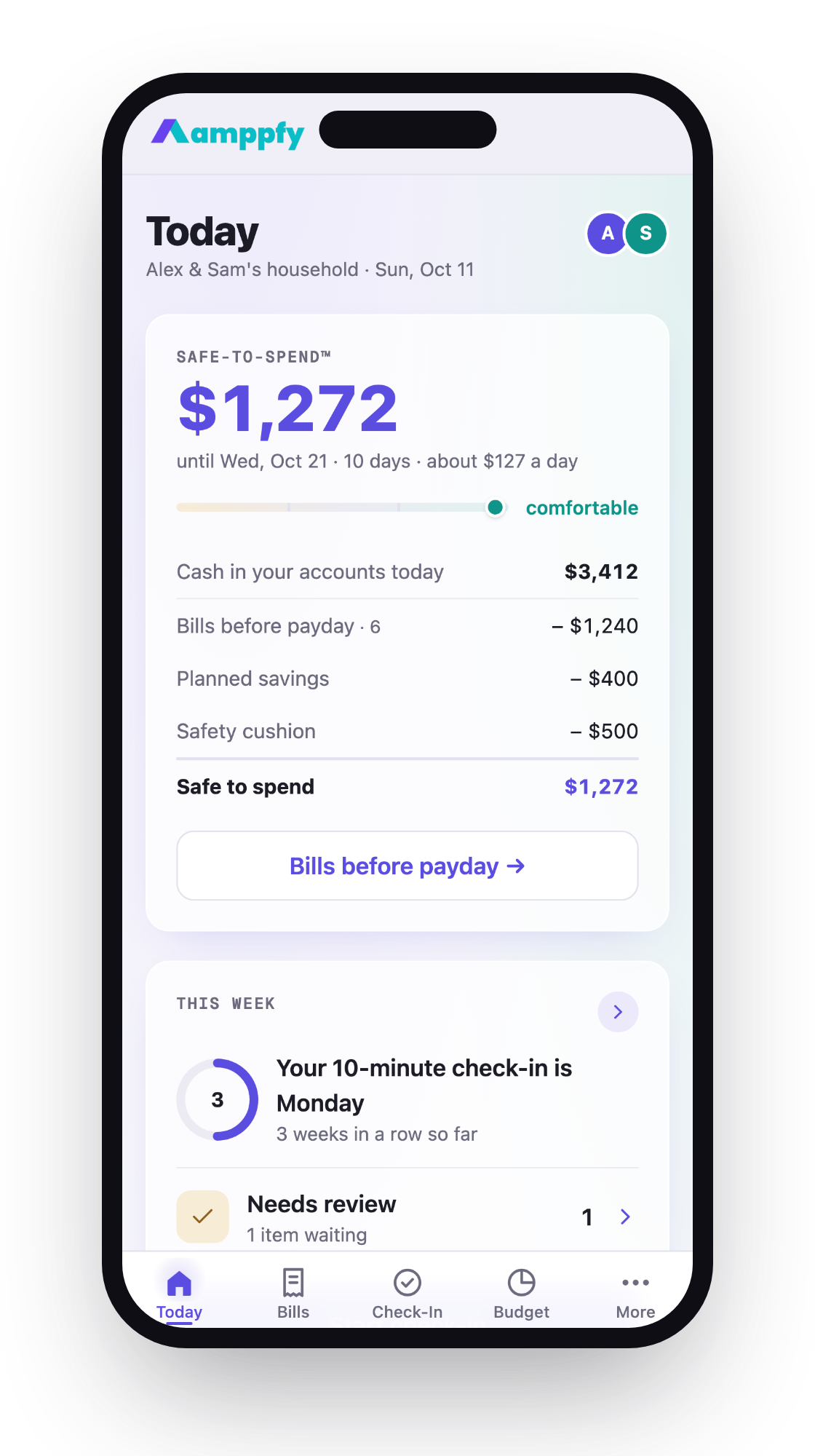
Amppfy shows your Safe-to-Spend™ number as available cash minus bills due before payday, minus planned savings, minus a safety cushion. Your car payment and insurance are already in your bills. Your repair set-aside lives in your savings goals. What’s left in Safe-to-Spend™ is genuinely yours to use, and you can trust it because the transportation costs are already accounted for.
The math looks like this: $4,800 cash – $2,100 bills – $500 savings – $400 cushion = $1,800 Safe-to-Spend™. Your car payment, insurance, and repair fund are baked into those first three numbers. No surprises.
Frequently Asked Questions
What percentage of my income should go to transportation?
A common guideline is 10% to 15% of your take-home pay. But your actual number depends on where you live, your commute distance, and whether you’re paying off a vehicle. A rural commuter driving 25,000 miles a year will spend more than someone biking to work in a city. Use the percentage as a reference point, not a rule. If you’re above 20%, it’s worth looking at what’s driving the cost up.
Should I include my car payment in my transportation budget or keep it separate?
Include it. A car payment is a transportation cost, full stop. Keeping it separate makes your transportation spending look artificially low and your “debt” category look artificially high. Bundling everything together gives you one honest number for what it costs you to get around.
How do I budget for transportation costs if my driving varies month to month?
Use a three-month average for fuel and a twelve-month estimate for irregular costs like repairs and registration. The three-month average smooths out the weeks you drove more or less than usual. For repairs, set aside a fixed monthly amount into a separate savings bucket so the money is there when you need it.
Do I need a separate savings account for car repairs?
You don’t need a separate bank account, but you do need a separate mental bucket. Some people open a dedicated savings account. Others tag a goal inside their budgeting app. The key is that the money isn’t mixed in with your everyday spending. When a $700 repair bill lands, you pull from the fund instead of from next week’s groceries.
Your Transportation Number, One Place
Getting all of your transportation costs into a single number takes about fifteen minutes the first time. After that, it’s a quick check each week. The payoff is knowing exactly what it costs you to get around, and knowing that the rest of your money is actually available for everything else.
If you want to see your own Safe-to-Spend™ number before your next payday, get Amppfy free. Enter your balances, bills, and payday once, about ten minutes, and the number stays current from there.