Most people don’t decide to save for a car down payment on a random Tuesday. It starts with a moment: your current car needs a $2,000 repair, your lease is ending in six months, or you just realized you’re paying $600 a month for something that’s underwater. The goal feels clear, but the path from “I should start saving” to “I have the cash” is where things get fuzzy. Your paycheck is already spoken for by rent, groceries, and a dozen subscriptions you forgot about. The trick isn’t willpower. It’s building a plan that fits the rhythm of your actual pay schedule, so money moves before you can spend it.
Picking a Down Payment Target From the Car You Actually Need
Start with the car, not the savings account. Your target number depends entirely on what you plan to buy and how you plan to finance it.
A common guideline is 10% to 20% of the vehicle’s purchase price. On a $30,000 car, that’s $3,000 to $6,000. But those numbers shift based on your credit score, the loan terms you qualify for, and whether you’re buying new or used.
Here’s a quick reference:
| Vehicle Price | 10% Down | 15% Down | 20% Down |
|---|---|---|---|
| $15,000 | $1,500 | $2,250 | $3,000 |
| $25,000 | $2,500 | $3,750 | $5,000 |
| $35,000 | $3,500 | $5,250 | $7,000 |
| $45,000 | $4,500 | $6,750 | $9,000 |
A larger down payment shrinks your monthly bill and the total interest you’ll pay. According to the Federal Reserve Bank of New York’s Q4 2025 Household Debt report, the median auto loan origination was around $24,000. At that price, even 15% down ($3,600) meaningfully reduces your monthly obligation.
Pick a realistic car first. Browse listings in your area. Get a feel for what a two- to four-year-old model costs in the trim you actually need, not the one with the panoramic sunroof. Then set your down payment target at 15% of that number. That gives you a solid starting point without requiring perfection.
If you have a trade-in, subtract its estimated value from your target. A car worth $4,000 in trade means you only need to save the difference.
How Many Paychecks It Takes and What to Set Aside Each One
Once you have a dollar target, divide it by the number of paychecks between now and your buy date. That’s your per-paycheck savings amount.
The Basic Math
Say you need $4,500 and you get paid biweekly. You want the car in eight months. That’s roughly 17 paychecks.
$4,500 ÷ 17 = $265 per paycheck.
If that number feels too high, you have two options: extend the timeline or lower the target. Both are fine. The point is to know the number before your next payday hits.
Making It Automatic
Set up an automatic transfer from checking to savings on each payday. Schedule it for the same day your direct deposit lands. The money moves before you see it as available cash.
Here’s a sample savings schedule for different goals and timelines:
| Down Payment Goal | Timeline | Biweekly Deposit | Monthly Deposit |
|---|---|---|---|
| $2,500 | 6 months | $192 | $417 |
| $4,000 | 8 months | $235 | $500 |
| $5,000 | 10 months | $192 | $500 |
| $7,000 | 12 months | $269 | $583 |
Checking Whether You Can Afford the Transfer
Before you commit, confirm you actually have room in your paycheck. Add up your fixed bills, your planned savings, and a cushion for surprises. What’s left is what you can safely spend. If the car deposit eats into grocery money, the number is too aggressive.
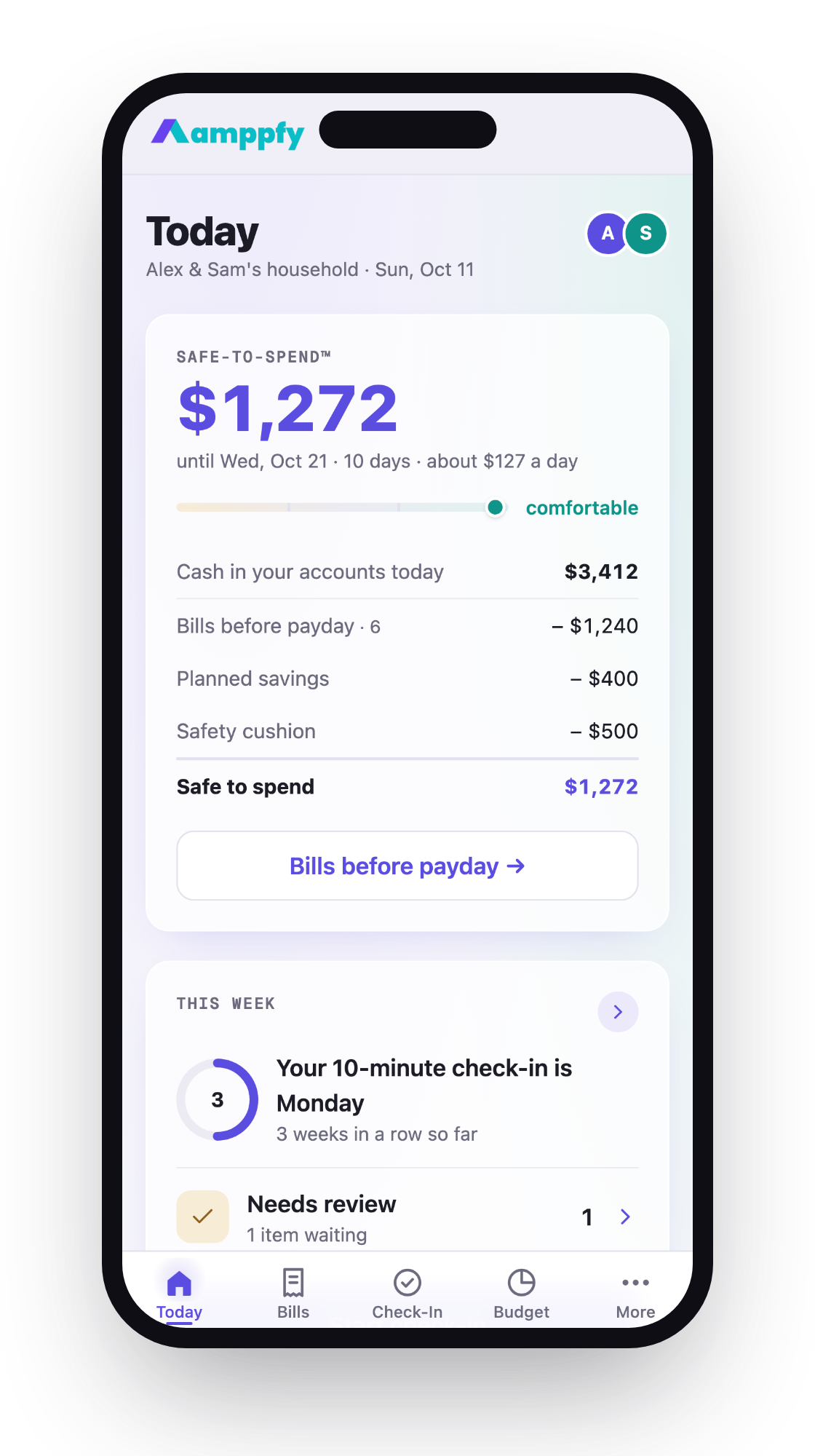
Amppfy’s Safe-to-Spend™ number does this math for you: $3,412 cash − $1,240 bills − $400 savings − $500 cushion = $1,272. That one line tells you whether a $265 auto transfer is comfortable or reckless. A 10-minute weekly check-in keeps it honest as your bills shift month to month.
The goal is a savings amount that’s firm but not painful. You’re building a habit across many paychecks, not white-knuckling through a single month.
Keeping the Total Cost of Ownership in View: Insurance, Registration, Fuel
Your down payment isn’t the only cash you need when you drive off the lot. Several expenses hit in the first 30 days of ownership, and ignoring them can drain the savings you worked so hard to build.
First-Month Costs to Budget For
- Insurance premium (often due upfront or as a large first installment)
- State registration and title fees (varies by state, typically $100 to $500)
- Sales tax (collected at purchase in most states, sometimes rolled into the loan)
- First month’s fuel and parking
A practical move: add 5% to 10% on top of your down payment target to cover these costs. If your down payment goal is $4,500, aim for $5,000 to $5,500 total. That buffer keeps you from raiding your emergency fund the week after buying the car.
Ongoing Costs That Affect Your Paycheck
Your car payment is one line item. But insurance, fuel, maintenance, and parking are recurring hits to every paycheck. Before you commit to a vehicle price, estimate the full monthly cost:
- Loan payment
- Insurance (get a quote before you buy, not after)
- Fuel or charging costs
- Maintenance and tires
- Parking or tolls
If the total monthly cost of the car exceeds 15% of your take-home pay, you’re stretching. A cheaper vehicle with a smaller down payment target might leave you in a better position month to month.
Think of the down payment as the entry fee. The ongoing costs are the membership dues. Both need to fit inside your paycheck.
Where to Keep the Money Until You Buy
You’ve got a savings target and a per-paycheck amount. Now you need somewhere to park the cash where it’s safe, accessible, and earning at least a little interest.
High-Yield Savings Account
This is the default choice for most people saving for a car down payment, and for good reason. In 2026, many online banks offer rates between 4% and 5% APY on savings accounts with no minimum balance. On a $5,000 balance held for eight months, that’s roughly $130 to $165 in interest: not life-changing, but free money.
Look for an account with no monthly fees and easy transfers to your checking account. You want the money accessible within one to two business days when you’re ready to buy.
Money Market Account
Similar to a high-yield savings account but sometimes comes with check-writing or debit card access. Useful if you want slightly more flexibility, though the rates are comparable. Watch for minimum balance requirements.
Where Not to Keep It
- Your regular checking account. The money will get spent. Guaranteed.
- A CD with an early withdrawal penalty. Your buy date might shift by a month or two, and penalties eat into your gains.
- Any investment account. Stocks, ETFs, or crypto can lose value in the exact window you need the cash. A six-month timeline is too short for market risk.
Keep it boring. A separate high-yield savings account, named something like “Car Fund,” is the right tool. The psychological separation from your spending money matters as much as the interest rate.
What to Do if the Timeline Slips
Life doesn’t always cooperate with savings plans. A medical bill, a job change, or an unexpected home repair can knock your car fund off track. Here’s how to respond without scrapping the whole plan.
Reassess, Don’t Quit
Pull up your numbers. How much have you saved so far? How much is left? If you’re 60% of the way there and your timeline slipped by two months, that’s a minor adjustment, not a failure. Recalculate your per-paycheck amount with the new timeline and keep going.
Three Common Setbacks and Next Steps
- You missed two or three transfers. Resume on the next payday. Don’t try to “make up” missed deposits in one lump sum if it means skipping bills. Just restart the rhythm.
- An emergency wiped out part of the fund. Decide whether to rebuild or adjust your car target downward. A $20,000 car with $3,000 down is still a solid purchase.
- Car prices shifted and your target vehicle costs more. Revisit the model or trim level. A base model with good reliability ratings often costs thousands less than the mid-trim version.
When Extending the Timeline Is the Right Call
If your per-paycheck amount needs to drop below $100 to stay sustainable, it’s worth adding a few months. Stretching from eight months to eleven months isn’t a setback. It’s a plan that fits your real life.
The worst outcome is abandoning the goal entirely. Even a partial down payment is better than zero down. You’ll pay less interest, have a lower monthly payment, and start with equity in the vehicle.
Amppfy can help here: set your car savings goal, and the app adjusts your Safe-to-Spend number each pay period to reflect what’s already earmarked. You see the real picture without a spreadsheet.
Frequently Asked Questions
How much should I put down on a car in 2026?
Aim for 10% to 20% of the vehicle’s price. A 15% down payment is a strong middle ground. It lowers your monthly payment, reduces total interest, and gives you immediate equity. If your credit score is below 680, a larger down payment can also help you qualify for better loan terms.
Can I save for a car down payment in three months?
You can, but the per-paycheck amount will be aggressive. For a $4,000 goal with biweekly pay, you’d need about $615 per paycheck over three months. That’s realistic for some households and impossible for others. Run the math against your actual take-home pay and fixed expenses before committing to a compressed timeline.
Should I use my emergency fund for a car down payment?
No. Your emergency fund exists for unplanned events. A car purchase is a planned expense. If you drain your emergency fund for the down payment and then face a surprise expense the following month, you’ll end up relying on credit cards or missing the new car payment. Build the down payment separately.
Is it better to save more or buy sooner?
Almost always better to save more. Every dollar you put down reduces the amount you finance, which means less interest paid over the life of the loan. Buying sooner with less money down often leads to higher monthly payments and a longer period of being upside-down on the loan, where you owe more than the car is worth.
Building Your Car Fund One Paycheck at a Time
Saving for a car down payment isn’t complicated. It’s specific. Pick a realistic vehicle, set a dollar target, divide by your remaining paychecks, and automate the transfer. Keep the money in a high-yield savings account where it’s safe and visible. Budget for insurance and registration on top of the down payment itself. And if life throws a curveball, adjust the timeline rather than ditching the plan.
The hardest part is the first two or three pay cycles, when the balance feels small and the goal feels far away. After that, momentum takes over. Each paycheck brings a visible step forward.
If you want one place to see whether your car savings goal fits alongside your bills and spending money, Amppfy shows that math in a single number, updated every time you check in. Take 10 minutes this week to set your goal and your first transfer. Future you will appreciate the head start.