The month you move is a financial blur. Boxes, deposits, overlapping rent, new utility accounts: money flies out in every direction while your regular bills keep hitting on schedule. Most people don’t plan a separate moving costs budget, and that’s exactly why the checking account looks so grim by day 15. This short guide gives you a category-by-category breakdown, a timing strategy, and a two-month plan with real numbers so you can relocate without wrecking your cash flow.
The Full List: Deposit, Overlap Rent, Movers, Utilities, Setup
Before you price out movers or start packing, write down every expense category. Missing even one can throw your whole plan off.
| Expense | Typical Range (2026) | When It’s Due |
|---|---|---|
| Security deposit | $500 – $2,500 | At lease signing |
| First month’s rent | $800 – $2,200 | At lease signing |
| Last month’s rent (if required) | $800 – $2,200 | At lease signing |
| Overlap rent (old place) | 2 – 4 weeks of current rent | Your existing lease end |
| Professional movers | $800 – $2,400 (local) | Moving day |
| Truck rental (DIY) | $100 – $400 | Moving day |
| Utility deposits | $50 – $300 per service | Before move-in |
| Internet setup | $50 – $150 | First week |
| Renter’s insurance | $15 – $30/month | Before move-in |
| Cleaning (old unit) | $100 – $300 | Before key return |
| Misc (locks, curtain rods, supplies) | $75 – $250 | First two weeks |
How the Math Actually Works
Add your specific numbers from the table above. A worked example for a $1,400/month apartment:
$1,400 deposit + $1,400 first month + $1,200 movers + $150 utilities + $100 internet + $200 cleaning + $150 misc = $4,600
That $4,600 hits on top of your normal monthly spending. If you earn $4,000 net per paycheck, you can see the problem immediately. The goal isn’t to shrink every line item to zero. It’s to know the total, then spread it across paychecks so no single pay period collapses.
Hidden Costs Most People Miss
- Packing supplies run $50 to $150 if you don’t source free boxes early.
- Pet deposits or pet rent add $200 to $500 at many complexes.
- Mail forwarding is free through USPS, but replacing a lost package isn’t.
- Parking permits for the moving truck can cost $25 to $75 in some cities.
Why Moving Month Needs Its Own Spending Number
Your regular monthly budget assumes a stable set of bills. Rent, car payment, groceries, subscriptions: same players, same timing. Moving month breaks that assumption completely. You’re paying rent in two places, buying things you already owned (shower curtain, again), and covering deposits that won’t come back for weeks or months.
Treating moving expenses as part of your normal spending is like trying to fit a couch through a window. It technically goes, but something’s going to crack.
Give Moving Its Own Line
Create a separate spending number just for the move. Start with the total from the table above. Then subtract anything you can cover from savings without touching your emergency fund. The remainder is what needs to come from cash flow.
Example: your move total is $4,600. You have $1,500 set aside. That leaves $3,100 to absorb across one or two pay cycles.
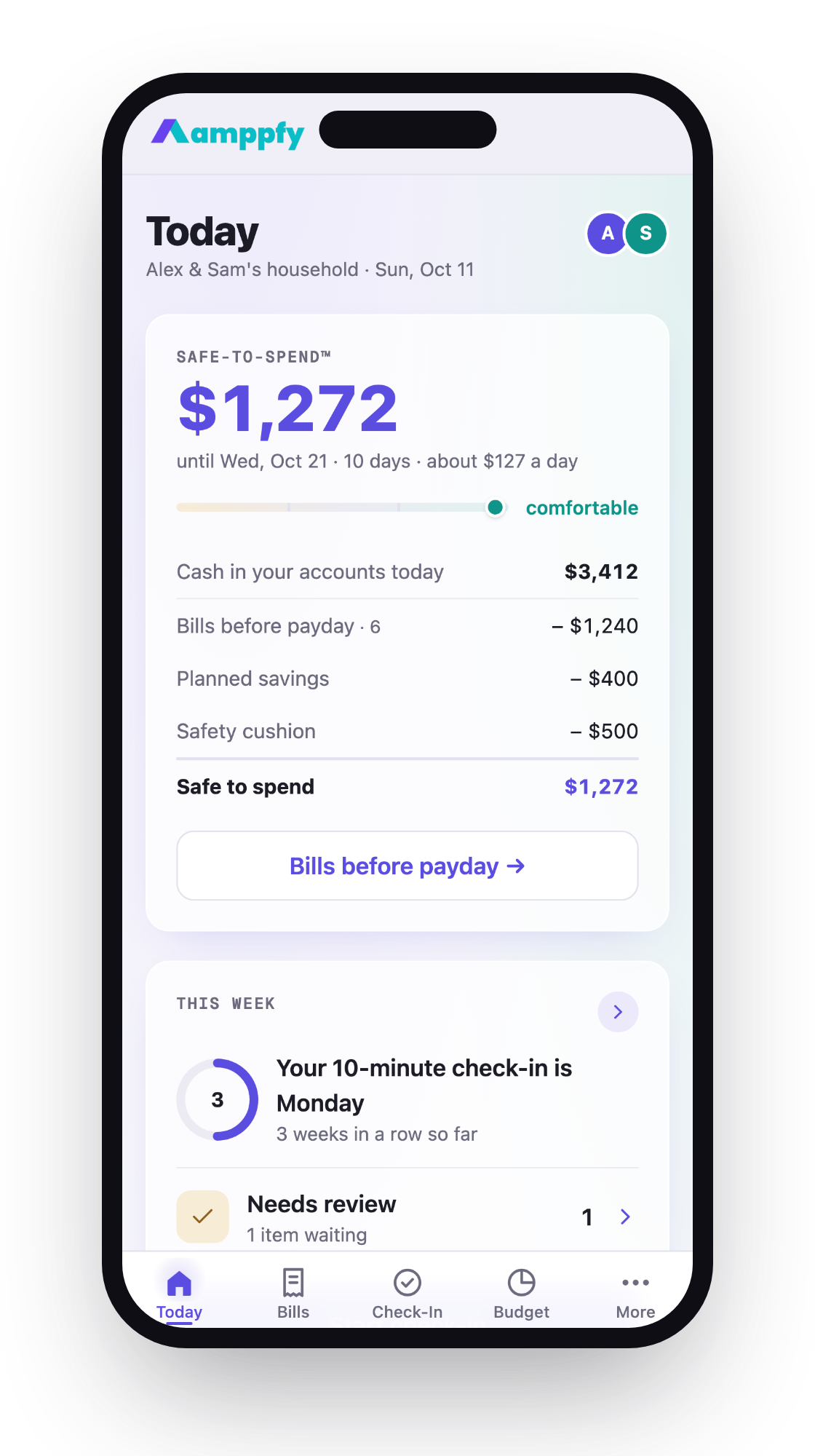
If you use Amppfy, you can add those move-related bills to your upcoming expenses. Your Safe-to-Spend™ number: available cash minus bills due before payday, minus planned savings, minus a safety cushion: will adjust automatically. You’ll see the real impact on your daily spending power without guessing.
What About Credit Cards?
Putting moving costs on a card is fine if you can pay the statement in full. Carrying a balance at 24% APR on a $3,000 charge adds roughly $60 in interest the first month alone. If you need to split the cost, a 0% intro APR card applied for 60 days before the move gives you breathing room without interest. Just set a payoff deadline and stick to it.
Timing the Move Around Paydays
The calendar matters as much as the dollar amount. A $4,600 move that lands between two paychecks feels very different from one that hits right after payday.
Best-Case Timing
- Sign the lease one to two days after a payday so the deposit and first month’s rent come out of a full check.
- Schedule movers for the weekend closest to your next payday. That way, the mover’s fee hits when cash is highest.
- Set up utilities and internet the week before you move. Most providers don’t charge until service starts, but you lock in the appointment.
Worst-Case Timing (and How to Handle It)
If your move date falls mid-cycle and you can’t shift it, front-load the biggest expenses onto the paycheck before the move. Pay the deposit and first month’s rent from paycheck one. Let the mover’s fee, cleaning, and setup costs land on paycheck two.
Here’s a split example on a biweekly pay cycle with $2,800 net per check:
| Paycheck | Move Expenses | Regular Bills | Remaining |
|---|---|---|---|
| Check 1 (pre-move) | $2,800 (deposit + first month) | $900 | -$900 (need savings to cover gap) |
| Check 2 (post-move) | $1,800 (movers + setup + cleaning) | $600 | $400 |
That negative number on check one is exactly why you need savings or a timing adjustment. If neither is possible, negotiate with your new landlord to split the deposit across two payments. Many smaller landlords will agree if you ask.
Getting Deposits Back and What to Do With Them
Your old security deposit is real money, but it’s not available money right now. Most states require landlords to return deposits within 14 to 30 days after move-out, though some allow up to 60. According to the Consumer Financial Protection Bureau, tenants should request a move-out inspection and document the unit’s condition with timestamped photos to protect their claim.
Maximize Your Refund
- Walk the unit with your landlord before you leave. Ask them to note any pre-existing damage on record.
- Fill small nail holes with spackle. A $5 tube can save you a $50 deduction.
- Clean the oven, fridge interior, and bathroom grout. These are the three spots landlords check first.
- Return all keys, garage remotes, and mailbox keys on the same day. Missing items often trigger replacement fees.
Don’t Count It as Income
A common mistake is mentally spending your old deposit before it arrives. Your budget for the move should assume you won’t see that money for 30 days. If it shows up sooner, great: put it toward the credit card balance from the move or replenish your savings cushion. If it’s late, you haven’t dug a hole.
One practical step: set a calendar reminder for 30 days after your key return. If the deposit hasn’t arrived, send a written request to your former landlord citing your state’s deadline. Most states impose penalties for late returns, which gives you real standing.
A Two-Month Moving Plan With Real Numbers
Spreading the work across eight weeks makes the financial hit manageable. Here’s a plan built for someone earning $5,600/month net (two biweekly checks of $2,800), moving into a $1,500/month apartment.
Month One: Six to Four Weeks Before the Move
- Week 1: Confirm your move date. Get three mover quotes. Start collecting free boxes from local buy-nothing groups.
- Week 2: Sign the lease. Pay the security deposit ($1,500) and first month’s rent ($1,500) from this paycheck plus $1,200 from savings. Total out: $3,000 from paycheck, $1,200 from savings. Remaining from paycheck: -$200 (covered by savings).
- Week 3: Set up renter’s insurance ($25/month). Schedule utility transfers. Buy packing supplies ($75).
- Week 4: Book movers ($1,200 deposit or full payment). Notify your current landlord in writing. Start packing one room per evening.
Running total spent: $5,800
Month Two: The Move and First Week
- Week 5: Deep-clean the old unit yourself or hire a cleaner ($200). Do a walkthrough with your old landlord. Take photos of every room.
- Week 6 (moving week): Pay movers if balance is due ($0 if prepaid, or remaining $600). Set up internet ($100). Buy immediate household needs ($150).
- Week 7: Return old keys. File for mail forwarding. Update your address with your bank, employer, and insurance.
- Week 8: First normal week. Adjust your monthly budget to reflect new rent, new utility costs, and any subscription changes.
Running total spent: $6,850
Here’s the paycheck-by-paycheck view:
| Paycheck | Move Costs | Regular Bills | From Savings | Cash Left |
|---|---|---|---|---|
| 1 (Week 1-2) | $3,000 | $900 | $1,200 | $100 |
| 2 (Week 3-4) | $1,300 | $900 | $0 | $600 |
| 3 (Week 5-6) | $950 | $900 | $0 | $950 |
| 4 (Week 7-8) | $0 | $1,500 (new rent cycle) | $0 | $1,300 |
The tightest paycheck is the first one. Everything after that loosens up. If your numbers are different, plug them into the same framework: list every cost, assign it to a paycheck, and check whether you stay positive. Amppfy’s month calendar marks your lowest-cash day, which tells you exactly where the squeeze point is before it arrives.
Frequently Asked Questions
How much should I save before moving?
A safe target is three months of new rent. For a $1,500 apartment, that’s $4,500. This covers the deposit, first month, and one month of overlap or emergency buffer. If you can’t reach that number, aim for at least the deposit plus first month ($3,000 in this example) and plan to absorb the rest from cash flow.
Can I negotiate moving costs with my new landlord?
Yes, and more people should try. Ask about splitting the security deposit into two payments, waiving the pet deposit for a slightly higher monthly pet rent, or getting the first month prorated if you move in mid-month. Smaller landlords and property managers have more flexibility than large corporate complexes.
What’s the cheapest day of the month to move?
Mid-month moves (around the 15th) are typically cheaper for movers because demand drops. Most leases start on the 1st, so moving companies are busiest on the last and first weekends of each month. A Tuesday or Wednesday mid-month move can save you 20% to 30% on mover fees.
Should I use savings or a credit card for moving expenses?
Use savings for the deposit and first month’s rent since these are large, non-negotiable amounts. A credit card works for smaller costs like supplies, cleaning, and setup if you can pay the balance within one billing cycle. Mixing both keeps your savings from bottoming out while avoiding interest charges.
Your Move, Your Plan
A budget for moving costs doesn’t need to be complicated. It needs to be complete. List every expense, assign each one to a specific paycheck, and check your cash position after each payment. The tightest moment is almost always the week you sign the new lease, so front-load your savings toward that date.
Take 10 minutes this week to fill in the table from this guide with your own numbers. If you want a single number that shows what’s actually safe to spend through the move, Amppfy is free and takes about the same 10 minutes to set up at amppfy.com/app/. Plug in your balances, your move-related bills, and your paydays. The math does the rest.