

Payday morning has a ritual. You open your bank app, refresh, and check whether the money is there yet. Sometimes it arrived at midnight. Sometimes it shows up mid-morning. Sometimes it came two days early, and you’re not sure whether to trust it.
The arrival time isn’t random. It follows a fairly predictable chain: your employer sends a file, the payment network moves it in batches, and your bank decides when to post it. Each bank sets its own rules. Most publish only part of them.
This guide gathers the posting rules that banks state on their own websites. Where a bank doesn’t publish a time, the table says so. It also covers weekends, holidays, and bill timing. Once you know your bank’s pattern, you can plan around it.
The short answer
For most people, direct deposit lands overnight. It is usually there when you wake up on payday. Funds that reach a bank before its daily cutoff are generally available the next business day.
Some banks post earlier than that. Early pay programs can release funds up to two days before your official payday. The bank does this once it sees the incoming payment file, before the money actually settles.
Here’s the practical version:
- Standard posting: Overnight, on or before the morning of payday.
- Early pay banks: Up to two days early, when your employer sends the file early.
- Not published: Many banks don’t state a clock time at all.
Your exact answer depends on two things: when your employer submits payroll and how your bank handles incoming files. You control neither one. You can still learn your own pattern in one or two pay cycles. Note the time the deposit appeared. After two paychecks, you’ll have a reliable window to plan around.
How direct deposit timing works
Direct deposit moves over the ACH network. Think of it like a mail truck, not a courier. Payments get sorted and delivered in scheduled runs, not one at a time.
The chain looks like this:
- Your employer submits payroll. The payroll provider sends a file listing everyone’s pay and settlement date.
- The file enters an ACH batch. Batches run at set times during business days.
- Your bank receives the file. It now knows the money is coming, even before settlement.
- Your bank posts the deposit. Some banks post on the settlement date. Others post early.
Cutoffs matter at every step. If your employer submits late in the day, the file waits for the next batch. That’s how a deposit slips by a day. You’ll see it most often around holidays.
Early pay is a policy choice. The bank sees the file in step 3 and decides to release funds before settlement. Ally, for example, says its early direct deposit is automatic and covers up to eight early deposits per statement cycle, each $10,000 or less (as of October 2026). So a $2,400 paycheck can arrive up to two days early. A $12,000 bonus would wait for payday.
For a fuller look at why one deposit lands early and the next lands late, see why your direct deposit lands early or late and how to plan around it.
Bank-by-bank summary table: posting windows and early pay
Wondering what time your direct deposit hits at your specific bank? Start here. This table lists only what each bank publishes on its own pages. “Not published” means we couldn’t find a stated time on the bank’s site. It doesn’t mean the bank is slow. All rows are as of October 2026.
| Bank or app | Posting window (as published) | Early pay (as published) | Source page |
|---|---|---|---|
| Chime | Not published | Up to 2 days early | Chime early direct deposit |
| Cash App | Not published (released when received) | Up to 2 days early | Cash App direct deposits help |
| Wells Fargo | Not published | Up to 2 business days early (Early Pay Day) | Wells Fargo Early Pay Day |
| Bank of America | Not published; ACH deposits generally available the business day received | No early-pay feature published | Bank of America deposit agreement |
| Chase | Not published | Up to 2 business days early (Chase Secure Banking) | Chase Secure Banking |
| Navy Federal | Not published | 1 business day early for military pay (Free Active Duty Checking) | Navy Federal posting calendar |
| Capital One | Not published | Up to 2 days early (360 Checking) | Capital One 360 Checking features |
| SoFi | Not published | Typically up to 2 days early | SoFi early paycheck |
| USAA | Not published | Up to 2 days early | USAA direct deposit |
| PNC | Usually midnight on payday | Up to 2 business days early (Early Pay) | PNC direct deposit and PNC Early Pay |
| Citi | Not published | No | None found |
| U.S. Bank | Not published | No (only on its payroll Focus Card) | None found for checking |
| Ally | Not published | Up to 2 days early | Ally direct deposit |
| Varo | Not published | Up to 2 days early | Varo early direct deposit |
| Venmo | Not published (posted when Venmo receives notice from the employer) | Up to 2 days early, depends on the employer’s file | Venmo Direct Deposit FAQ |
| PayPal | Not published (available the day funds are applied) | Up to 2 days early, varies by payer | PayPal direct deposit |
| TD Bank | Not published | Up to 2 business days early (TD Early Pay), not guaranteed | TD Early Pay |
| Huntington | Not published | Up to 2 days early (Early Pay); up to 90 days to enroll | Huntington Early Pay |
| Regions | Not published (generally available the same day) | Up to 2 days early (Early Pay), not guaranteed | Regions direct deposit |
| Truist | Posts throughout the day; available immediately | No early-pay feature published | Truist funds availability disclosure |
| Current | Not published (released when the employer sends) | Up to 2 days early | Current faster direct deposit |
| Discover | Checking accounts are becoming Capital One 360 Checking | Up to 2 days early carries over to Capital One | Discover checking transition (Capital One) |
| Fifth Third | Not verified: 53.com’s Early Pay page could not be loaded on 2026-10-17 | Early Pay is published on 53.com; check the bank’s page | Fifth Third Early Pay |
| Netspend | Not published (funds available when the payment instruction arrives) | Paycheck up to 2 days early; federal benefits up to 5 days faster; not guaranteed | Netspend direct deposit |
| Citizens | Not published | Up to 2 days early (Citizens Paid Early), at the bank’s discretion; 1-2 pay periods to start | Citizens Paid Early |
| KeyBank | Not verified: key.com’s Early Pay page could not be loaded on 2026-10-19 | Early Pay is published on key.com; check the bank’s page | KeyBank Early Pay |
| Most other banks | Usually overnight; next business day if received before cutoff | Varies | Your bank’s funds availability policy |
Citi and U.S. Bank stand out. Neither publishes a posting time for checking. Neither offers an early-pay feature for checking accounts. At U.S. Bank, early access to pay is tied to the Focus Card, a payroll card, not a standard checking account.
For your own account, open the source page in the table or your bank’s funds availability policy. Search it for “direct deposit” or “early.” It takes about two minutes. If the policy is silent, rely on your own records from the last two paydays.
What changes on weekends and holidays
ACH runs on business days. Weekends and federal holidays pause the network. That one rule explains most “where’s my paycheck” moments.
If payday falls on a Saturday or Sunday, most employers pay on the Friday before. Some pay the following Monday instead. Your employer chooses, not your bank. Check your pay stub or ask payroll once. Then you know for good.
Holidays work the same way. When a Federal Reserve holiday lands on a weekday, no batches run that day. The Federal Reserve publishes its holiday schedule, and Capital One keeps a list of bank holidays on which direct deposits and transfers between banks wait for the next business day (as of October 2026). Payments due that day typically move to the next business day, unless your employer sends the file early.
A simple example: your payday is Monday, and Monday is a bank holiday. Your employer may send payroll so it settles Friday. Or it may settle Tuesday. Early pay banks can still release funds before the holiday, but only if the file has arrived.
Here’s the calm move: open your calendar now. Mark the federal holidays that fall near your paydays this year. It takes five minutes, and it removes the surprise.
Planning bills around the landing time
Bills don’t care when your paycheck posts. They hit on their own schedule. The trick is to give yourself a gap.
Set autopay dates at least one business day after your expected deposit. If your pay usually lands Friday morning, a bill pulling Friday at 12:01 a.m. could beat it. Move that bill to Monday or later. Most billers let you change the due date online.
Watch for these timing traps:
- Same-day autopay: A bill and a deposit on the same date is a race. Avoid it.
- Early pay that doesn’t repeat: If your employer sends payroll late one week, early pay won’t happen. Don’t schedule bills that depend on it.
- Holiday weeks: A deposit that slides to Tuesday can collide with a Monday bill.
- Pending charges: Card purchases can sit pending for days, then post after your deposit. They still count.
That last one catches many people. Your balance can look healthy while charges are still settling. Read more in pending transactions: how long they take and how to plan around them.
One rule covers most cases: plan bills around your standard payday, not your early one. Treat early money as a bonus in timing, not a new schedule.
What is safe to spend once it lands
Your balance jumps on payday. That number feels like permission. It isn’t, quite.
Some of that money already has a job. Here’s the arithmetic, using a $2,400 paycheck:
| Line | What it is | Amount |
|---|---|---|
| Available cash | Balance after the deposit posts | $2,750 |
| Bills before next payday | Rent share, phone, car insurance | −$1,450 |
| Planned savings | Transfer to emergency fund | −$200 |
| Cushion | Buffer you choose for surprises | −$150 |
| Safe-to-Spend™ | What’s actually free | $950 |
The balance said $2,750. The real figure is $950. Neither is bad news. One is just more honest.
Count only bills due before your next payday. Bills after that get covered by the next check. That keeps the math focused on now, not on the whole month.
Early deposits make this step more useful, not less. If your money arrives Wednesday, you have two extra days to spend before payday. Your bills haven’t moved. Run the numbers before the first purchase. It takes a minute.
Bank-by-bank guides
Each bank’s posting window and early-pay policy, as published on its own site:
- Chime Early Direct Deposit: How Early It Lands, What Time, and the First-Paycheck Catch
- What Time Does Cash App Direct Deposit Hit? Early Pay, Wednesdays, and Pending Deposits
- What Time Does Wells Fargo Direct Deposit Hit? Posting Times and Early Pay Day
- What Time Does Bank of America Direct Deposit Hit? What Their Posting Schedule Says
- What Time Does Chase Direct Deposit Hit? Posting Times, Early Pay, and Pending Deposits
- What Time Does Navy Federal Direct Deposit Hit? Early Pay for Military Paydays
- What Time Does Capital One Direct Deposit Hit? Early Paycheck and Posting Times
- What Time Does SoFi Direct Deposit Hit? Up to Two Days Early, Explained
- What Time Does USAA Direct Deposit Hit? Military Pay and Early Deposits
- What Time Does PNC Direct Deposit Hit?
- What Time Does Ally Direct Deposit Hit? Early Pay and Posting Times
- What Time Does Varo Direct Deposit Hit? Early Pay at a Fintech Bank
- What Time Does Venmo Direct Deposit Hit? Early Pay, Wednesdays, and Late Deposits
- What Time Does PayPal Direct Deposit Hit? Up to Two Days Early, Explained
- What Time Does TD Bank Direct Deposit Hit? Posting Times and Early Pay
- What Time Does Huntington Direct Deposit Hit? Early Pay and the 90-Day Rule
- What Time Does Regions Direct Deposit Hit? Early Pay and Posting Times
- What Time Does Truist Direct Deposit Hit? Early Direct Deposit, Explained
- What Time Does Current Direct Deposit Hit? Wednesdays, Early Pay, and Pending
- Social Security Direct Deposit Dates: When Your Payment Lands Each Month
- What Time Does Netspend Direct Deposit Hit? Early Pay on a Prepaid Card
- What Time Does Citizens Direct Deposit Hit? Early Pay and Posting Times
Setting up direct deposit
Not set up yet? The steps, as each employer, bank, app or agency publishes them:
- How to Set Up Direct Deposit: Employer, Bank, or Government Payment
- How Long Does Direct Deposit Take to Set Up? The First Deposit, Explained
- How to Set Up Direct Deposit Without an Employer
- How to Set Up Direct Deposit for Social Security
- How to Set Up Direct Deposit on Cash App
- How to Set Up Chime Direct Deposit, With or Without an Employer
- How to Set Up Direct Deposit With Chase
FAQ
What time does direct deposit usually post?
Most deposits post overnight and are there by the morning of payday. Funds received before a bank’s daily cutoff are generally available the next business day. Some banks don’t publish a clock time at all.
Why did my deposit come early last time but not this time?
Early pay depends on when your employer sends the payroll file. If payroll goes out late, your bank has nothing to release early. Some banks also cap early deposits. Ally, for example, limits each early deposit to $10,000 or less (as of October 2026).
Does direct deposit post on Saturdays or holidays?
ACH doesn’t settle on weekends or federal holidays. Your employer usually pays the business day before or after. Check your pay stub for the exact date.
Do Citi or U.S. Bank offer early direct deposit?
Neither publishes an early-pay feature for checking, and neither publishes a posting time. At U.S. Bank, early pay exists only on its payroll Focus Card (as of October 2026).
Once the money lands
Deposit timing follows a logic. Your employer sends a file, ACH moves it in business-day batches, and your bank decides when to post. Learn your bank’s pattern from its own policy, or from your last two paydays. Then schedule bills one business day after your standard payday, and mark holidays ahead of time.
The last step is the one that matters most. Once the deposit lands, the balance is not what’s safe to spend. Bills due before your next payday come out first. Then planned savings. Then a cushion. What’s left is the real number.
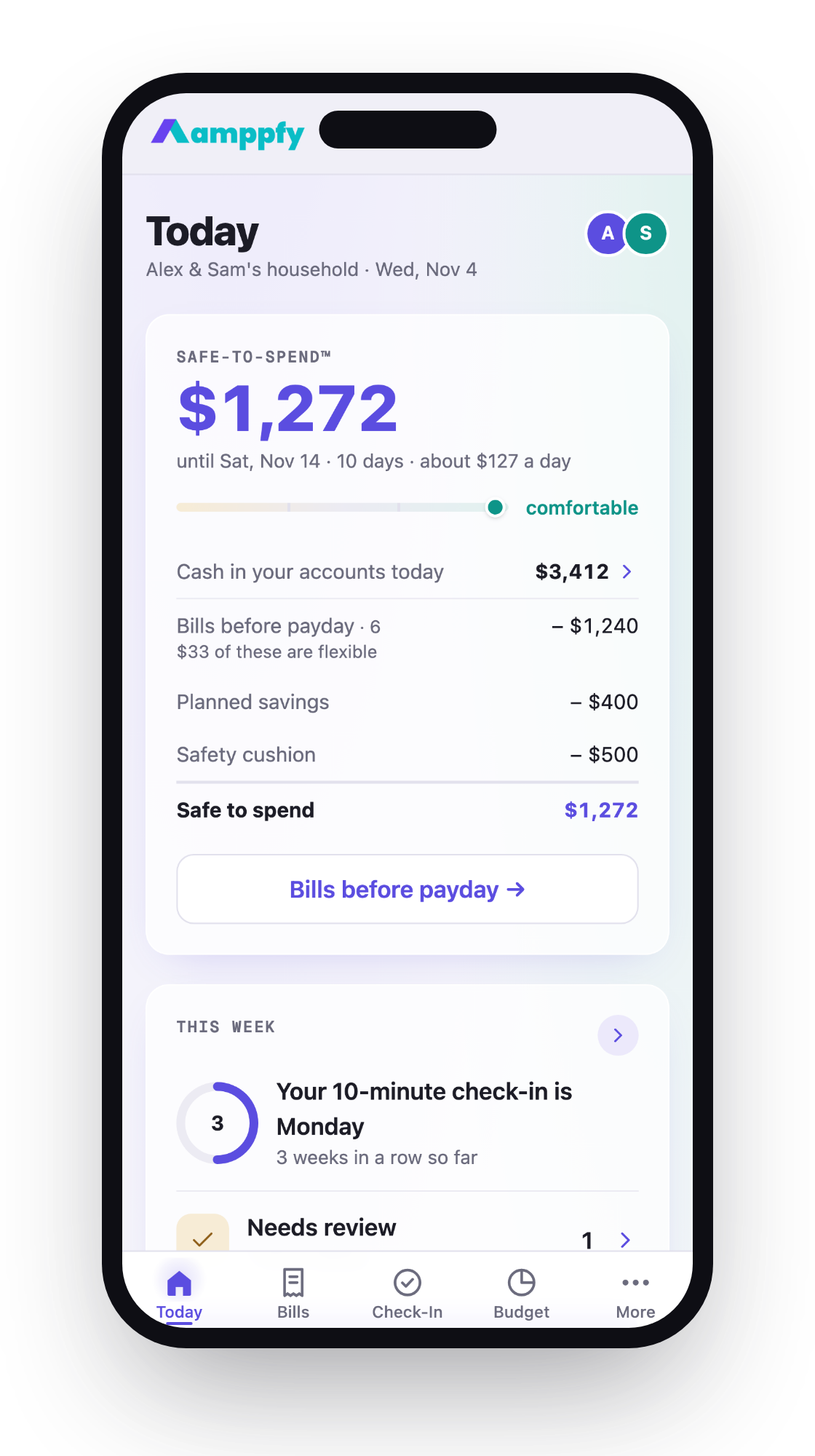
Amppfy does this arithmetic for you, with the math printed under the number and a bills calendar that marks your lowest point before payday. You type in your balances, so there’s no bank login. Take ten minutes this week to set up your bills and paydays in Amppfy, and the next deposit will come with a number you can trust.