

The letter from Social Security arrives, and suddenly there’s a new number to think about. You know a raise is coming. What you may not know yet is exactly when it lands, how much of it reaches your bank account, and what to do with it once it’s there.
That’s ordinary uncertainty, and a little arithmetic clears it up. You don’t need to predict prices or worry about next year’s headlines. You only need three things: the official figure, the date your deposit changes, and a plan for the extra dollars. Each one takes a few minutes to sort out.
This guide walks through the social security cola 2027 step by step. You’ll see the dates, the dollar amounts, and how Medicare fits in. Then you’ll update your monthly plan so the new number works for you from the first deposit.
The 2027 cost-of-living adjustment: 3.6%, announced October 14, 2026
The Social Security Administration set the 2027 cost-of-living adjustment at 3.6%[1] in its October 14, 2026 announcement. The official details also live at ssa.gov/cola.
The raise covers retirement, survivors, and disability benefits. It also covers Supplemental Security Income (SSI). It applies to benefits for January 2027.
Here’s who gets it, by the SSA’s count:
- Social Security beneficiaries: nearly 72 million people, starting with January 2027 benefits
- SSI recipients: about 7.3 million people, in the payment dated December 31, 2026
- Average retirement benefit: rises by about $75 a month
One more change affects workers rather than retirees. The SSA says the maximum earnings subject to Social Security tax rises to $192,300 in 2027, up from $184,500. If you still earn a paycheck above the old limit, a little more of it will be taxed.
That’s the whole announcement. One percentage applies to everyone, and your own dollar amount depends on your current benefit.
When the new amount first shows up in your deposit
Your payment date depends on your birth date. The 2027 COLA follows the SSA’s regular January schedule:
| Who you are | January 2027 payment date |
|---|---|
| Birth date 1st to 10th | Wednesday, January 13 |
| Birth date 11th to 20th | Wednesday, January 20 |
| Birth date 21st to 31st | Wednesday, January 27 |
| Paid on the 3rd (claimed before May 1997, or also get SSI) | Thursday, December 31, 2026 |
| SSI | Thursday, December 31, 2026 |
Two groups get paid early. If you’re normally paid on the 3rd, January 3, 2027 falls on a Sunday. Your deposit moves up to December 31.
SSI follows a similar logic. The January SSI payment is normally due January 1, which is a holiday. So it arrives December 31, 2026. That’s still your January payment, just paid early. Plan for it to cover January, not as a bonus December check.
You can see the timing for both programs on the SSA’s COLA FAQ page[2]. For a month-by-month view of your deposit dates, this guide to Social Security direct deposit dates lays out the pattern.
What 3.6% looks like on a real check
The math behind the 2027 cola social security raise is simple. Multiply your current benefit by 0.036. That’s your raise. Add it back to get your new amount.
| Current monthly benefit | 3.6% increase | New monthly amount (before Medicare) |
|---|---|---|
| $1,500 | $54.00 | $1,554.00 |
| $2,000 | $72.00 | $2,072.00 |
| $2,500 | $90.00 | $2,590.00 |
| $3,000 | $108.00 | $3,108.00 |
Take the $2,000 row. $2,000 × 0.036 = $72. Then $2,000 + $72 = $2,072. It works the same at any benefit level.
Your actual amount may differ by a few cents. The SSA rounds benefits, and the exact figure appears in your COLA notice. Treat this table as a close estimate. Treat the notice as the final word.
The notice arrives two ways. It shows up online in your my Social Security account from late November 2026. Paper notices are mailed in early December 2026. Either one gives you the number to plan with.
Medicare Part B and your net deposit
If you’re on Medicare, your deposit isn’t your full benefit. The standard Part B premium comes out of your Social Security payment before the money is deposited. So the amount in your bank account is your benefit minus that premium.
For 2026, the standard Part B premium is $202.90 a month. The 2027 premium is set by the Centers for Medicare & Medicaid Services. As of November 5, 2026, CMS had not announced it. The figure is usually announced in November.
Until it’s out, use one honest formula:
- Net raise = COLA increase − any Part B premium increase
Say your benefit is $2,000. Your COLA adds $72. If the premium goes up, subtract that increase from $72, and what remains is your real raise. If the premium stays flat, you keep the full $72.
Don’t guess at the 2027 premium. Wait for the CMS announcement or your COLA notice, which shows the deduction. Then write down your net deposit. That’s the number your plan runs on.
Updating your monthly plan with the new number
The day your January deposit lands is your update day. It takes about ten minutes.
- Change your income amount. Replace the old figure with the new one, net of Medicare. Use what actually landed in your account, not the gross benefit.
- Re-check bills due before the next deposit. Look at everything due between now and your next payment. Some bills reset in January too.
- Decide where the extra goes. For most people, that’s somewhere between $54 and $108 a month. Give it a job before it blends in.
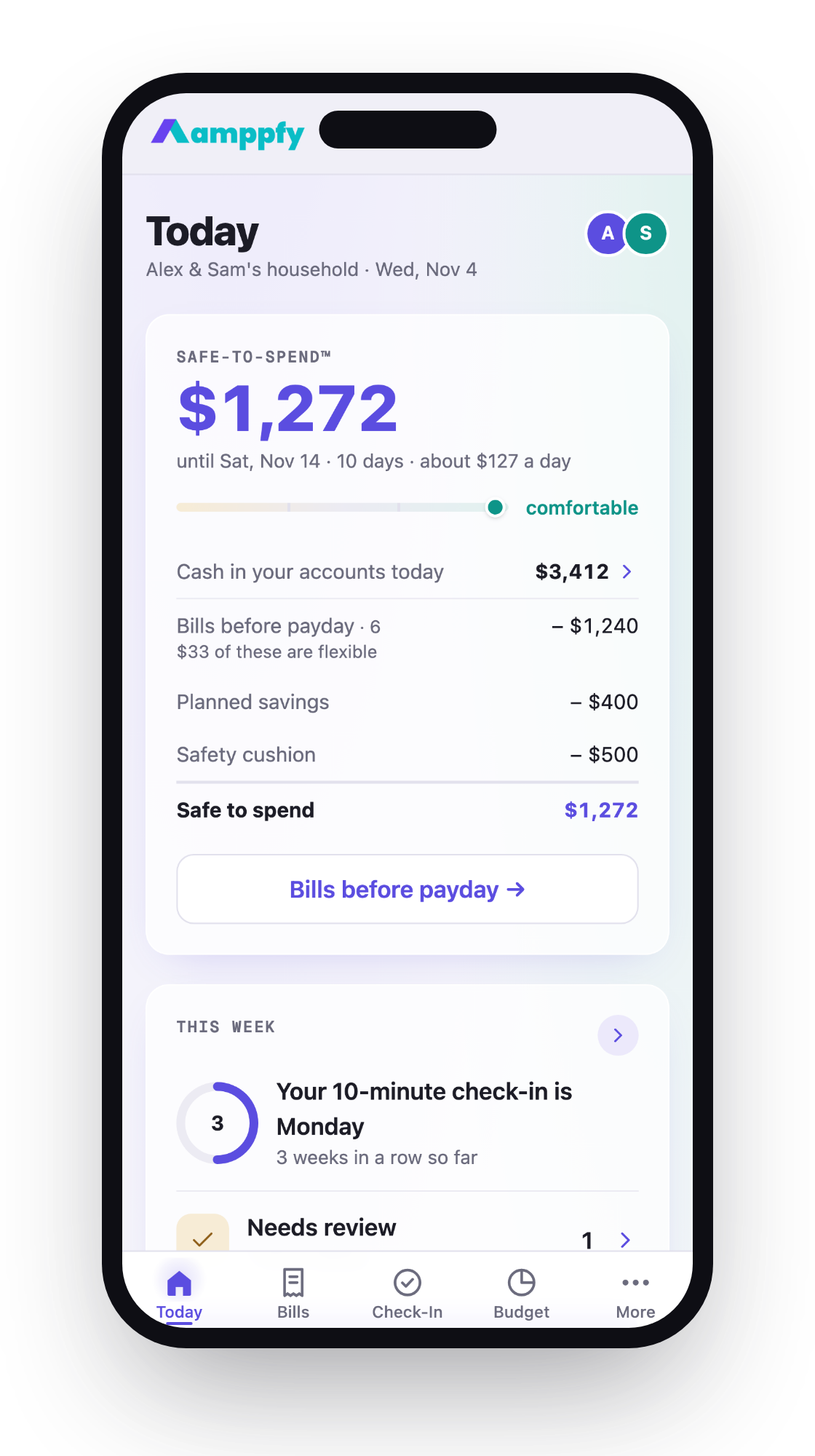
Here’s how the new deposit flows into a Safe-to-Spend™ number. Say your accounts show $3,412 after the January deposit:
- Cash available: $3,412
- Minus bills before next payday: − $1,240
- Minus planned savings: − $400
- Minus safety cushion: − $500
- Safe-to-Spend™: $1,272
That $1,272 is what you can use freely until the next deposit. Every line is visible, so nothing is hidden.
In Amppfy, you enter your income once with the next payment date. After that, the number updates on its own. The bills calendar marks your lowest cash point before the next deposit. That way you’ll see a tight week coming before you’re in it.
Where a raise in benefits should go first
A social security increase in 2027 of $54 to $108 a month won’t fix everything. It can still do one useful thing well. The trick is order.
Start with a cushion if you don’t have one. A few hundred dollars set aside turns a surprise bill into a minor event. Even one month of your raise moved into savings starts that buffer. Once it’s there, your plan has room to breathe.
Next, look for a bill that has crept up. Utilities and insurance are the usual suspects. If your electric bill or car insurance rose $30 this year, part of your raise is already spoken for. Matching the raise to that specific increase keeps your plan accurate.
Fix the line that moved, and leave the rest alone.
Then fund a goal. Once the cushion exists and your bills match reality, the leftover can go somewhere you choose. That might be a trip, a home repair fund, or gifts for the grandkids. Small monthly amounts add up over a year.
FAQ
When will I see the 2027 COLA in my check?
It depends on your payment schedule. Most people see it on January 13, 20, or 27, 2027, based on birth date. If you’re paid on the 3rd or receive SSI, it arrives Thursday, December 31, 2026.
Is the COLA the same for SSI?
Yes. SSI recipients get the same 3.6% increase. It shows up in the payment dated December 31, 2026, which is the January payment paid early because of the holiday.
Will Medicare take part of the raise?
It might. The Part B premium is deducted before your deposit, so any premium increase reduces your net raise. The 2027 premium comes from CMS and is usually announced in November.
How do I see my new amount?
Log in to your my Social Security account. COLA notices appear there from late November 2026. Paper notices are mailed in early December 2026, and both show your exact rounded amount.
The 2027 COLA is a steady, predictable change. You know the rate, 3.6%. You know the dates. You know Medicare may take a slice, and that the notice will show exactly how much. What’s left is one calm update when the deposit lands: new income, a check of upcoming bills, and a job for the extra dollars.
You don’t have to rebuild your whole plan. You only need to change one number and decide where the difference goes. Cushion first, then the bill that crept up, then a goal.
If you’d like that number done for you, Amppfy shows your Safe-to-Spend™ amount with the math printed underneath. It’s free on iPhone, Android, and the web, and you type in your balances yourself, with no bank login. Take ten minutes this week, enter your balances, bills, and next payment date once, and get Amppfy free before January’s deposit arrives.