

Two paychecks, one rent payment, and a grocery bill that somehow always lands on the wrong card. That’s the ordinary reason most couples start looking at a shared checking account. It isn’t romance. It’s logistics.
If you bank with Truist, adding a partner is a short process. There are a few details worth knowing before you tap submit, though. Some are about who owns what. Others are about how the monthly fee gets waived. A few are about what happens when two people can both move the same money.
This guide walks through a Truist joint account the way you’d actually set one up. You’ll see the requirements, the order of steps, and the published fees as of October 2026. You’ll also see how couples split shared and private money without turning every purchase into a conversation.
You don’t need to read it all at once. Skip to the step you’re on. Each section stands on its own. The math is shown wherever there’s math, because seeing the arithmetic is usually what makes a decision feel calm instead of rushed.
Joint accounts at Truist: what they are and who can be on one
A joint account is one account with two or more owners. At Truist, that ownership carries specific legal weight. The Bank Services Agreement says an account owned by two or more people is treated as joint tenants with right of survivorship. That’s the policy as of October 2026.
In plain terms, that means two things:
- Equal access: Each joint owner may deposit, withdraw, and conduct any transaction on the account.
- Survivorship: If one owner dies, the account passes to the surviving owner.
Age is the other gate. Truist’s checking application page says you may add a joint owner if they’re at least 18. For anyone under 18, you can visit a branch to add them later. That’s the published rule as of October 2026.
So a spouse, partner, or adult roommate qualifies for online setup. A teenager goes through a branch instead.
Add a partner to an existing account vs open a new joint account
You have two honest options. Each fits a different situation.
Adding your partner to an account you already have keeps your account number, direct deposits, and autopays in place. Nothing needs to be rerouted. The trade-off is history. Your partner joins an account with your past transactions on it, and they become a full owner of the current balance.
Opening a fresh account gives you a clean start. It’s a new account number, a new balance, and shared history from day one. You’ll need to point paychecks and bills at it, which takes some setup time.
| Situation | Better fit |
|---|---|
| Your account already pays rent and utilities | Add your partner |
| You want a separate “household” pot | Open a new account |
| You’d rather keep your personal account private | Open a new account |
| You want the fewest changes this week | Add your partner |
One detail matters here. Truist’s application flow works in a set order. You open your individual account first, then add a joint owner afterward. That’s how the account application describes it as of October 2026. Either path ends in the same place. The only question is whether the account is new or one you already have.
Step by step
Truist publishes a short sequence. Here it is as described on its application page, as of October 2026.
- Open your individual account. This is where you start if you’re opening something new.
- Confirm your partner’s age. They must be at least 18 for online setup.
- Gather three details. You’ll need your partner’s full name, the last four digits of their Social Security number, and their email address.
- Submit the joint owner request. Truist uses those three details to add them.
- For anyone under 18, visit a branch. Truist says you can add them there later.
All of this comes from Truist’s own application page. Truist doesn’t publish a processing time for adding a joint owner on that page, so this guide won’t guess at one.
A small prep tip saves time. Ask your partner for their email and the last four SSN digits before you start. It takes about two minutes and avoids a half-finished form.
What each of you can see, move, and close
This is the section to read twice. Under Truist’s Bank Services Agreement, each joint owner may deposit, withdraw, and conduct any transaction. That’s as of October 2026.
“Any transaction” is broad. In practice, it means both of you have the same power over the money in that account. There’s no primary owner with a veto over spending.
What that looks like day to day:
- Deposits: Either of you can add money.
- Withdrawals: Either of you can take money out, including the full balance.
- Transactions: Either of you can make payments and transfers.
Truist’s agreement grants each owner the right to conduct any transaction. It doesn’t publish a separate rule on that page about one owner closing a joint account alone. If closing rules matter to you, ask Truist directly before you open.
The calm takeaway here is simple. A joint account works best for money you both agree is shared. Keep money you want to control alone in an account that’s yours alone.
Fees, minimums, and waivers
Truist One Checking has a short fee list. Here’s what Truist publishes for this account as of October 2026:
- Minimum opening deposit: $50
- Monthly maintenance fee: $12, or $0 with a waiver
- Overdraft fees: None
The $12 fee is waived if you meet any one of these, as of October 2026:
- $500 or more in qualifying direct deposits per statement cycle
- A $500 combined balance across related accounts
- A Truist credit card, mortgage, or loan
- Being a student
- Being under 25, or 62 and older
Here’s the useful part for couples. Related accounts include those of primary and secondary owners. Your partner’s Truist balances can count toward the $500 combined balance.
The math is short. If you miss every waiver, the fee is $12 x 12 months = $144 a year. If one paycheck of $500 or more lands by direct deposit each cycle, that drops to $0. Two working adults on direct deposit usually clear this without trying.
One more line to know: Truist’s fee disclosures[1] list a non-Truist domestic ATM fee rising to $3.50, effective November 9, 2026. That’s as published in October 2026. Using Truist ATMs keeps that cost off your account.
Joint, separate, or both: how couples actually use it
There’s no single right setup. Most couples land on one of three, and each has its own logic.
All joint
Both paychecks go to one Truist joint account. Every bill comes out of it. This is the simplest setup to see at a glance. It also asks for the most trust, since both of you have full access to every dollar.
All separate
Each person keeps their own account. You split bills by transfer or by assigning each bill to one person. It’s private and tidy. The catch is coordination. Someone has to know whether rent is covered this month. Here’s a guide to budgeting as a couple with separate accounts that walks through that rhythm.
Both (hybrid)
A shared account covers rent, utilities, and groceries. Each of you keeps a personal account for everything else. This is the setup many couples settle into. Shared bills stay visible to both of you, and personal spending stays personal.
A quick hybrid example: shared bills total $3,000 a month. Partner A earns $4,500 and Partner B earns $3,000. Split by income, A puts in 60% ($1,800) and B puts in 40% ($1,200). The rest stays in each personal account. For setup details on each model, see this breakdown of bank accounts for couples: joint, separate, or both.
One number for two people
A shared account solves where the money sits. It doesn’t answer the question couples ask most often: can we spend this right now?
Checking balances don’t answer it. A $2,400 balance looks fine until you remember rent comes out Thursday. Your partner sees the same $2,400 and reaches the same wrong conclusion. Two people looking at one balance can still be guessing.
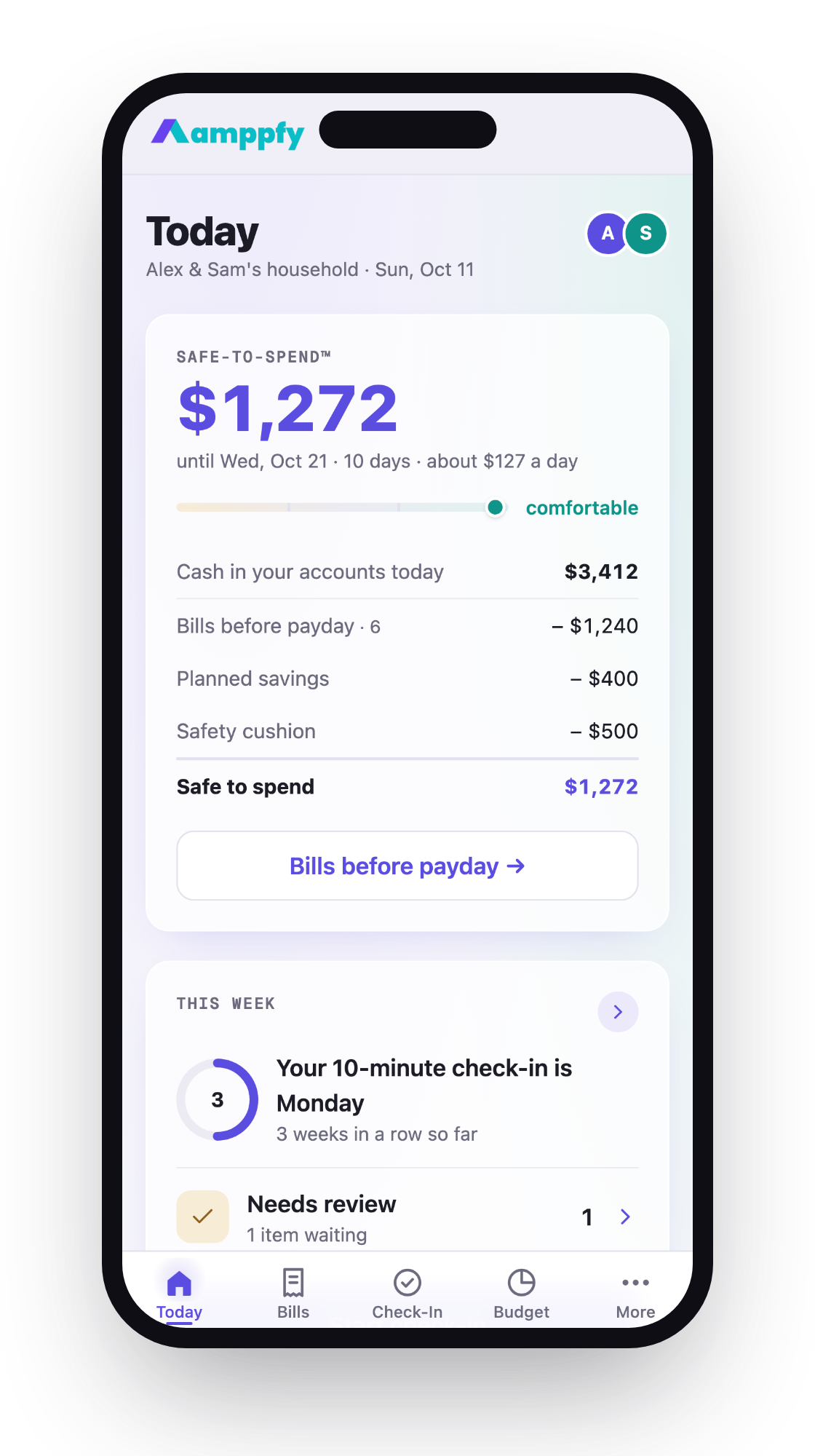
The calmer approach is one shared number with the math printed underneath. Amppfy shows a Safe-to-Spend™ number built like this:
| Line | What it is |
|---|---|
| Available cash | Balances you type in |
| minus bills due before payday | Only bills before the next paycheck |
| minus planned savings | Goals you’ve set |
| minus your cushion | A buffer you choose |
A worked example: $2,400 cash in the joint account – $1,600 rent due before payday – $300 planned savings – $200 cushion = $300 safe to spend. That’s the honest figure until payday.
Each partner gets their own login and sees the same number. Private balances stay private, so a hybrid setup still works. There’s no bank login. You type balances in, about 30 seconds per account. A 10-minute weekly check-in keeps the number fresh. The app is free on iPhone and the web, so a partner on Android or a laptop uses the browser.
If that sounds useful, set up a shared number for the two of you. Take ten minutes this week, after your joint account is open.
Comparing banks? Here is the list of online banks that offer joint accounts, with each bank’s own steps.
FAQ
Can I add my partner to my Truist account online?
Yes, if they’re at least 18. You’ll need their full name, the last four digits of their SSN, and their email address. That’s per Truist’s application page, as of October 2026.
Can I add my teenager as a joint owner?
Not through the online flow. Truist says anyone under 18 can be added later at a branch, as of October 2026.
Does my partner’s balance help waive the monthly fee?
It can. Truist counts related accounts of primary and secondary owners toward the $500 combined balance waiver, as of October 2026.
Can my partner withdraw money without asking me?
Yes. Under Truist’s agreement, each joint owner may deposit, withdraw, and conduct any transaction. Keep money you’d rather control alone in an individual account.
Either way, a shared account works best when you both agree on what it’s for. Once you’ve settled that, the rest is just arithmetic.