Family budgets rarely fail for lack of willpower. They fail because the numbers they’re working from are wrong. A realistic budget for a family of four starts with what things actually cost in 2026, not what a template from five years ago says they should cost. This piece breaks the month into real categories, with example dollar ranges you can swap for your own, so you can build a plan that holds up between paydays.
What a family of four’s month includes
Your monthly spending falls into a handful of big buckets. The trick is knowing which ones you control and which ones are fixed. Here’s an example plan for one family of four. Treat the ranges as placeholders for your own numbers:
| Category | Example Monthly Range |
|---|---|
| Housing (rent/mortgage + utilities) | $1,400 – $2,400 |
| Food (groceries + dining out) | From $1,023.70 (USDA Thrifty plan) |
| Childcare / education | $0 – $2,500+ |
| Transportation | $600 – $1,200 |
| Health insurance (employee share) | $500 – $700 |
| Savings + emergency fund | $200 – $600 |
| Everything else | $400 – $900 |
These ranges shift based on your metro area, your kids’ ages, and whether one parent stays home. The point isn’t to match every line. It’s to see where your money actually goes so you can decide where it should go.
A useful starting point: list your last month’s bank and credit card transactions. Group them into the categories above. You’ll spot the gaps between what you assumed and what you spent. That gap is where a workable plan begins.
Housing, food, and childcare
These three categories take the biggest share of a family’s take-home pay. They’re also the hardest to cut quickly.
Housing costs in 2026
Rent and mortgage payments vary more by location than any other line. Homeowners with locked-in mortgages fare better on the principal-and-interest line, but property taxes and insurance keep climbing. Utilities add another layer, and those bills tend to climb over time.
Budget for utilities on top of your rent or mortgage payment, using last year’s bills as your guide. If your total housing cost exceeds 30% of gross income, you’re in the squeeze zone. You can’t always fix that overnight, but you should know you’re in it.
Feeding a family of four
The USDA’s Thrifty Food Plan pegs the lowest-cost nutritious diet for a family of four at $1,023.70 per month as of August 2026[1], and USDA’s higher-cost plans run above that. Meal planning, batch cooking, and a strict grocery list are the most reliable ways to stay closer to the lower end. Dining out or ordering delivery even twice a week adds up fast.
The childcare problem
Childcare for two young children can rival a housing payment. If both parents work and you have a toddler plus a preschooler, this is often the single largest line item, bigger than housing.
Options that lower the number: a dependent care FSA (pre-tax dollars), staggered work schedules, family help, or a nanny share with another family. None of these are magic. But ignoring this line item will wreck any budget you build.
Transportation and insurance
Getting around
For a two-car household, transportation is often the next-biggest line. It includes car payments, gas, insurance, maintenance, and registration. One-car families cut this significantly, but it requires schedule coordination that isn’t always possible with kids.
An example breakdown for one financed vehicle:
- Car payment: $350 – $550
- Gas: $120 – $200
- Auto insurance: $100 – $180
- Maintenance and repairs (averaged): $75 – $125
If you’re carrying two car payments, this category alone can rival your grocery bill. Paying off one vehicle, even if it means driving an older car, frees up real cash.
Health insurance
Family health coverage is one of the largest paycheck deductions, and premiums tend to rise each year. Check your pay stub for the exact amount and plan around it.
Don’t forget out-of-pocket costs. Copays, prescriptions, and dental visits add up for a family with two kids. Budget for them or they’ll come out of your grocery money.
Savings for a family that is already stretched
Saving feels impossible when every dollar has a job. But even small, consistent deposits change your trajectory over 12 months.
Start with one goal: a $1,000 starter emergency fund. That’s $84 per month for a year, or $42 per paycheck if you’re paid biweekly. Once you hit $1,000, shift to building one month of expenses, then three months.
Here’s a practical way to think about savings tiers:
- Starter emergency fund: $1,000 (first priority)
- Full emergency fund: 3 months of essential expenses
- Retirement: enough to capture your employer match
- Kids’ future costs: 529 or similar, even $25/month
The order matters. An emergency fund prevents credit card debt when the car breaks down. Your employer match is free money. Everything else comes after those two.
If you’re building a household budget from your existing plan, the savings line should be treated like a bill, not a leftover. Decide the amount on payday and move it before you spend.
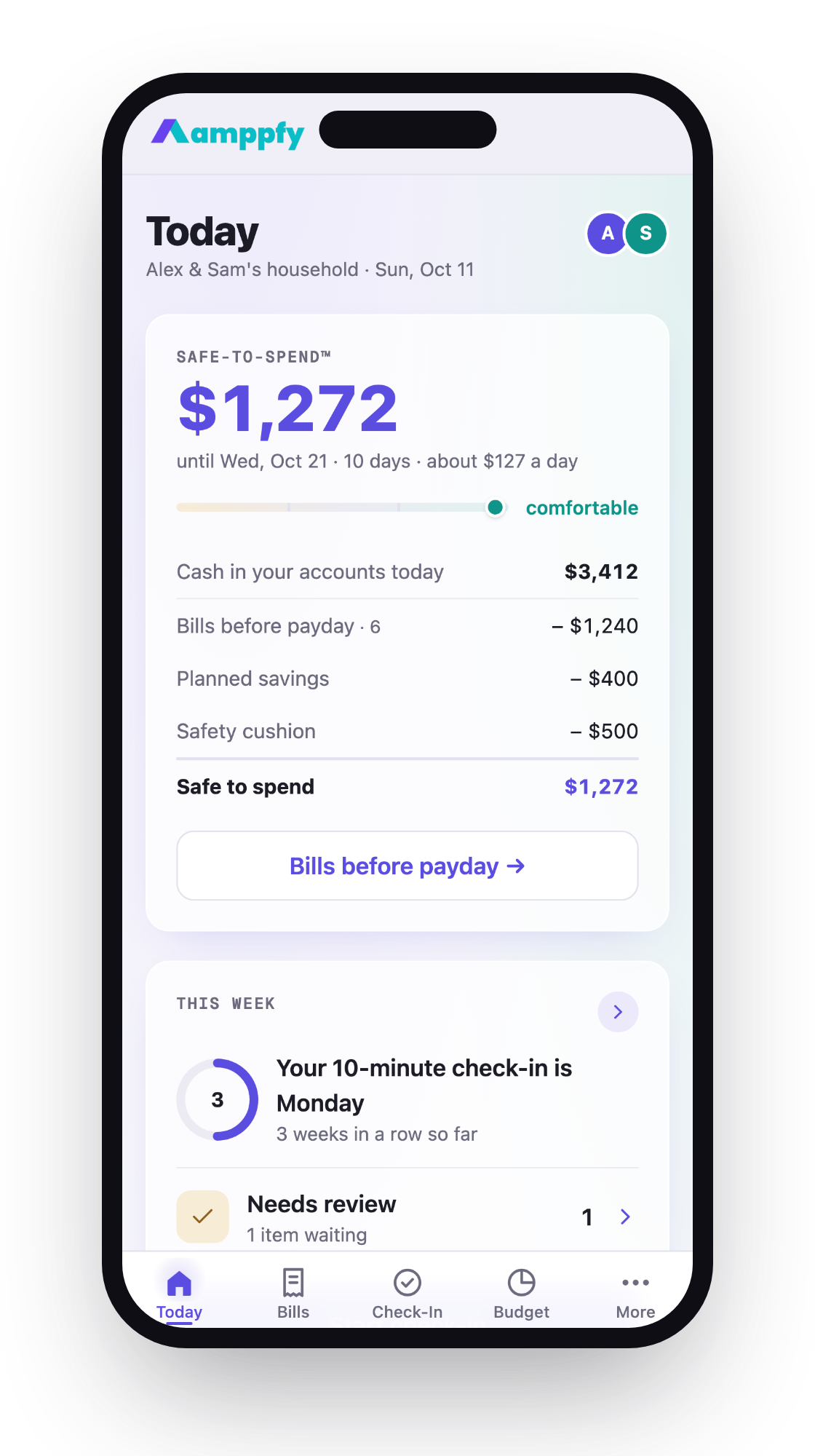
Amppfy’s Budget page breaks the month into four slices: Bills, Savings, Subscriptions, and Everyday spending. Your savings goal shows up as a line item alongside your electric bill and car payment, so it doesn’t get skipped. The math is simple: $3,412 cash − $1,240 bills − $200 savings − $500 cushion = $1,472 Safe-to-Spend™. That number updates as you check in each week.
Adjusting the plan as kids grow
A budget built for a family with a toddler and a baby won’t fit a family with a 10-year-old and a 7-year-old. Costs shift, sometimes dramatically.
The childcare cliff (in a good way)
Once both kids enter public school, childcare costs often drop sharply, though after-school care still costs something. For many families, that’s the biggest budget relief of the early school years. The key is redirecting that freed-up cash toward savings or debt payoff before lifestyle creep absorbs it.
Rising food and activity costs
Older kids eat more. A lot more. Your grocery bill will climb as your children grow, and activities like sports, music lessons, and camps add costs that change with the season. Build a “kid activities” line into your plan and review it each semester.
Annual budget reviews
Sit down once a year, ideally around your birthday or New Year’s, and update every number. Income changes, insurance premiums shift, a car gets paid off. A family of four budget that worked last January might be off by $300 or more by December. Ten minutes with your actual numbers keeps the plan honest.
Frequently Asked Questions
How much should a family of four spend per month?
Total spending depends heavily on location and childcare needs. Housing and childcare drive most of the variation. Families in lower-cost areas with school-age kids can land closer to the low end.
What’s the biggest budget mistake families make?
Ignoring irregular expenses. Car repairs, back-to-school shopping, holiday gifts, and annual insurance premiums hit every year, but they rarely show up in a monthly plan. Divide last year’s irregular spending by 12 and add that line to your budget. It prevents the “where did that money go” moment.
How do you budget when both parents have different spending habits?
Pick one shared number you both agree on: what’s safe to spend before the next payday. You don’t need to agree on every purchase. You need to agree on the boundary. Amppfy lets partners see the same Safe-to-Spend™ number while keeping individual account balances private, which removes most of the friction.
Should you budget for savings if you have credit card debt?
Yes, but adjust the split. Build a small emergency buffer of $500 to $1,000 first, then throw everything extra at the highest-interest card. Without that buffer, every surprise expense goes right back on the card and the cycle continues.
Building a Budget That Actually Lasts
A realistic plan for your family doesn’t require a spreadsheet with 47 tabs. It requires knowing what you earn, what you owe before payday, and what you’re setting aside. The rest is what you can actually spend without stress.
Review your numbers once a week. Adjust once a quarter. Rebuild once a year. That rhythm keeps the plan alive without turning budgeting into a second job.
If you want one number that tells you what’s safe to spend right now, get Amppfy free. Enter your balances, bills, and payday once, about ten minutes, and your Safe-to-Spend™ number is always there. No Sunday-afternoon spreadsheet sessions required.