December sneaks up on your bank account faster than it does on the calendar. You’ve got gifts, travel, food, parties, and maybe year-end donations all hitting within a few weeks. The trick isn’t spending less on everything: it’s knowing which paycheck funds which expense, so no single pay period takes the full hit. Building a holiday budget around your paycheck schedule turns a stressful guessing game into a short list of numbers you can actually trust.
Count the Paydays Between Now and December 31
Your first move is simple: count the paychecks you’ll receive between today and December 31, 2026. Open your calendar and mark every payday. If you’re paid biweekly, you’ll typically see two or three paydays in December, depending on your company’s pay calendar. Semimonthly employees always get two. Weekly earners might see four or five.
Here’s a quick reference:
| Pay Frequency | Typical December 2026 Paydays | Dates to Confirm |
|---|---|---|
| Weekly | 4-5 | Every Friday or your set day |
| Biweekly | 2-3 | Check if a third lands before 12/31 |
| Semimonthly | 2 | Usually the 1st and 15th |
| Monthly | 1 | Often the 1st or last business day |
Don’t assume. Check your employer’s 2026 pay calendar or your last pay stub for the exact dates. A biweekly schedule sometimes delivers a bonus third paycheck in December, and that changes everything.
Once you’ve got the count, add any paychecks left in November too. November earnings are part of your holiday runway. If you’re reading this in early November, you might have five to seven total paydays before New Year’s. That’s five to seven chances to set money aside in small, painless chunks rather than one painful withdrawal.
Write the dates down. You’ll use them in the next step.
Which Holiday Costs Land in Which Pay Period
Not all December expenses hit at the same time. Gifts might be purchased over several weeks, but your holiday travel is probably booked (and charged) on a specific date. A family dinner lands on a specific weekend. Matching each cost to the right pay period keeps any single paycheck from being wiped out.
List Every Holiday Expense
Start with a quick brain dump. Common categories:
- Gifts for family, friends, coworkers, teachers
- Travel costs: flights, gas, tolls, rental car
- Food and entertaining: holiday meals, potluck contributions, baking supplies
- Decorations or a tree
- Charitable donations
- Event tickets, ugly sweater parties, outings with kids
- Shipping and wrapping supplies
Assign a rough dollar amount to each. Don’t aim for perfection: a reasonable estimate works.
Map Costs to Pay Periods
Now place each expense on the timeline next to the paycheck that arrives before it’s due. If you’re buying gifts online by December 15 to guarantee shipping, that cost belongs in the pay period ending around December 12-13. If your family dinner is December 24, the grocery run probably happens December 22-23, so it falls under the last paycheck before that date.
A simple table helps:
| Pay Period | Payday Date | Holiday Expenses Due | Estimated Cost |
|---|---|---|---|
| Period 1 | Fri, Nov 20 | Early online gift orders, shipping | $250 |
| Period 2 | Fri, Dec 4 | Remaining gifts, decorations | $300 |
| Period 3 | Fri, Dec 18 | Travel, groceries, last-minute items | $350 |
This layout shows you exactly how much holiday spending each paycheck needs to cover on top of your regular bills. No surprises, no scrambling.
A Per-Paycheck Holiday Number
You’ve got your paydays. You’ve got your expenses mapped. Now calculate a single number for each pay period: how much of that check can actually go toward holiday spending.
Here’s the one-line formula:
Take-home pay minus regular bills minus savings minus cushion equals your available holiday dollars.
A worked example: say your December 6 paycheck is $2,400. Regular bills due before the next payday total $1,100. You want to keep saving $200 toward a goal. You hold back a $300 cushion for the unexpected. That leaves $800. If $300 of that is earmarked for gifts and decorations, you’ve still got $500 for groceries, gas, and normal life.
$2,400 cash – $1,100 bills – $200 savings – $300 cushion = $800 available.
That’s the kind of clarity that prevents the “I thought I had enough” moment at checkout. Repeat this for every pay period through December.
What If the Numbers Don’t Work
Sometimes the math shows a gap. Your planned holiday spending exceeds what’s available in one or more pay periods. That’s not failure: it’s information you can act on.
- Shift a purchase to an earlier pay period that has more room.
- Reduce the gift list or set a per-person cap.
- Start pulling small amounts from November paychecks. Even $50 per check across three November paydays gives you $150 of breathing room.
- Swap a purchased gift for something homemade or experiential.
The goal is to make the numbers balance before you start spending, not after.
Keeping January Bills Funded
December generosity has a cost that shows up in January. Your rent or mortgage, utilities, insurance, and subscriptions don’t take a holiday. One of the most common post-holiday problems is arriving in January with bills due and an account balance that’s too low to cover them.
Protect January by treating it as part of your December plan. Here’s how:
- Identify every bill due between January 1 and your first January payday. For biweekly earners, that first check might not arrive until January 9 or later.
- Set that total aside now, in a separate savings bucket or just as a mental reservation on your last December paycheck.
- Don’t touch it for gifts, travel, or parties.
A practical example: your January rent is $1,500, due January 1. Your car insurance auto-pays $180 on January 3. A streaming bundle charges $45 on January 5. That’s $1,725 that must survive December untouched.
According to the Federal Reserve’s 2024 Survey of Household Economics and Decisionmaking, 37% of U.S. adults said they couldn’t cover an unexpected $400 expense with cash. January bills aren’t unexpected, but they become a crisis when December spending doesn’t leave room for them.
If you use Amppfy, the app’s month calendar marks your lowest-cash day, so you can see at a glance whether January 3 is going to be tight. That one visual can change how aggressively you spend in the last week of December.
A Weekly Check-In Through the Season
A plan only works if you revisit it. Set aside ten minutes each week from late November through early January to compare your actual spending against the per-paycheck numbers you mapped out.
What to Check Each Week
- Current account balances: type them into your tracking tool or write them down.
- Spending so far this pay period versus your planned holiday amount.
- Upcoming bills before the next payday.
- Whether your January reserve is still intact.
This isn’t about guilt. It’s a quick status report. If you’re ahead of plan, great. If you’ve gone over in one category, you can adjust another before the next paycheck arrives.
A Sample Weekly Rhythm
| Week | Action |
|---|---|
| Nov 23 | Finalize gift list and per-paycheck targets |
| Nov 30 | Check balances, confirm early orders placed |
| Dec 7 | Review Period 1 spending, adjust Period 2 if needed |
| Dec 14 | Check shipping deadlines, update remaining gift budget |
| Dec 21 | Final pre-holiday balance check, confirm January reserve |
| Dec 28 | Post-holiday review: actual vs. planned, note lessons for next year |
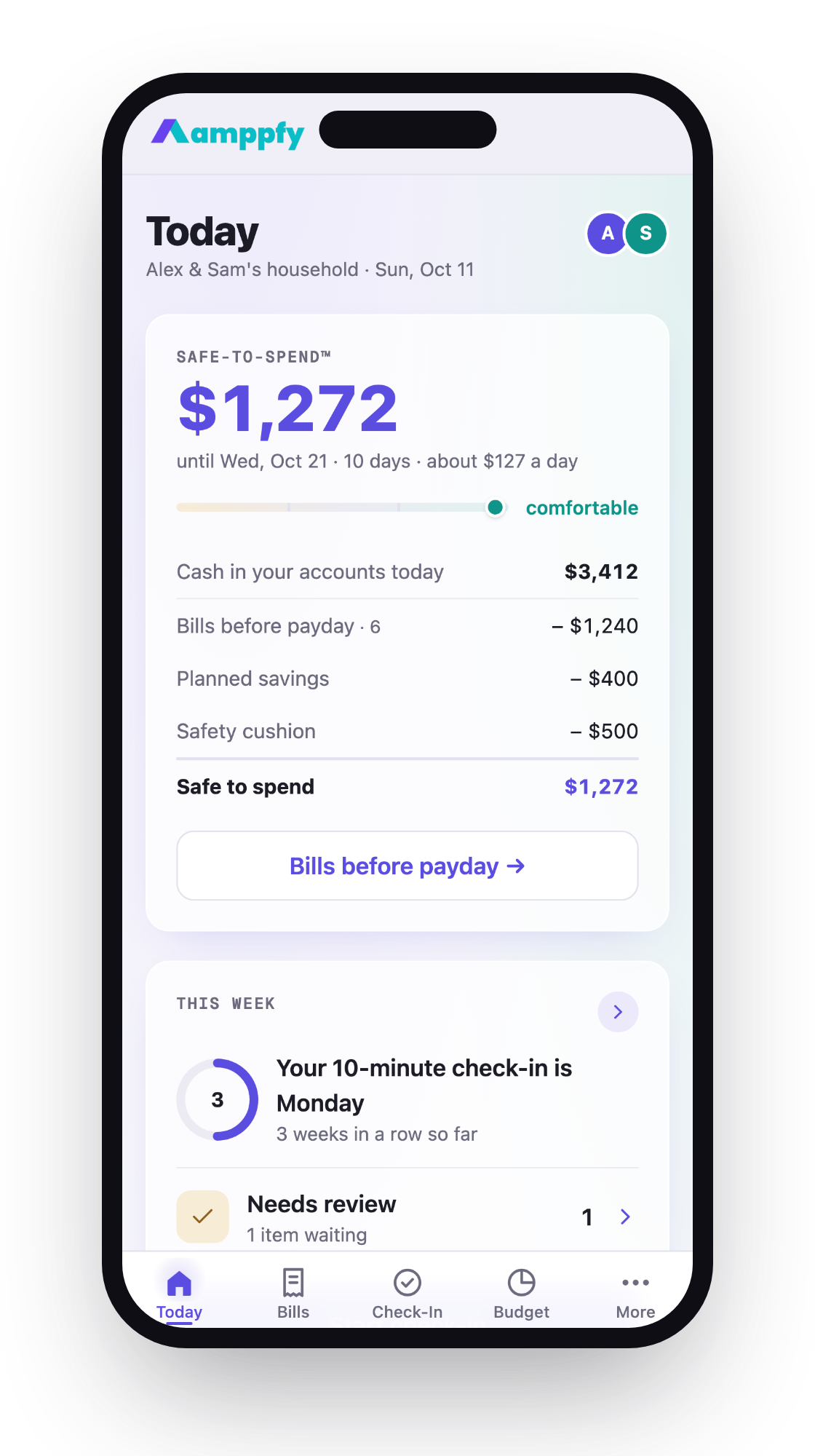
Amppfy’s Safe-to-Spend™ number updates every time you enter a balance, so your weekly check-in can take about two minutes: open the app, update your checking account balance, and see whether your available dollars still cover what’s ahead. The four-line math sits right under the number, so there’s nothing to wonder about.
The weekly habit also catches subscription renewals you forgot about. That annual software charge or a streaming price increase hitting in December can throw off a tight plan. A quick glance at your upcoming charges keeps those from being a surprise.
Frequently Asked Questions
What if I get paid monthly and only have one December paycheck?
One paycheck means all your holiday spending comes from a single deposit. Start setting aside holiday funds from your October and November checks. Even small amounts, like $100 per month, create a separate pool so your December check doesn’t have to do everything alone. Map your December bills first, protect your January obligations second, and whatever remains is your holiday budget.
Should I use a credit card for holiday purchases and pay it off later?
You can, but only if the payoff plan is specific. Decide which January or February paycheck will cover the balance, and confirm the math works before you swipe. Vague plans to “pay it off eventually” tend to carry interest for months. If you can’t assign the repayment to a specific payday, spend cash instead.
How do I handle holiday spending when my partner and I split finances?
Agree on a shared holiday number and decide which account it comes from. If you each contribute, split the total by paycheck: one partner covers gifts from their December 6 check, the other handles the holiday dinner from their December 20 check. Write it down so both people see the same plan. Amppfy lets partners view the same Safe-to-Spend™ number while keeping individual balances private, which simplifies this conversation.
What’s a reasonable holiday spending target?
There’s no universal answer because it depends on your income, obligations, and values. A useful starting point: your holiday spending shouldn’t require you to skip a savings contribution or leave January bills unfunded. Work backward from what’s available after bills and savings, and that’s your ceiling.
Start January With Confidence
Aligning your holiday budget with your paycheck schedule isn’t complicated. Count your paydays, assign expenses to each one, run the per-paycheck math, protect January, and check in weekly. The whole setup takes about 30 minutes, and the weekly updates take less than ten.
The payoff is real: you enjoy December without the January hangover. You start the new year with bills covered, savings intact, and no surprise credit card balance.
If you want one number that tells you what’s safe to spend before your next payday, get Amppfy free. Enter your balances, bills, and payday once, about ten minutes, and the number stays current all season.