Most people on biweekly pay know their rhythm: work two weeks, get paid on Friday, repeat. But 2027 throws a wrinkle into that rhythm. The year starts on a Friday and ends on a Friday, creating a 53-Friday anomaly[1] that only happens every five or six years. That gives one of the two biweekly schedules 27 Friday paydays instead of 26. The catch: the first of them is New Year’s Day, so most people on that schedule will see that check on December 31, 2026, and 26 deposits in 2027. Whether you’re planning your bills, your savings goals, or just trying to figure out which Fridays are yours, a clear 2027 pay calendar makes the whole year easier to manage.
Two Biweekly Friday Schedules in 2027 and How to Tell Which One Is Yours
Every biweekly payroll falls on one of two tracks. Think of them as Schedule A and Schedule B. They alternate Fridays, so if Schedule A pays on January 1, Schedule B pays on January 8, and they never overlap.
Schedule A vs. Schedule B
Schedule A kicks off on January 1, 2027. Schedule B starts on January 8, 2027. From there, each schedule repeats every 14 days. Because 2027 has 53 Fridays, Schedule A lands on 27 of them. January 1 is a bank holiday, though, so that first check usually arrives on Thursday, December 31, 2026. Schedule B gets the standard 26.
How to Find Your Schedule
Pull up your most recent pay stub from late 2026. Find the pay date. Count forward in 14-day jumps until you land in January 2027. If your first 2027 payday is January 1, you’re on Schedule A. If it’s January 8, you’re on Schedule B.
Your HR or payroll department can confirm this in about 30 seconds. Some companies also post the full-year calendar on their internal portal by December. If you’re still unsure, look at your December 2026 paydays. Schedule A pays on Friday, December 18, 2026, and again around New Year’s (usually Thursday, December 31, 2026). Schedule B pays on Friday, December 11, 2026, and again around Christmas (usually Thursday, December 24, 2026, since Christmas is a bank holiday).
The distinction matters because each schedule gets its third paycheck in different months, which changes your cash flow in those months. Here’s the full list.
The Full List of 2027 Paydays for Each Schedule
Below are every Friday payday for both biweekly schedules in 2027. These dates assume your employer pays on the standard Friday without shifts. Holiday adjustments are covered in a later section.
Schedule A: 27 Fridays (the Jan 1 check usually lands Dec 31, 2026)
| Pay Period | Date | Pay Period | Date |
|---|---|---|---|
| 1 | Jan 1 | 15 | Jul 16 |
| 2 | Jan 15 | 16 | Jul 30 |
| 3 | Jan 29 | 17 | Aug 13 |
| 4 | Feb 12 | 18 | Aug 27 |
| 5 | Feb 26 | 19 | Sep 10 |
| 6 | Mar 12 | 20 | Sep 24 |
| 7 | Mar 26 | 21 | Oct 8 |
| 8 | Apr 9 | 22 | Oct 22 |
| 9 | Apr 23 | 23 | Nov 5 |
| 10 | May 7 | 24 | Nov 19 |
| 11 | May 21 | 25 | Dec 3 |
| 12 | Jun 4 | 26 | Dec 17 |
| 13 | Jun 18 | 27 | Dec 31 |
| 14 | Jul 2 |
Schedule B: 26 Pay Dates
| Pay Period | Date | Pay Period | Date |
|---|---|---|---|
| 1 | Jan 8 | 14 | Jul 9 |
| 2 | Jan 22 | 15 | Jul 23 |
| 3 | Feb 5 | 16 | Aug 6 |
| 4 | Feb 19 | 17 | Aug 20 |
| 5 | Mar 5 | 18 | Sep 3 |
| 6 | Mar 19 | 19 | Sep 17 |
| 7 | Apr 2 | 20 | Oct 1 |
| 8 | Apr 16 | 21 | Oct 15 |
| 9 | Apr 30 | 22 | Oct 29 |
| 10 | May 14 | 23 | Nov 12 |
| 11 | May 28 | 24 | Nov 26 |
| 12 | Jun 11 | 25 | Dec 10 |
| 13 | Jun 25 | 26 | Dec 24 |
Print these tables or save them to your phone. They’re the backbone of your biweekly pay calendar for 2027.
Which Months Bring a Third Paycheck
Most months, you’ll receive two biweekly deposits. But a few months squeeze in three paydays, and that third check can feel like a bonus if you plan for it.
Schedule A: Three-Paycheck Months
Schedule A employees see three deposits in July (2nd, 16th, 30th) and December (3rd, 17th, 31st). January also has three Friday paydays on paper (the 1st, 15th, and 29th), but because January 1 is a bank holiday, that first check usually arrives on December 31, 2026, so January 2027 feels like a normal two-check month.
Schedule B: Three-Paycheck Months
Schedule B picks up three checks in April (2nd, 16th, 30th) and October (1st, 15th, 29th).
Why the Third Check Matters
Your fixed monthly bills – rent, car payment, insurance – are sized around two paychecks per month. When a third arrives, those fixed costs are already covered. That third deposit is genuinely available for other priorities: an extra debt payment, a savings goal boost, or a buffer for the holidays.
Here’s a quick example. Say your biweekly take-home is $2,400. In a normal month, you bring in $4,800. In a three-check month, you bring in $7,200. That extra $2,400 is real money. The key is knowing it’s coming so you don’t accidentally absorb it into everyday spending.
One thing worth asking if you’re on Schedule A and salaried: whether your employer divides your salary by 27 or by 26 this year. Dividing by 27 makes each check slightly smaller; your annual pay stays the same.
Paydays That Move for Holidays
Biweekly paydays land on Fridays, and a few 2027 Fridays are holidays. When banks are closed, most employers move the deposit to the Thursday before. Some Fridays are federal holidays while banks stay open; those deposits usually arrive on time, but confirm with your payroll team.
| Scheduled Payday | Holiday | When the deposit usually arrives |
|---|---|---|
| Jan 1 (Sched A) | New Year’s Day (banks closed) | Thu, Dec 31, 2026 |
| Jun 18 (Sched A) | Juneteenth, observed (banks open) | Usually on time; some employers pay Thu, Jun 17 |
| Dec 24 (Sched B) | Christmas, observed (banks open) | Usually on time; some employers pay Thu, Dec 23 |
| Dec 31 (Sched A) | New Year’s Day 2028, observed (banks open) | Usually on time; some employers pay Thu, Dec 30 |
The January 1 payday on Schedule A is the trickiest. Some employers push it into late December 2026, which means you’d technically receive an extra paycheck in 2026’s tax year rather than 2027. Ask your payroll team how they’re handling it. This affects your W-2 totals for both years.
The December 31 check is simpler: banks are open that day, and an employer that moves it would move it earlier, to December 30, so it stays in 2027 either way. Paydays around July 4 and Thanksgiving do not move in 2027: Independence Day is observed on Monday, July 5, and the Friday after Thanksgiving is a normal bank day.
Check your company’s holiday pay policy in December 2026. A quick email to HR now saves confusion later.
If your employer counts 27 pay periods in 2027, ask how they handle benefit deductions on the extra check. Some skip certain deductions on it, which makes that check slightly larger.
Assigning Each Bill to a 2027 Payday
Knowing your pay dates is half the job. The other half is matching each bill to the right paycheck so you’re never caught short.
Step 1: List Every Recurring Bill
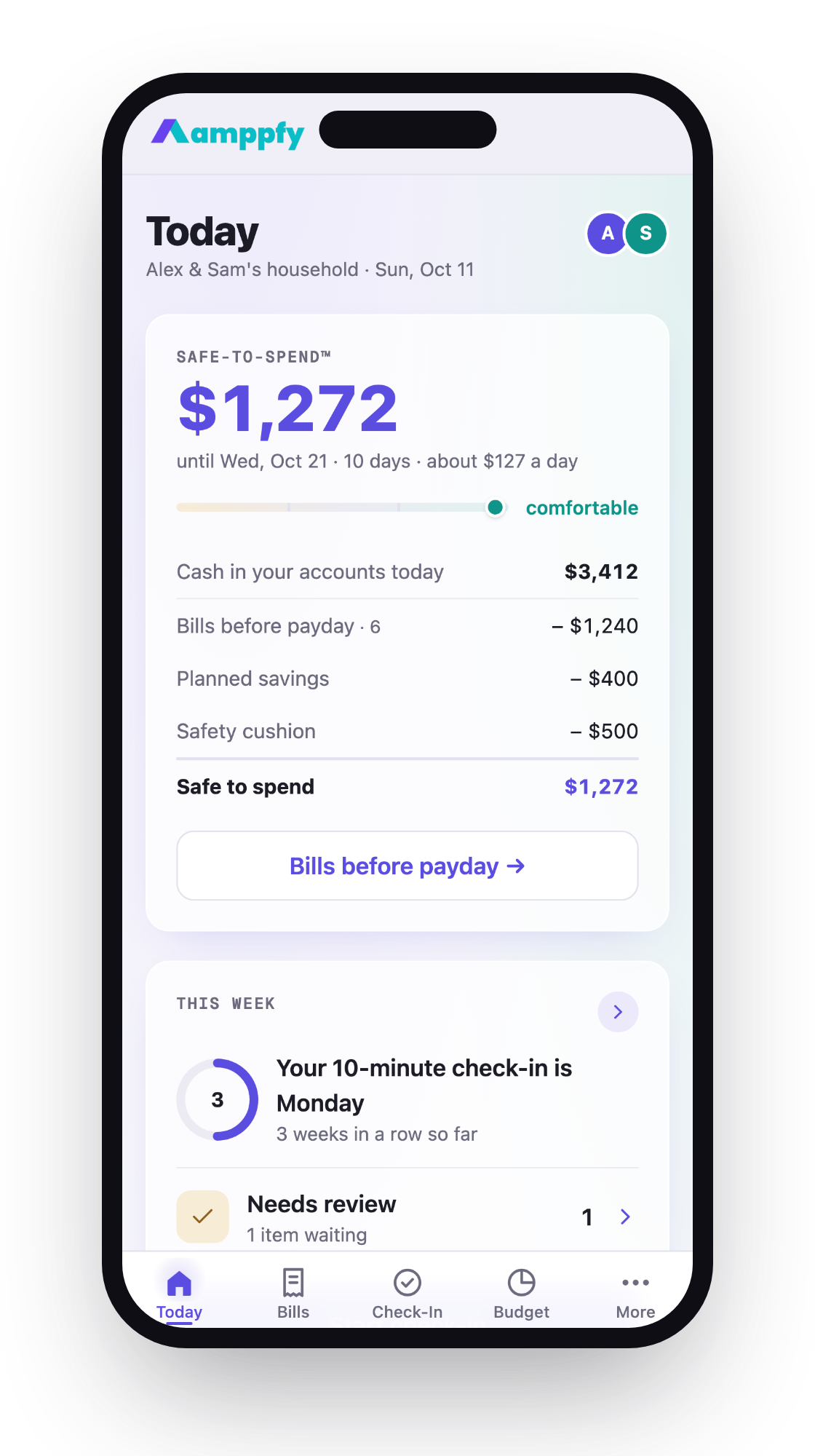
Write down each bill, its due date, and its amount. Rent on the 1st, car insurance on the 15th, streaming on the 22nd – all of it. Include subscriptions you forget about. If you use Amppfy, you can enter your bills, paydays, and savings goals once, and it shows your Safe-to-Spend™ number before each paycheck: available cash minus bills due, minus savings, minus your chosen cushion.
Step 2: Map Bills to the Paycheck Before They’re Due
Each bill gets assigned to the last paycheck that arrives before its due date. Here’s how that looks for a Schedule B employee in March 2027:
- Paydays: March 5 and March 19
- Rent ($1,500) due March 1: funded from the February 19 paycheck
- Car payment ($380) due March 10: funded from March 5
- Phone ($85) due March 22: funded from March 19
- Utilities ($140) due March 28: funded from March 19
Run that math for March 19: $2,400 paycheck minus $85 phone minus $140 utilities = $2,175 remaining. That’s your working number for groceries, gas, and everything else until April 2.
Step 3: Flag the Tight Paydays
Some pay periods carry more bills than others. Scan your full-year map for any paycheck that’s loaded with due dates. When you spot one, you have options: call a provider and shift a due date by a week, or set aside a small buffer from the lighter paycheck before it.
In three-paycheck months, the third deposit often falls in a gap between heavy bill cycles. That’s your chance to send an extra payment toward debt or fund a savings goal. The math might look like this: $2,400 paycheck minus $0 bills due minus $400 savings minus $500 cushion = $1,500 Safe-to-Spend™.
Planning bills against your 2027 biweekly pay calendar takes about 20 minutes once. After that, you just follow the map.
Frequently Asked Questions
Does everyone on biweekly pay get 27 paychecks in 2027?
No. Only Schedule A has 27 Friday paydays in 2027, and its January 1 check usually arrives on December 31, 2026 because New Year’s Day is a bank holiday. So most people on either schedule see 26 deposits land in 2027. Schedule B has 26 Fridays.
Will my individual paycheck amount change in a 27-pay-period year?
It depends on your employer. Some salaried payrolls divide annual pay by 27 in a 27-period year, so each check is slightly smaller; others keep dividing by 26 and the extra check is extra pay. Hourly workers are paid for hours worked, so their checks don’t change. Ask payroll which method they use.
How do I handle the extra paycheck for budgeting?
Treat it like found money that you planned for. Since your regular two-check months already cover your fixed bills, the third check in a three-paycheck month is available for savings, debt payoff, or building a cushion. Decide its job before it arrives.
What if my employer moves the January 1 payday into December 2026?
That paycheck counts as 2026 income on your W-2. You’d show higher taxable income in 2026 and lower in 2027. This could affect tax brackets, withholding, and any income-based benefits. Ask your payroll department how they plan to handle the timing so you can adjust your withholding if needed.
Make Your 2027 Paydays Work Harder
The 53-Friday year is unusual, but it’s not complicated once you see the full picture. Know your schedule. Mark the three-paycheck months. Watch for holiday shifts. Assign every bill to a specific paycheck.
If you want one number that does this math for you before every payday, get Amppfy free. Enter your balances, bills, and pay dates once – about ten minutes – and your Safe-to-Spend™ updates on its own. Take 15 minutes this week to map your first quarter of 2027. The rest of the year follows the same pattern.