

Two paychecks, one rent bill, and a growing list of “who paid for what” texts. At some point, plenty of couples who aren’t married start wondering if a shared account would make things simpler. It often does. But a joint account works the same way whether or not you have a marriage certificate, and that matters more than most people expect.
The bank doesn’t ask about your relationship. It asks who owns the money, who can take it out, and what happens if one of you dies or owes someone. When you’re married, state marital-property and inheritance rules fill in some gaps. When you’re not, the account title and the bank’s agreement do almost all of that work.
This guide covers what a joint account actually changes for unmarried partners and what stays exactly as it was. You’ll also see the setup steps, the exit plan if things end, and a simple way to see one shared number without merging everything. It draws on bank terms and consumer-agency pages from the CFPB and FDIC. It isn’t legal advice, and your own account agreement and state law are what control.
The short answer
Yes, you can open a joint account with a partner you’re not married to. Banks generally allow it. You both apply, you both pass identity checks, and you both become full owners.
Fewer couples do this than you might think. Only 16% of unmarried householder couples held a joint bank account in 2023[1], and that share rose to 25% for couples living with minor children. So if you’re on the fence, you’re in ordinary company.
Here’s the core idea in one line: marriage status doesn’t change the bank’s rules. What changes is the backup. Married couples have default marital-property and inheritance rules behind them. Unmarried partners don’t, so the way the account is titled carries the full load.
That has three practical effects:
- Ownership: either of you can usually withdraw everything.
- Survivorship: the title decides who gets the money if one of you dies.
- Creditors: one partner’s debt can reach the shared balance.
None of this is a reason to panic. It’s a reason to read the account terms once, pick the right title, and agree on a plan. That’s about twenty minutes of work.
What a joint account changes when you are not married
Ownership: both of you can take it all
The CFPB explains that in most circumstances either person on a joint checking account can withdraw money and close the account. It doesn’t matter who deposited what. The account agreement and state law control. For a deeper look at who owns the balance and who pays the fees, see joint checking accounts: who owns the money.
Survivorship: the title decides
Most joint accounts are held with rights of survivorship, so the money passes to the surviving owner. An account titled as tenants in common works differently. The deceased owner’s share goes to their estate, not to you.
For unmarried partners, that difference is big. There’s no default inheritance rule pointing to you. So check the title on the signature card. Ask the bank which one you have.
Creditors: one person’s debt touches both
A creditor of one owner can try to collect from the joint account. The calm fix is simple: keep records of your deposits, and keep the shared balance sized to shared bills.
What does not change
Opening a joint account doesn’t touch the accounts you already have. Your personal checking stays yours. Your savings stays yours. Your partner can’t see them or withdraw from them unless you add them as an owner.
Your credit doesn’t merge either. There’s no such thing as a joint credit score. A standard checking or savings account generally isn’t a credit product, so it doesn’t sit on your credit report the way a card or loan does. If either of you later opens a joint credit card or co-signs a lease, that’s a separate decision with its own effects.
Deposit insurance also stays straightforward. The FDIC insures joint accounts up to $250,000 per co-owner at each bank (as of October 2026). Here’s the arithmetic for two owners:
- Co-owner A: $250,000
- Co-owner B: $250,000
- Joint coverage at one bank: $500,000
That’s separate from coverage on each person’s single-owner accounts. Most couples’ shared bill accounts sit far below these limits.
And your relationship status on paper doesn’t move either. A joint account isn’t a legal partnership, a domestic partnership, or a marriage. It’s a bank product with two owners. That’s all.
How to set one up: the steps most banks share
Exact steps differ by bank, and each bank publishes its own. The overall pattern looks like this.
- Agree on the job. Decide what the account pays for: rent, groceries, utilities, or all of it. Write down how much each of you adds per paycheck.
- Pick a bank. Opening at a bank one of you already uses is often fastest. Check its own fee page before you apply.
- Choose open new or add a partner. Some banks let you add a co-owner to an existing account. Others ask you to open a fresh joint account.
- Gather ID for both people. Expect to provide a legal name, address, date of birth, and Social Security number for each owner.
- Confirm the title. Ask whether the account has rights of survivorship. Get the answer in the account agreement, not just from a chat.
- Fund it and set transfers. Schedule each person’s contribution for payday so the bills never wait on a reminder.
Bank-specific walkthroughs live here:
- Ally joint account steps
- Capital One 360: opening one and adding a partner
- Bank of America: adding your partner or opening one together
- Wells Fargo: adding a partner to checking
Fees, minimums, and waivers vary by bank and change over time. Use the figures on the bank’s own site as of October 2026 when you apply.
If you break up: closing or splitting a joint account
Nobody opens an account planning for the end. A plan still helps, the same way a spare key helps. You hope you won’t need it.
Start with the hard part. Because either owner can usually withdraw funds and close the account, a joint account offers no built-in protection if trust breaks down. If a partner empties it, the CFPB notes the account agreement and state law decide what happens next. The bank generally won’t referee who deserved which dollars.
A calm exit usually looks like this:
- Pause new deposits. Redirect each paycheck to a personal account.
- List what’s still coming. Note bills set to draw from the joint account before your next payday.
- Do the split math. Take the balance, subtract the remaining shared bills, then divide by your agreed ratio.
- Move recurring charges. Switch subscriptions and autopays to individual accounts.
- Close it together. Many banks want both owners to agree. Others let either one close it. Check your agreement.
Here’s an example. The balance is $3,200. Remaining shared bills total $1,400. That leaves $1,800 to split. With a 50/50 deal, each of you gets $900. With a 60/40 deal, it’s $1,080 and $720.
Deposit records make this step much easier. Statements already show who sent what. Keep them.
Joint, separate, or both: one number for two people
Most couples land somewhere in the middle. A shared account for shared bills. Personal accounts for everything else. That’s the hybrid setup, and it keeps the creditor and withdrawal risk sized to what you actually share.
| Setup | How it works | Good fit when |
|---|---|---|
| All joint | Both paychecks land in one account | Your goals and spending styles closely match |
| All separate | You split bills by transfer each month | You’re new to living together or want full independence |
| Hybrid | Each adds a set amount to a joint bill account | You want shared bills simple and personal money private |
For real dollar examples, see hybrid money for couples, explained with real numbers. For a side-by-side guide to all three, read bank accounts for couples: joint, separate, or both.
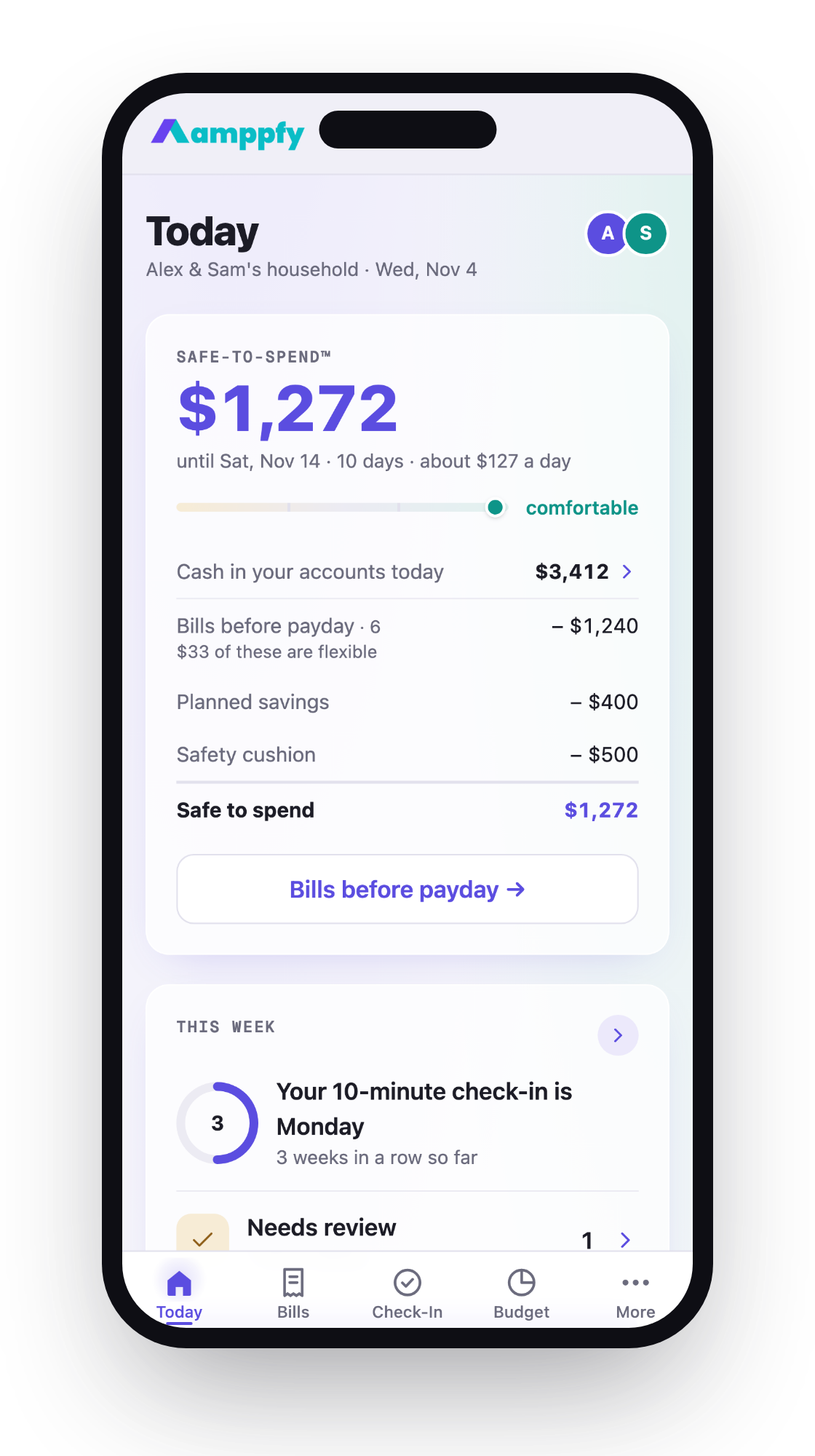
Whatever structure you pick, there’s still one daily question: what can we safely spend before payday? Amppfy answers it with a single Safe-to-Spend™ number. Here’s the math for a shared bill account:
- Available cash: $2,600
- Minus bills due before payday: $1,450
- Minus planned savings: $300
- Minus your chosen cushion: $200
- Safe-to-Spend™: $650
Each partner gets their own login and sees the same number. Private accounts stay private. You type in balances yourself, with no bank login. A ten-minute weekly check-in keeps it current.
For the joint-versus-separate decision itself, see bank accounts for couples: joint, separate, or both.
Comparing banks? Here is the list of online banks that offer joint accounts, with each bank’s own steps.
FAQ
Can an unmarried couple open a joint bank account?
Yes. Banks don’t require marriage for a joint account. Both of you apply, verify your identity, and become co-owners with equal access.
What happens to the money if my partner dies?
It depends on the title. With rights of survivorship, the money passes to you as the surviving owner. With tenants in common, your partner’s share goes to their estate. Without marriage, there’s no default inheritance rule to fall back on, so confirm the title with your bank.
Can my partner’s debt affect our joint account?
It can. A creditor of one owner can try to collect from the joint account. Keeping clear deposit records helps you show which money is yours. Keeping the joint balance close to shared bills limits what’s exposed.
Is our money insured if we’re not married?
Yes. FDIC coverage for joint accounts doesn’t depend on marriage. It’s $250,000 per co-owner at each bank, as of October 2026.
Joint bank accounts for unmarried couples work well when you set them up on purpose. The bank’s rules are the same for everyone. The difference is that your account title and agreement are doing the job marriage law would otherwise share. Check the survivorship title, keep the shared balance sized to shared bills, and agree on an exit plan while things are good.
Then make the day-to-day part easy. Take ten minutes this week to set up one shared number in Amppfy for couples. Two logins, one number, and your private accounts stay private.