

Two paychecks, one rent payment, and a grocery bill that nobody’s quite sure who covered. That’s usually the moment couples start looking at a shared account. If you both already bank with Bank of America, it feels like it should be simple. Mostly, it is.
The friction tends to show up in small places. Can you add your partner to the checking account you’ve had since college, or do you need a fresh one? Does someone have to visit a branch? What happens to the monthly fee? Who can close the account if things change?
This guide walks through those questions in order, using what Bank of America publishes about its own accounts. Every fee and policy line is marked as of October 2026, because banks update these pages. If the bank doesn’t publish a detail, you’ll see that said plainly rather than guessed at.
You’ll also find a short section on how couples use a joint account alongside separate ones, and one shared answer to “what can we spend this week?”
Joint accounts at Bank of America: what they are and who can be on one
A Bank of America joint account is a single deposit account with two or more owners. Each co-owner can get their own debit card and has equal standing on the account. Bank of America’s Deposit Agreement treats each co-owner as having full access to the money, not a share of it, “regardless of whose money is deposited in the account”[1].
That last point matters. A joint account isn’t split 50/50 behind the scenes. Either of you can spend the whole balance, as of October 2026.
Who can be on one:
- A spouse or partner. Marriage isn’t required. The Deposit Agreement says the bank may open an account “without regard to whether you are married” and regardless of the relationship between the owners, as of October 2026.
- A family member. A parent and adult child, or two siblings sharing household costs.
- More than two people. The agreement allows an account owned “jointly with one or more other persons,” though most couples keep it to two.
Each co-owner completes the bank’s account-opening process. The Deposit Agreement asks for the same identifying information from every owner of a joint account, including at least one government-issued photo ID and a tax ID or Social Security number, as of October 2026. That agreement[1] is the document to read if you want the exact legal wording.
Add a partner to an existing account vs open a new joint account
You have two paths. Both end with a shared account. They differ in time, paperwork, and history.
| Path | What it keeps | What it involves (as of October 2026) |
|---|---|---|
| Add a co-owner | Your account number, autopays, direct deposit, history | No online or in-app option; Bank of America says to schedule a financial center appointment with all owners present[2] |
| Open a new joint account | A clean slate both of you start together | Open at a financial center, or start online and check whether the application offers a second owner; every owner completes the account-opening process and provides ID |
Adding your partner to an existing account makes sense if it’s already the account your rent and utilities come out of. You skip re-routing every bill. The tradeoff: your partner gains full access to the balance and the account’s past statements.
Opening a new joint account makes sense if you’d rather keep your personal account as is. Many couples do exactly this. Your paycheck still lands in your own account, and you move a set amount into the shared one.
Step by step
The process depends on which path you picked. Here’s how each one runs, as of October 2026.
Adding a co-owner to an existing account
- Schedule an appointment. Bank of America’s account-ownership page says you need to schedule an appointment in a financial center to add or remove an owner, as of October 2026[2]. If you live far from one, the page says to call 800-432-1000.
- Bring both people. The page says all account owners need to be present, each with a valid government-issued photo ID. Owners who can’t attend must visit a financial center themselves to finish the process.
- Complete the account-opening process. The Deposit Agreement requires it of each co-owner.
- Ask about the new owner’s card and online access. The Deposit Agreement lets any co-owner obtain a debit card. Bank of America’s pages we checked don’t describe how the new owner enrolls in Online Banking, so ask the banker before you leave.
Bank of America does not publish a guaranteed turnaround time for a new card or online access. Ask the banker at the appointment.
Opening a new joint account
- Pick the account type. Advantage SafeBalance or Advantage Plus are the common choices (fees below).
- Start the application. Book a financial center appointment, or start online and look for a second-owner option. Bank of America’s pages we checked don’t say whether the online application supports a joint owner, as of October 2026.
- Enter both owners’ details. Name, address, date of birth, SSN, and ID for each person.
- Fund the account. Make the opening deposit.
- Ask about online access. Confirm with the banker how each owner gets into Online Banking.
If the online flow has no place for a second owner, a financial center appointment finishes the job.
What each of you can see, move, and close
This is the section worth reading twice. Under Bank of America’s Deposit Agreement, as of October 2026, each co-owner “acts as the agent of each other co-owner” and can use the account without the others’ approval[1]. The agreement’s own list includes:
- See: Either co-owner can obtain information about the account, including transactions made by the other.
- Move: Either co-owner can deposit funds and withdraw or transfer part or all of the money, and can obtain an ATM or debit card. No second approval is required.
- Deposit: Either co-owner can endorse for deposit a check payable to the other.
- Change: Either co-owner can add more co-owners, stop a payment the other requested, or pledge the account as security for a debt.
- Close: Either co-owner can close the account. Removing a co-owner is different: the agreement says the bank may require you to close the account to remove one.
One thing that isn’t shared: anything outside the joint account. If you also have a personal checking or savings account, your partner can’t see it unless they’re an owner on it too. Your own accounts stay your own.
There’s also a debt angle. The Deposit Agreement says the bank may use funds in a joint account to pay the debt of any account owner, under its right of set off, as of October 2026[1]. If one of you owes Bank of America money, that matters for what you keep in the shared account.
Fees, minimums, and waivers
Monthly maintenance fees are the same for joint and individual accounts. Here’s the small version.
| Account | Monthly fee (as of October 2026) | How to waive it (as of October 2026) |
|---|---|---|
| Advantage SafeBalance Banking | $4.95 | Waived when an account owner is under 25, you keep a minimum daily balance of $500 or more, or an owner is enrolled in BofA Rewards at the Preferred Plus, Preferred Honors, or Premier tier[3] |
| Advantage Plus Banking | $12 | Waived with at least one qualifying direct deposit of $250 or more, a minimum daily balance of $1,500 or more, or BofA Rewards enrollment at the Preferred Plus, Preferred Honors, or Premier tier[3] |
Those figures come from Bank of America’s Advantage Banking page, as of October 2026[3]. The Member tier of BofA Rewards doesn’t waive either fee. Check the page before you rely on a waiver, since thresholds change.
Two notes that help couples specifically. First, the waiver conditions are written per account, so one qualifying direct deposit into the joint account covers it, not one per owner. Second, if you add an owner under 25 to an existing account, the page says the under-25 waiver may take 3 business days to apply.
Twelve months at $12 is $144 a year. One qualifying direct deposit of $250 or more into the joint account takes it to zero.
SafeBalance has no paper checks. If your landlord still wants a check, Advantage Plus is the easier fit.
Joint, separate, or both: how couples actually use it
Opening the account is the easy part. Deciding what goes through it is the real conversation.
Most couples land in one of three setups:
- All joint. Both paychecks go into one account. Everything comes out of it. Simple, but it asks for a lot of trust and similar spending habits.
- All separate. No shared account. You split bills by Venmo or by taking turns. Low friction at first, harder to see the big picture.
- Hybrid. Each of you keeps a personal account. You each send a set amount into the joint account for shared bills. This is the most common middle ground.
The hybrid setup works well with plain numbers. Say rent is $1,900, utilities and internet run $250, and groceries are about $700 a month. That’s $2,850 in shared costs. If one partner earns $5,000 a month and the other earns $3,500, a proportional split looks like this:
- Partner A: 5,000 ÷ 8,500 = 59%, or about $1,680
- Partner B: 3,500 ÷ 8,500 = 41%, or about $1,170
Both of you pay the same share of your income.
If you’d rather not merge at all, that works too. This guide on budgeting as a couple with separate accounts walks through the separate approach step by step.
One number for two people
Here’s the gap a joint account doesn’t close. Two people can open the same banking app and see the same balance. Neither can say what’s actually safe to spend before payday.
The balance doesn’t know that the car insurance hits on the 14th. It doesn’t know you’re putting $200 toward a trip. It doesn’t know you’d both feel better keeping a $300 cushion.
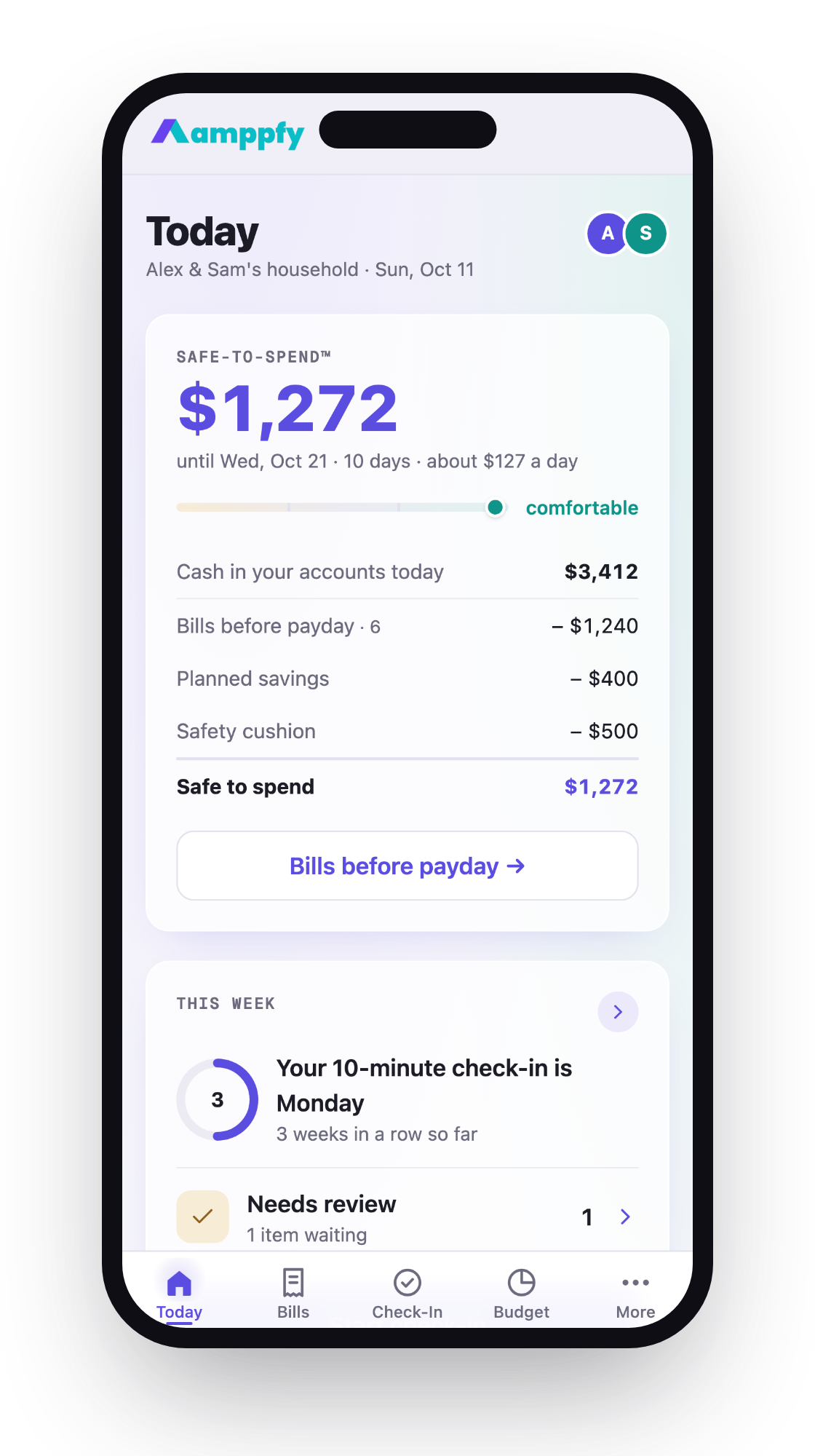
A Safe-to-Spend™ number answers that question directly. The logic is four lines:
- Available cash: what’s in the accounts right now
- Minus bills due before payday: only the ones that land before the next check
- Minus planned savings: goals you’ve committed to
- Minus a cushion: the buffer you picked
Example: $3,100 in checking, minus $1,240 in bills before payday, minus $200 for savings, minus $300 cushion. That leaves $1,360. That’s the number you can both glance at.
Amppfy is built around this idea for couples. Each partner gets their own login on iPhone or the web and sees the same number. Personal accounts stay private unless you choose to share them. You type in balances yourself (no bank login), and a weekly check-in takes about ten minutes. You can set it up with your partner here.
FAQ
Can I add my partner to my Bank of America account in the app?
Not as of October 2026. Adding a co-owner to an existing account is handled at a financial center. Book an appointment and go together, each with a valid government-issued photo ID.
Do we each pay a monthly fee on a joint account?
No. The fee applies once per account, as of October 2026. Advantage SafeBalance is $4.95 and Advantage Plus is $12 per month, and one owner meeting a waiver requirement waives it for the account.
Can my partner withdraw all the money without me?
Yes. Each joint owner has full access under Bank of America’s terms, as of October 2026. Either of you can withdraw or transfer the full balance without the other’s approval.
Can my partner see my personal accounts if we open a joint one?
No. They see only the accounts they own. Your individual checking and savings stay private under your own login unless you add them as an owner.