

You got the offer. You picked a start date. And then the math hit: your last paycheck from the old job lands this Friday, but your first paycheck at the new company won’t show up for three or four weeks. That gap between jobs can quietly drain a checking account if you don’t plan for it. The good news is that a few hours of prep this weekend can keep your bills paid, your savings intact, and your stress low while you settle into the new role.
Why the first check can take three to four weeks
Most people assume they’ll get paid within a week or two of starting. That’s rarely how payroll works. Your new employer runs payroll on a fixed schedule, and your start date almost never lines up with the beginning of a pay period.
Here’s a common scenario. You start on a Monday in the middle of a two-week pay period. You work the remaining days of that period, but the company needs another week to process payroll. Your first deposit lands roughly three weeks after your first day. If you started just after a pay-period cutoff, it can stretch to four weeks or more.
State laws set minimum pay frequency, but they don’t speed up your first cycle. California, for example, requires non-exempt employees to be paid at least twice per month[1], with wages earned from the 1st through the 15th due by the 26th. That’s the outer boundary, not a promise of a quick first check.
Some employers now offer Earned Wage Access programs that let you draw a portion of wages you’ve already earned. A December 2025 CFPB advisory opinion clarified that employer-integrated EWA programs aren’t treated as credit[2] under the Truth in Lending Act. That ruling has encouraged more companies to add EWA as a workplace benefit in 2026. Ask HR on your first day whether it’s available. If it is, you may be able to shorten the wait by a week or so.
Work out exactly how many days you need to cover
A vague sense of “a few weeks” isn’t enough. You need a specific number so you can build a specific plan.
Three Steps to Find Your Number
- Confirm your last paycheck date at the old job. Check whether it covers work through your final day or only through the prior pay period. If there’s unused PTO being paid out, note that date too.
- Ask your new employer two questions: what pay period does my start date fall in, and when does that period’s paycheck deposit? Get the exact date.
- Count the calendar days between your last incoming deposit and your first new one. That’s your gap.
Here’s what that looks like for a few common pay schedules:
| Pay Schedule | Typical Gap (Start Mid-Period) | Worst Case (Start Just After Cutoff) |
|---|---|---|
| Biweekly (every two weeks) | 18-21 days | 28 days |
| Semi-monthly (1st and 15th) | 14-20 days | 26 days |
| Weekly | 10-14 days | 14 days |
Once you have the number, write it down. Every decision in the next two sections depends on it.
Don’t Forget the Partial Check
Your first paycheck will likely be smaller than a normal one because it only covers part of a pay period. If you started halfway through a two-week cycle, expect roughly half your usual net pay. Plan for that partial check, not a full one.
Bills to move, bills to pause, bills to pay
Not every bill is equally urgent. Sort yours into three buckets so you can protect the essentials and buy yourself breathing room on everything else.
- Must pay on time: Rent or mortgage, utilities, insurance premiums, minimum debt payments. Late fees and credit hits aren’t worth the risk.
- Can shift the due date: Many credit card issuers let you move your due date once per billing cycle with a phone call. If your card is due on the 5th and your first check lands on the 12th, push the due date to the 15th.
- Can pause or reduce: Streaming services, gym memberships, subscription boxes. Cancel or pause anything with a monthly renewal that falls inside your gap. You can restart them later.
Call your student loan servicer, auto lender, or credit card company before a payment is due, not after. Most have a short-term hardship or payment-date adjustment option. A five-minute call now saves you a late fee and a ding on your credit report.
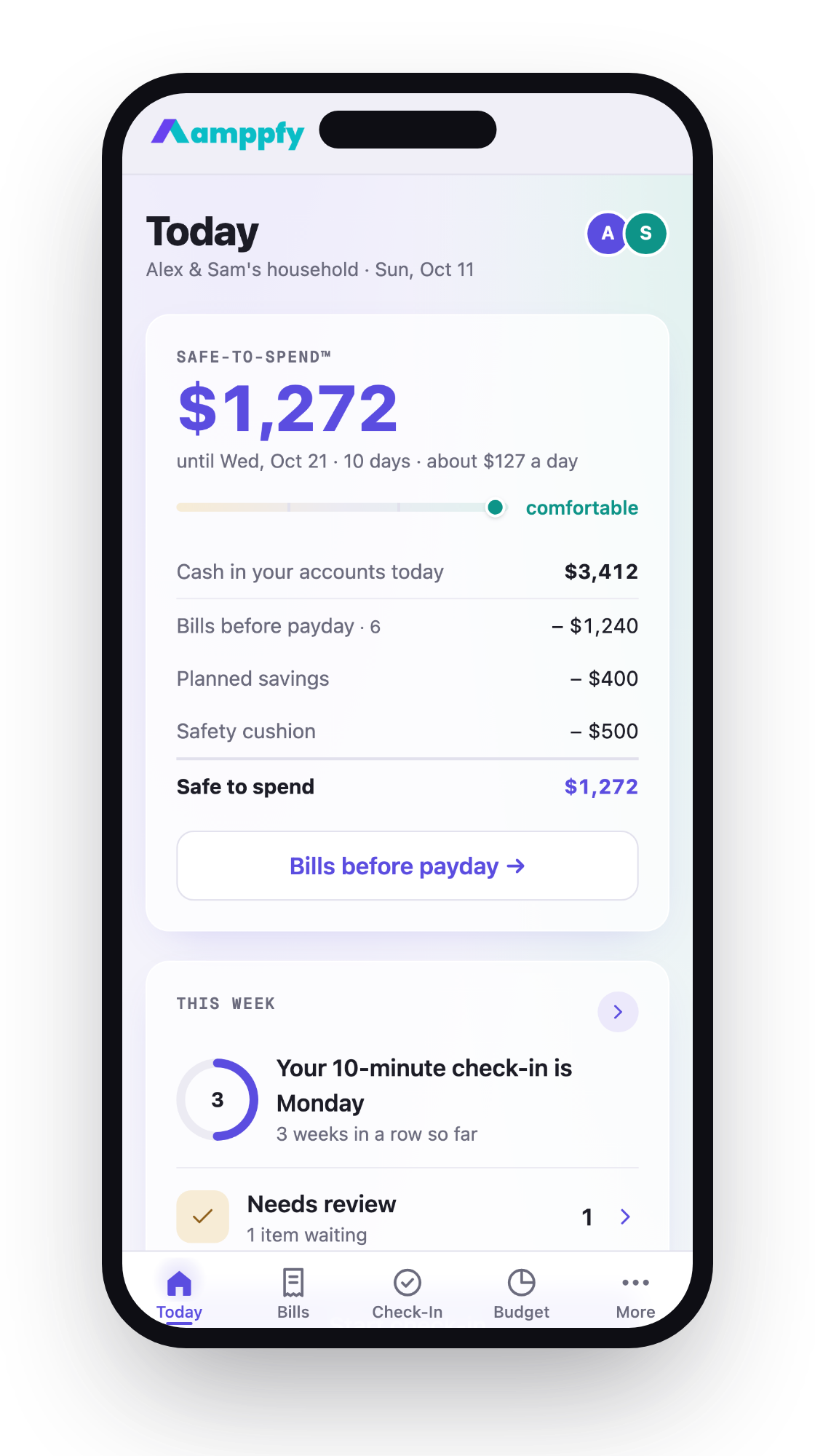
For subscriptions you’ve lost track of, a quick audit helps. Amppfy keeps a subscriptions list with next-charge dates, which makes it easy to spot charges that’ll hit during the gap and pause them before they draft.
A cushion plan for the gap
You’ve counted the days and sorted your bills. Now you need a plan to cover the difference between what’s going out and what’s coming in.
Build a Mini Cash-Flow Forecast
Write out every dollar leaving your account during the gap. Then list every dollar coming in: final paycheck, PTO payout, side income, anything. The difference is the hole you need to fill.
Here’s a worked example for a 21-day gap:
| Category | Amount |
|---|---|
| Rent (prorated or full) | $1,400 |
| Utilities and phone | $220 |
| Groceries (3 weeks) | $360 |
| Gas or transit | $150 |
| Insurance premium | $180 |
| Minimum card payment | $85 |
| Total out | $2,395 |
| Last paycheck (net) | $1,850 |
| PTO payout | $400 |
| Total in | $2,250 |
| Shortfall | $145 |
A $145 shortfall is manageable. A $1,200 shortfall requires a different set of moves. Knowing the number is the whole point.
Filling the Shortfall
- Trim discretionary spending for the gap period. Eating out, subscriptions, and impulse purchases are the fastest cuts.
- Sell items you no longer need. A weekend listing on a local marketplace can cover a few hundred dollars.
- Pick up short-term gig work if the gap is long and the shortfall is large.
- Use savings only as a last resort, and treat it as a loan to yourself: repay it from your second or third paycheck.
A 2026 Bankrate survey found that only 47% of Americans have enough savings to cover a surprise $1,000 expense[3]. If your shortfall is larger than your liquid savings, that’s not a personal failing. It’s the reason you’re planning ahead instead of reacting later.
One way to keep the picture clear during this stretch is to check a single number each morning: your Safe-to-Spend™. In Amppfy, that’s your available cash minus bills due before payday, minus planned savings, minus a cushion you set. The math looks like this: $2,250 cash – $2,395 bills – $0 savings goal – $0 cushion = -$145. Seeing that negative number early gives you time to shift a due date or pause a subscription before anything bounces.
What to do with the first check when it lands
Your first paycheck will feel like relief. Resist the urge to spend it all on the things you skipped during the gap. That check has a job to do.
Priority Order for Your First Deposit
- Cover any bills that are now due or past-shifted. Pay the credit card you moved to the 15th. Catch up on anything you delayed.
- Restock essentials. Groceries, gas, prescriptions: the basics you rationed.
- Repay your savings. If you pulled from an emergency fund, put it back before lifestyle spending creeps in.
- Restart paused subscriptions, but only the ones you actually missed. The gap might reveal a few you don’t need at all.
Remember, that first check is probably a partial one. Your second paycheck, the first full one, is where you can start building a normal rhythm. Use it to set up your recurring bills, savings goals, and a small cushion so you’re never caught off guard by a pay-cycle gap again.
If you’re starting fresh with a new pay schedule, take 10 minutes to enter your balances, bills, and paydays into Amppfy. It’ll show your Safe-to-Spend after every bill and every goal, so you always know what’s actually available.
Frequently Asked Questions
Can I ask my new employer for an advance on my first paycheck?
Some companies offer signing bonuses or payroll advances, but it’s not standard. Ask HR during onboarding. Frame it as a logistical question, not a financial emergency. If they offer an Earned Wage Access program, that’s a more structured way to access wages you’ve already earned without it being treated as a loan.
What if I have no savings and the gap is three weeks or longer?
Start by shifting every flexible due date past your first payday. Pause all non-essential subscriptions. Sell items you can part with. If you still come up short, contact your landlord and utility providers before the due date to ask about a brief extension. Most would rather work with you than start a collections process.
Should I use a credit card to cover the gap?
A credit card can bridge a small, short-term shortfall if you pay the balance in full once your check arrives. The risk is carrying that balance into the next month and paying interest. Set a hard limit on what you charge, and treat it as a bridge, not a buffer.
Does my old employer owe me a final paycheck right away?
It depends on your state. Some states require final wages within 72 hours of your last day. Others allow until the next regular payday. Check your state’s labor department website for the exact rule. If your employer is late, you may be entitled to waiting-time penalties.
Your New Paycheck Rhythm Starts Here
The gap before your first paycheck at a new job is temporary, but it can feel long when bills keep arriving. Count the days, sort your bills, build a mini forecast, and give your first deposit a clear priority list. That’s the whole playbook. Take 15 minutes this weekend to map it out, and you’ll walk into your first day focused on the work, not the checking account.