Most people spend hours comparing prices on a phone case but never question the date printed on a bill. That single number controls whether your checking account dips before your next paycheck or stays steady. Shifting a due date by even a week can stop the cycle of scraping by mid-month. The good news: many billers will move your date if you ask. Some let you do it online in under two minutes. This guide walks through which bills are flexible, what to say on the phone, and how to line everything up with your pay schedule so you stop white-knuckling the last few days before payday.
Why due dates matter more than amounts
A $150 electric bill isn’t a problem on the 20th if you get paid on the 15th. That same bill on the 2nd, five days before payday, is a different story. The date a bill hits your account determines whether you have enough cash or whether you’re floating on fumes.
Think of your checking account like a bathtub. Money flows in on paydays and drains out on due dates. When three or four bills cluster on the same day, the water level drops fast. Spread those drains across the month, and the level stays more predictable.
A 2024 CFPB report found that roughly 1 in 3 adults said they couldn’t cover a $400 unexpected expense without borrowing. That stat reflects a cash-flow timing problem as much as an income problem. People earn enough across the month but run dry in the wrong week.
Late payments also carry real costs. A single missed credit card payment can trigger a penalty APR above 29%. Utility companies tack on flat late fees of $10 to $25. These charges aren’t about how much you owe: they’re about when you pay.
Changing a bill’s due date removes the timing trap. You’re not earning more money. You’re just making sure the money you already earn is sitting in your account on the day each bill pulls out. That shift alone can eliminate late fees, reduce stress, and give you a clearer picture of what’s actually safe to spend between paychecks.
Bills that let you pick a date: utilities, cards, loans
Not every biller gives you the same flexibility. Here’s a quick breakdown of which bills typically let you adjust your due date and which ones don’t.
| Bill Type | Can You Change It? | How | Limits |
|---|---|---|---|
| Credit cards | Yes, almost always | Online account or one phone call | Usually once per 6-12 months |
| Electric / gas / water | Yes, most providers | Phone call or online chat | May only shift by a few days |
| Internet / cable | Yes, many providers | Phone call | Depends on billing cycle |
| Auto loans | Sometimes | Phone call to servicer | Lender-specific; may extend term |
| Mortgage | Rarely | Contact servicer | Grace period exists (usually 15 days) |
| Student loans (federal) | Yes | StudentAid.gov or servicer | Pick from a few date options |
| Rent | Rarely | Negotiate with landlord | Lease terms usually fixed |
| Insurance premiums | Sometimes | Call your agent or carrier | Depends on billing method |
| Subscriptions (streaming, apps) | Rarely | Cancel and re-subscribe on preferred date | Workaround, not a formal option |
Credit cards are the easiest to move
Most major issuers (Chase, Capital One, Citi, Discover, Amex) let you pick a new statement closing date, which shifts the due date accordingly. You can often do this through the app or website. The new date usually takes effect within one or two billing cycles.
Utilities vary by provider
Some municipal utilities let you choose from a handful of cycle dates. Others will only move your date by a few days. Call and ask. The worst they’ll say is no.
Mortgages and rent are the hardest
Your mortgage due date is typically the 1st of the month, with a grace period through the 15th. Landlords set rent dates in the lease. Neither is easy to move, so plan your other bills around these fixed anchors.
The one-call script
Calling a biller to change your due date doesn’t need to be complicated. Most customer service reps handle this request multiple times a day. Here’s a step-by-step approach that keeps the call under five minutes.
Before you dial
- Have your account number ready (check your last statement or the app).
- Know the exact date you want. Pick one that falls two to three days after a payday.
- Write down your current due date so you can confirm the change.
What to say
Use something close to this:
“Hi, I’d like to move my billing due date. I’m currently due on the [current date] and I’d like to switch to the [new date]. Is that something you can do today?”
That’s it. No long explanation needed. You don’t have to justify why. If the rep asks, “I’m aligning my bills with my pay schedule” is a perfectly clear answer.
What to expect after
- The rep may offer you a few date options rather than any date you want.
- Your next bill might be a short cycle (less than 30 days) or a long cycle (more than 30 days) to make the transition.
- Ask whether the change affects your minimum payment for the transitional period.
- Request a confirmation number or email.
One call, five minutes, done. If the company has an app or online portal, check there first. Credit card issuers especially have made this a self-service feature. Look under “Account Settings” or “Manage Billing.”
Lining up due dates with paydays
Once you know which bills are movable, the next step is deciding where to put them. The goal is simple: make sure money arrives before it leaves.
If you’re paid twice a month
Split your bills into two groups. Assign each group to land a few days after a payday. Here’s an example for someone paid on the 1st and the 15th:
- Bills due the 3rd-5th: mortgage/rent, car insurance, internet
- Bills due the 18th-20th: credit card, electric, phone, subscriptions
This keeps each paycheck from carrying the full weight of the month’s expenses.
If you’re paid biweekly
Biweekly pay (every two weeks) is trickier because your paydays shift. You’ll get two “extra” paychecks per year. Anchor your bills to the middle and end of the month, then use those bonus checks for savings goals or a buffer.
If you’re paid weekly
You have the most flexibility. Spread bills across each week so no single week feels heavier than the others.
The math check
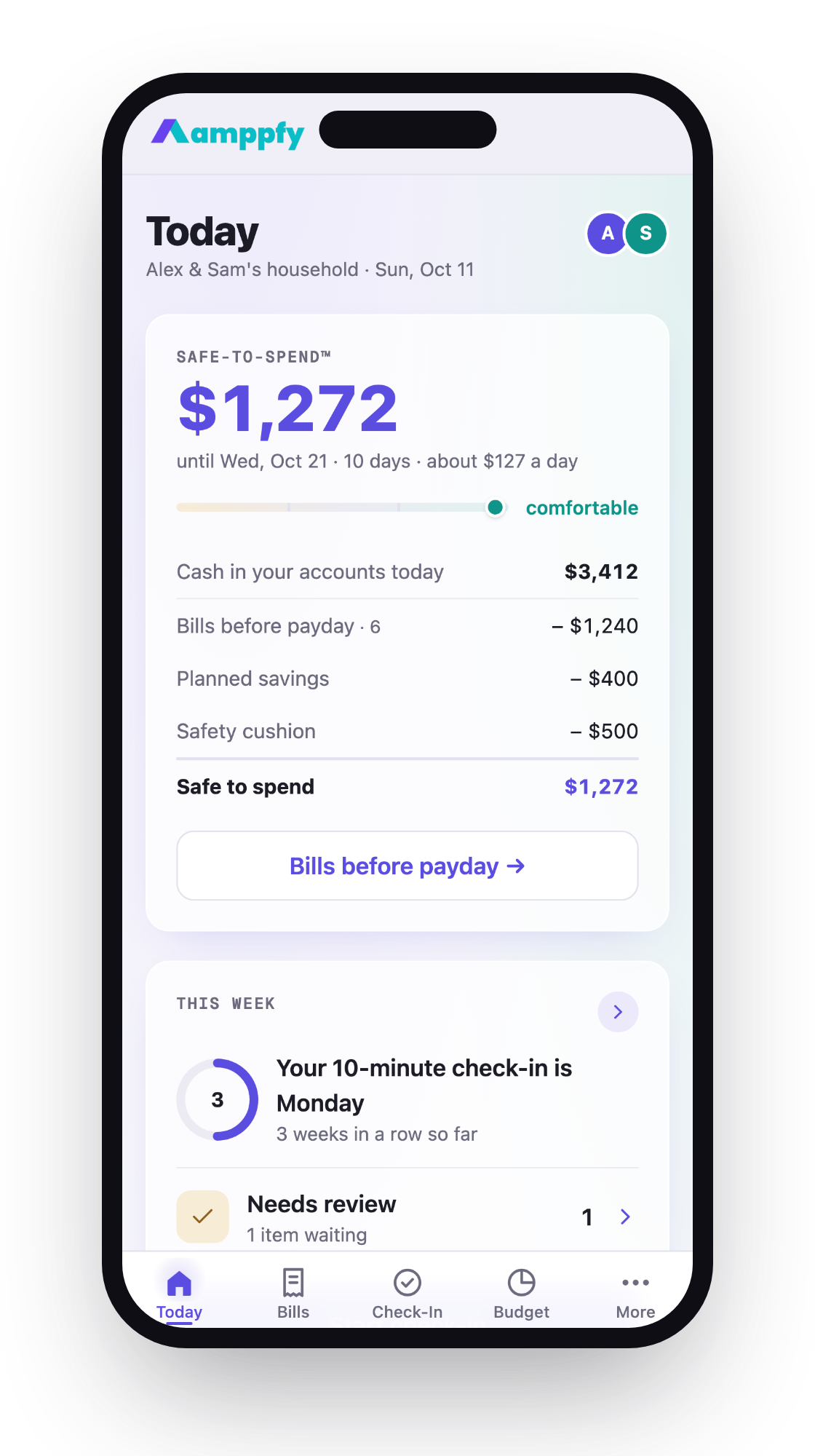
Run a quick test after you’ve chosen your dates. Take your checking balance on the day after payday, subtract every bill due before the next payday, subtract what you plan to save, and subtract a cushion for surprises. The number left is what you can actually spend.
For example: $3,412 cash − $1,240 bills − $400 savings − $500 cushion = $1,272.
That $1,272 is your real spending money. If you use Amppfy, this is the Safe-to-Spend™ number it calculates for you automatically. You enter your balances, bills, and paydays once, and the app keeps that number current between paychecks.
Rechecking the calendar after every change
Moving a due date isn’t a set-it-and-forget-it task. Things shift. You get a raise and your pay schedule changes. You refinance a loan. You add a new subscription. Each change can throw off the balance you worked to create.
Build a quick review into your routine. Once a month, open your calendar (digital or paper) and confirm that every bill still falls where you expect it. Look for clusters: if three bills land on the same day, see if one can move.
Watch for these common disruptions
- A new auto-pay subscription you forgot about
- A servicer transfer on your student loan or mortgage (the new company may assign a different date)
- A rate increase that changes the amount, making a previously manageable cluster feel tight
- Switching jobs, which almost always changes your pay dates
Keep a simple bill list
You don’t need a spreadsheet. A list on your phone works. For each bill, note three things: the name, the due date, and whether it’s on auto-pay. Update it whenever something changes. Amppfy’s bill list does this automatically and sends a heads-up the day before each bill, so nothing sneaks past you.
The real payoff of adjusting your bill dates shows up over months, not days. You stop paying late fees. You stop guessing whether your account can handle a grocery run on the 12th. You know what’s safe to spend because the math is clear and the timing works.
Frequently Asked Questions
Does changing my credit card due date affect my credit score?
No. Moving your due date doesn’t trigger a credit inquiry or change your account standing. Your payment history stays intact as long as you keep paying on time under the new schedule. The only thing that changes is when your statement closes, which can slightly shift the balance reported to credit bureaus that month.
How long does a new due date take to go into effect?
It depends on the biller. Credit card issuers typically apply the change within one to two billing cycles. Utility companies may adjust it by your next bill. Always ask the rep for the exact effective date and mark it on your calendar so you don’t miss a payment during the transition.
Can I change my bill due date more than once?
Most credit card companies limit changes to once every 6 to 12 months. Utility providers are generally more flexible but may not advertise it. If your pay schedule changes again (new job, for instance), call and ask. The worst outcome is they say you need to wait a few months.
What if my landlord won’t move my rent due date?
Rent is one of the hardest bills to shift because it’s locked into your lease. Your best option is to treat rent as a fixed anchor and move everything else around it. If rent is due on the 1st and you’re paid on the 15th, set aside half of each paycheck specifically for rent so the money is waiting when the 1st arrives.
Make the Timing Work for You
The bills you pay each month probably won’t change much. But the dates you pay them on are often more flexible than you think. One phone call or a few taps in an app can move a due date to match your paycheck. That small shift keeps your checking account steadier and removes the guesswork from daily spending.
Take 15 minutes this week. List your bills, note the dates, and pick the one or two that cause the most stress. Call or log in and ask for a change. Then plug your updated bills and paydays into Amppfy so you always see one clear Safe-to-Spend number: no math, no surprises, just the amount you can actually use before your next paycheck.