Your budget doesn’t fall apart on a good week. It falls apart on the week you’re running on four hours of sleep, your kid is sick, and you haven’t opened your bank app in days. Budgeting when burned out is the real test, and most systems fail it. The spreadsheet stays closed. The receipts pile up. The guilt compounds faster than any interest rate.
This piece is built for those weeks. Not the Sunday-afternoon-with-coffee weeks. The ones where you’re barely holding it together and still need to know whether you can cover groceries without dipping into rent money. A low-energy budget routine isn’t a lesser version of a “real” budget. It’s the only version that actually survives real life.
Why Tired Weeks Are When Money Slips
Fatigue changes how you make decisions. A 2024 Federal Reserve survey found that 37% of U.S. adults said they could not cover an unexpected $400 expense with cash or savings. That number doesn’t spike because people suddenly forget how money works. It spikes because stress and exhaustion erode the mental bandwidth needed to plan ahead.
Think about what happens during a burned-out week. You order delivery instead of cooking because you can’t face the kitchen. You forget a subscription renewed. You skip checking your account because the number might stress you out more. Each choice is tiny. Together, they can cost $100 to $300 in a single week.
The problem isn’t willpower. It’s friction. Traditional budgeting asks you to categorize transactions, reconcile accounts, and review spending across a dozen categories. That’s fine when you have energy. When you’re exhausted, it’s a wall. You don’t climb the wall. You walk away.
What Burnout Actually Costs You in Dollars
Here’s a quick example. Say your normal week includes $60 in packed lunches and home-cooked dinners. A burned-out week replaces those with $25 delivery orders, four times. That’s $100 versus $60: a $40 gap. Add a forgotten $15 streaming charge and a $5 convenience-store impulse buy, and you’ve leaked $60 without making a single conscious spending decision.
The goal isn’t to eliminate those leaks entirely. It’s to see them before they drain your next paycheck. That requires a system so small it works even when you don’t.
The Three Numbers to Look at and Nothing Else
Forget categories. Forget pie charts. When you’re running on fumes, you need exactly three numbers.
| Number | What It Tells You | Where to Find It |
|---|---|---|
| Cash available right now | Your checking balance, minus any pending charges | Your bank app, 10-second check |
| Bills still due before payday | The total of rent, utilities, insurance, and any other obligations hitting before your next deposit | A simple list you update once a month |
| What’s left after those bills | The actual money you can spend without bouncing something | Subtract bills from cash |
That third number is the only one that matters day to day. If you have $2,800 in checking and $1,900 in bills before Friday’s paycheck, you have $900 to work with. That’s it. One number. One decision filter.
Making the Math Even Simpler
You can refine that number by subtracting savings and a cushion. The formula looks like this:
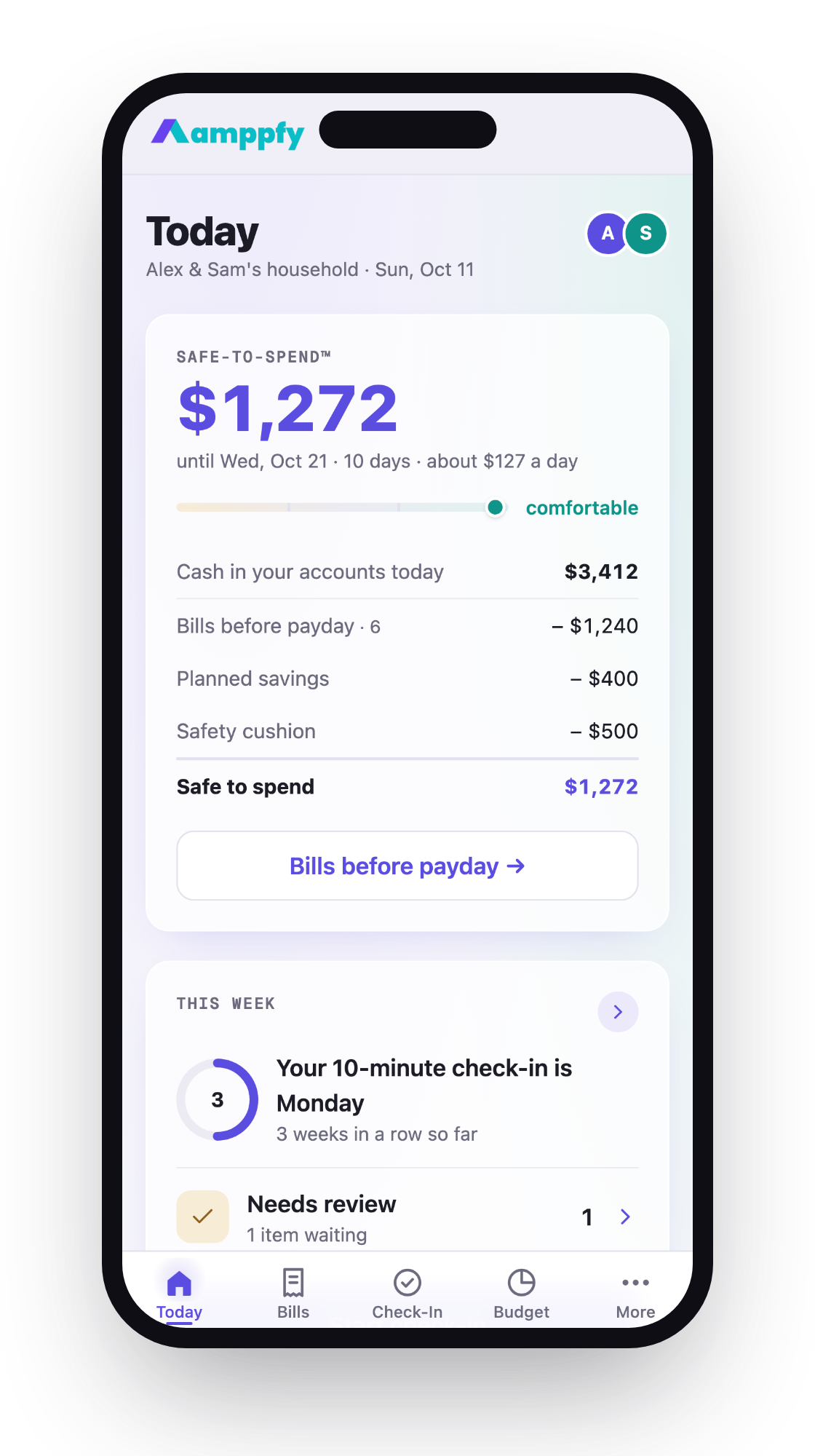
$2,800 cash – $1,900 bills – $200 savings – $200 cushion = $500 Safe-to-Spend™
Amppfy shows this math as a single number on your phone. You enter your balances yourself: about 30 seconds per account, no bank login required. The point is that you don’t need to categorize a single transaction. You just need to know what’s safe to spend before payday, and that number updates every time you punch in a balance.
Three numbers. One subtraction. That’s the entire intellectual load of your budget on a bad week.
A Five-Minute Version of the Weekly Check-In
A full budget review might take 30 minutes. You don’t have 30 minutes. Here’s what a five-minute version looks like, step by step.
- Open your bank app. Write down your checking balance. (60 seconds)
- Glance at pending charges. Subtract anything that hasn’t cleared yet. (60 seconds)
- Compare your adjusted balance to bills still due before payday. (60 seconds)
- Note your Safe-to-Spend number. Is it higher or lower than you expected? (30 seconds)
- If it’s lower, pick one thing to skip or postpone this week. (90 seconds)
That’s it. Five minutes. No spreadsheet. No transaction review. No guilt spiral.
When to Do It
Pick the day after payday. Your account is at its highest, and you can see the full picture for the pay period ahead. If you get paid every other Friday, your check-in is Saturday morning. Set a phone reminder. Make it boring and repeatable.
What to Skip When You’re Truly Wrecked
Some weeks even five minutes feels like too much. On those weeks, do only step one and step four. Check your balance. Compare it to your bills. If the number is positive, you’re okay for now. If it’s negative or close to zero, that’s your signal to freeze non-essential spending until payday. Two minutes. Two numbers. Done.
The weekly check-in at Amppfy is designed around this exact idea: 10 minutes on a normal week, but the core number is always visible without opening a single report.
Automating What Does Not Need a Decision
Every decision you automate is one less thing your exhausted brain has to process. Here’s what should run on autopilot.
- Bill payments. Set up autopay for every recurring bill with a fixed amount: rent, car payment, insurance, phone. Variable bills like electricity can autopay the minimum or average.
- Savings transfers. Schedule a transfer to savings the day after payday. Even $25 counts. The key is that it happens before you see the money as spendable.
- Subscription tracking. List every subscription with its next charge date. Cancel anything you haven’t used in 30 days. For the rest, knowing when they hit prevents surprises.
| Task | Automate? | Why |
|---|---|---|
| Rent / mortgage | Yes | Fixed amount, same date monthly |
| Car insurance | Yes | Fixed amount, predictable |
| Electric bill | Maybe | Varies by season; autopay average or budget billing |
| Savings deposit | Yes | Remove the decision entirely |
| Grocery spending | No | Varies too much; use your Safe-to-Spend number instead |
| Subscriptions | Autopay but review monthly | Prevents missed charges; the review catches creep |
The goal is to shrink the number of money decisions you make each week to as few as possible. Automated bills and savings mean your Safe-to-Spend number already accounts for obligations. You’re only deciding how to spend what’s genuinely left over.
A Note for Couples
If you share bills with a partner, automation matters even more. Two tired people forgetting the same bill is worse than one. Amppfy lets partners see the same Safe-to-Spend number with their own login, so neither person has to ask “did you pay the electric bill” at 11 p.m. on a Tuesday. The bill just pays itself, and the number reflects it.
Picking It Back Up After a Missed Week
You missed a check-in. Maybe two. Maybe a whole month. That’s not a failure. It’s just a gap. Here’s how to close it without turning it into a project.
Start with your current balance. Not last month’s. Not the week you missed. Right now. Open your bank app, look at the number, and write it down. That’s your starting point.
Next, list what’s due before your next paycheck. Rent, utilities, any bills with hard deadlines. Subtract those from your balance. You now have a working Safe-to-Spend number again. The whole reset takes under 10 minutes.
What You Don’t Need to Do
- You don’t need to go back and categorize old transactions.
- You don’t need to figure out where the money “went” last month.
- You don’t need to recalculate your annual budget.
All of that is useful during a high-energy week. None of it is necessary to regain control right now. The only question that matters after a gap is: what’s safe to spend between now and payday?
Preventing the Shame Spiral
Missing a week doesn’t mean the system is broken. It means you were tired. The best response is the smallest possible next step: check your balance, subtract your bills, and move on. A budget routine that survives burnout is one you can restart in two minutes without any cleanup.
Think of it like brushing your teeth. You don’t deep-clean the bathroom to make up for the night you skipped flossing. You just floss tonight.
Frequently Asked Questions
How do I budget when I’m too exhausted to think about money?
Strip your routine down to one number: cash minus bills due before payday. That’s your Safe-to-Spend. You can calculate it in under two minutes with just your bank balance and a list of upcoming bills. Skip categories, skip transaction reviews, skip anything that requires more than basic subtraction. On your worst weeks, this single number tells you whether you’re okay or need to pause spending.
What if I keep forgetting to do my weekly check-in?
Set a recurring phone alarm for the day after payday. Tie it to something you already do, like your morning coffee. If you still miss it, don’t try to catch up on multiple weeks. Just do the check-in for the current week. The routine only works if restarting it feels effortless, not like homework.
Should I cancel all my subscriptions when I’m burned out?
Not necessarily. Canceling everything in a reactive moment can create more hassle later when you re-subscribe. Instead, keep a simple list of subscriptions with their next charge dates. Cancel only the ones you haven’t used in the past 30 days. Review the rest during a higher-energy week. The point is awareness, not austerity.
Can budgeting when you’re burned out actually work long-term?
Yes, because a low-energy routine builds consistency. A 2023 CFPB report found that people who checked their finances regularly, even briefly, were more likely to catch billing errors and avoid late fees. The habit matters more than the depth. Five minutes every payday beats a two-hour session once a quarter that you dread and eventually stop doing.
Keep the Routine Smaller Than Your Worst Day
The only budget that works during burnout is one that asks almost nothing of you. Three numbers. Five minutes. One question: is my Safe-to-Spend number positive? Everything else, the categories, the goals review, the net-worth tracking, can wait for a week when you have the bandwidth.
Automate your bills. Schedule your savings. And when you miss a week, restart without looking back. Your budget doesn’t need to be perfect. It needs to be there when you’re not at your best.
If you want a tool built around this idea, Amppfy is free and shows your Safe-to-Spend number the moment you open it. Take 10 minutes this week to set it up at amppfy.com/app/ and give your tired self one less thing to figure out.