The first of the month hits different. Your last paycheck might have felt like a blur of bills and impulse buys, but today the calendar resets. That reset feeling isn’t just in your head: psychologists call it the “Fresh Start Effect,” and temporal landmarks like a new month create a psychological blank slate that boosts motivation[1] for pursuing goals. You don’t need to tear up your entire financial plan and start from scratch. A monthly money reset is smaller than that: it’s a quick recalibration that takes what’s working, drops what isn’t, and sets you up for the next 30 days. Think of it like adjusting your mirrors before a drive, not buying a new car.
What to Carry Forward and What to Let Go
Every month teaches you something if you’re willing to look. The trick is sorting the lessons from the noise. You don’t need a full post-mortem of every dollar. You need two short lists.
What to Keep
Look at what actually worked last month. Maybe you packed lunch three days a week and saved $60. Maybe you moved $200 into savings the day after payday and didn’t miss it. Those wins are your foundation. Write them down or just mentally note them, because they’re proof that your system has functional parts.
What to Release
Now look at what didn’t serve you. This isn’t about guilt. It’s about information. Maybe you signed up for a gym class pack you used once. Maybe you told yourself you’d call about that insurance rate and never did. Those aren’t failures. They’re data points telling you the plan was too ambitious or too vague for that particular month.
Here’s a simple way to sort it:
| Keep | Release |
|---|---|
| Habits that saved money without stress | Goals you set but never started |
| Automatic transfers that ran smoothly | Spending patterns that surprised you |
| Bills you paid on time | Workarounds that created more work |
The goal isn’t perfection. It’s momentum. Carry forward two or three things that worked. Release the rest without ceremony. You’ll set a fresh intention for those gaps in a later step.
Updating Balances and the Bill List
Your numbers from last month are stale. Balances shifted. Bills posted. Maybe a refund landed or a fee hit that you forgot about. The first thing your monthly reset needs is current data.
Refresh Every Balance
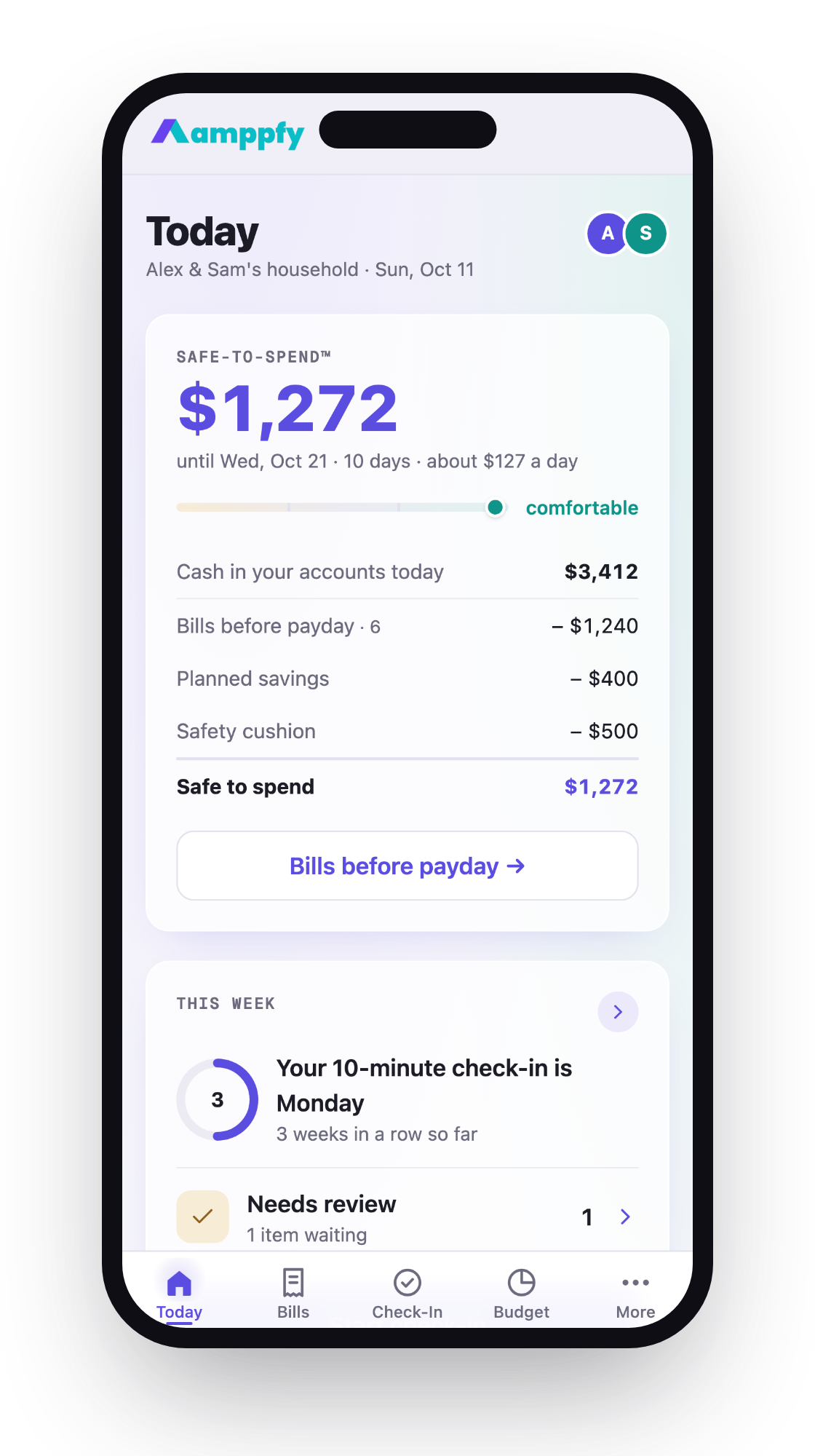
Open each account: checking, savings, credit cards, even that old PayPal balance. Write down what’s actually there right now, not what you think is there. This takes about 30 seconds per account if you’re just typing numbers into a tracker. Amppfy makes this step straightforward: you enter your balances yourself, and the app recalculates your Safe-to-Spend™ number on the spot. No waiting for a bank sync to catch up.
Rebuild the Bill List
Your bills aren’t static. A streaming service raised its price. Your car insurance renewed at a different rate. That annual domain registration you forgot about is due on the 18th. Go through your upcoming charges for the month and confirm three things for each:
- The correct amount
- The exact due date
- Whether it’s still on the right payment method
Research on managing multiple financial accounts shows that simplifying how you track distinct obligations can improve your decision-making[2] by a meaningful margin. A clean, current bill list reduces the mental load of wondering what’s coming next.
Once your balances and bills are current, you can see the real picture. Here’s what that math looks like: your total liquid cash minus upcoming bills, savings goals, and a cushion equals your Safe-to-Spend number. That single number tells you what’s actually available until your next paycheck.
Setting One Goal for the Month
Not three goals. Not five. One.
The instinct on the first of a new month is to overhaul everything. Pay off debt faster. Save more. Start investing. Cook every meal at home. That ambition is the Fresh Start Effect working overtime, and it burns out by the second week.
Pick one financial goal that matters most right now. Make it specific and time-bound. “Save more” is a wish. “Move $150 into savings on the 3rd and the 17th” is a plan. Research on goal-setting confirms that if-then planning is dramatically more effective than vague intentions[3] for actually hitting financial targets.
How to Frame Your One Goal
Use this format: “On [date], I will [specific action] of [specific amount] into/toward [specific destination].”
Examples that work:
- On July 3rd, I will transfer $200 from checking to my emergency fund.
- On July 15th, I will make an extra $75 payment toward my credit card.
- By July 31st, I will have spent under $400 on dining out.
Each of these is measurable. Each has a deadline. And each is small enough that it won’t collapse under the weight of daily life.
If you use Amppfy, your savings goals are built into the Safe-to-Spend calculation. That means the money earmarked for your goal is already subtracted before you see what’s available to spend. You can’t accidentally use it because the number already accounts for it.
One goal per month adds up to twelve meaningful financial moves per year. That’s more progress than most people make with a 47-line spreadsheet.
Clearing Old Subscriptions and Autopays
Subscriptions are the slow leak in most budgets. They’re small enough to ignore individually and large enough collectively to matter. The average American wastes roughly $21 per month on subscriptions they don’t actually use[4], and that number has been climbing. Over a year, that’s $252 gone for nothing.
The first of the month is the right time to audit these because most subscriptions bill on a monthly cycle. Catch them before they renew.
The Three-Question Subscription Test
For every recurring charge, ask:
- Did I use this in the last 30 days?
- Will I use it in the next 30 days?
- If it disappeared tomorrow, would I re-subscribe within a week?
If the answer to all three is no, cancel it. Don’t downgrade. Don’t pause. Cancel. You can always re-subscribe later if you genuinely miss it.
Where to Look
Your bank statement is the obvious place, but don’t stop there. Check these spots too:
- Apple or Google Play subscriptions (managed through your phone settings, not the app itself)
- PayPal recurring payments
- Annual charges that bill once a year and hide between monthly expenses
- AI tools: a new category worth watching, since many users now pay for multiple premium AI subscriptions averaging $66 per month across four tools
A quick pass through your subscriptions list with next-charge dates visible makes this audit faster. You see what’s coming, when it’s coming, and you can decide before the charge posts instead of after.
Autopay Hygiene
While you’re in there, check your autopay settings too. Confirm that each autopay is pulling from the account you expect, at the amount you expect. Credit card autopays set to “minimum payment” deserve a second look: is that still what you want, or did you mean to increase it?
A 20-Minute Reset Routine
Everything above sounds like a lot. It’s not. The whole process fits into 20 minutes if you do it in order and resist the urge to reorganize your entire financial life.
Here’s the routine, broken into four blocks:
| Block | Time | Task |
|---|---|---|
| 1 | 3 min | Review last month: note two wins, release what didn’t work |
| 2 | 5 min | Update all account balances and confirm upcoming bills |
| 3 | 4 min | Set one specific goal with a date and dollar amount |
| 4 | 8 min | Audit subscriptions and autopays, cancel what’s dead weight |
That’s it. Twenty minutes on the 1st, and you’ve given yourself a financial fresh start for the new month without blowing up what already exists.
Making It Stick
Put it on your calendar as a recurring event. The first of every month, 20 minutes. Pair it with something you already do: your morning coffee, the first quiet moment after the kids are in bed, your lunch break. Habit stacking works because it removes the decision of when to do it.
If you share finances with a partner, do this together or at least compare notes after. Two people looking at the same numbers catch things one person misses. The conversation doesn’t need to be long. “Here’s what I see. Here’s my one goal. Here’s what I canceled.” Five minutes of alignment saves hours of confusion later.
What This Routine Replaces
This 20-minute reset replaces the Sunday-afternoon budget marathon that nobody actually does. It replaces the anxious mental math at the checkout counter. It replaces the vague sense that money is leaking somewhere but you’re not sure where. You’re not building a new system each month. You’re tuning the one you have.
Frequently Asked Questions
What if I missed the 1st? Is it too late for a monthly money reset?
Not at all. The 1st is a convenient anchor, but the 5th or the 10th works just as well. The point is picking a consistent day each month and sticking with it. Your reset is about recalibrating, not hitting a deadline.
How is this different from traditional budgeting?
Traditional budgeting assigns every dollar a category and asks you to stay within limits all month. A monthly reset is lighter. You update your real numbers, set one goal, and clear out dead subscriptions. You’re working with what you actually have, not what a spreadsheet says you should have.
What if my partner and I disagree on the one goal?
Pick two: one each. Keep them small enough that they don’t compete for the same dollars. If they do compete, that’s a conversation worth having before the month starts, not after. The reset routine gives you a structured moment to have it.
Should I do anything between monthly resets?
A quick weekly check-in helps. Spend about 10 minutes updating your balances and scanning for surprises. The monthly reset sets direction. The weekly check-in keeps you on course.
Your Next First of the Month
A fresh start with your money doesn’t require a new app, a new spreadsheet, or a new philosophy. It requires 20 minutes, honest numbers, and one clear goal. The calendar gives you twelve of these resets per year. Use the next one.
If you want a tool that makes the balance-updating and bill-tracking steps faster, Amppfy is free and built for exactly this kind of monthly routine. Grab your coffee on the 1st, open your accounts, and give yourself 20 minutes. That’s all it takes to start the month knowing exactly where you stand.