You’ve done it before. You see something online, your thumb moves faster than your brain, and the package arrives before you’ve even thought about whether you needed it. That quick hit of excitement fades, and what’s left is a charge on your card that quietly chips away at your paycheck. A simple impulse buying rule can interrupt that cycle: wait 48 hours before you buy anything unplanned. It sounds almost too basic, but that short pause creates space for a real decision. The rest of this piece breaks down why the wait works, how to check it against your actual money, and when it’s fine to skip the rule entirely.
Why waiting changes the decision
Your brain treats a good deal the same way it treats a slice of cake. The reward circuits light up, urgency kicks in, and logic takes a back seat. Retailers know this. Limited-time banners, countdown timers, and “only 2 left” warnings all push you toward a fast yes.
The 48-hour rule works because it targets that urgency directly. Once two days pass, the emotional charge around the purchase drops sharply. You’re no longer reacting to a sale ending or a social media ad that caught you mid-scroll. You’re just a person looking at a product description and a price tag.
Here’s what typically happens during those 48 hours:
- Hour 0-4: The want feels intense. You might add the item to your cart or screenshot it.
- Hour 12-24: The initial excitement fades. You start thinking about whether you already own something similar.
- Hour 24-48: You either forget about it entirely or decide it’s genuinely worth the money.
A 2024 survey published by Slickdeals found that American consumers reported spending an average of roughly $314 per month on impulse purchases. That’s nearly $3,800 a year on things that weren’t planned. Even cutting that number in half by pausing before buying puts real money back in your pocket.
The rule doesn’t ask you to say no. It asks you to say “not yet.” That distinction matters. Restriction feels like punishment. A short pause feels like common sense. And two days is long enough to break the emotional grip without being so long that you forget about things you actually need.
Checking the purchase against what is left before payday
Waiting 48 hours is step one. Step two is checking whether the purchase fits your actual financial picture right now, not last month, not in theory, but today.
This is where most people get stuck. They check their bank balance, see a number that looks fine, and buy. But that balance doesn’t account for the electric bill hitting Thursday or the car insurance auto-pay next Tuesday. The number in your bank app is not the number you can safely spend.
The one-line math check
Before you buy, run this quick subtraction:
| Component | Example |
|---|---|
| Cash in accounts | $3,200 |
| Minus bills due before payday | -$1,100 |
| Minus planned savings | -$300 |
| Minus safety cushion | -$400 |
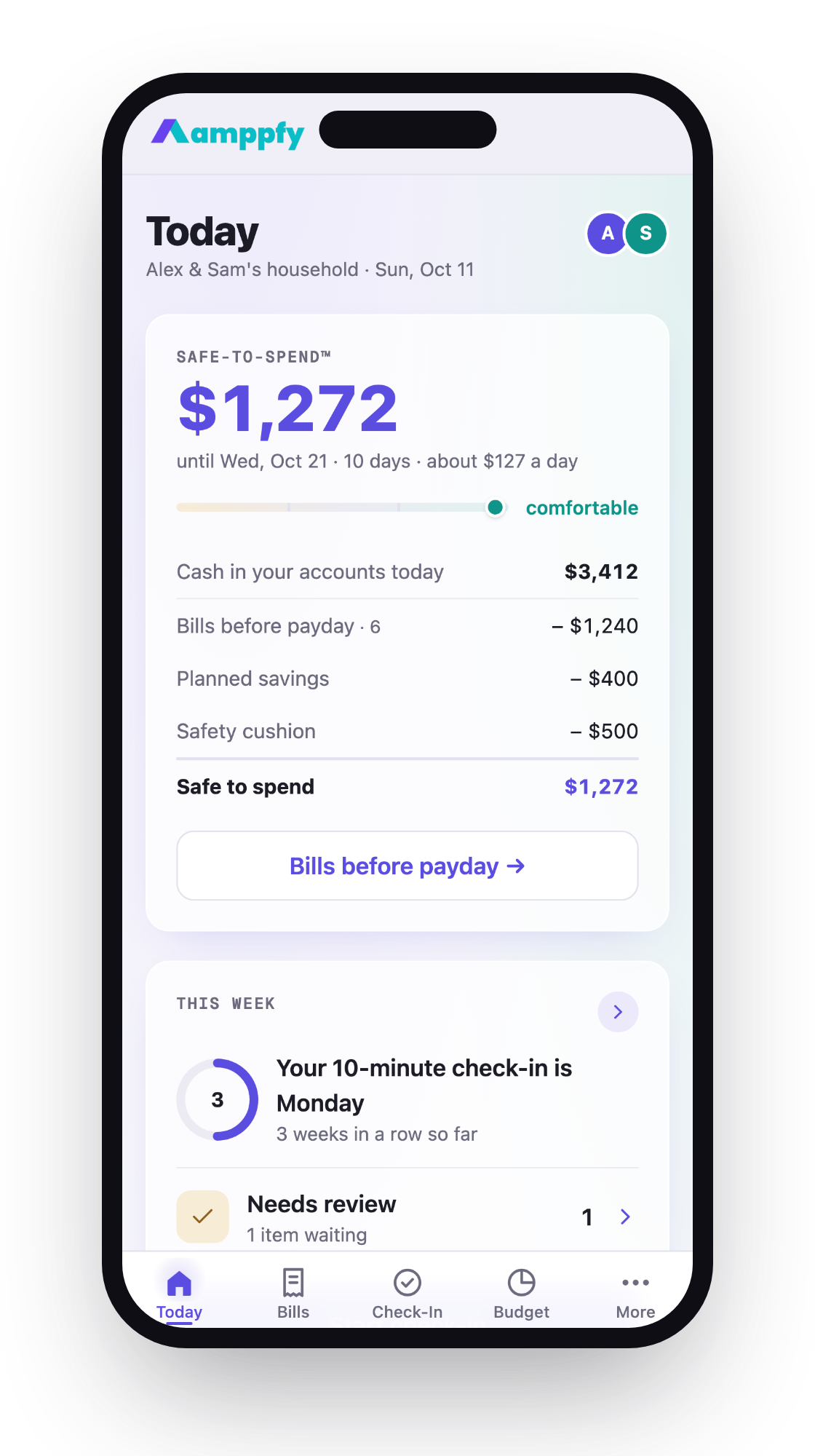
| = What’s actually available | $1,400 |
So if you’re eyeing a $250 jacket after your 48-hour wait, you can see it fits. But if that available number is $180, the jacket doesn’t work this pay cycle, no matter how good the deal is.
Making the check take 30 seconds, not 30 minutes
The reason people skip this step is friction. Nobody wants to open a spreadsheet and add up bills manually every time they want to buy something. Amppfy’s Safe-to-Spend™ number does this math for you automatically: your cash minus upcoming bills, savings, and a cushion you set. One glance tells you whether a purchase fits before payday. You can set it up in about ten minutes and keep it current with a quick weekly check-in.
The point isn’t to build a complicated system. The point is to answer one question fast: “Can I actually afford this before my next paycheck?” If the answer is yes, buy with confidence. If not, the item goes on a wishlist.
A wishlist that keeps wants visible
Telling yourself “I’ll remember it later” almost never works. Either you forget and miss something you genuinely wanted, or the unresolved desire nags at you until you give in. A wishlist solves both problems.
The key is making it dead simple. Use whatever tool you’ll actually open: a note on your phone, a bookmarks folder, or even a running list on paper stuck to your fridge. The format doesn’t matter. Consistency does.
What to capture on each entry
Keep each wishlist item to three pieces of information:
- Item and price: “Noise-canceling headphones, $179”
- Date added: So you can see how long it’s been sitting there
- Why you want it: One sentence, like “Current earbuds hurt after 30 minutes”
That “why” line is the most useful part. When you review the list in a week or two, some reasons will still feel solid. Others will look thin. “Because the ad was cool” doesn’t hold up the way “my current one is broken” does.
Review the list on payday
Payday is the natural moment to look at your wishlist. You know your fresh balance. You know your bills. Pick one or two items that still matter and that fit your available cash. Cross off anything that’s been sitting there for a month with no pull. That’s your answer: you didn’t actually want it.
This approach turns buying into a deliberate choice instead of a reaction. You’re not depriving yourself. You’re choosing the things that matter most to you and letting the rest go.
When to buy without waiting
Rules need exceptions, or people abandon them. The 48-hour guideline isn’t meant for every single transaction. Some purchases deserve a quick yes.
Here’s a practical breakdown of when to skip the wait:
| Skip the 48-hour wait when… | Still wait when… |
|---|---|
| It’s a genuine need: groceries, medicine, a flat tire | It’s a “need” you just discovered via an Instagram ad |
| The price is under your threshold (e.g., under $15) | The price is low but you’re buying five low-price items at once |
| You’ve already planned and budgeted for it | You’re rationalizing it as “basically the same” as something you budgeted for |
| It’s a time-sensitive replacement (broken phone for work) | The “urgency” is a sale ending, not a real deadline |
Set a personal dollar threshold below which the rule doesn’t apply. For many people, that’s somewhere between $10 and $20. A $4 coffee doesn’t need a 48-hour deliberation. A $400 coffee machine does.
The other exception is planned purchases. If you’ve had “new running shoes” on your wishlist for three weeks and you find a pair you like, you’ve already done the waiting. The rule served its purpose. Buy them.
Being honest with yourself is the only hard part. If you find yourself inventing exceptions every other day, the rule isn’t the problem. The pattern is worth examining. A quick look at your Safe-to-Spend number before each purchase keeps you grounded without turning every buying decision into a debate.
Making the rule a habit
Knowing about the 48-hour rule and actually using it are two different things. The gap between them is habit design.
Start with one category
Don’t try to apply this rule to everything at once. Pick your weakest spot. For some people, it’s online shopping after 9 PM. For others, it’s home décor stores or tech accessories. Apply the rule only there for two weeks. Once it feels automatic, expand.
Use friction to your advantage
Remove saved payment methods from your most-visited shopping sites. Turn off one-click purchasing. Delete shopping apps from your phone’s home screen. Each extra step between impulse and purchase gives your brain time to catch up with your thumb.
Pair the pause with a quick check
Every time you add something to your cart and walk away, check your available cash. This two-step combo, wait then check, becomes a single habit over time. You stop thinking of them as separate actions.
Track your wins
Keep a simple note of purchases you skipped after waiting 48 hours. After a month, add up the dollar amounts. Seeing “$620 not spent” written down reinforces the habit more than any motivational quote. That’s real money that stayed in your account, available for things that actually matter to you.
The first two weeks are the hardest. After that, the pause starts to feel normal. You’ll notice the urge, acknowledge it, and move on. The goal isn’t perfection. It’s catching yourself more often than you miss.
Frequently Asked Questions
Does the 48-hour rule work for online sales that expire in 24 hours?
Most “limited-time” sales come back. Retailers cycle promotions constantly. If a deal truly expires and you miss it, a similar one will appear within weeks. The money you save by avoiding ten impulse purchases far outweighs the one deal you might miss. If the sale is real and the item has been on your wishlist, that’s a planned purchase, and you can skip the wait.
What if my partner and I have different spending habits?
This is common and completely workable. Agree on a shared dollar threshold for the rule, say $25 or $50, and let each person handle purchases below that however they like. For larger amounts, both of you check the same available-cash number before buying. Amppfy lets partners see the same Safe-to-Spend figure while keeping individual account balances private, which removes the “checking up on each other” tension.
Is 48 hours the right amount of time, or should I wait longer for big purchases?
Forty-eight hours works well for everyday impulse buys under a few hundred dollars. For bigger purchases, like furniture, electronics over $500, or travel, consider a longer cooling-off period: one week per $500 is a reasonable guideline. A $1,500 laptop gets three weeks of consideration. That extra time lets you compare options and confirm the purchase fits your goals.
How is this different from a strict budget?
A traditional budget assigns every dollar to a category. This rule doesn’t require categories at all. It’s one simple behavior change: pause, then check your available cash. You can use it alongside a budget or completely on its own. The simplicity is the point. Most people who quit budgeting apps did so because the upkeep was too much. One rule with one number is easier to maintain.
Turn the Pause Into a Pattern
The 48-hour rule costs nothing and takes almost no effort. Wait two days. Check what you can actually spend. Buy with clarity or walk away without guilt. That’s the entire system.
Your impulse buying habit didn’t develop overnight, and it won’t disappear overnight either. But each time you pause, check your number, and make a deliberate choice, you’re building a pattern that protects your paycheck. Start this week: pick one category, remove a saved payment method, and give yourself 48 hours before the next unplanned purchase. If you want a single number that tells you what’s safe to spend before payday, Amppfy is free and takes about ten minutes to set up at amppfy.com/app/.