You’ve done the math a dozen times, and it still doesn’t add up. Your semester refund or monthly allowance hits your account, you cover a few things, and then you’re scraping by with two weeks left. You’re not careless. You’re just working without a system that fits the way college money actually arrives and leaves. This guide gives you a budget structure built for the uneven cash flow of student life: one that keeps a college student from running out of money before the month ends. Every step takes minutes, not hours.
Why student money runs out early: lump sums and loose dates
Most budgeting advice assumes a steady paycheck every two weeks. Student income doesn’t work that way. You might get a financial aid refund once a semester, a monthly transfer from family, and a part-time paycheck on a different cycle. Those sources land on different dates, in different amounts, and your brain treats a fat deposit like a windfall.
That’s the core problem: lump-sum thinking. A $4,800 semester refund feels like $4,800 of spending power. But spread across 16 weeks, it’s $300 a week. That reframe changes everything.
The second issue is loose dates. Your phone bill hits on the 3rd. Your transit pass renews on the 12th. Groceries happen whenever you’re hungry. Without fixed timing, your money gets spent in the order things pop up, not in the order they matter.
Here’s what typically happens:
- Week 1: Refund lands. You stock up on supplies, maybe eat out a few times.
- Week 2: A subscription renews. You buy something you’ve been eyeing.
- Week 3: Groceries feel tight. You start skipping meals or borrowing.
- Week 4: You’re stuck until the next deposit.
This pattern isn’t a character flaw. It’s a timing mismatch between when money arrives and when bills come due. Fixing the timing fixes most of the stress.
Turning a semester refund or monthly allowance into a weekly number
The single most useful thing you can do is convert every income source into a weekly amount. This gives you a number you can actually feel and compare against your weekly spending.
How the math actually works
Start with your total income for the period, then divide by the number of weeks it needs to cover.
| Income Source | Amount | Period | Weekly Equivalent |
|---|---|---|---|
| Semester refund | $4,800 | 16 weeks | $300/week |
| Monthly family transfer | $600 | ~4.3 weeks | $140/week |
| Part-time job (biweekly) | $480 | 2 weeks | $240/week |
If you receive all three, your combined weekly number is about $680. That’s your starting point, not your spending limit.
Subtract fixed costs first
Pull out the bills you know are coming. Phone, transit pass, streaming, any loan payment. Add those up for the month, divide by four, and subtract from your weekly number.
Example: $680/week − $45 phone − $30 transit − $15 subscriptions = $590/week before food and flexible spending.
That $590 is closer to reality than the $4,800 lump sum ever was. Write it on a sticky note. Put it on your laptop. This is the number that keeps you solvent through the 30th.
Set a weekly cash envelope (even if it’s digital)
Transfer your weekly amount to a separate checking account or just note it as your weekly cap. Spend from that number only. When it’s gone, the week is over. This approach turns a vague semester budget into something concrete you can check every morning.
Covering phone, transit, and food before anything else
Not all spending categories carry equal weight. Missing a phone payment can trigger a late fee. Running out of groceries means you skip meals. A new hoodie can wait.
Rank your expenses into three tiers:
- Non-negotiable bills: Phone, transit, medications, minimum loan payments. These have due dates and consequences.
- Essential variable costs: Groceries, laundry, basic toiletries. You control the amount, but you can’t skip them entirely.
- Everything else: Eating out, entertainment, clothes, impulse buys.
Your weekly number from the previous section should cover tiers one and two with room left over. Tier three gets whatever remains.
A realistic food budget
According to the USDA’s June 2025 Thrifty Food Plan, the low-cost monthly grocery estimate for a single adult is roughly $290. That’s about $73 a week. You can hit that number with batch cooking, store brands, and a short weekly grocery list.
A practical weekly grocery run might look like this:
- Rice or pasta (bulk): $3
- Canned beans and vegetables: $8
- Eggs (18-count): $5
- Frozen chicken or ground turkey: $12
- Bread: $3
- Bananas, apples, carrots: $8
- Milk or oat milk: $4
- Peanut butter: $4
- Seasoning and cooking oil (amortized): $3
That’s about $50, leaving $23 of your grocery budget for variety or a single meal out. The point isn’t deprivation. It’s knowing the floor so you never go without.
Transit and phone: automate or calendar them
Set your phone bill and transit pass to auto-pay if you can. If auto-pay feels risky because your balance fluctuates, put the due dates on your phone calendar with a reminder two days before. That two-day buffer gives you time to move money around if needed. Apps like Amppfy can send you a heads-up the day before a bill so nothing sneaks past you.
Part-time paychecks on top of aid: how to combine them
Mixing aid money with job income creates a common trap: you mentally separate them. The refund feels like “school money” and the paycheck feels like “fun money.” That split leads to spending your paycheck freely while your refund covers bills, leaving you short on both fronts.
Combine everything into one weekly number instead.
Step-by-step: merging income streams
- List every income source and its schedule (semester, monthly, biweekly, weekly).
- Convert each to a weekly amount using the table method above.
- Add them together for your total weekly income.
- Subtract your weekly fixed costs (phone, transit, subscriptions, loan minimums).
- Subtract a weekly savings target, even if it’s just $20.
- What’s left is your Safe-to-Spend.
Here’s a worked example:
$680 weekly income − $90 fixed bills − $20 savings − $50 cushion = $520 Safe-to-Spend
That $520 covers groceries, laundry, social spending, and anything else. If you spend $490 one week, the extra $30 rolls into next week’s cushion. If you spend $550, you know immediately you need to pull back.
What about irregular paychecks?
If your hours vary, use your lowest recent paycheck as the baseline. A week where you earn more becomes a bonus, not an expectation. This protects you from budgeting around a best-case scenario that doesn’t always happen.
The 2023 Federal Reserve Survey of Household Economics found that 37% of adults couldn’t cover an unexpected $400 expense with cash. As a student, building even a small cushion puts you ahead of that statistic. Start with $50 set aside and grow it when you can.
A ten-minute Sunday check-in for busy weeks
You don’t need an hour-long spreadsheet session. You need ten minutes on Sunday evening before the week starts. That’s it.
The check-in routine
- Open your bank app. Write down your current checking balance.
- List any bills due this week and their amounts.
- Subtract those bills from your balance.
- Subtract your savings contribution for the week.
- The remaining number is what you can spend through Saturday.
This five-line exercise takes less time than ordering coffee. Do it while your laundry runs or between study sessions.
What to do when the number is tight
Some weeks, your Safe-to-Spend will be uncomfortably low. That’s information, not failure. When the number is small, you have a few moves:
- Cook every meal from what’s already in your kitchen.
- Skip any subscription you can pause for a month.
- Pick up an extra shift if your schedule allows.
- Push a non-urgent purchase to next week.
The key is knowing early. A tight week discovered on Sunday is manageable. A tight week discovered on Thursday is stressful.
Making the check-in stick
Pair it with something you already do. If you meal-prep on Sundays, do your money check-in while water boils. If you plan your class schedule on Sunday night, add five minutes for finances. Habit stacking works because you’re not creating a new routine from scratch.
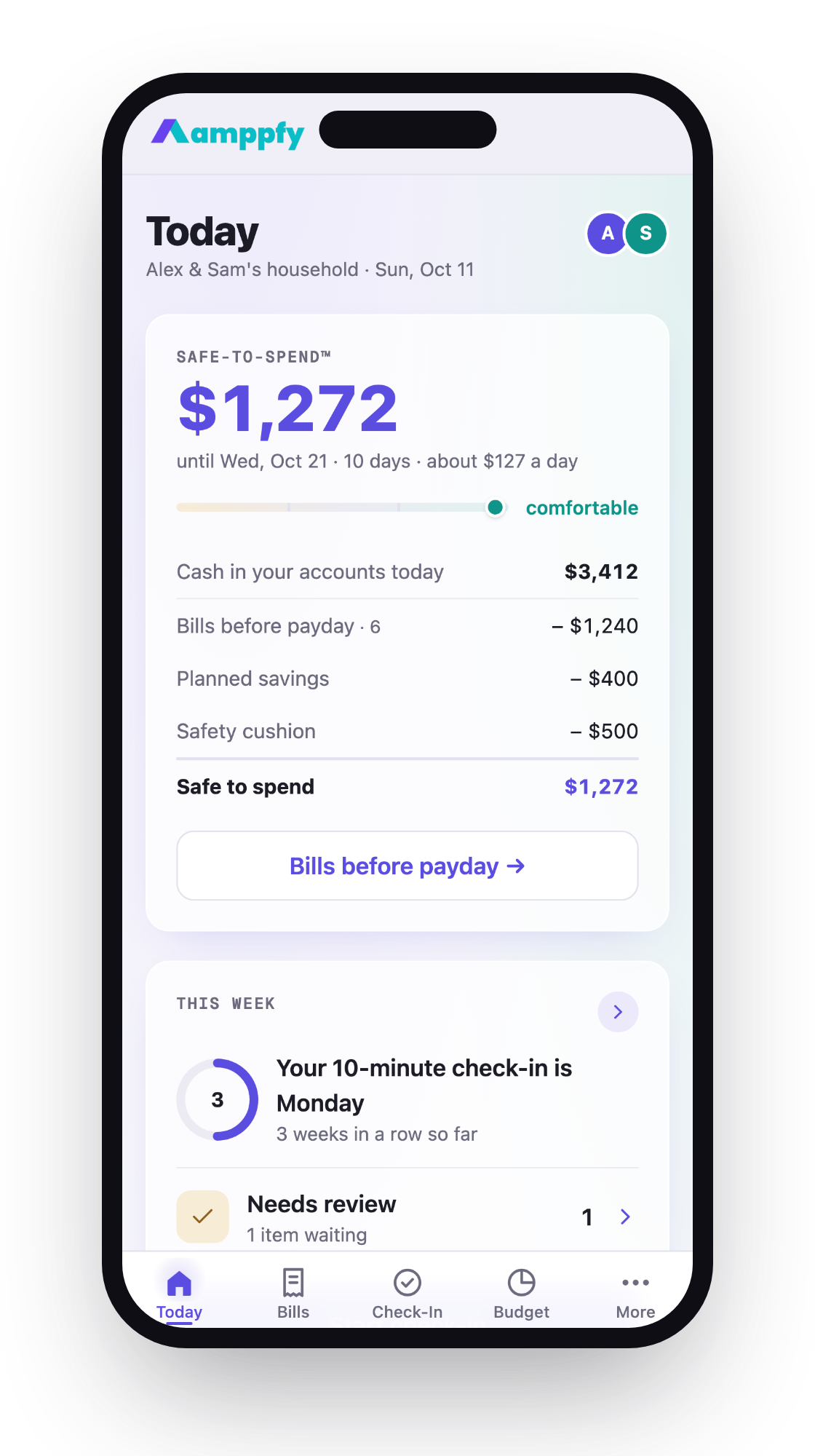
Amppfy’s weekly check-in is built around this same idea: update your balances in about 30 seconds per account, and the app shows your Safe-to-Spend for the days until your next deposit. No spreadsheet required.
Frequently Asked Questions
How much should a college student budget per week?
It depends on your location and lifestyle, but a reasonable starting point is $100 to $150 for variable expenses like food, transportation, and personal items after fixed bills are covered. Use the weekly conversion method above to find your actual number based on your real income and real obligations.
What’s the fastest way to stop running out of money mid-month?
Convert your total monthly or semester income into a weekly spending limit and check your balance every Sunday. Most students run short because they spend from a large lump sum without tracking how fast it shrinks. A weekly cap makes the problem visible before it becomes urgent.
Should I use a credit card to cover gaps between deposits?
Only if you can pay the full balance when your next deposit arrives. Carrying a balance at 20%+ interest turns a timing problem into a debt problem. A better approach is building a small cushion of $50 to $100 that acts as your personal float between deposits.
How do I budget when my work hours change every week?
Use your lowest recent paycheck as your baseline budget. Treat any extra earnings as bonus money that goes toward savings or your cushion. This way, a slow week doesn’t wreck your plan, and a busy week gives you breathing room.
Keep your money past the 15th
Running out of money before the month ends isn’t about willpower. It’s about structure. Convert lump sums to weekly numbers. Pay fixed bills first. Know your grocery floor. Combine all income into one weekly figure. Check in for ten minutes on Sunday.
These five steps take less time than most assignments and pay off every single week. If you want a tool that does the weekly math for you, Amppfy is free and shows your Safe-to-Spend number with the math printed right underneath: no bank login needed, just your balances typed in once. Take ten minutes this Sunday and set it up at amppfy.com/app/ so next month, you’re still eating on the 28th.