

Payday is circled on your calendar, and you’re refreshing the USAA app before breakfast. Rent is due Friday. The car payment comes out Monday. You just want to know when the money arrives and whether you can count on it.
That question has a calm answer. It isn’t a fixed clock time, though. USAA direct deposit time depends on your employer or paying agency, the calendar, and how ACH payments move between banks. Once you see how those pieces fit, the morning refresh becomes a single glance.
This guide covers what USAA publishes about early pay, what it doesn’t, and how military pay dates fit in. It also explains why a deposit can sit as pending and what to do if payday passes with nothing posted. The last section covers the most useful part: what to do with the money once it lands.
Every USAA policy detail below comes from USAA’s own published pages, as of October 2026. Where USAA doesn’t publish a specific time or date, this guide says so plainly. It doesn’t guess.
What time USAA posts direct deposits
USAA does not publish a specific posting time for direct deposits, as of October 2026. You won’t find “12:01 a.m.” or “6 a.m. Eastern” on its support pages. Any exact hour you see quoted elsewhere is someone’s observation, not a USAA commitment.
What USAA does explain is the trigger. Early availability depends on when the payer sends payment notice to USAA. That is generally one to two business days before the scheduled payment date.
Think of it like a package tracking notice. USAA can’t hand you the box until the sender ships it. The sender also has to tell USAA the box is coming.
Here’s what “early” means in practice:
- Scheduled payment date: The day your employer or agency says you get paid.
- Notice date: The day the payer’s file reaches USAA. This is often one to two business days earlier.
- Early deposit: USAA may make the funds available once it has that notice, rather than holding them until the scheduled date.
So the deposit lands when it lands. It isn’t set to a clock. If your employer sends its payroll file on Tuesday for a Friday payday, you might see it Wednesday. If it sends the file Thursday, early access shrinks or disappears. The timing is set upstream, by the payer.
Does USAA pay early? The policy as published
Yes, with conditions. As of October 2026, USAA’s direct deposit page says you’ll get your paycheck up to 2 days early, and its list of eligible paychecks includes wages from an employer, payroll, or the military. Its fine print says early access is not guaranteed, may be stopped at any time, and may vary between pay periods. The same page ties the timing to when the payer sends notice.
That “up to” matters. Two days is the ceiling, not the average or a promise. Some pay periods you’ll see funds two days ahead. Others, one day. Sometimes the money arrives on the scheduled date itself.
Military members often ask whether USAA posts a calendar of early pay dates. As of October 2026, USAA’s direct deposit setup page does not list specific early military pay dates. It states the “up to 2 days” policy and the payer-notice condition, and that’s it.
Plan around the official payday, then. Here’s the logic in steps:
- Find your official payday. Use your employer’s pay calendar or your service’s published schedule.
- Treat early money as a bonus. If it shows up Wednesday, great. Don’t schedule a bill for Wednesday because of it.
- Set bill dates on or after the official payday. Then early access gives you breathing room, not a dependency.
Bank-led early direct deposit is generally a feature of the account itself. That’s different from separate earned wage access products, which can carry their own costs. Check any fee directly with the provider before you use one.
Weekends, holidays, and the first deposit from a new employer
Calendars shift deposits more than anything else. A payday on a Saturday doesn’t mean Saturday money.
For active duty, paydays fall on the 1st and 15th. When either lands on a weekend or federal holiday, pay moves to the business day before. For retirees, DFAS’s pay schedule says retired pay is due on the 1st of the month; when the 1st falls on a weekend or holiday, retirees are paid on the last business day of the prior month, and annuitants on the first business day after[1].
Both schedules can stack with USAA’s early access. Say the 15th is a Sunday. The official payday moves to Friday the 13th. Early access, if the notice arrives in time, could land funds a day or two before that. For a fuller walkthrough of budgeting around these dates, see this guide on military pay dates and bills around the 1st and 15th.
Your first deposit from a new employer
The first paycheck is the one most likely to arrive late or by paper check. New payroll setups take time. Your employer has to enter your routing and account numbers, and some payroll systems run a test transaction first.
Plan for your first deposit to land on the official payday, or later. Don’t count on early access until you’ve watched one or two cycles come through. After that, you’ll know your employer’s rhythm.
Why a deposit shows as pending
You open the app and see the deposit, but it’s labeled pending. That’s a normal step, not a problem.
Pending means USAA has received information about an incoming payment, but it hasn’t fully posted to your balance yet. It’s like seeing a delivery truck in your driveway before the driver knocks. The package is there. It just isn’t in your hands.
USAA doesn’t publish the exact hour a pending deposit becomes posted, as of October 2026. What you can watch for in the app:
- Pending line: The deposit appears, often with a pending tag. Treat it as on its way, not spendable.
- Available balance: This is the figure that reflects what USAA will actually let you use right now.
- Posted transaction: The pending label drops off. The deposit is part of your balance.
The safe habit is simple. Spend from your available balance, not from a pending line. If a bill pulls before the deposit fully posts, the pending amount may not cover it.
One practical move: if you have a bill set to auto-pay on payday morning, shift it one day later. It costs nothing. It removes a timing question you’d otherwise have to sweat every two weeks.
What to do if payday passed and nothing landed
It’s the evening of your official payday. No deposit, not even pending. Take a breath. Missing deposits usually trace back to a short list of causes, and most are fixable in a phone call.
Work through this in order:
- Confirm the date. Check your pay calendar again. Was payday moved for a weekend or holiday? Is this your first check from a new employer?
- Check for a pending line. Scroll your transaction list, not just the balance. Pending items sometimes sit below the fold.
- Verify your account details with the payer. A single wrong digit in a routing or account number sends money astray. Ask payroll or your finance office to read back what they have on file.
- Ask the payer when they sent the file. If notice reached USAA late, the deposit will be late. USAA can’t post what it hasn’t received.
- Contact USAA. Once you’ve confirmed the payer sent it, USAA can check for an incoming payment on its end.
While you wait, protect the next few days. List any bills due before the money arrives. Call those billers and ask to move the date a day or two. Many will, especially if you call before the due date, not after.
Military families facing pay disruptions, like a government shutdown, should check USAA’s site directly for any member relief programs. Use only what’s published there for current terms.
The deposit landed. What is actually safe to spend?
Your $2,400 paycheck shows as posted. That number feels like permission. It isn’t.
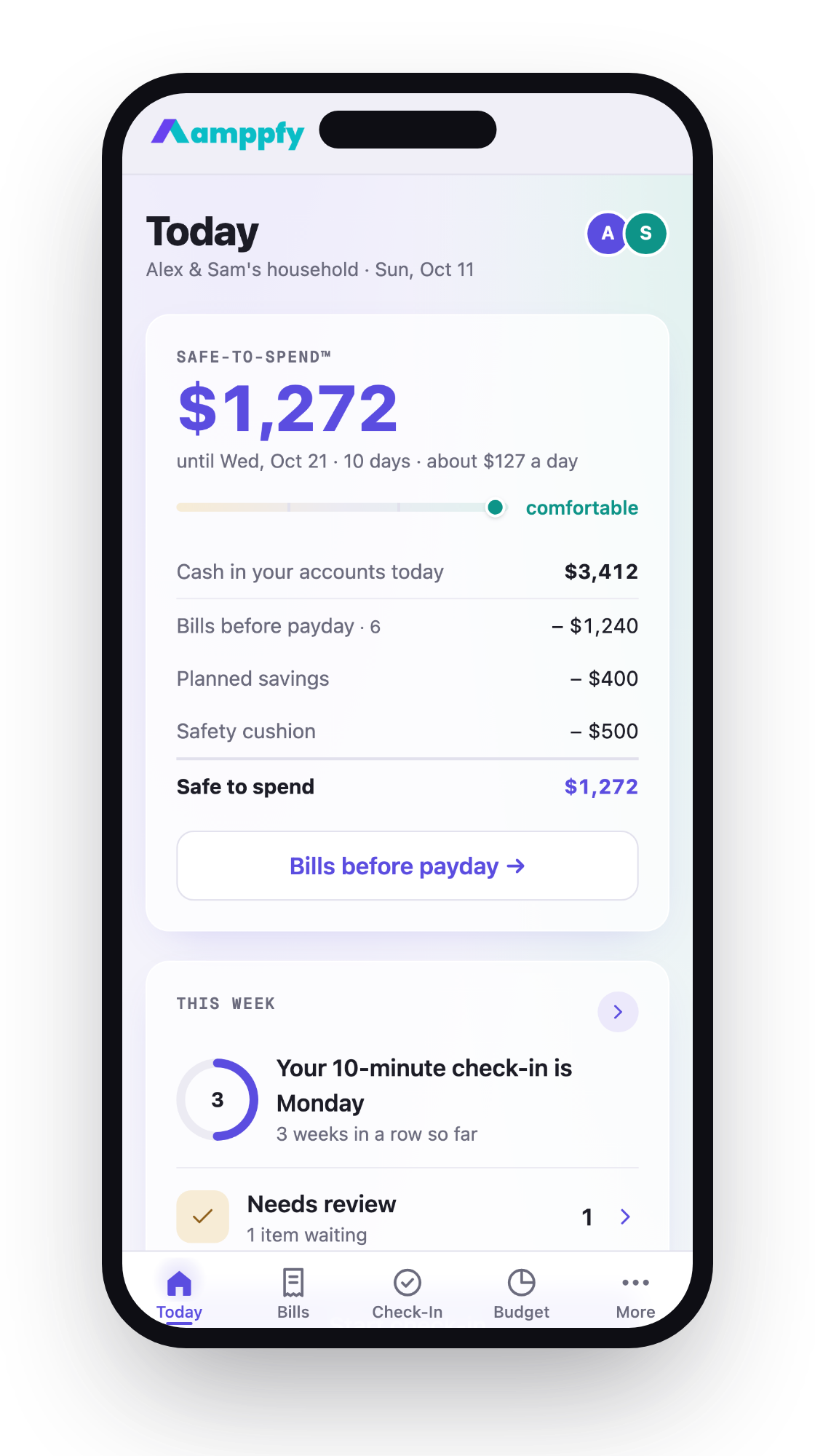
A balance tells you what’s in the account. It doesn’t tell you what’s already promised to someone else. This is where your Safe-to-Spend™ figure comes in: the part of your balance with no job assigned to it yet.
How the math actually works
Safe-to-Spend™ = Available cash − Bills due before next payday − Planned savings − Cushion
Here’s that with real numbers:
| Line | What it is | Amount |
|---|---|---|
| Available cash | Posted balance after the deposit | $2,400 |
| Bills before next payday | Rent share $900, phone $65, car insurance $135, streaming $50 | −$1,150 |
| Planned savings | Transfer to emergency fund | −$200 |
| Cushion | Buffer you choose for surprises | −$150 |
| Safe-to-Spend™ | What’s left for groceries, gas, life | $900 |
That $900 is the honest number. Groceries, gas, and a dinner out come from there.
Notice the date boundary. Only bills due before your next payday count. A bill due in three weeks, after another paycheck arrives, waits for that paycheck. This keeps the math focused on the next two weeks, not the whole month at once.
Run this once, and it takes about ten minutes. Run it each payday, and it takes less. Early deposits just mean you can do the arithmetic a day or two sooner.
FAQ
What time does USAA direct deposit hit on payday?
USAA doesn’t publish a specific posting time, as of October 2026. Funds can arrive up to 2 days early, depending on when your payer sends notice to USAA. Plan around your official payday.
Does USAA post early military pay dates?
As of October 2026, USAA’s direct deposit setup page doesn’t list specific early military pay dates. It states that military pay can arrive up to 2 days early, and that this isn’t guaranteed.
Why did my deposit come early last time but not this time?
Early access depends on when the payer sends notice, generally one to two business days before the scheduled date. If your employer or agency sends its file later, the early window shrinks. That variation is normal, and it’s why the best USAA direct deposit time to plan around is the official payday itself.
Can I spend a pending deposit?
Treat pending money as not yet spendable. Use your available balance as the guide, and schedule bills on or after the official payday so a pending line never decides whether a payment clears.
Early deposits are a nice cushion, not a plan. The plan is what happens next. Once the money lands, your balance isn’t what’s safe to spend. Bills due before the next payday come out first. Then planned savings. Then a cushion you choose. What’s left is yours, with nothing quietly spoken for.
If you’d rather not redo that subtraction by hand every payday, Amppfy does it for you. You type in your balances and bills, and it shows one Safe-to-Spend™ number with the four-line math printed underneath. Partners can see the same number while private accounts stay private. It’s free on iPhone and the web.
Take ten minutes before your next payday. Enter your balances, list the bills due before the following paycheck, and see your number. Try Amppfy free.