

Payday is circled on your calendar. Rent, the car payment, and a streaming renewal are all lined up behind it. You open the PNC app at 6 a.m. and want one answer: is the money there yet?
The short answer is that the bank publishes a general window, not an exact minute. Below is what PNC actually says about posting, what its Early Pay feature promises and doesn’t, and how to handle the gaps. It covers weekends, holidays, and a first paycheck from a new job.
You’ll also see why a pending deposit isn’t always spendable, and what to do if payday comes and goes with nothing. Every policy detail here comes from PNC’s own published pages or from the rule-making body for ACH payments. Where PNC doesn’t publish a specific time, you’ll see that stated plainly instead of a guess.
The goal is simple. You should be able to glance at your account on payday, know what you’re looking at, and decide calmly what comes next. No refreshing the app every ten minutes.
What time PNC posts direct deposits
PNC’s direct deposit page says funds are available when deposited, usually midnight on your payday (as of October 2026). That’s the whole published answer on PNC direct deposit timing. PNC does not publish a more specific posting hour, such as 2 a.m. or 4 a.m. If you see a precise time quoted elsewhere, it isn’t coming from the bank.
“Usually” matters in that sentence. It means most deposits are ready as the calendar flips to your payday. It doesn’t mean every deposit will be.
Your employer also plays a part. Payroll sends an electronic file through the ACH network ahead of payday. Under current ACH rules, receiving banks must make standard (non-Same Day) ACH credits available by 9:00 a.m. local time on the settlement date[1] (as of October 2026). That gives you a useful outer boundary.
So here’s the practical read:
- Midnight on payday: when PNC says funds are usually available
- 9:00 a.m. local time on payday: the industry deadline for standard ACH credits
- Anything earlier: possible through Early Pay, covered next
“Early” at PNC means before the settlement date your employer set. It doesn’t mean a fixed time on the night before.
Does PNC pay early? The policy as published
Yes, with conditions. PNC describes Early Pay in its personal account agreement[2], the fine print for checking accounts (the current version is effective September 20, 2026). Here’s what the policy says, as of October 2026:
- How early: up to 2 business days before the payor (typically your employer or its payroll provider) transfers the funds to PNC
- Enrollment: automatic if you, your account, and your direct deposits are eligible; you can opt out at any time
- Ramp-up: enrollment may take up to one to two pay cycles to take effect after you set up direct deposit
- Guarantee: none; Early Pay is never guaranteed, may vary between pay periods, and PNC may stop it at any time without notice
- Limits: eligible deposits (generally payroll, pension, and government benefit payments sent by ACH) may be subject to a maximum dollar limit
Two phrases in that list are worth your attention. “Up to” means anywhere from zero to two business days. “Not guaranteed” means one paycheck can arrive early while the next one arrives on the regular date.
PNC’s agreement also says that for interest-bearing accounts, interest on Early Pay funds starts accruing on the day they’re credited, not the official settlement date (as of October 2026). On a typical checking balance, that difference is small. It’s still a nice detail to know.
The smart move is to treat early money as a pleasant surprise. Plan your bills around the actual payday, not the earliest possible one. If Early Pay shows up, you’ve gained breathing room. If it doesn’t, nothing breaks.
Weekends, holidays, and the first deposit from a new employer
ACH payments settle on business days. Weekends and federal bank holidays don’t count. When your scheduled payday lands on one of those days, the employer’s payroll calendar decides what happens next.
Most employers shift payday to the business day before a weekend or holiday. Some shift it to the business day after. PNC doesn’t control that choice, so check your pay schedule or ask HR. Early Pay counts in business days too, so a Monday holiday can affect how early funds appear.
The first paycheck at a new job
Expect your first deposit to be the least predictable one. A few things can slow it down:
- Setup timing: payroll may need a full cycle to activate your direct deposit. Your first check might come as a paper check or pay card.
- Prenote tests: some employers send a $0 test transaction first, which can delay the real one.
- Early Pay ramp-up: PNC says Early Pay may take one to two pay cycles to begin (as of October 2026).
A simple fix: for the first month, plan as if the money lands on payday morning and not a minute before. Once you’ve seen two deposits arrive, you’ll know your real pattern. That pattern beats any general rule.
Why a deposit shows as pending
A pending deposit is like a package marked “out for delivery.” It’s on its way, but it isn’t on your porch yet. PNC knows the money is coming, but it hasn’t fully posted to your available balance.
Pending items can show up when the payroll file arrives before the settlement date. PNC’s funds availability policy also sets a cut-off of 10:00 p.m. ET: an electronic deposit received after that time, or on a day that isn’t a business day, counts as received on the next business day[2] (as of October 2026).
Here’s the distinction that matters:
- Current or ledger balance: may include pending items
- Available balance: what you can actually spend right now
When a debit card purchase or a bill comes out, the available balance is what counts. If your paycheck is still pending, don’t schedule a payment against it. Wait until it moves into available funds.
For a longer explanation of how pending items behave on both sides of your account, see this guide on how long pending transactions take and how to plan around them. The short version: let pending money finish posting before you count it.
What to do if payday passed and nothing landed
It’s 10 a.m. on payday and your balance hasn’t moved. Take a breath. This is usually a fixable paperwork problem, not a crisis. Work through these steps in order. Most take five minutes or less.
- Check the calendar. Was today a federal holiday? Did your employer move payday for a weekend?
- Look for a pending item. Open your account activity, not just the balance at the top.
- Pull your pay stub. Confirm the deposit date and the last four digits of the account it went to.
- Verify your numbers. Compare the routing and account numbers on file with payroll against PNC’s direct deposit details.
- Contact payroll first. They can confirm the file was sent and give you a trace or transaction date.
- Then contact PNC. Bring the date, amount, and employer name so the bank can search for it.
The most common cause is a typo or an old account number. A missed setup on a new job comes second. Both are fixed on the employer side.
While you wait, protect what’s already scheduled. Check which bills draft in the next few days. If any would hit before the money arrives, move the payment date or call the biller. Most billers will work with you if you call before the due date.
The deposit landed. What is actually safe to spend?
The full deposit just hit. Your balance looks great. It isn’t all yours to spend yet, though.
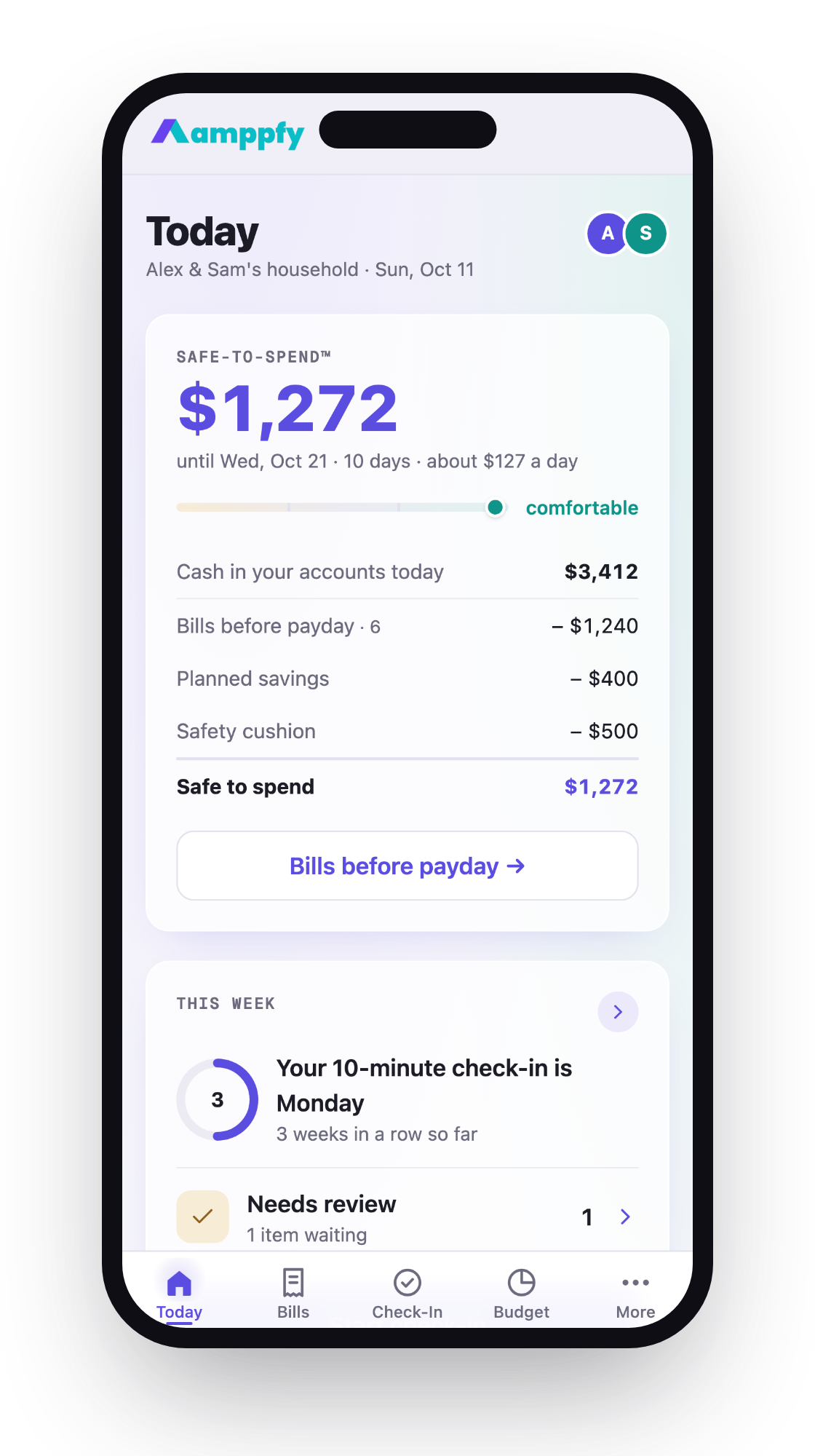
Your Safe-to-Spend™ amount is smaller than your balance, and the gap is simple arithmetic. Here’s the formula:
Safe-to-Spend™ = available cash − bills due before next payday − planned savings − cushion
Walk it through with real numbers. Say your balance after the deposit is $3,200.
| Line | What it is | Amount |
|---|---|---|
| Available cash | Balance after the deposit posts | $3,200 |
| Bills before next payday | Rent $1,400, car $380, phone $85 | −$1,865 |
| Planned savings | Transfer to emergency fund | −$200 |
| Cushion | Buffer you choose for surprises | −$150 |
| Safe-to-Spend™ | What’s free for the next two weeks | $985 |
That $985 is the honest number. It covers groceries, gas, and whatever else comes up before the next deposit. Seeing it laid out tends to feel calmer than staring at $3,200 and wondering.
Early Pay doesn’t change this math. It only changes when the first line goes up. The bills and savings are still waiting.
FAQ
What time does PNC direct deposit hit on payday?
PNC says funds are usually available at midnight on payday (as of October 2026). The bank does not publish a more specific posting time. Standard ACH credits must be available by 9:00 a.m. local time on the settlement date under current ACH rules.
Can I count on PNC Early Pay every time?
No. PNC’s account agreement says Early Pay is not guaranteed and may have a maximum dollar limit (as of October 2026). Plan around your regular payday and treat any early arrival as extra margin.
Why is my PNC paycheck early one week and on time the next?
Early Pay depends on when your employer sends the payroll file, and it’s up to 2 business days early, not exactly 2. Holidays, weekends, and the one-to-two-cycle ramp-up for new deposits can also shift it.
My paycheck is pending. Can I spend it?
Wait until it shows in your available balance. Pending deposits haven’t fully posted, and bills or card purchases draw from available funds. Paying against pending money is how overdrafts happen.
Knowing the PNC direct deposit time is useful. Knowing what the deposit is actually for matters more. Once your paycheck lands, your balance still isn’t what’s Safe-to-Spend™. Bills due before the next payday come out first. Then planned savings. Then a cushion you choose. What’s left is yours.
Amppfy does that arithmetic for you. You type in your balances, bills, and paydays once, and it shows one number with the four-line math printed underneath. It’s free on iPhone and the web, and a partner can see the same number with their own login. Take ten minutes this week to set it up, then check it on your next payday instead of the raw balance. Get started with Amppfy.