Military pay hits your account twice a month, every month, like clockwork. That rhythm should make budgeting simple, but the reality is messier. Bills don’t split evenly across two pay periods. Some months the gap between checks stretches to 16 days. A PCS move can land right when your car insurance auto-drafts. Building a military pay dates budget that actually works means matching your bills, savings, and spending to the calendar your paycheck follows, not the other way around. Here’s how to set it up once and keep it running with minimal effort.
How military pay dates work, including early deposits
Active-duty service members are paid on the 1st and 15th of each month[1]. When either date falls on a weekend or federal holiday, pay shifts to the preceding business day. That means your January 1 check might actually land on December 31, and a Saturday the 15th pays on Friday the 14th. These shifts happen several times a year, so your “twice a month” schedule isn’t always evenly spaced.
What’s in each check
Your mid-month pay (around the 15th) and end-of-month pay (around the 1st) each carry half your base pay. Allowances like BAH and BAS land on the 1st. The 2026 base pay increase of 3.8%[2] bumped every grade and step, and BAH rose a national average of 4.2%[3] this year. That means your 1st-of-the-month check is typically larger than your 15th check.
Early direct deposits
Many military-friendly banks and credit unions release direct deposits one to two days early. If your bank does this, your “1st” pay might show up on the 30th. That’s helpful, but it can also blur your mental calendar. Pick one date as your official payday for planning purposes and stick with it, even if the money appears earlier.
A quick math snapshot
Here’s a simplified look at how a typical E-5 with dependents might see pay split across the month:
| Pay Date | Base Pay (half) | BAH | BAS | Approximate Net |
|---|---|---|---|---|
| 1st | ~Half Base Pay | ~BAH | ~$476.95 | ~Total Net |
| 15th | ~Half Base Pay | $0 | $0 | ~Half Base Pay |
Your 1st check does the heavy lifting. Your 15th check covers roughly a third of total monthly income. That imbalance matters when you assign bills.
Assigning allotments and bills to each pay date
The simplest way to build a budget around military pay is to sort every recurring bill by its due date, then assign it to the paycheck that arrives before it.
Splitting bills between the 1st and the 15th
Grab your last two months of bank statements. List every recurring charge: rent, car payment, insurance, subscriptions, phone, utilities, childcare. Write the due date next to each one. Then group them:
- Bills due the 1st through the 14th: Paid from your 1st check (the bigger one).
- Bills due the 15th through the end of the month: Paid from your 15th check.
If one paycheck is overloaded, call the biller and move the due date. Most lenders, utilities, and insurance companies will shift your due date by request. It takes one phone call.
Using military allotments
Discretionary allotments are deducted in two equal halves from the mid-month and end-of-month paychecks. You can set them up through myPay to send money directly to a savings account, a spouse’s account, or a creditor. Allotments are useful for rent, car loans, or savings goals because the money never touches your checking account. You can’t accidentally spend what you never see.
A worked example
Say your 1st check nets $4,283 and your 15th nets $1,706. Your bill split might look like this:
- 1st check: Rent + car + insurance + utilities = total bills, leaving remaining funds
- 15th check: Phone + subscriptions + childcare co-pay = total bills, leaving remaining funds
That leftover is your starting point for groceries, gas, savings, and spending money. The key is knowing the number before you start swiping.
PCS moves, deployments, and irregular months
A steady paycheck doesn’t mean a steady life. PCS orders, deployments, and TDY trips all disrupt your normal spending patterns.
PCS moves and temporary costs
A PCS move can stack costs before reimbursement arrives. You might pay out of pocket for gas, hotels, meals, pet boarding, and deposits on a new rental. DLA (Dislocation Allowance) helps, but it often hits your LES a pay cycle or two after you’ve already spent the money. Plan for a one-month gap between spending and reimbursement.
Before you PCS, take 15 minutes to list every auto-pay bill tied to your current location. Cancel or pause gym memberships, local utilities, and lawn care. Set reminders to activate new accounts at your next duty station. Missing a cancellation means paying for a service you’re not using 1,500 miles away.
Deployments and reduced spending
Deployments usually lower your monthly expenses. No commute, no dining out, fewer subscriptions. But they also introduce new pay elements: hostile fire pay, family separation allowance, tax exclusions. Your LES will look different. Review it the first month to confirm the new amounts are correct.
This is a good window to increase allotments toward savings or debt payoff. If you’re sending $500 extra per month to a car loan during a nine-month deployment, that’s $4,500 in principal you won’t owe when you get home.
Months with shifted pay dates
Some months create a longer-than-usual gap between checks. When the 15th falls on a Saturday and pay arrives on the 13th, but the next month’s 1st pay doesn’t land until the 1st (a Monday), you’re looking at 19 days between deposits. That stretch catches people off guard. Flag those months early in the year and set aside extra funds as a bridge.
A cushion for the long half of the month
The gap between the 15th and the 1st is almost always longer than the gap between the 1st and the 15th. That second half of the month is where most budget stress lives.
Why 16 days feels different than 14
From the 1st to the 15th, you have 14 days. From the 15th to the 1st, you have 15 to 16 days, sometimes more when pay dates shift early. That extra day or two adds another grocery run, another tank of gas, another round of “where did the money go.” Your 15th check is also the smaller one, so you’re covering more days with less money.
Building a buffer
A cushion isn’t an emergency fund. It’s a smaller, dedicated amount that sits in your checking account to absorb timing mismatches. A reasonable starting point is at least $500 (https://militarysaves.org/resource-center/insights/how-military-personnel-and-their-families-can-jumpstart-their-emergency-fund/[4]). You don’t touch it for spending. It’s there so your account doesn’t dip below zero on day 15 of a 16-day stretch.
Here’s how the math works in practice. Say your 15th check nets $1,706 and you have $400 in bills due before the 1st:
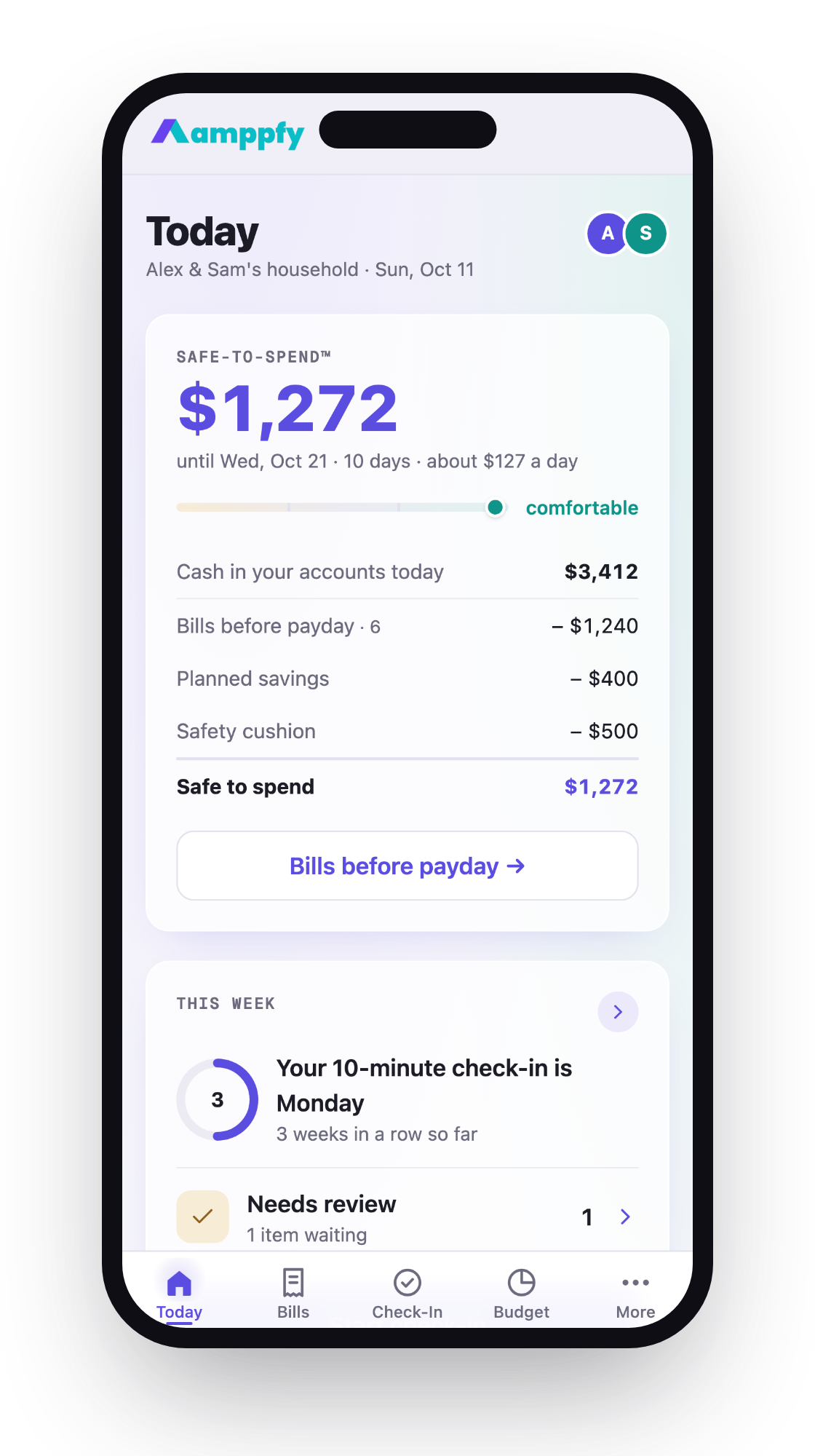
Cash – bills – savings – cushion = Safe-to-Spend
That $806 is what you can actually use for groceries, gas, and daily life over those 16 days. Knowing that number on the 15th, before you spend a dollar, is the whole point.
Amppfy calculates this Safe-to-Spend number automatically. You enter your balances, bills, paydays, and a cushion amount you choose. The app shows you what’s left after everything due before your next paycheck is accounted for. It takes about 10 minutes a week to keep current.
Keeping a spouse on the same number from anywhere
Two people spending from the same pool of money need to see the same balance, the same bills, and the same Safe-to-Spend figure. That’s hard enough when you’re in the same house. It’s harder when one of you is at Fort Liberty and the other is in San Diego.
The “same number” problem
Most couples run into trouble not because they disagree about money, but because they’re working from different information. One person pays a bill and forgets to mention it. The other checks the bank balance, sees $1,200, and assumes it’s all available. It’s not. There are bills due in three days that haven’t posted yet.
The fix is a shared view of what’s actually safe to spend, updated in near-real time. Amppfy handles this by giving each partner their own login while showing the same Safe-to-Spend number. Private balances stay private. Shared bills and goals stay visible to both. No one has to text “did you pay the electric bill” from across the country.
A weekly check-in that works at any distance
Set a recurring 10-minute check-in once a week. Pick a day that works across time zones. During the check-in:
- Update account balances (takes about 30 seconds per account)
- Confirm upcoming bills are correct
- Review the Safe-to-Spend number together
- Adjust spending plans for the rest of the pay period
This works on a Tuesday night FaceTime just as well as it works sitting at the kitchen table. The point is consistency, not duration. Ten minutes keeps both people aligned without turning money into a long, tense conversation.
BAS and groceries: a common friction point
BAS is a flat rate meant to cover the service member’s meals only, not the full family grocery bill. For 2026, enlisted BAS is $476.95 per month. A family of four spends well beyond that on food. Treating BAS as “the grocery budget” sets you up for a shortfall every month. Instead, combine BAS with a set grocery amount from base pay and agree on that total together.
Frequently Asked Questions
Do I get paid on the exact 1st and 15th every month?
Not always. When the 1st or 15th falls on a weekend or federal holiday, DFAS moves pay to the last business day before that date. In 2026, this happens multiple times. Check the annual DFAS pay calendar at the start of each year and mark the actual deposit dates on your own calendar. If your bank releases deposits early, you might see money one to two days before even the adjusted date.
Should I set up allotments or just use auto-pay from my bank?
Both work, but they serve different purposes. Allotments are deducted before your paycheck hits your bank account, which means you never see that money in your checking balance. That’s useful for rent, savings, or loan payments you don’t want to accidentally spend around. Auto-pay from your bank gives you more flexibility to pause or adjust. A good setup uses allotments for fixed, non-negotiable payments and auto-pay for everything else.
How do I handle months where both checks feel tight?
Start by checking whether your bills are evenly distributed. If 70% of your bills hit in the first half of the month, your 1st check will always feel short even though it’s the bigger one. Move due dates to balance the load. If bills are already balanced and it’s still tight, look at subscriptions and recurring charges you’ve forgotten about. A single pass through your last bank statement usually turns up $50 to $100 in charges you can cut or pause.
What’s the best way to budget for a PCS move?
Set aside at least one month of essential expenses in a separate savings account before your report date. DLA and travel reimbursements can take a full pay cycle or longer to appear on your LES. Having that buffer means you won’t rely on credit cards to cover the gap. Cancel location-specific services before you leave, and delay signing up for new ones until your first full paycheck at the new duty station confirms your updated BAH and any special pay changes.
Build your military pay budget once, then maintain it
A twice-monthly paycheck is a solid foundation. The challenge is matching your bills, savings, and spending to the actual rhythm of those deposits. Sort your bills by pay period. Build a small cushion for the long half of the month. Use allotments for the payments you never want to miss. And if you share finances with a partner, get on the same number so neither of you is guessing.
Take 15 minutes this week to list your bills by due date and assign each one to a paycheck. If you want a single number that tells you what’s safe to spend after bills, savings, and your cushion are covered, Amppfy does that math for you, free, on iPhone and web. Set it up once, check in weekly, and stop wondering whether you can afford Thursday’s grocery run.