

A single car repair can quietly rearrange your entire month. The alternator dies, the mechanic quotes $800, and suddenly you’re reshuffling bills and skipping a savings deposit. Most people know they should set money aside for repairs. The real question is how much to put in a car repair fund and how to build it without wrecking your weekly cash flow. That’s what this piece is about: a realistic number, a paycheck-by-paycheck plan, and a system that holds up when the bill comes early.
Repairs You Can Predict: Tires, Brakes, Maintenance
Your car tells you what it needs before it breaks. The trick is listening to the maintenance schedule, not just the warning lights. Most repair costs aren’t surprises at all. They’re expenses with rough timelines you can plan around.
Here’s a quick look at common predictable costs:
| Repair or Service | Typical Interval | Approximate Cost |
|---|---|---|
| Oil change | Every 5,000-7,500 miles | $40-$100 |
| Tire replacement (set of 4) | Every 40,000-60,000 miles | $500-$900 |
| Brake pads (front) | Every 30,000-50,000 miles | $150-$350 |
| Battery replacement | Every 3-5 years | $150-$250 |
| Timing belt | Every 60,000-100,000 miles | $500-$1,000 |
| Transmission fluid | Every 60,000 miles | $150-$300 |
These aren’t guesses. They’re ranges you can find in your owner’s manual or on the manufacturer’s website.
Building a Simple Maintenance Timeline
Pull up your current mileage. Check your last service receipt. Then estimate when each item above is due. If you’re at 55,000 miles and your tires were new at 30,000, you’ve got roughly one year before you need a new set. That’s $500-$900 you can start saving for now.
Brakes, belts, and batteries follow the same logic. Spread the known costs across the months between now and when they’ll hit. You won’t get every date right, but you’ll be close enough to avoid the shock. A car with 80,000 miles and original brake pads isn’t going to surprise you. That bill is coming. The only variable is the month.
Picking a Monthly Number From Your Car’s Age and Mileage
A newer car with low miles doesn’t need the same fund as a 10-year-old sedan with 120,000 on the odometer. Your monthly target should reflect what your car actually costs to maintain, not some generic rule.
According to AAA’s 2025 annual driving cost study, the average annual maintenance and repair cost for a new vehicle is about $0.10 per mile. For a car driven 12,000 miles a year, that’s roughly $1,200 annually, or $100 a month. Older vehicles cost more. A car past 100,000 miles can easily run $150-$200 a month in averaged repair costs.
A Quick Formula for Your Car
Use this as a starting point:
- Under 5 years old, under 60,000 miles: $75-$100/month
- 5-10 years old, 60,000-100,000 miles: $100-$150/month
- Over 10 years old or over 100,000 miles: $150-$200/month
These aren’t exact. They’re anchors. If you drive a Toyota Corolla, lean toward the lower end. If you own a German luxury sedan out of warranty, lean higher.
The Ceiling Test
Ask yourself: what’s the most expensive single repair your car might need this year? For most vehicles, that’s a transmission issue ($1,500-$3,000) or an AC compressor ($800-$1,200). Your fund should be able to cover at least one major repair within 12 months of saving. If you’re putting away $125 a month, you’ll have $1,500 by the end of the year. That covers most single-event repairs without borrowing.
The point isn’t perfection. It’s having a number that’s grounded in your car’s reality, not a vague intention to “save something.”
Saving It Per Paycheck Without Feeling It
A monthly target is useful. A per-paycheck deposit is what actually works. Most people don’t save monthly. They save when money hits their account. Match your car fund deposits to your pay cycle.
If your target is $125 a month and you’re paid biweekly, that’s roughly $58 per paycheck. Paid weekly? About $29. The smaller the slice, the less it stings.
Three Ways to Automate the Habit
- Set up an automatic transfer from checking to a dedicated savings account on payday. Even a basic online savings account works. The transfer should happen the same day your check lands.
- Use your payroll’s direct deposit split if your employer offers it. Send $58 straight to a second account before you ever see it in checking.
- If automation isn’t an option, move the money manually within 24 hours of payday. Waiting until “later in the week” is how the money disappears.
Making It Invisible
The goal is to remove the decision from your week. You shouldn’t be choosing whether to fund your car savings each payday. You should be confirming it happened.
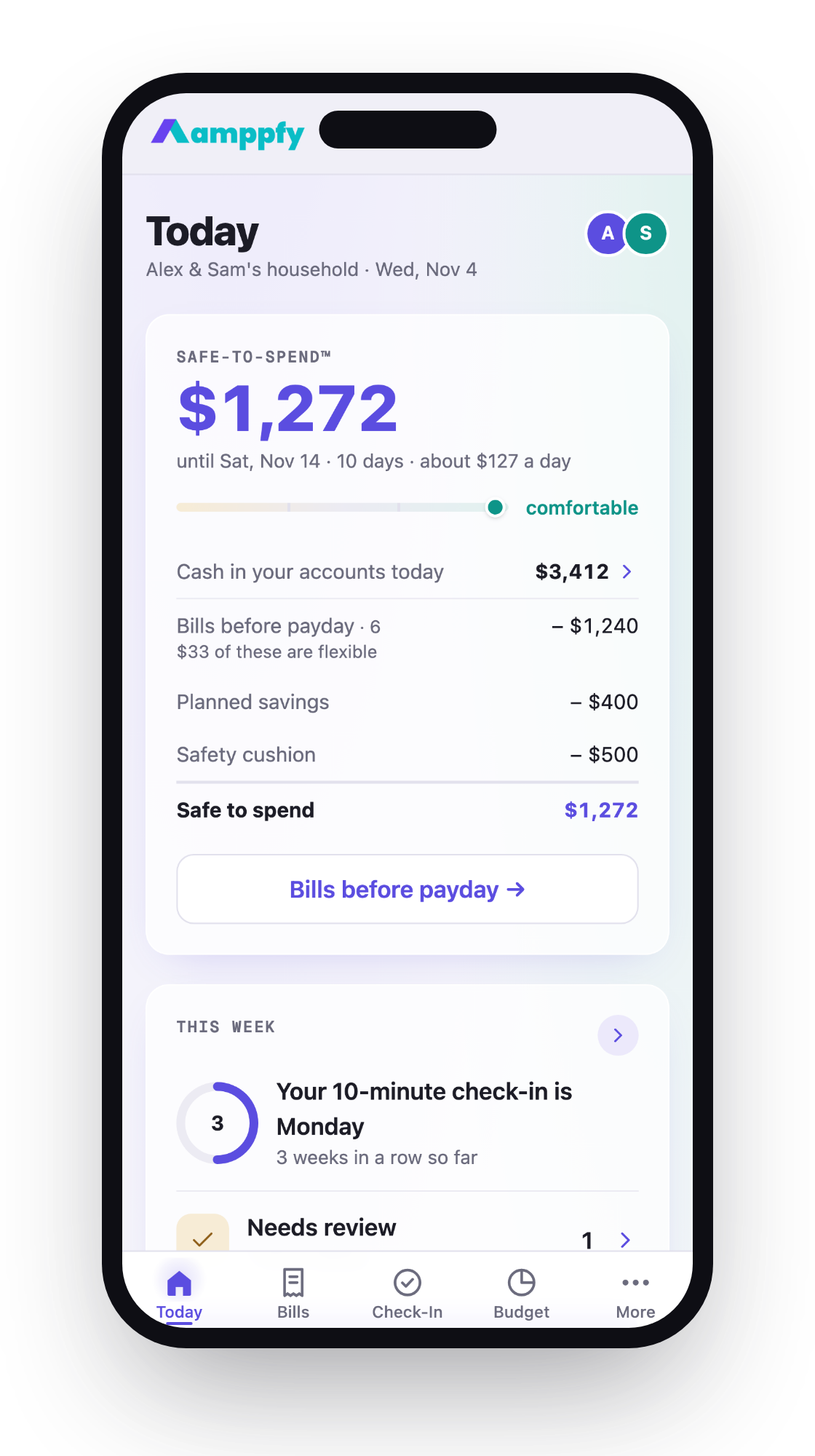
If you use Amppfy, the math is visible every time you check your Safe-to-Spend™ number: your available cash minus bills, minus planned savings, minus your cushion. Your car fund deposit shows up as part of the savings line, so it’s already subtracted from what you can spend. There’s no mental math and no guessing whether you “already accounted for it.” A 10-minute weekly check-in keeps the number honest.
The deposit doesn’t have to be fixed forever, either. If you get a raise, bump it by $10. If money is tight for a month, drop it by $10. Consistency matters more than the exact dollar amount.
What to Do When a Big Repair Hits Early
You’ve been saving for four months. You have $500 in the fund. Then the water pump fails: $750. You’re $250 short. This happens. It’s not a failure of the plan. It’s the plan doing its job partway.
Cover the Gap Without Derailing Everything
Here’s how to handle it:
- Use the $500 you’ve saved. That’s what it’s for.
- Cover the remaining $250 from your checking if you can. Check your Safe-to-Spend number first. If it shows enough room after bills and your cushion, pay the difference directly.
- If checking can’t absorb it, ask the shop about a payment plan. Many independent mechanics offer 30- or 60-day terms. Dealerships often have service financing at 0% for short periods.
- Put the repair on a credit card only as a last resort, and only if you can pay it off within one billing cycle.
Rebuilding After a Hit
Once the repair is paid, your fund is at zero. That’s fine. Start the deposits again immediately. Don’t skip a paycheck “to recover.” The next deposit is the most important one because it restarts the habit.
If the repair was larger than expected, consider bumping your monthly target by $25 for six months. That accelerates the rebuild without a dramatic change to your spending. For example: $3,412 cash – $1,240 bills – $475 savings (car fund included) – $500 cushion = $1,197 Safe-to-Spend. That extra $25 barely moves the number, but it adds $150 to your fund over half a year.
The worst response to an early repair is to abandon the fund entirely. A partially funded repair account still saved you $500 in this scenario. That’s $500 you didn’t put on a credit card at 22% interest.
Keeping the Fund Separate From Your Cushion
Your emergency cushion and your car repair fund serve different purposes. Mixing them creates confusion and makes both less effective.
Your cushion is for income disruptions: a job loss, a medical bill, an unexpected move. It’s the money that keeps your household running if everything goes sideways. Your car fund is for a specific, predictable category of expense. Tires wear out. Brakes need pads. These aren’t emergencies. They’re certainties with uncertain timing.
Why Separation Works
When the two funds share an account, a $900 tire bill feels like it’s eating your safety net. That triggers anxiety, and anxious savers often stop saving. A separate car fund reframes the expense. You’re not “dipping into savings.” You’re spending money you set aside for exactly this purpose.
You don’t need a fancy setup. A second savings account at your bank works. Some people use a high-yield savings account for the car fund since the money sits for months between uses. Label it “Car” or “Auto Repair” so there’s no ambiguity.
The Two-Account Rule
Keep it simple:
- Account 1: Emergency cushion. One to three months of essential expenses. Don’t touch it for car repairs.
- Account 2: Car repair fund. Your monthly target times 12, building over time. Use it only for vehicle maintenance and repairs.
If your car fund runs dry after a big repair, resist the urge to “borrow” from your cushion. Rebuild the car fund through deposits. The cushion stays intact for true emergencies.
According to the Federal Reserve’s 2024 Survey of Household Economics and Decisionmaking, 37% of U.S. adults said they would struggle to cover a $400 emergency expense with cash. A dedicated car fund keeps you on the other side of that statistic.
Frequently Asked Questions
How much should I keep in a car repair fund if my car is paid off?
A paid-off car still costs money to maintain. Without a monthly payment, you have room to redirect some of that freed-up cash. Aim for $100-$150 per month if your car is under 100,000 miles, or $150-$200 if it’s older. A good target balance is $1,500-$2,500 sitting in the fund at any given time. That covers most single repairs without scrambling.
Should I save for car repairs if I have a warranty?
Yes, but you can save less. Warranties cover specific components, not everything. Tires, brakes, batteries, and wear items are almost never covered. A $50-$75 monthly deposit handles those costs while your warranty takes care of the bigger mechanical items. Once the warranty expires, increase your deposit to the full recommended amount for your car’s age.
What if I can’t afford the recommended monthly amount right now?
Start with what you can. Even $25 per paycheck adds up to $650 in a year. That’s enough for a brake job or a battery replacement. The habit matters more than the dollar amount in the first few months. Increase the deposit by $10 whenever your income changes or a recurring expense drops off.
Is a car repair fund the same as a sinking fund?
Same concept, different name. A sinking fund is any savings account where you set aside money for a known future expense. Your car repair fund is a sinking fund dedicated to vehicle costs. Some people run multiple sinking funds for different categories: car, home, medical. The key is keeping each one separate so the money is there when you need it.
Build the Fund, Then Forget About It
Your car will need work. That part isn’t optional. The optional part is whether you’re ready for it. Pick a monthly number based on your vehicle’s age and mileage. Split it across your paychecks. Keep it in its own account. When the repair comes, pay it and start refilling.
The whole system runs on about five minutes of setup and a few seconds per payday. If you want a single view of how your car fund fits into your overall spending, Amppfy shows your Safe-to-Spend number with the savings already subtracted, so you always know what’s actually available. Take 10 minutes this week to open a second savings account, set your first automatic transfer, and stop worrying about the next repair bill.