Every December, the same thing happens. You open your bank app, see a balance that looks fine, and then remember: three birthdays, a wedding gift, and holiday shopping all land before your next paycheck. The scramble begins. A gift budget for the full year removes that scramble entirely. You figure out the total, break it into small pieces, and let each occasion arrive without denting your checking account. The trick is doing the math once, in one sitting, and then letting the plan run on autopilot. This works whether you’re single, splitting costs with a partner, or managing a household where kids’ party invitations show up weekly. The rest of this piece walks you through each step, from listing every date to keeping the system alive into 2027.
Listing every gift-giving date for the year
Grab a calendar and a blank spreadsheet. Your job is to capture every occasion that will cost you money this year. Not just birthdays: everything.
Start with the obvious ones:
- Birthdays for immediate family, close friends, your partner, and your kids’ friends
- Winter holidays (Christmas, Hanukkah, Kwanzaa, or whatever your household celebrates)
- Valentine’s Day, Mother’s Day, Father’s Day
- Anniversaries you exchange gifts for
- Weddings you’ll attend as a guest
- Baby showers and housewarmings
- Teacher appreciation or end-of-year gifts
- Graduations
The average American is projected to spend roughly $1,340 per year on gifts[1] across all occasions in 2026. That number climbs fast once weddings enter the picture: the average cost to attend a wedding as a guest has reached $610 in 2026[2], counting travel, lodging, and the gift itself.
Write each occasion on its own row. Add the month it falls in and a rough dollar amount. Don’t aim for perfection. A best guess is fine. You’ll adjust later. The point is to stop being surprised by expenses you already know are coming.
Once you’ve listed everything, total it up. That single number is your annual gift spend. It might sting a little. That’s normal. Knowing the number is the first step toward controlling it.
Turning the total into a per-paycheck amount
A lump-sum number like $1,500 or $2,200 feels heavy. Broken into paychecks, it shrinks fast.
Here’s the math. Say your annual gift total is $1,800 and you’re paid every two weeks (26 paychecks a year):
$1,800 ÷ 26 = $69.23 per paycheck
If you’re paid twice a month (24 paychecks):
$1,800 ÷ 24 = $75.00 per paycheck
| Pay Frequency | Paychecks per Year | Gift Total | Per-Paycheck Amount |
|---|---|---|---|
| Weekly | 52 | $1,800 | $34.62 |
| Biweekly | 26 | $1,800 | $69.23 |
| Semimonthly | 24 | $1,800 | $75.00 |
| Monthly | 12 | $1,800 | $150.00 |
Set that amount aside the same day your paycheck hits. Move it to a separate savings account, a sinking fund, or just label it mentally. The key: treat it like a bill. It leaves your available cash before you spend on anything else.
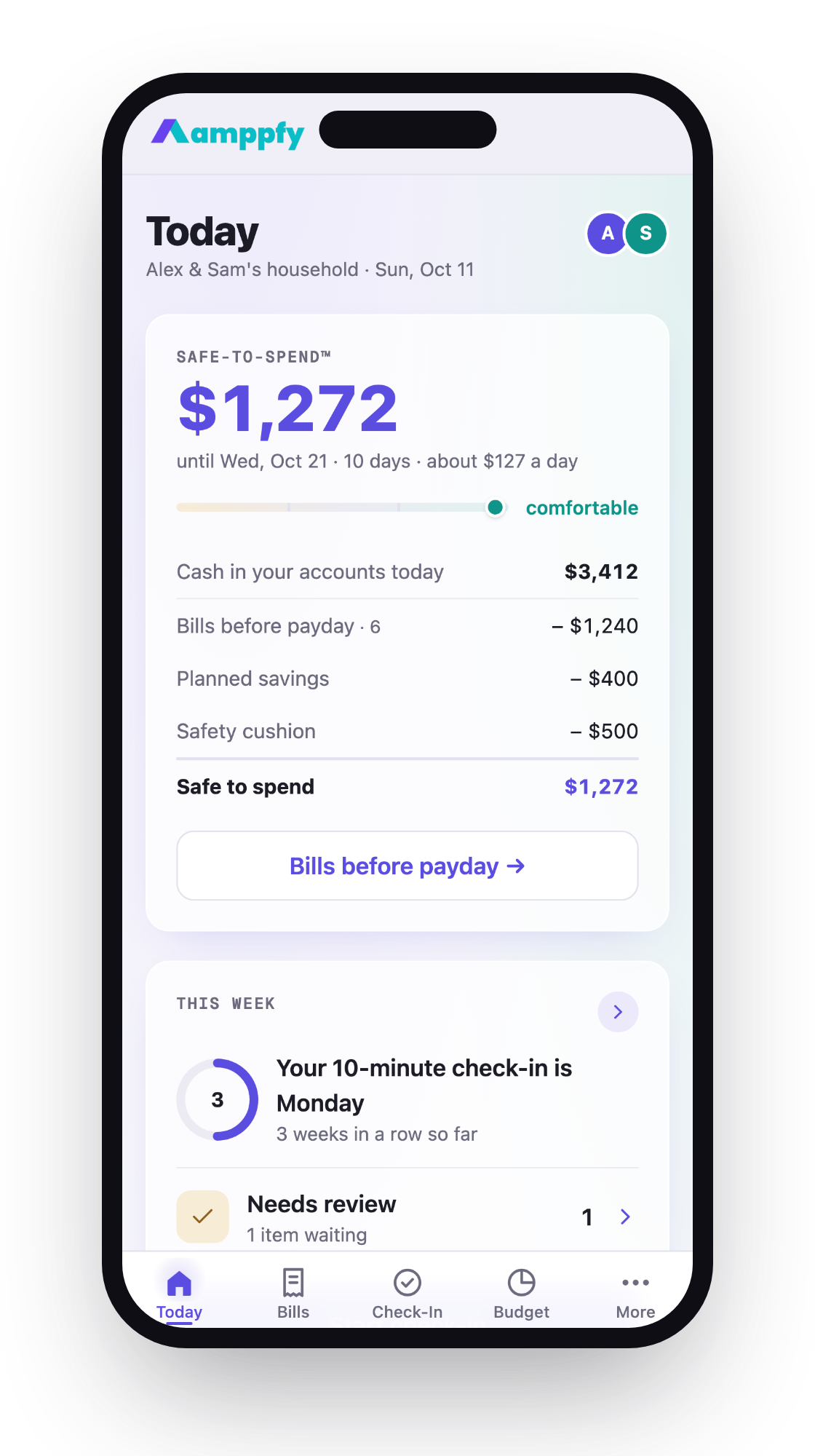
If you use Amppfy, you can add this as a savings goal. Your Safe-to-Spend™ number already subtracts planned savings from your available cash, so the gift money disappears from your spendable balance automatically. No willpower required.
The per-paycheck approach works because it turns a yearly problem into a small, repeating habit. You don’t need to “find” $200 in November. It’s already sitting there.
Setting a per-person number you can keep
Your list of occasions is done. Your per-paycheck transfer is set. Now you need a cap for each person or event. Without one, a single generous impulse can blow the whole plan.
Sort your list into tiers. Not everyone gets the same amount, and that’s perfectly fine.
| Tier | Who | Budget per Gift |
|---|---|---|
| Tier 1 | Partner, kids, parents | $50 – $100 |
| Tier 2 | Siblings, close friends | $25 – $50 |
| Tier 3 | Coworkers, acquaintances, kids’ classmates | $10 – $25 |
| Tier 4 | Wedding gifts | $75 – $150 |
These numbers are examples. Your tiers depend on your total and your relationships. The rule is simple: every tier times every person in it should add up to your annual total. If it doesn’t, adjust the tiers down until it does.
A few practical tips:
- Round to clean numbers. A $30 cap is easier to shop around than $27.50.
- For kids’ birthday parties, keep a small stash of $15 gifts ready. Lego sets, art kits, and books work across ages.
- Wedding gifts don’t have to match the per-plate cost myth. Give what fits your budget. The couple would rather have you there than receive an expensive blender you can’t afford.
Americans spent more than $10.1 billion on unwanted gifts in 2025[3], with the average unwanted item costing $72. A smaller, thoughtful gift often lands better than an expensive one chosen in a panic. Your per-person cap protects your bank account and, oddly enough, tends to produce better gifts.
Months with three birthdays and how to handle them
Some months are brutal. March might hold your mom’s birthday, your best friend’s, and your nephew’s. June might stack a wedding on top of Father’s Day and a graduation. These clusters are where gift budgets fall apart.
Front-load the savings
If you know a heavy month is coming, start buying early. A gift purchased six weeks ahead still counts. Spread the spending across two or three paychecks instead of one. Your sinking fund balance should be building all year, so by the time a cluster month arrives, the cash is already there.
Batch your shopping
Pick one afternoon to buy all three gifts at once. You’ll spend less time, avoid impulse upgrades, and stick closer to your per-person caps. Online shopping makes this even easier: three tabs, three carts, done in 30 minutes.
Adjust, don’t abandon
If a cluster month genuinely exceeds what you’ve saved so far, trim the per-person amount for that month by $10 or $15. A $35 gift instead of $50 is still a gift. The alternative, putting $150 on a credit card and paying interest, costs you more in the long run.
Here’s a worked example for a tough month:
$50 (mom) + $30 (friend) + $25 (nephew) + $100 (wedding gift) = $205
If your per-paycheck set-aside is $75 and you’ve had two paychecks since the last gift month, you’ve got $150 saved. You’re $55 short. Options: trim each gift by $15, buy one gift early from the prior month’s balance, or shift $55 from your next paycheck’s allocation. All three work. None require a credit card.
The point isn’t to be rigid. It’s to have a plan that bends instead of breaks.
Keeping the plan going next year
A gift budget only works if it survives past January. Here’s how to make it stick into 2027 and beyond.
Do a year-end review in December. Pull up your list and compare what you planned against what you actually spent. Were your per-person caps realistic? Did you miss any occasions? Add new ones (a friend’s baby, a coworker’s retirement) and remove any that no longer apply.
Update your annual total. Prices shift. Relationships change. A five-minute edit keeps the numbers honest.
Keep the per-paycheck transfer running. Don’t pause it after the holidays. January and February feel light on gifts, but that’s exactly when you’re building the cushion for spring birthdays and summer weddings.
If you share finances with a partner, make sure you’re both looking at the same number. Amppfy lets partners see the same Safe-to-Spend balance, so neither person accidentally spends the gift fund on groceries. One quick check-in a week, about ten minutes, keeps everything current.
A few signs your plan is working:
- You stop Googling “last-minute gift ideas” at 11 p.m.
- Your checking account doesn’t dip after a birthday weekend.
- You buy gifts you’re actually proud of, because you had time to think.
The whole system runs on one idea: gifts are predictable expenses disguised as surprises. Once you treat them like the recurring costs they are, they stop catching you off guard.
Frequently Asked Questions
How much should I budget for birthday gifts each year?
That depends on how many people are on your list and what tier they fall into. A reasonable starting point: $25 to $50 per person for close friends and family, $10 to $25 for acquaintances. Multiply by the number of birthdays, add your other gift occasions, and you’ve got your annual number. Most people land somewhere between $800 and $2,000 for all gift-giving combined.
Should I include holiday spending in my gift budget?
Yes. Holiday gifts are the single largest chunk of most people’s annual gift spending. Separating them into a different mental bucket is how people end up blindsided in December. One plan, one fund, one per-paycheck transfer covers everything.
What if I can’t afford the per-paycheck amount?
Cut the per-person caps first. A $20 gift with a handwritten card beats a $50 gift bought with borrowed money. You can also reduce your list: not every coworker needs a gift. Focus on the people who matter most and let go of obligation gifts that don’t bring you or the recipient any real joy.
How do I handle gift-giving when my partner and I have different budgets?
Talk about it once, early in the year. Agree on a shared gift list and a total you’re both comfortable with. If you keep separate finances, split the per-paycheck amount however feels fair. If you use a shared tool like Amppfy, the gift savings goal shows up in both of your views, so nobody has to guess where the money went.
A Gift Plan That Runs Itself
You listed the dates. You did the division. You set caps that fit your real life. That’s the whole system. The birthday gift budget you build once this year carries forward with minor tweaks each December. No spreadsheet wizardry, no guilt, no last-minute credit card charges. Take 20 minutes this week to write your list and set up the transfer. Future-you, standing in a store in October with zero panic, will be glad you did.