Your VA disability deposit doesn’t land on the same calendar date every month. Some months you’ll see it a day or two early, and other months it arrives right on the first. Knowing the exact schedule for 2027 helps you line up rent, car payments, and everything else that pulls from your account. This guide lays out every 2027 VA disability payment date, explains why some deposits show up early, and gives you a plan for keeping bills and pay in sync all year.
VA Pays on the 1st for the Month Before
The VA pays disability compensation in arrears. That means the payment due January 1 (deposited Thursday, December 31, 2026) covers December’s benefit, your February 1 deposit covers January, and so on. You’re always being paid for the prior month of service-connected disability.
The legal rule is straightforward. Under federal law, if the first of the month falls on a weekend or federal holiday, the payment is issued on the preceding business day[1]. In 2027, for example, the January 1 payment (New Year’s Day) arrives Thursday, December 31, 2026, and the May 1 payment (a Saturday) arrives Friday, April 30.
This “arrears” setup trips people up at first. You might wonder why your very first VA payment after a rating decision feels delayed. It’s because the VA doesn’t pay for the current month on the first of that month. It pays for the month that just ended.
One thing worth tracking: the 2027 cost-of-living adjustment. The COLA rate becomes legally effective on December 1, 2026, with the first increased payment issued on December 31, 2026[2]. That means the deposit for December 2026, which arrives on Thursday, December 31, 2026, already reflects the new rate. You don’t need to wait until February or March to see the bump.
Keep your direct deposit info current in VA.gov. A wrong routing number can delay your payment regardless of the schedule.
Every 2027 VA Payment Date
Below is the full schedule for 2027. Each deposit covers the month before it. The “deposit date” column shows when the money should hit your bank account.
| Payment Month | Covers | Deposit Date | Notes |
|---|---|---|---|
| January | December 2026 | January 1, 2027 (Fri, New Year’s Day) | Paid December 31, 2026 (Thu); COLA increase reflected |
| February | January | February 1, 2027 (Mon) | |
| March | February | March 1, 2027 (Mon) | |
| April | March | April 1, 2027 (Thu) | |
| May | April | May 1, 2027 (Sat) | Paid April 30 (Fri) |
| June | May | June 1, 2027 (Tue) | |
| July | June | July 1, 2027 (Thu) | |
| August | July | August 1, 2027 (Sun) | Paid July 30 (Fri) |
| September | August | September 1, 2027 (Wed) | |
| October | September | October 1, 2027 (Fri) | |
| November | October | November 1, 2027 (Mon) | |
| December | November | December 1, 2027 (Wed) | |
| January 2028 | December | January 1, 2028 (Sat) | Paid December 31, 2027 (Fri); a federal holiday but banks are open, so VA may instead pay Thu, December 30 |
A few notes on this table. The dates above follow the federal rule for weekend shifts. Your bank’s processing time can add a few hours, but most direct deposits post by early morning on the listed date. Credit unions sometimes release funds a day early on their own, but that’s your bank’s policy, not the VA’s.
Check your bank’s posted transaction history after each deposit. If a payment doesn’t appear by midday on the listed date, contact the VA at 800-827-1000.
Months When the Deposit Arrives at the End of the Prior Month
Four deposits in the 2027 schedule arrive in the prior month. The January 1 payment arrives Thursday, December 31, 2026, because New Year’s Day is a holiday. May 1 falls on a Saturday and August 1 on a Sunday, so those deposits move to the Friday before. And January 1, 2028 is a Saturday, so the payment for December 2027 arrives on Friday, December 31, 2027.
May 2027: Paid April 30
Your May 1 payment shifts to Friday, April 30. This means you’ll receive two VA deposits in April: one on April 1 (covering March) and one on April 30 (covering April). That’s two deposits roughly four weeks apart, but the second one lands a day before you might expect it.
August 2027: Paid July 30
The same thing happens in August. The August 1 deposit moves to Friday, July 30. Again, you’ll see two VA payments hit your account in July: July 1 and July 30.
January 2028: Paid December 31, 2027
December brings two deposits as well: December 1 (covering November) and December 31 (covering December). December 31, 2027 is the observed New Year’s Day federal holiday. Banks are open, so the deposit should land that Friday, but VA may pay on Thursday, December 30 instead, so check your account that week.
Why This Matters for Your Budget
Getting paid early sounds like a bonus, but it can throw off your rhythm. If you budget month by month, an early deposit might make your account look flush at the end of April or July, only for the next month to feel tight because the following deposit is a full 32 or 33 days away. The gap between the early deposit and the next scheduled deposit stretches longer than usual.
Mark the early-pay months on your calendar now. Treat the early deposit as if it arrived on the first. Don’t spend it just because it showed up a day or two ahead of schedule.
Planning Bills Around an Early Deposit
Knowing the schedule is half the job. The other half is making sure your bills don’t collide with a gap between deposits.
Line Up Due Dates with Your Deposit Rhythm
Most creditors let you choose your due date. If your rent is due on the first, you’re already aligned with the VA schedule. But if your car payment hits on the 28th, you’re paying it before your VA deposit arrives. Consider calling your lender and shifting the due date to the 3rd or 5th. That gives your deposit a day or two to clear.
Here’s a practical way to think about it:
- List every recurring bill and its due date
- Sort them by date, earliest to latest
- Flag anything due before the 1st of the month
- Call those creditors and ask to move the due date to the 3rd-5th
Build a Small Buffer
A buffer of even $300-$500 keeps you from sweating a deposit that posts at 9 a.m. instead of 6 a.m. Think of it as a timing cushion, not an emergency fund. Your emergency fund is separate.
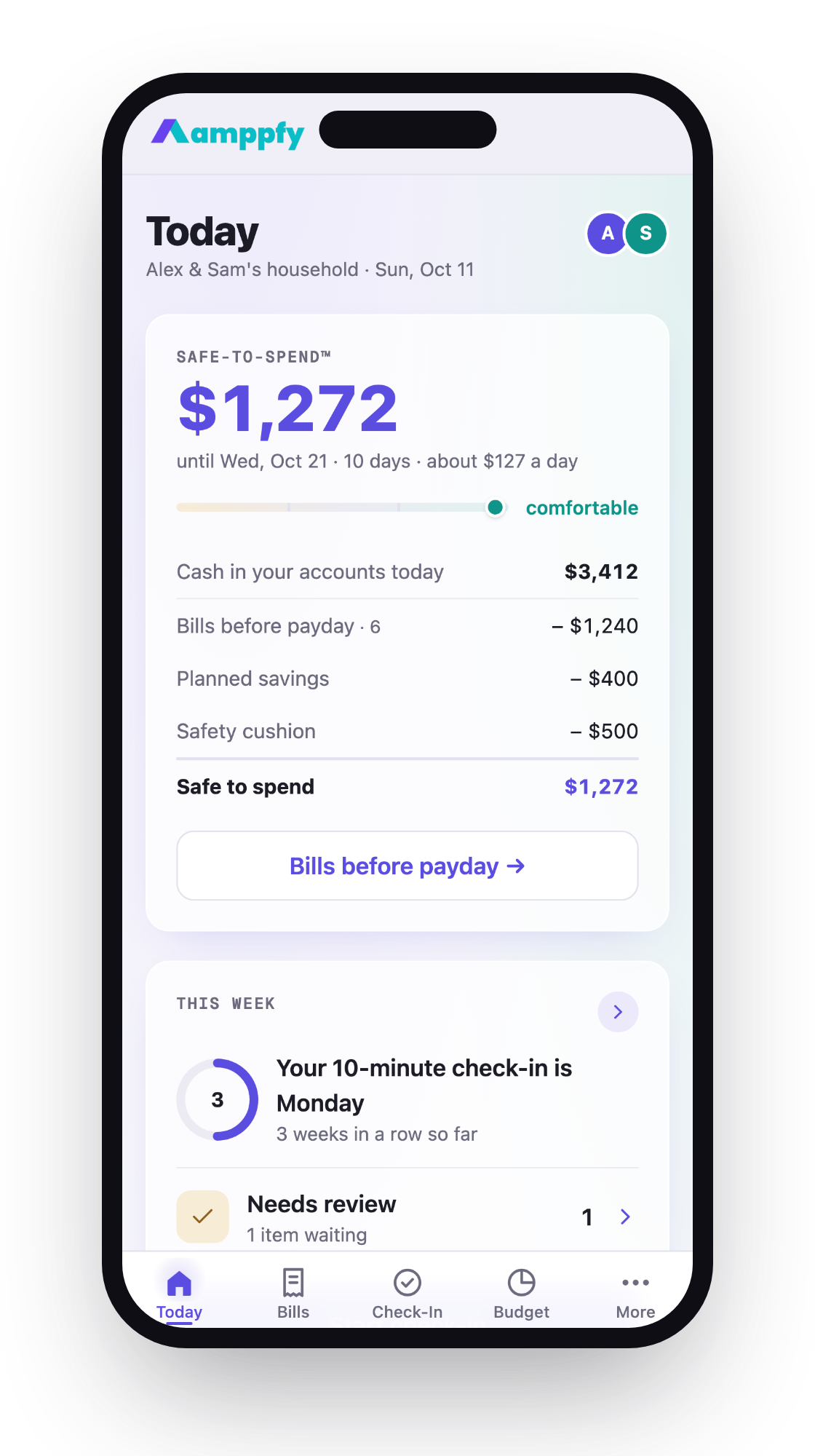
One way to see this clearly: $1,800 VA deposit – $1,100 bills due before next payday – $200 savings goal – $300 cushion = $200 Safe-to-Spend™. That math tells you what’s actually available without guessing. Amppfy shows this as a single Safe-to-Spend™ number that updates when you enter your balance, so you don’t have to run the calculation yourself each month.
Don’t Forget Annual and Quarterly Bills
Car insurance every six months, annual subscriptions, property taxes: these irregular bills can wreck a month if you’re not tracking them. Split the annual cost by 12 and set that amount aside each month. When the bill arrives, the money is already waiting.
Combining VA Pay with a Paycheck or Retirement Pay
Many veterans receive VA disability alongside a civilian paycheck, military retirement pay, or both. Coordinating multiple income streams with one set of bills takes a little planning, but it simplifies your finances once it’s set up.
VA Pay + Civilian Paycheck
If you’re paid biweekly at work, you have 26 paydays a year. Your VA deposit adds 12 more income events, one on the first of each month (or the last business day before it). The cleanest approach: assign your VA deposit to cover one category of bills, like housing costs, and use your paycheck for everything else.
For example:
- VA deposit (1st): Rent or mortgage, renter’s insurance, HOA
- Paycheck 1 (mid-month): Utilities, groceries, gas
- Paycheck 2 (end of month): Car payment, subscriptions, savings
This way each income source has a job. You’re not mixing streams and wondering which dollars are spoken for.
VA Pay + Military Retirement
If you receive both VA disability and military retirement, you may already know about concurrent receipt. Some veterans receive both full amounts, while others have their retirement pay offset by the VA amount. Your individual offset depends on your disability rating and years of service.
Check your retirement pay statement on myPay and your VA payment on VA.gov. Compare the two. If you see an offset, contact DFAS to confirm whether you qualify for Combat-Related Special Compensation (CRSC) or Concurrent Retirement and Disability Pay (CRDP).
Keeping It All Visible
When money arrives from two or three sources on different dates, it’s easy to lose track of what’s already committed to bills. A 10-minute weekly check where you update your balances and confirm upcoming bills keeps the picture clear. Amppfy handles this by showing one number across all your income sources: your VA deposit, paycheck, and retirement pay all feed into the same Safe-to-Spend™ calculation.
Frequently Asked Questions
What time does my VA disability deposit hit my bank account?
Most direct deposits post between midnight and 6 a.m. on the scheduled date. Your bank controls the exact posting time, not the VA. Credit unions often release funds a few hours earlier than large banks. If your deposit hasn’t posted by noon on the scheduled date, call the VA at 800-827-1000.
Will the 2027 COLA increase my VA disability payment?
Yes. The VA applies the same percentage as the Social Security cost-of-living adjustment, which is announced each October. Your first COLA-adjusted payment, covering December 2026, is scheduled to arrive on Thursday, December 31, 2026. Every 2027 payment reflects the new rate automatically.
Do I need to do anything to get paid on the early dates?
No. The VA automatically shifts your payment to the last business day before a weekend or holiday. You don’t need to request it or update anything. Just make sure your direct deposit information is current on VA.gov.
What if I also receive SSDI or SSI on a different schedule?
SSDI payments follow their own calendar, typically the second, third, or fourth Wednesday of the month based on your birth date. SSI is due on the 1st and moves earlier for weekends and holidays, much like your VA payment. Your VA payment schedule is independent. Track both deposit dates separately and assign specific bills to each income source so nothing falls through the gap.
Your 2027 VA Pay Calendar, Sorted
Four deposits arrive before the 1st (December 31, 2026; April 30; July 30; and December 31, 2027), the rest arrive on the 1st, and the COLA bump is already baked in. Print the table above or save it to your phone. Mark the early deposits so they don’t catch you off guard.
The simplest move you can make this week: enter your VA deposit date, your bills, and your current balance into one place so you always know what’s safe to spend before the next deposit. Get Amppfy free on iPhone or the web: it takes about ten minutes to set up, and you’ll see one number that accounts for every bill between now and your next payday.