One partner gets paid every other Friday. The other sees a deposit on the 1st and 15th. The bills don’t care. Rent hits on the same day each month regardless of whose check just landed, and the grocery run won’t wait for a pay cycle to align. Couples on different pay schedules need a shared calendar that turns two income streams into one clear spending plan, and 2027 is the year to set one up right.
Biweekly meets semi-monthly: what the overlap looks like in 2027
A biweekly paycheck arrives every 14 days. That means 26 paychecks per year. A semi-monthly paycheck lands twice a month, always on the same dates: the 1st and 15th, for example. That’s 24 paychecks per year. The two rhythms almost never line up.
Here’s what a typical month looks like when one partner is biweekly (every other Friday) and the other is semi-monthly (1st and 15th):
| Week of month | Biweekly partner | Semi-monthly partner | Household cash event |
|---|---|---|---|
| Week 1 | Possibly paid Friday | Paid on the 1st | One or two deposits |
| Week 2 | Paid Friday (if alternating) | No deposit | One deposit |
| Week 3 | Possibly paid Friday | Paid on the 15th | One or two deposits |
| Week 4 | Paid Friday (if alternating) | No deposit | One deposit |
Some weeks you’ll have two deposits within 48 hours. Other weeks, nothing comes in at all. The mismatch creates confusion about what’s actually available to spend on any given Tuesday.
The fix isn’t syncing the schedules: you can’t control payroll. The fix is mapping both schedules onto a single monthly view so you always know when cash arrives and when it leaves. Print or share a 12-month calendar with every payday for both partners color-coded. One color per person. Bills get a third color. You’ll spot the gaps and the windfalls in seconds.
Which partner’s check covers which bill
Splitting bills 50/50 sounds fair, but it ignores timing. If rent is due on the 1st and only one partner gets paid that day, the other partner’s biweekly check from three days earlier might already be half spent. A better approach: assign each recurring bill to whichever paycheck lands closest before it’s due.
Here’s a sample assignment for a household with $4,200 in monthly fixed bills:
| Bill | Due date | Assigned to | Reason |
|---|---|---|---|
| Rent/mortgage | 1st | Semi-monthly partner (1st) | Check lands same day |
| Car insurance | 5th | Semi-monthly partner (1st) | Still within that pay period |
| Utilities | 12th | Biweekly partner (nearest Friday) | Closest prior payday |
| Streaming/subscriptions | 15th | Semi-monthly partner (15th) | Check lands same day |
| Student loan | 20th | Biweekly partner (nearest Friday) | Closest prior payday |
| Credit card minimum | 25th | Biweekly partner (nearest Friday) | Closest prior payday |
This isn’t about who earns more. It’s about which dollar is sitting in an account when the bill hits. The partner whose paycheck lands right before a due date covers that bill.
If one partner ends up assigned a heavier load, balance it with a transfer. Say Partner A covers $2,600 in bills and Partner B covers $1,600. If you split costs equally, Partner B sends Partner A $500 on their next payday. Simple math, no arguments. Plenty of money fights start with “I thought you were paying that.” Assigning bills by timing, not by guesswork, removes that trigger.
The months when both get an extra check or neither does
The biweekly partner gets 26 paychecks a year. Most months that means two checks. But two months in 2027 will have three biweekly paydays. If the biweekly partner’s Fridays include January 1, those months are July (Jul 2, 16, and 30) and December (Dec 3, 17, and 31). If they include January 8, they’re April and October. Those are bonus-check months: the budget is built on two checks per month, so the third is gravy.
The semi-monthly partner’s 24 checks are fixed, but weekend and holiday shifts move some deposits into the month before. On a 1st-and-15th schedule in 2027, the May 1 check lands Friday, April 30 and the August 1 check lands Friday, July 30. So April and July each show three deposits, while May and August show one. January shows one too, because the January 1 check is paid Thursday, December 31, 2026.
Here’s how the two schedules stack up month by month in 2027, using the dates deposits actually land:
| Month | Biweekly partner (Fridays from Jan 1) | Semi-monthly partner (1st and 15th) | Household deposits |
|---|---|---|---|
| January | Jan 15, Jan 29 | Jan 15 | 3 |
| February | Feb 12, Feb 26 | Feb 1, Feb 12 | 4 |
| March | Mar 12, Mar 26 | Mar 1, Mar 15 | 4 |
| April | Apr 9, Apr 23 | Apr 1, Apr 15, Apr 30 | 5 |
| May | May 7, May 21 | May 14 | 3 |
| June | Jun 4, Jun 18 | Jun 1, Jun 15 | 4 |
| July | Jul 2, Jul 16, Jul 30 | Jul 1, Jul 15, Jul 30 | 6 |
| August | Aug 13, Aug 27 | Aug 13 | 3 |
| September | Sep 10, Sep 24 | Sep 1, Sep 15 | 4 |
| October | Oct 8, Oct 22 | Oct 1, Oct 15 | 4 |
| November | Nov 5, Nov 19 | Nov 1, Nov 15 | 4 |
| December | Dec 3, Dec 17, Dec 31 | Dec 1, Dec 15 | 5 |
July is the month both partners get an extra deposit: six in all. January, May, and August are the months neither does: three deposits each. Two notes: June 18 and December 31 are federal holidays when banks stay open, so some employers pay the Thursday before. And January 1, 2028 is a Saturday, so the semi-monthly partner’s first 2028 check may land in late December 2027 too.
Here’s what matters for planning:
- In a three-paycheck month for the biweekly partner, the household has extra cash. Don’t absorb it into daily spending. Route it somewhere specific: an emergency fund top-up, a debt payment, or a savings goal.
- In months where the biweekly partner’s paydays cluster early, you might face a long stretch at month’s end with no deposit from either person. Flag those months now.
- Weekends and bank holidays move semi-monthly deposits earlier at most employers. In 2027 that’s Jan 1 (paid Thu, Dec 31, 2026), Feb 15 (paid Fri, Feb 12), May 1 and May 15 (paid Fri, Apr 30 and Fri, May 14), and Aug 1 and Aug 15 (paid Fri, Jul 30 and Fri, Aug 13). Mark those shifts on your shared calendar.
A practical rule: budget every month as if the biweekly partner gets two checks and the semi-monthly partner gets two checks. Any third check is “found money” with a pre-assigned job. You decide that job in January, not in the moment. This keeps your baseline stable and your windfalls productive.
Treating bonus checks as spending money is how couples end up bridging gaps with credit cards the following month.
A shared Safe-to-Spend™ number across two schedules
Two pay schedules mean two checking accounts, two deposit dates, and two sets of assumptions about what’s available. The household needs one number that answers: “What can we actually spend today without missing a bill or draining savings?”
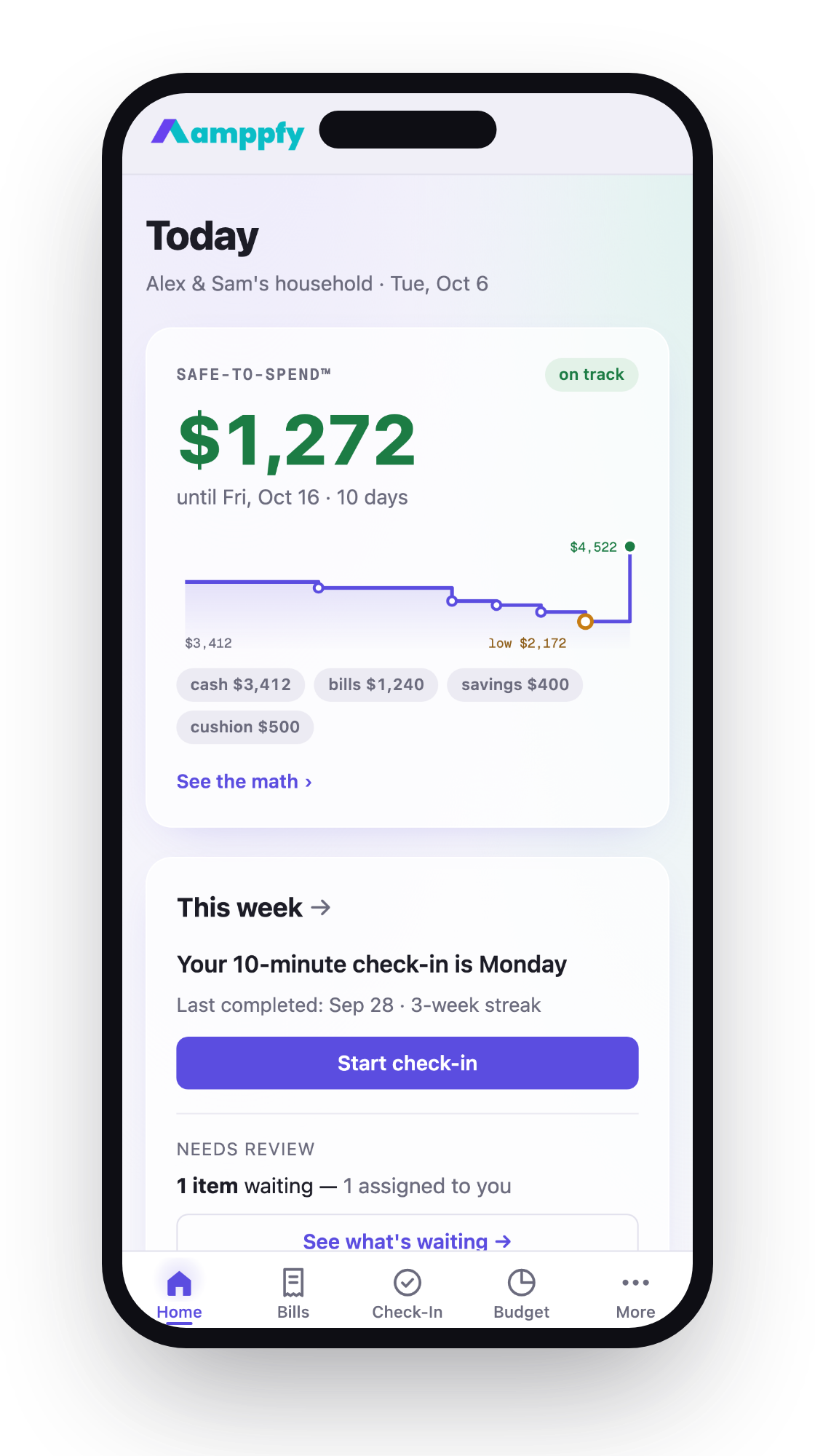
That number is your Safe-to-Spend™. Here’s the math:
$5,100 combined cash – $2,400 bills due before next payday – $600 savings goals – $400 cushion = $1,700 Safe-to-Spend™
Both partners see the same result. It doesn’t matter whose account holds more. The number reflects total household cash minus total household obligations.
Why one number beats two separate budgets
When each partner tracks their own spending in isolation, blind spots grow. Partner A might think they’re fine because their account looks healthy, while Partner B is quietly short for a shared bill due in three days. A single Safe-to-Spend™ figure eliminates that disconnect.
Tools that let couples with different pay schedules share a calendar view of upcoming bills and a unified spending number help both partners see the same picture instead of two partial ones. The key is shared visibility without forced transparency on every personal purchase.
Amppfy handles this by letting each partner log in separately and see the same Safe-to-Spend™ number, with the four-line math printed underneath. Private balances stay private. You type in your balances yourself: about 30 seconds per account, no bank login required. The month calendar marks the lowest-cash day so you can see trouble before it arrives.
Updating the number on payday
Each time a paycheck lands, one partner updates their balance. Takes half a minute. The Safe-to-Spend™ recalculates instantly. This matters most in weeks where both partners get paid within a day or two of each other: the number jumps, and it’s tempting to spend freely. The math keeps you honest.
A monthly ten-minute sync
A weekly check-in works well for individuals. For couples juggling two pay schedules, a monthly sync is the anchor, with quick weekly updates filling the gaps.
What the ten-minute monthly sync covers
- Open your shared calendar or app. Confirm next month’s paydays are correct.
- Review which bills are assigned to which paycheck. Adjust if a due date shifted.
- Check the Safe-to-Spend™ number. Is the cushion intact? If it dropped below your target, talk about why.
- Look at the bonus-check months ahead. Confirm where that extra check goes.
- Name one thing that went well and one thing to adjust. Done.
That’s it. No spreadsheet audit. No blame session. Ten minutes with coffee on a Sunday morning.
Keeping weekly updates painless
Between monthly syncs, each partner spends about two minutes per week updating their balance in Amppfy. The Safe-to-Spend™ number stays current without a full sit-down conversation. If something looks off, either partner can flag it. The weekly nudge is a habit, not a project.
The goal of the sync isn’t perfection. It’s preventing the slow drift where both partners assume the other person is handling something. Two pay schedules create twice as many chances for that drift. A short, regular conversation closes the gap.
Frequently asked questions
What if both partners are biweekly but on opposite weeks?
This is actually one of the easier setups. You get a paycheck hitting the household almost every Friday. Map your bills to whichever Friday falls right before the due date. The risk is assuming every week has a deposit: some weeks both checks land, and the following week has none. Build your Safe-to-Spend™ around the leaner weeks, not the flush ones.
Should we use a joint account or keep things separate?
Either works. Many couples use a hybrid: each person keeps a personal account and both contribute to a shared account that covers household bills. The important thing isn’t the account structure. It’s that both people can see the same Safe-to-Spend™ number so nobody’s guessing what’s left.
How do we handle a month where one partner’s pay is delayed?
Flag it immediately. If a holiday or payroll issue pushes a deposit back by even one day, a bill could bounce. Your cushion exists for exactly this reason. If the delay is longer than a day or two, temporarily reassign that bill to the other partner’s next check and rebalance with a transfer later.
Do we need to share every purchase with each other?
No. Shared visibility means seeing the same Safe-to-Spend™ number and knowing which bills are covered. It doesn’t mean auditing each other’s coffee purchases. Each partner can have personal spending money built into the plan. The number already accounts for bills, savings, and the cushion: whatever’s left is yours to spend without a conversation.
Your 2027 calendar starts with ten minutes
Two incomes on different rhythms don’t have to mean twice the confusion. Map both pay schedules onto one calendar. Assign each bill to the nearest paycheck. Protect your bonus-check months from lifestyle creep. And agree on a single number that tells you both what’s safe to spend right now.
If you want that number ready before your next payday, get Amppfy free on iPhone or the web. Enter your balances, bills, and paydays once: about ten minutes, and the Safe-to-Spend™ number stays current from there.