Most people know their credit card has a due date. Fewer realize there’s another date that matters just as much: the statement date. The gap between these two dates controls when your balance gets locked in, when it hits your credit report, and how much breathing room you actually have before a payment is owed. Understanding the difference between your credit card statement date and due date is the first step toward fitting card payments into a paycheck rhythm that works.
What Each Date Means and Why They Are Weeks Apart
Your statement date is the day your card issuer closes the books on a billing cycle. Think of it like a monthly snapshot. Every purchase, payment, and fee from the past 28 to 31 days gets totaled up, and you receive a statement with that balance.
Your due date is the deadline to pay at least the minimum on that statement balance. By law, the due date must fall at least 21 days after the statement date. That 21-day window is your grace period: interest-free time to pay the balance before finance charges kick in. The Credit CARD Act of 2009 set this minimum gap, and most issuers stick to exactly 21 to 25 days.
Here’s a quick comparison:
| Statement Date | Due Date | |
|---|---|---|
| What happens | Billing cycle closes; balance is calculated | Payment is due on the statement balance |
| Typical gap | N/A | 21-25 days after statement date |
| Reported to bureaus | Balance on this date is usually what appears on your credit report | Late payments reported if you miss this date by 30+ days |
| You control it | Some issuers let you change it | Moves automatically with the statement date |
Why does this matter for your paycheck? Because the statement date and the due date almost never land on the same pay period. A card with a January 5 statement date will have a due date around January 26 to 30. If you’re paid biweekly, those two dates might fall in completely different paychecks. Knowing which paycheck covers which obligation keeps you from scrambling.
Which Paycheck Should Pay Which Card
The simplest rule: assign each card’s due date to the paycheck that lands right before it. Not the paycheck after. Not the one two weeks before. The closest paycheck before the due date is the one that should fund that payment.
Here’s how to sort it out:
- List every credit card you carry.
- Write down each card’s due date.
- Write down your pay dates for the month.
- Match each due date to the nearest preceding payday.
If you’re paid on the 1st and 15th, a card due on the 22nd gets paid from the 15th paycheck. A card due on the 8th gets paid from the 1st paycheck. Simple.
Where it gets tricky is when two or more cards share the same paycheck window. That single paycheck now carries a heavier load. You have two options:
- Call one issuer and ask to move your statement date. Most will do it. Shifting the statement date shifts the due date automatically, spreading card payments across both paychecks.
- Pay one card early, before the due date, from the prior paycheck. This front-loads the expense but frees up the later paycheck.
The goal is balance: not in the credit card sense, but in the cash flow sense. Each paycheck should carry a roughly equal share of your fixed bills. Credit card payments are fixed-ish bills (at least the minimum is), so they belong in the rotation alongside rent, utilities, and subscriptions.
Paying Before the Statement Closes
Most advice focuses on paying by the due date. That’s the bare minimum to avoid late fees and interest. But paying before the statement date closes offers a different benefit: a lower reported balance.
Your card issuer typically reports your balance to the credit bureaus on or near the statement date. If you charge $2,000 during the cycle and pay $1,500 before the statement closes, only $500 shows up on your credit report. That’s a big deal if you’re applying for a mortgage, auto loan, or another credit card soon.
When Pre-Statement Payments Make Sense
- You’re planning a major credit application in the next 60 days.
- Your credit utilization regularly exceeds 30% of your limit.
- You want your reported balance to reflect your actual spending habits, not a mid-cycle spike.
When They Don’t Matter Much
- You pay in full every month and aren’t applying for new credit.
- Your limits are high enough that your utilization stays low regardless.
A pre-statement payment isn’t a second payment. It’s the same money, just sent earlier. You still need to check after the statement posts and pay any remaining balance by the due date. Think of it as two bites: one before the snapshot, one after.
According to the Consumer Financial Protection Bureau, credit utilization is one of the most influential factors in credit scoring models. Paying down before the statement date is the fastest way to influence that factor without changing your spending.
Keeping Card Payments in Your Bills-Before-Payday List
Credit card payments often feel separate from “real” bills like rent or car insurance. They shouldn’t. A card payment due on the 20th is just as fixed as a utility bill due on the 20th, at least at the minimum payment level.
The trick is treating your card payment like any other recurring bill:
- Add it to your bill list with the due date, the expected amount (minimum or full payoff, your choice), and which paycheck funds it.
- Set a reminder for one day before the due date. Not the day of. The day before gives you time to confirm funds and submit payment.
- If you pay more than the minimum, decide that amount at the start of the month, not on the fly.
A Quick Formula for Your Paycheck Plan
Take your paycheck amount. Subtract every bill due before your next payday. Subtract your savings goal. Subtract a cushion (whatever feels comfortable: $200, $500, your call). What’s left is what you can actually spend.
For example: $2,800 paycheck – $1,100 bills – $300 savings – $400 cushion = $1,000 Safe-to-Spend™.
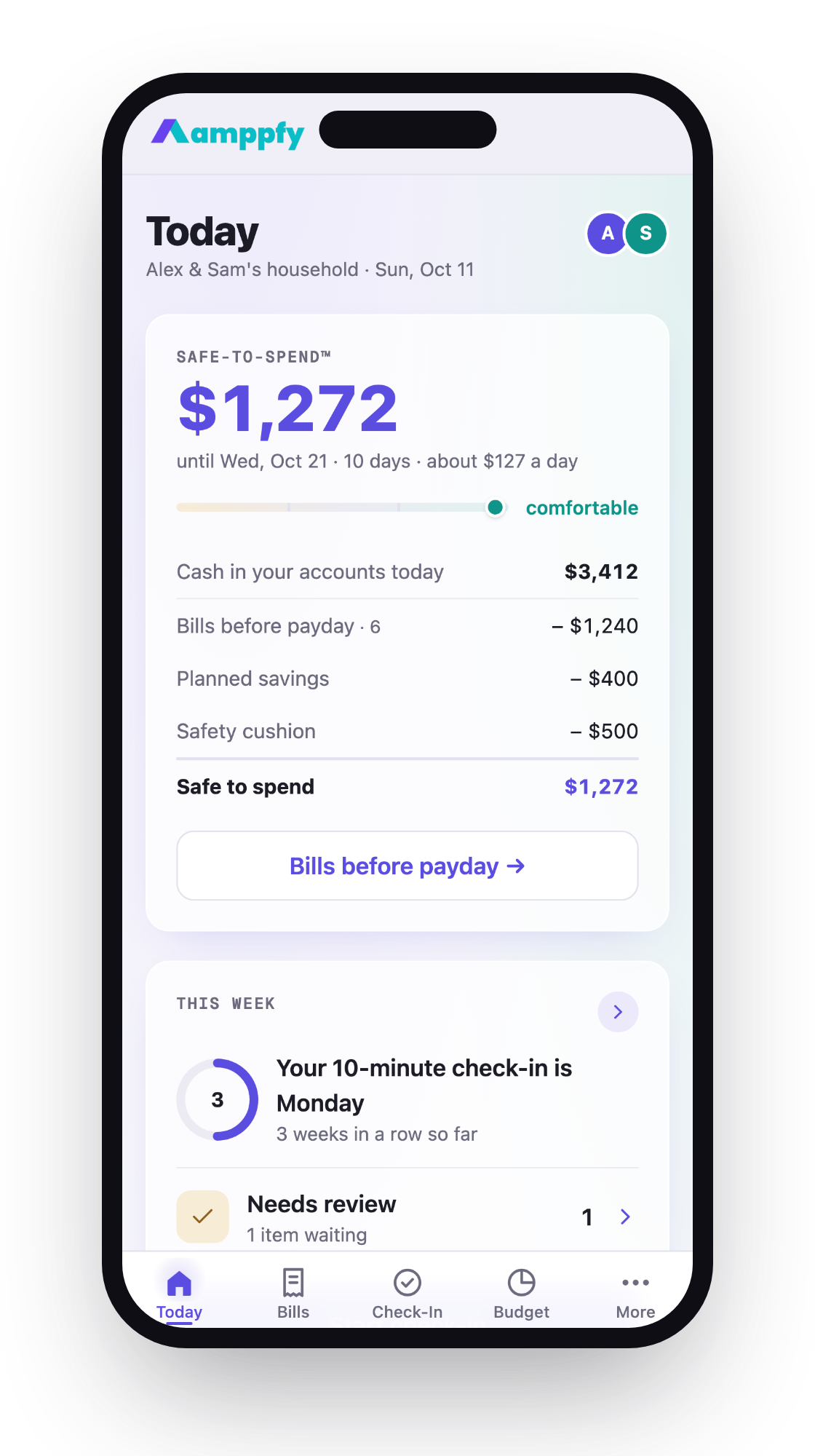
Your credit card minimum or full payment is one of those bills in the $1,100. It sits right alongside your electric bill and streaming subscriptions. Amppfy handles this math automatically: you enter your balances and bills once, and it shows one number that accounts for card payments, savings, and a cushion you pick. The weekly check-in takes about ten minutes.
The point is this: your card payment isn’t a surprise. It’s a known amount, on a known date, funded by a known paycheck. Treat it that way and it stops feeling unpredictable.
A Worked Example With Two Cards and Biweekly Pay
Meet Jess. She earns $2,600 every two weeks, paid on Fridays. Her next three paydays are February 6, February 20, and March 6. She has two credit cards.
| Card A (Groceries/Gas) | Card B (Online Shopping) | |
|---|---|---|
| Statement date | 2nd of each month | 18th of each month |
| Due date | 23rd of each month | 10th of each month |
| Current balance | $780 | $430 |
| Minimum payment | $25 | $25 |
| Jess’s planned payment | $400 | $430 (full payoff) |
Step 1: Assign Payments to Paychecks
Card B is due February 10. The closest preceding payday is February 6. So the February 6 paycheck covers Card B’s $430.
Card A is due February 23. The closest preceding payday is February 20. So the February 20 paycheck covers Card A’s $400.
Step 2: Check the Math
February 6 paycheck ($2,600):
- Rent: $1,200
- Card B payment: $430
- Utilities: $140
- Savings: $200
- Cushion: $300
- Safe-to-Spend: $330
February 20 paycheck ($2,600):
- Car insurance: $180
- Card A payment: $400
- Subscriptions: $55
- Savings: $200
- Cushion: $300
- Safe-to-Spend: $1,465
Step 3: Notice the Imbalance
The February 6 paycheck is tight. The February 20 paycheck has over four times the spending room. Jess could call Card B’s issuer and ask to move her statement date from the 18th to the 28th. That would push the due date from the 10th to roughly the 19th or 20th, letting her pay Card B from the February 20 paycheck instead. Now both paychecks share the load more evenly.
This is exactly the kind of rebalancing that turns a stressful month into a predictable one. No extra income needed. Just better timing.
If Jess uses Amppfy, both cards show up in her bill list with their due dates. The app flags the lowest-cash day in the month (February 7, the day after rent and Card B hit) and sends a heads-up the day before each bill is due.
Frequently Asked Questions
Can I change my credit card statement date?
Yes, most issuers allow it. Call the number on the back of your card or check the app/website settings. Ask to move your statement closing date, and the due date will shift automatically (staying 21-25 days later). Some issuers limit how often you can make this change: typically once every six months.
What happens if I pay my credit card between the statement date and the due date?
That’s the normal payment window. You’re paying the statement balance within the grace period, so no interest accrues on purchases (assuming you paid in full the prior month too). This is the standard approach for most cardholders.
Does paying before the statement date affect my credit score?
It can. The balance reported to credit bureaus is usually the balance on your statement date. Paying down your balance before that date lowers your reported utilization, which can improve your score. This is especially useful if you’re about to apply for a loan or new card.
Is there a penalty for paying too early?
No. There’s no penalty for paying your credit card early or multiple times per month. The only timing that triggers a penalty is paying late, after the due date. Early payments simply reduce your balance before the statement closes or before the due date arrives.
Making These Dates Work for Your Paycheck
The difference between a statement closing date and a payment due date is about three weeks of breathing room. Use that gap to your advantage. Assign each card to a specific paycheck. Move statement dates if two cards pile onto the same pay period. Pay before the statement closes when your credit report matters.
None of this requires earning more money. It’s about matching the timing of outflows to the timing of inflows. Take 15 minutes this week to write down your statement dates, due dates, and paydays side by side. The pattern will jump out, and the fix is usually a single phone call to your card issuer.
If you want one number that accounts for card payments, savings, and a cushion before your next payday, Amppfy is free and takes about ten minutes a week to maintain.