

Retirement changes the rhythm of money. You go from two or four paychecks a month to a single deposit, usually Social Security, a pension draw, or a scheduled withdrawal from savings. That shift doesn’t have to feel stressful. A fixed income budget built around one monthly deposit, a few simple habits, and a short weekly review can keep your finances calm and predictable. The goal isn’t to pinch every penny. It’s to know what’s safe to spend after every bill is covered and every surprise has a cushion. This guide walks through five practical steps that work whether you’re newly retired or ten years in.
One deposit a month and thirty days of bills
Most retirees receive one Social Security payment per month. In 2026, the average monthly benefit for retired workers rose to roughly $2,072[1] after a 2.8% cost-of-living adjustment. If you also draw from a 401(k), IRA, or pension, you can schedule those withdrawals on the same day your Social Security hits. One deposit date simplifies everything.
Start by listing every dollar that arrives on that date. Then subtract your fixed monthly obligations: housing, insurance premiums, utilities, phone, and any debt payments. Here’s a quick example of how the math might look for a single retiree:
| Line | Amount |
|---|---|
| Social Security deposit | $2,072 |
| Minus rent/mortgage | -$850 |
| Minus Medicare Part B premium | -$202.90 |
| Minus utilities and phone | -$190 |
| Minus car insurance (monthly share) | -$110 |
| Minus savings set-aside | -$100 |
| Minus cushion | -$200 |
| Safe to spend for the month | $419 |
That last line is your spending money for groceries, gas, prescriptions, and anything fun. Knowing it on day one of the month removes guesswork. You don’t need to wonder mid-month whether you can afford lunch out. You already know.
If you’re budgeting as a couple, the same structure works. Add both deposits, subtract shared bills, and split or share the remainder however you agree. The key is one clear number you both trust.
Spacing bills so the month does not end tight
A common problem with a monthly budget for retirees on fixed income: all the bills cluster in the first two weeks, and the last ten days feel empty-handed. You can fix this by spreading due dates across the month.
Most billers let you choose your due date. Call or log into each account and request a change. Here’s a simple framework:
- Week 1 (1st-7th): Rent or mortgage, Medicare premium
- Week 2 (8th-14th): Utilities, phone, internet
- Week 3 (15th-21st): Car insurance, any subscription services
- Week 4 (22nd-31st): Credit card payment, miscellaneous
Spreading bills this way means your checking account doesn’t crater on the 3rd and then sit idle. You always have a portion of your deposit still working for you.
One practical tip: keep a simple calendar with each bill’s due date and amount written on it. Paper works. A phone calendar works. Amppfy’s month calendar marks the lowest-cash day so you can see at a glance where the tight spot falls and adjust a due date before it pinches.
Don’t forget subscriptions. Streaming services, newspaper deliveries, and pharmacy auto-refills all pull from the same pot. List them with their next charge date. Cancel anything you haven’t used in 60 days. Even $12 a month adds up to $144 a year, and on a fixed deposit, that’s real money.
Planning for annual costs like insurance and property tax
Monthly bills are predictable. Annual and semi-annual bills are the ones that catch people off guard. Property tax, homeowner’s insurance, car registration, a supplemental Medicare plan: these arrive once or twice a year and can run into the hundreds or thousands.
The fix is straightforward. List every non-monthly expense you paid last year. Divide each by 12. Set that amount aside every month in a separate savings account or a labeled envelope.
| Annual expense | Yearly cost | Monthly set-aside |
|---|---|---|
| Property tax | $2,400 | $200 |
| Homeowner’s insurance | $1,200 | $100 |
| Car registration | $180 | $15 |
| Holiday gifts | $360 | $30 |
| Total monthly set-aside | $345 |
When the bill arrives in October or March, the money is already sitting there. No scramble. No dipping into next month’s groceries.
The Medicare Part B premium for 2026 is $202.90 per month[2], and the annual deductible rose to $283. If you pay that deductible out of pocket early in the year, setting aside a small amount each month through the prior year keeps it painless. The same logic applies to dental work, eye exams, or any cost that hits once and hits hard.
Tax season deserves a mention too. If you owe taxes on retirement withdrawals, estimate the annual amount and divide by 12. Treat it like any other bill.
A cushion for medical and home surprises
A retired couple at 65 can expect to spend a significant amount on healthcare over the course of retirement. Fidelity projects that a 65-year-old retiring in 2026 may face roughly $185,500 in medical expenses through retirement[3], a 7.5% jump from the prior year. That number covers Medicare premiums, deductibles, copays, and out-of-pocket prescription costs over many years.
You can’t plan for every medical bill. But you can build a cushion that absorbs the small ones without wrecking your month. A reasonable starting cushion is one month’s worth of fixed expenses. If your bills total $1,500, keep $1,500 untouched in your checking account at all times.
How to build it gradually
If you don’t have a cushion yet, don’t try to save it in one month. Set aside $50 or $75 per deposit. In six to twelve months, you’ll have a buffer that handles a surprise copay, a plumbing repair, or a new set of tires.
What counts as a surprise
- An unplanned specialist visit or lab test
- A home repair: furnace, roof leak, appliance failure
- A car repair that isn’t covered by warranty
- A prescription that jumps in price mid-year
The cushion isn’t an emergency fund for catastrophic events. It’s a shock absorber for the $200 to $800 surprises that happen a few times a year. If you dip into it, refill it over the next two or three months.
Think of the cushion as a line in your monthly math. Using the earlier example: $2,072 deposit minus $1,353 in bills minus $100 savings minus $200 cushion equals $419 safe to spend. The cushion sits between your bills and your spending money, protecting both.
A weekly check-in that takes ten minutes
A retiree’s budget on fixed monthly income doesn’t need daily attention. It needs ten minutes once a week. Pick a morning, maybe Tuesday with coffee, and do three things:
- Check your bank balance and compare it to what you expected.
- Look at the next seven days of bills. Confirm the money is there.
- Update your safe-to-spend number if anything changed.
That’s it. No spreadsheet marathon. No guilt. Just a quick confirmation that reality matches your plan.
What to look for during the check-in
- A bill that posted for a different amount than expected
- A subscription charge you forgot about
- A deposit that hasn’t arrived yet
- Your cushion balance: is it still intact?
If something is off, you catch it early. A $40 surprise on Tuesday is easy to absorb. A $40 surprise on the 28th, when you’ve already spent your safe-to-spend amount, is not.
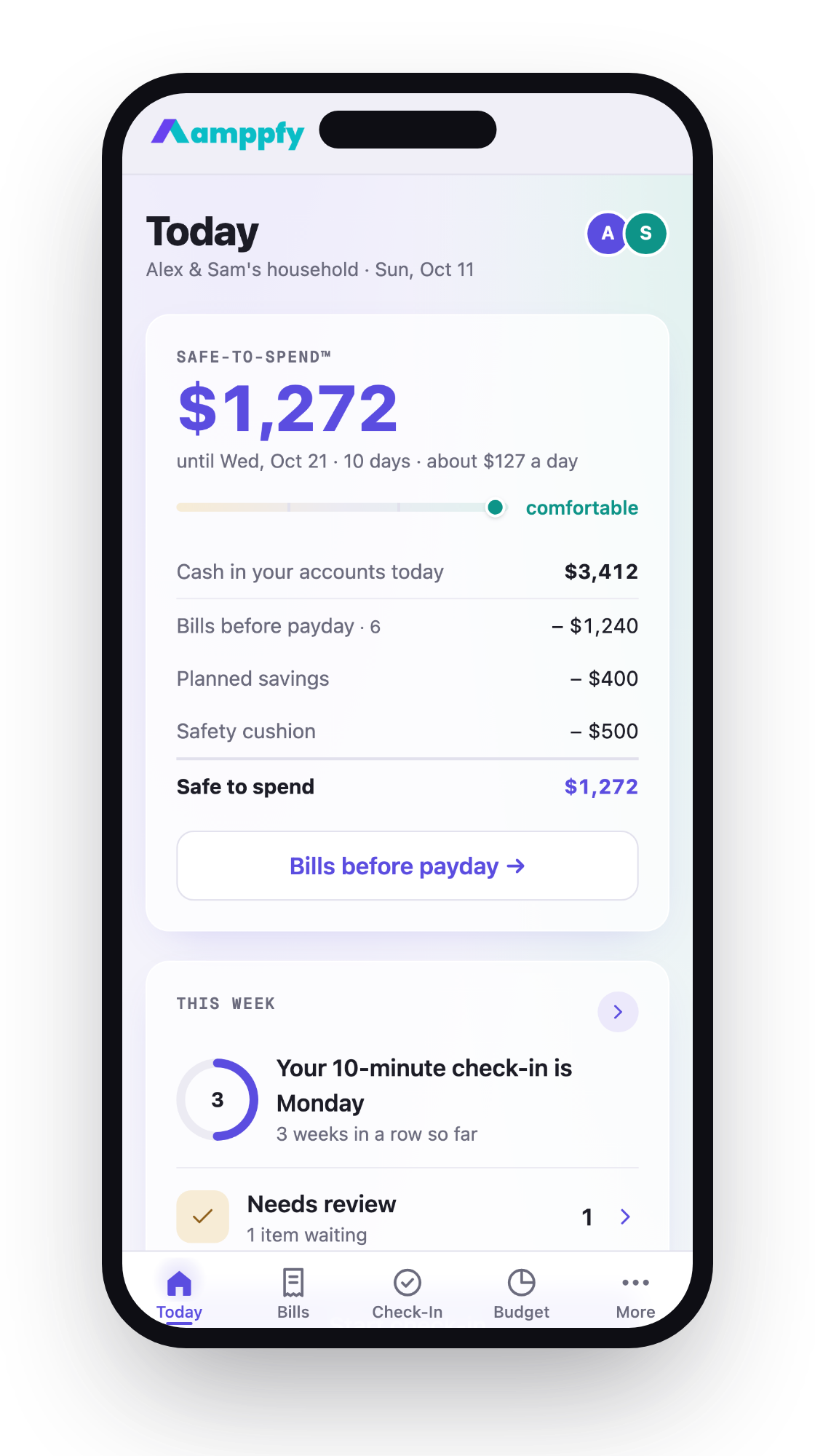
Amppfy is built around this kind of quick weekly review. You enter your balances yourself, about 30 seconds per account, and the app shows your Safe-to-Spend number with the math printed right below it. Bills roll forward automatically, and you get a heads-up the day before one is due. The whole check-in fits inside a coffee break.
If you budget with a partner, the check-in works the same way. One of you updates the balances. Both of you see the same number. No second chore, no separate spreadsheet.
Frequently Asked Questions
How much should a retiree keep in checking versus savings?
A good rule of thumb: keep one month of fixed expenses plus your cushion in checking. Everything else can sit in a savings account earning interest. For the example above, that’s roughly $1,553 in bills plus a $200 cushion, so about $1,750 stays in checking. Surplus goes to savings where it works harder.
What if my Social Security doesn’t cover all my bills?
You’ll need a second income source: a pension, a scheduled IRA withdrawal, or part-time work. Add all income sources together as your single monthly deposit. The budgeting method stays the same. If there’s still a gap, look at your bill list and find the flexible expenses (cable, subscriptions, dining) you can reduce.
Should I pay bills manually or use autopay?
Autopay removes the risk of missing a due date, which matters on a fixed income. But set calendar reminders to verify each charge posted correctly. Autopay works best for bills that stay the same each month: rent, insurance, Medicare. For variable bills like utilities, manual payment gives you a chance to review the amount first.
How do I handle inflation on a fixed budget?
Social Security’s annual COLA helps, but it doesn’t always match real price increases. Review your budget every January after the new COLA takes effect. Adjust your set-asides for annual costs and your cushion target. If groceries or utilities jumped, trim a discretionary category by the same amount to keep the math balanced.
A Calm Month, Every Month
Retirement income doesn’t grow with overtime or a bonus. What you deposit is what you have. That constraint, handled well, actually makes budgeting simpler than it ever was during your working years. One deposit, bills spaced across the month, annual costs broken into monthly pieces, a cushion for surprises, and a ten-minute weekly check-in. Five habits, repeated.
If you want a single number that tells you what’s safe to spend after bills, savings, and your cushion are covered, Amppfy is free and takes about five minutes to set up. Start with just your balances and your next few bills. The rest fills in as you go.