Your last parental leave payment hit the account weeks ago. Your first full paycheck hasn’t landed yet. Somewhere in between, a childcare deposit is already due. Returning to work after parental leave with a new budget line item is one of the most disorienting money moments a family faces. The math you relied on before leave doesn’t apply anymore, and the math you need going forward has a big new variable: recurring childcare costs that rival rent in many U.S. cities. This guide walks through the real sequence of money events, week by week, so you can restart your household budget without guessing what’s safe to spend.
The gap between the last leave payment and the first paycheck
Most parents don’t return to work on a payday. There’s almost always a gap between the final leave benefit (state disability, PFL, employer short-term disability, or saved PTO) and the first regular paycheck. That gap can be one week or three, depending on your employer’s pay cycle and your state’s benefit timing.
How the gap actually looks
Picture this: your last paid family leave deposit was April 11. Your return date is April 21. Your employer pays biweekly, next check May 2. That’s 21 days between incoming deposits. If your household runs on a two-week rhythm, you just added an extra week of bills with no new income.
Here’s a quick comparison of common leave-to-paycheck gaps:
| Leave type | Typical last payment | First paycheck after return | Likely gap |
|---|---|---|---|
| State PFL (CA, NY, NJ) | 1-2 weeks after last covered day | Next scheduled payday | 7-21 days |
| Employer short-term disability | Aligns with payroll | Next scheduled payday | 0-14 days |
| Unpaid FMLA (savings only) | N/A | Next scheduled payday | Varies widely |
What to do right now
- Call payroll before your return date. Confirm exactly when your first check will process and whether it’s a full or partial cycle.
- Check your state benefit portal. Some states issue a final payment after you report your return, which can add another 5-10 day delay.
- Add up fixed costs that fall inside the gap: rent or mortgage, utilities, insurance premiums, and that first childcare payment.
- If the gap math is tight, move money from savings to checking now rather than scrambling later.
The goal isn’t to panic. It’s to know the exact number of days you’re covering on old money so you can plan around it.
Childcare as a fixed bill with a due date
Childcare doesn’t behave like groceries. You can’t scale it down in a tight week. It’s a fixed obligation with a specific due date, often the first of the month, sometimes biweekly. Miss it and you risk losing your spot.
According to the U.S. Census Bureau’s 2023 Survey of Income and Program Participation, families with children under five who paid for childcare spent a median of about $600 per month. In high-cost metro areas, that number easily doubles or triples. Treat this line item like rent: non-negotiable and due on time.
Fitting childcare into your pay cycle
The trick is aligning the childcare due date with the right paycheck. If you’re paid biweekly, one check each month will carry the childcare bill. That check is now structurally smaller than the other one.
- Ask your provider about payment timing. Some centers allow you to split into two payments per month.
- Label one paycheck as the “childcare check” in your budget. Subtract childcare first, then allocate what’s left.
- If your partner also earns income, decide which paycheck covers childcare. Splitting it across two pay cycles reduces the single-check hit.
A simple example: you bring home $2,800 every two weeks. Childcare is $1,400 per month. If you pay it all from one check, that check drops to $1,400 before any other bill. If you split it, each check absorbs $700, which is much easier to manage.
Childcare is also the bill most likely to increase annually. Build in a 3-5% annual bump when you’re projecting costs for the year ahead.
Re-assigning household bills across two paychecks again
Before leave, you probably had a system: certain bills came from the first paycheck, others from the second. Leave scrambled that rhythm. Now you’re rebuilding it with one major new expense and possibly a different take-home amount (new tax withholding, benefit elections, or a changed schedule).
Step-by-step reassignment
- List every recurring bill with its due date and amount. Include subscriptions, loan payments, insurance, utilities, and childcare.
- Map each bill to the paycheck that arrives before its due date. Don’t rely on the paycheck that arrives the same week: use the one before.
- Total each paycheck’s assigned bills. If one check is overloaded, call a biller and shift a due date. Most utilities and credit card issuers will move your due date once per year for free.
- Subtract bills and a savings contribution from each paycheck. What’s left is your actual spending money.
Here’s what that math looks like for one paycheck:
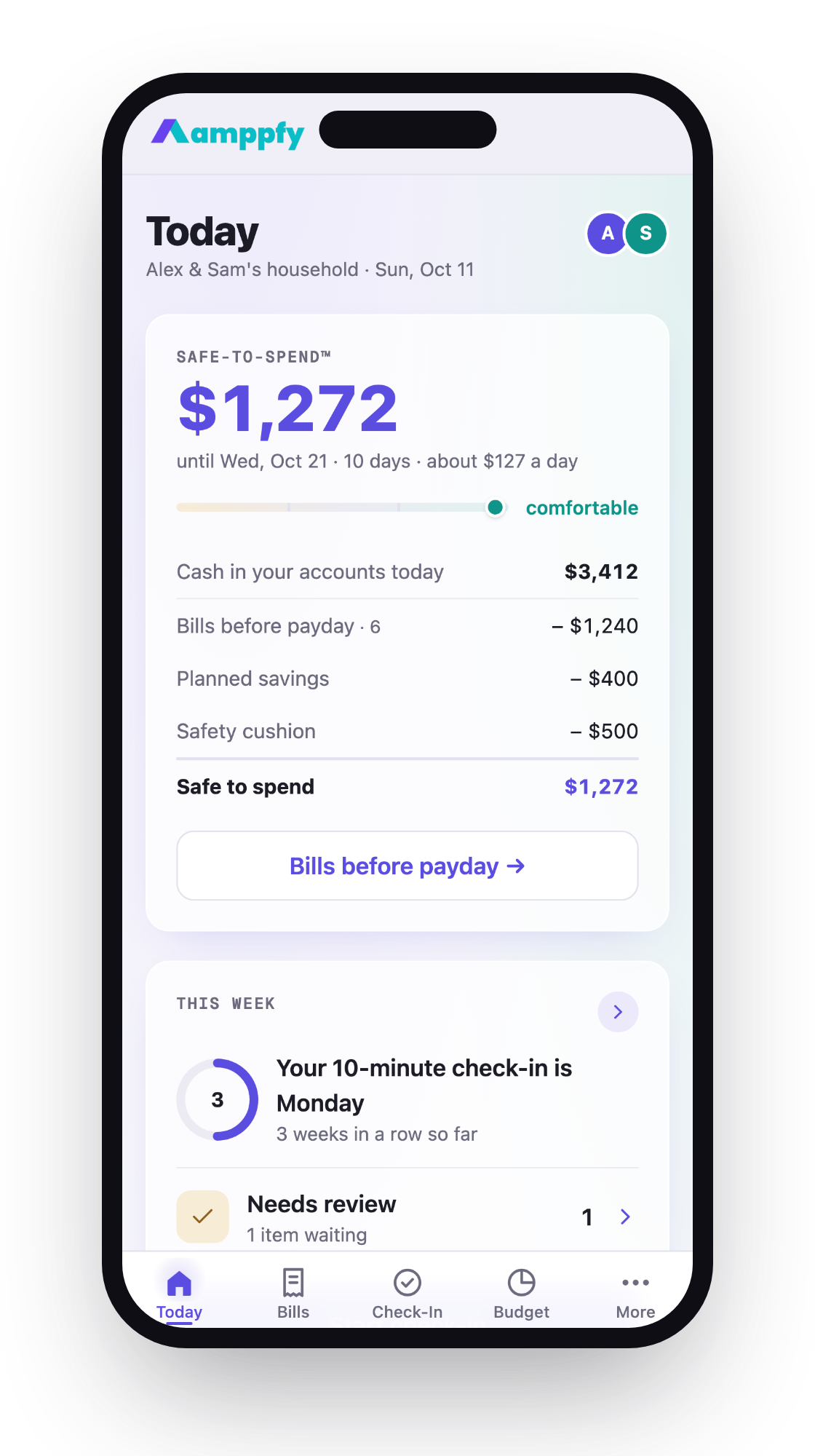
$2,800 cash – $1,540 bills – $200 savings – $300 cushion = $760 Safe-to-Spend™
That $760 is what you can actually use for groceries, gas, and everything else until the next payday. Seeing one number instead of juggling five apps is the whole point. Amppfy shows this calculation automatically: enter your balances, bills, paydays, and a cushion, and it returns one Safe-to-Spend number with the math printed underneath.
Watch for these common traps
- Annual or quarterly bills you forgot about (car registration, life insurance premiums, property tax escrow changes).
- New benefit deductions from open enrollment changes you made during leave.
- Subscriptions you added during leave (streaming, meal kits, baby apps) that now compete with childcare for space.
Audit subscriptions ruthlessly. A $15 streaming service doesn’t matter much alone, but four of them equal $60 a month, nearly a week of groceries.
Rebuilding the cushion you spent on leave
Most families dip into savings during leave. That’s what savings are for. But coming back to a thinner emergency fund while adding childcare costs creates real vulnerability. One car repair or urgent-care copay can knock the whole month off track.
The Federal Reserve’s 2023 Survey of Household Economics and Decisionmaking found that 37% of U.S. adults would struggle to cover an unexpected $400 expense with cash or its equivalent. After leave, you might temporarily be in that group even if you weren’t before.
A realistic rebuild plan
Don’t try to refill your emergency fund in 60 days. That pressure leads to cutting too deep, burning out, and abandoning the plan entirely. Instead, aim for a small, automatic weekly transfer that you barely feel.
- Pick a weekly amount between $25 and $75. Even $25 per week rebuilds $1,300 in a year.
- Automate the transfer for the day after payday. Money you don’t see is money you don’t spend.
- Set a first milestone: one month of childcare costs in savings. For a $1,400 monthly childcare bill, that’s $1,400 saved before you worry about a full three-month emergency fund.
- Redirect any windfalls: tax refunds, back-pay adjustments, or rebates from your dependent care FSA.
If you and a partner share finances, agree on the rebuild target together. Amppfy lets both partners see the same Safe-to-Spend number from separate logins, so neither person has to guess whether the other already moved money.
Rebuilding is slow. That’s fine. The point is consistent forward motion, not speed.
A two-week settling-in plan
Your first two weeks back at work set the financial tone for the months ahead. Here’s a concrete day-by-day plan to get your post-leave budget running.
Week 1: Confirm the numbers
| Day | Action |
|---|---|
| Day 1 | Verify your first paycheck stub (gross pay, deductions, net). Flag anything unexpected. |
| Day 2 | Enter your current checking and savings balances into your budgeting tool. Takes about 30 seconds per account in Amppfy. |
| Day 3 | List every bill due in the next 30 days with amounts and due dates. |
| Day 4 | Assign each bill to a specific paycheck. Adjust due dates if one check is overloaded. |
| Day 5 | Set your weekly savings auto-transfer amount. Start small. |
Week 2: Stress-test and adjust
| Day | Action |
|---|---|
| Day 8 | Review actual spending from Week 1. Did groceries, gas, or takeout exceed what you expected? |
| Day 9 | Cancel or pause any subscriptions you haven’t used in 30 days. |
| Day 10 | Confirm your childcare payment processed correctly. Check for late fees or billing errors. |
| Day 12 | Do a 10-minute check-in: update balances, review upcoming bills, note your Safe-to-Spend number. |
| Day 14 | Decide if your cushion amount is realistic. Adjust up or down based on what Week 1 taught you. |
After these two weeks, shift to a weekly check-in every payday. Ten minutes keeps the numbers honest without turning budgeting into a second job.
Frequently asked questions
Should I change my tax withholding when I return from parental leave?
Yes, review your W-4. Adding a dependent may change your withholding, and if you received taxable state leave benefits, your year-to-date withholding might be lower than expected. Use the IRS Tax Withholding Estimator before your first full paycheck to avoid a surprise at tax time.
What if my childcare costs more than my take-home pay?
Run the math on net income, not gross. Include your employer’s dependent care FSA (up to $5,000 pre-tax in 2026 for married filing jointly) and the Child and Dependent Care Tax Credit. For some families, the after-tax cost of working is tight but positive once you factor in retirement contributions, health insurance, and career trajectory. If the number is genuinely negative, part-time or adjusted schedules may make more sense financially.
How do I budget when my partner and I have different pay schedules?
Map each person’s pay dates on a calendar alongside every household bill. Assign each bill to whichever paycheck arrives first before the due date. If you use a shared tool, both partners can see the same spending number without merging bank accounts or sharing passwords.
How long does it take to stabilize a post-leave budget?
Most families find a workable rhythm within two to three pay cycles, roughly four to six weeks. The first month involves the most adjustments: shifted due dates, new deductions, and childcare billing surprises. By month two, the pattern is usually predictable enough that a weekly check-in is all you need.
Your next step
Going back to work with a child in daycare rewrites your household math. The paycheck gap, the new fixed bill, the thinner savings: none of it is permanent, but all of it needs a plan. Start with the two-week settling-in checklist above. Get your bills assigned to the right paychecks. Set one small auto-transfer toward rebuilding your cushion. And give yourself a single number that tells you what’s actually safe to spend before the next payday. If you want that number calculated for you, Amppfy is free and takes about 10 minutes to set up at amppfy.com/app/.