

You earn every other Friday. Your partner gets paid on the 1st and the 15th. Bills don’t care about either schedule. That mismatch is why so many couples feel broke mid-month even when the household income is solid. When two people budget around different paydays, the calendar itself becomes the problem: money arrives in bursts, bills cluster in clumps, and the gap between deposits can stretch uncomfortably long. This guide walks through a practical system for syncing two pay schedules into one plan that actually holds up week to week.
Two paychecks, four dates: why the month feels random
Most budgeting advice assumes a single monthly income. That’s not how most two-income households work. According to the Bureau of Labor Statistics, roughly 78% of U.S. workers in 2025 were paid biweekly or semimonthly. Put two of those schedules in one household and you could have four separate deposit dates in a single month, sometimes five.
The real headache isn’t the number of paydays. It’s that bills don’t shift to match them. Rent hits on the 1st whether or not either of you just got paid. A car payment on the 20th might land three days before one paycheck and eleven days after another. The result: some weeks feel flush, other weeks feel empty, and neither of you can say with confidence what’s actually safe to spend right now.
This creates two common traps. First, the “flush week” trap: one partner gets paid and the checking account looks healthy, so a dinner out or an impulse buy feels fine. But that balance is already spoken for by bills due before the next deposit. Second, the “coverage gap” trap: there’s a stretch of days when neither paycheck has landed, and the account dips low enough to trigger stress or even an overdraft.
Neither trap means you’re doing anything wrong. It just means your system hasn’t accounted for timing yet. That’s fixable.
Map both pay dates and every shared bill on one calendar
The fix starts with visibility. You need one view that shows every dollar coming in and every dollar going out, plotted by date.
Build the calendar in three steps
- Write down every pay date for the next two months. If you’re biweekly, count forward from your last check. If you’re semimonthly, lock in the 1st and 15th (or whatever your employer uses).
- List every recurring bill with its due date: rent, utilities, insurance, subscriptions, loan payments, daycare. Include the amount.
- Plot them together. A shared Google Calendar works. A whiteboard on the fridge works. Amppfy’s month calendar works too: it marks the lowest-cash day automatically, which is exactly the date you’re hunting for.
What to look for
Once everything is on one calendar, patterns jump out fast. You’ll probably spot a cluster of bills in the first five days of the month. You’ll see which paycheck lands right before that cluster and which one lands too late to help. You’ll also find the quiet stretches where no money moves at all.
| Week of month | Partner A pay | Partner B pay | Bills due | Net cash flow |
|---|---|---|---|---|
| 1st – 7th | $2,100 (1st) | – | Rent $1,500, insurance $180 | +$420 |
| 8th – 14th | – | $1,800 (10th) | Internet $65, electric $110 | +$1,625 |
| 15th – 21st | $2,100 (15th) | – | Car $340, daycare $600 | +$1,160 |
| 22nd – 28th | – | $1,800 (24th) | Subscriptions $45 | +$1,755 |
This table is an example, but your version will tell you exactly where the pressure points sit.
Assign each bill to the paycheck that lands first
Now that you can see the full picture, assign ownership. Each bill gets matched to the paycheck that arrives just before it’s due. This isn’t about who “should” pay what. It’s about timing.
The matching rule
Pick the paycheck that hits closest before the bill’s due date. If rent is due on the 1st and Partner A gets paid on the 1st, that paycheck covers rent. If the car payment is due on the 20th and Partner B gets paid on the 17th, Partner B’s check covers the car.
Here’s a simple assignment table using the same example:
| Bill | Due date | Assigned to | Paycheck date |
|---|---|---|---|
| Rent | 1st | Partner A | 1st |
| Insurance | 3rd | Partner A | 1st |
| Internet | 10th | Partner B | 10th |
| Electric | 12th | Partner B | 10th |
| Car payment | 20th | Partner A | 15th |
| Daycare | 18th | Partner A | 15th |
| Subscriptions | 25th | Partner B | 24th |
When it feels uneven
One partner might end up covering more bills simply because their pay dates line up with more due dates. That’s a timing decision, not a fairness problem. If the dollar amounts feel lopsided, balance it with a transfer. Partner B sends Partner A $300 on the 10th to offset the heavier first-of-month load, for example. Keep the transfer amount fixed each month so it becomes automatic.
The goal is simple: every bill has a name on it and a paycheck funding it before it’s due. No guessing, no last-minute scrambles.
One household number both of you can read
Splitting bills by paycheck solves timing. But you still need a way to answer the daily question: what can we actually spend right now without putting a future bill at risk?
How the math works
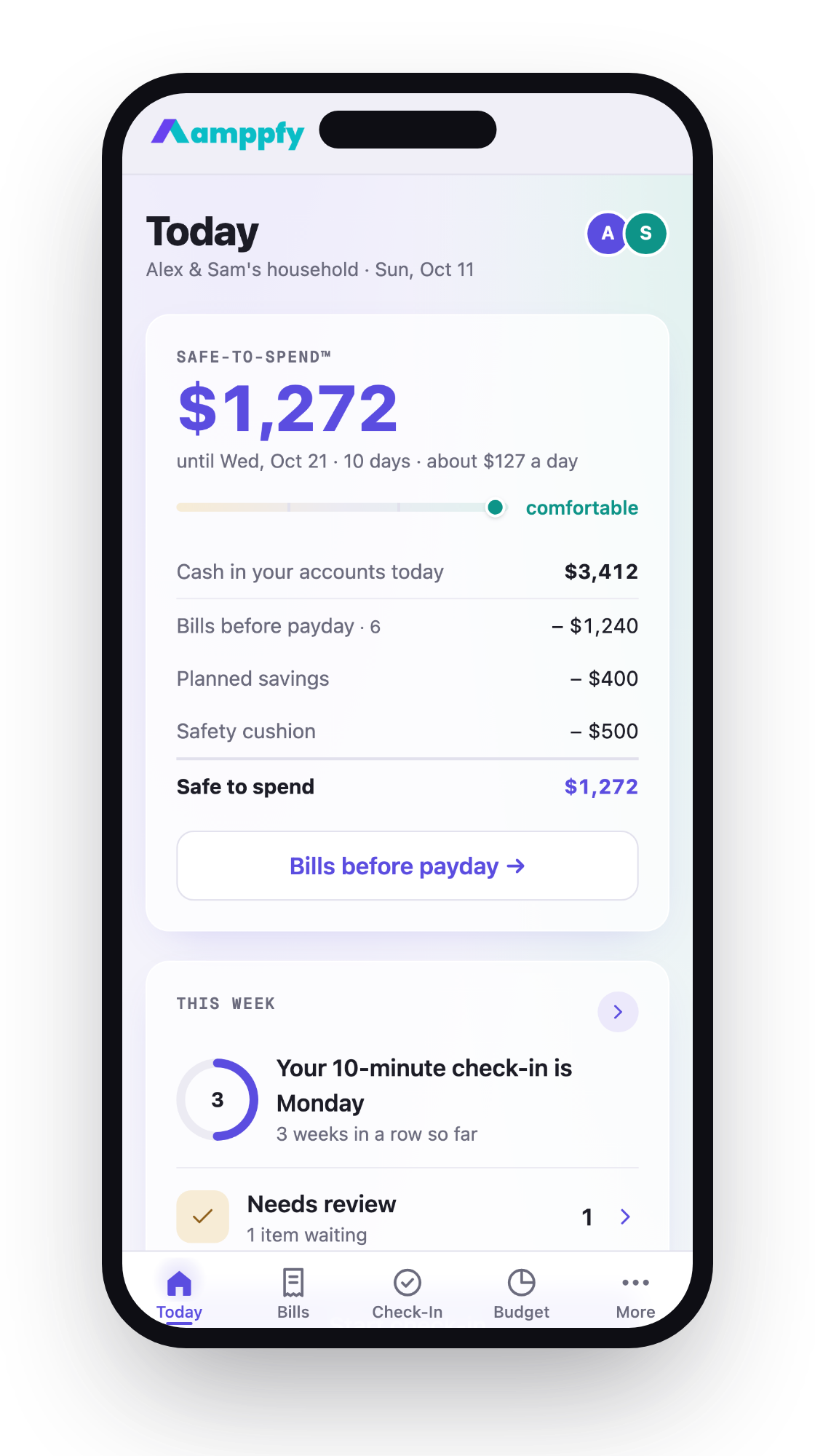
Take your current cash. Subtract every bill due before your next payday. Subtract whatever you’ve agreed to save. Subtract a cushion for the unexpected. What’s left is safe to spend.
Here’s a worked example for Partner A after the 1st paycheck:
$2,100 cash – $1,680 bills – $200 savings – $150 cushion = $70
That $70 is the real spending money until the 15th. It might feel tight, but it’s honest. And honest is better than surprised.
Make it visible to both partners
When couples budget around different paydays, both people need to see the same number. Otherwise one partner spends assuming the balance is free while the other is mentally reserving it for a bill. This is where a shared tool matters more than a shared account.
Amppfy handles this by showing both partners one Safe-to-Spend number with the four-line math printed underneath. Each person logs in separately, private balances stay private, but the household number is identical. You update your balances once a week: about 30 seconds per account, no bank login required. The weekly check-in takes roughly ten minutes.
You don’t need Amppfy to do this. A shared spreadsheet works if both of you actually open it. The principle is the same: one number, visible to both, updated regularly.
Handling the week when neither of you gets paid
Every couple with mismatched pay schedules has at least one week per month where no deposit lands. This is the gap week, and it’s where most budgets break.
Three ways to bridge the gap
- Build a buffer in your checking account. Keep one week’s worth of shared bills as a floor. For most households, that’s $400 to $800. Don’t touch it. Think of it as a permanent resident of your checking account, not savings.
- Time your variable spending. Groceries, gas, and household supplies should be purchased right after a payday, not during the gap. A Sunday meal plan built around the pay calendar keeps the fridge full when the account is quiet.
- Use the gap week for a no-spend reset. No eating out, no impulse purchases, no online orders. It’s not punishment. It’s just the week you coast.
What if the gap is longer than a week?
Some biweekly and semimonthly combinations create a ten-day stretch with no income. If that’s your situation, consider calling one or two billers to shift due dates. Most utility companies, insurance providers, and even some landlords will adjust. A five-minute phone call can move a bill from the gap week to the day after a paycheck, permanently.
The gap week doesn’t have to feel like a crisis. With a buffer in place and spending timed around deposits, it becomes the quietest week of the month.
Frequently asked questions
Should we combine bank accounts if our paydays don’t match?
You don’t have to. Many couples keep separate checking accounts and use a joint account only for shared bills. Each partner transfers their assigned bill money into the joint account right after payday. This keeps personal spending separate while ensuring shared bills are always funded on time. The structure matters more than the account type.
How do we handle months with an extra paycheck?
If you’re paid biweekly, you’ll get 26 paychecks per year, which means two months will have three paydays instead of two. Decide in advance what that extra check covers. Common choices: topping off your emergency fund, paying down debt, or funding a specific savings goal. Don’t absorb it into regular spending, because next month reverts to two checks and you’ll feel the squeeze.
What if one partner earns significantly more than the other?
Split bills by proportion, not 50/50. If Partner A earns 60% of household income, they cover 60% of shared costs. The paycheck-to-bill assignment still follows timing, but the balancing transfer between partners adjusts to reflect the income ratio. This keeps things fair without making every bill a negotiation.
How often should we review the system?
A ten-minute weekly check-in is enough to update balances and confirm nothing shifted. Do a deeper review once a quarter: look for bills that changed amounts, subscriptions you forgot about, or due dates that drifted. If either partner changes jobs or pay frequency, rebuild the calendar from scratch that same week.
Make the calendar do the work
Mismatched pay schedules aren’t a flaw in your finances. They’re just a scheduling problem, and scheduling problems have scheduling solutions. Map the dates, assign the bills, agree on one number you both trust, and plan for the gap week. That’s the whole system.
If you want a tool that does most of this automatically, Amppfy is free and built for exactly this situation: two partners, different paydays, one Safe-to-Spend number with the math showing. Set it up in about ten minutes this weekend and see what your real spending room looks like before your next paycheck lands.