Money fights don’t usually start with big purchases. They start with the electric bill, the groceries, or a streaming subscription nobody remembers signing up for. Figuring out how couples divide shared expenses is one of those quiet problems that gets louder over time. The good news: a simple system, set once and revisited rarely, can take the tension out of it. About 23% of married couples now have no joint bank accounts at all[1], up from 15% in 1996. Whether you pool everything or keep things separate, the real question isn’t which account the money sits in. It’s whether the split feels fair to both of you.
Three fair ways to split: 50/50, by income, by bill
Most couples land on one of three approaches. Each has a clear logic, and none is automatically wrong.
| Method | How it works | Best fit |
|---|---|---|
| 50/50 | Each partner pays exactly half of every shared expense | Similar incomes, similar spending habits |
| Income-proportional | Each partner contributes a percentage that matches their share of household income | Different incomes, shared lifestyle |
| Bill-by-bill | Each partner “owns” specific bills (one pays rent, the other pays utilities and groceries) | Couples who prefer simplicity over precision |
The 50/50 split is the easiest to calculate. You add up shared costs, divide by two, done. It works well when both partners earn roughly the same amount. But if one person earns $90,000 and the other earns $45,000, a straight half-split leaves the lower earner with far less breathing room.
The income-proportional method fixes that gap. Financial experts recommend this approach[2] so both partners keep a similar percentage of discretionary income after shared bills. If your combined income is $10,000 a month and you earn $6,500 of it, you’d cover 65% of shared expenses.
The bill-by-bill method skips percentages entirely. One person handles rent and insurance. The other covers groceries, utilities, and subscriptions. It’s informal and fast, but it can drift out of balance if costs shift. A $200 grocery bill in January might be $300 by June.
Pick the method that matches your income gap and your tolerance for math. The next section helps you decide.
Choosing the method that fits your incomes
Start with one number: the gap between your two incomes. If you and your partner earn within about 10-15% of each other, a 50/50 split is usually fine. Beyond that range, proportional tends to feel more fair.
Here’s a quick worked example. Say your household brings in $8,000 a month total. Partner A earns $5,000 (62.5%). Partner B earns $3,000 (37.5%). Your shared expenses: $4,000 a month.
- Partner A pays: $4,000 x 0.625 = $2,500
- Partner B pays: $4,000 x 0.375 = $1,500
Both partners still have the same percentage of their income left for personal spending, savings, and fun money. The concept behind this is sometimes called the “Equal Pinch” principle[3]: fairness measured by the impact on each person’s remaining quality of life, not by the dollar amount.
What if one partner doesn’t earn income right now?
This happens. Parental leave, a career change, grad school. The proportional method still works: the earning partner covers 100% of shared costs during that stretch. What matters is that you’ve agreed on the system in advance, so nobody has to ask or feel awkward about it.
What about the bill-by-bill approach?
Use it when you both dislike spreadsheets and your incomes are close. Assign bills so the totals roughly balance. Just check the math once a quarter. Bills creep up, and the partner who “owns” groceries might quietly absorb a bigger share over six months.
The real goal isn’t perfect math. It’s a system both of you can explain in one sentence. “We each pay our share of income” or “I handle rent, you handle everything else” both work, as long as neither person feels squeezed.
Setting it up once so nobody keeps a ledger
The worst version of splitting expenses is the one where someone keeps a running tab in their head. That mental scorekeeping builds resentment faster than any dollar amount.
Set up your system in one sitting. Here’s a step-by-step:
- List every shared expense. Rent or mortgage, utilities, groceries, insurance, streaming services, pet costs, childcare. Write them all down.
- Total them up. Get one monthly number.
- Pick your method (50/50, proportional, or bill-by-bill) based on the income gap conversation above.
- Decide how money moves. Options: a joint account you both fund, Venmo transfers on payday, or each person auto-paying their assigned bills directly.
- Automate what you can. Set up auto-pay for fixed bills. Schedule transfers for the same day each month.
The joint-account approach has some research behind it. A study published in the Journal of Consumer Research found that couples using joint accounts maintained higher relationship quality and better alignment on financial goals over two years. You don’t need to merge everything. A single shared account for shared bills, funded by each partner’s contribution, keeps things clean.
A practical example
Your shared expenses total $4,200 a month. You’ve chosen the proportional method. Partner A earns 60%, Partner B earns 40%.
- Partner A transfers $2,520 to the joint account on the 1st
- Partner B transfers $1,680 on the 1st
- All shared bills auto-pay from that account
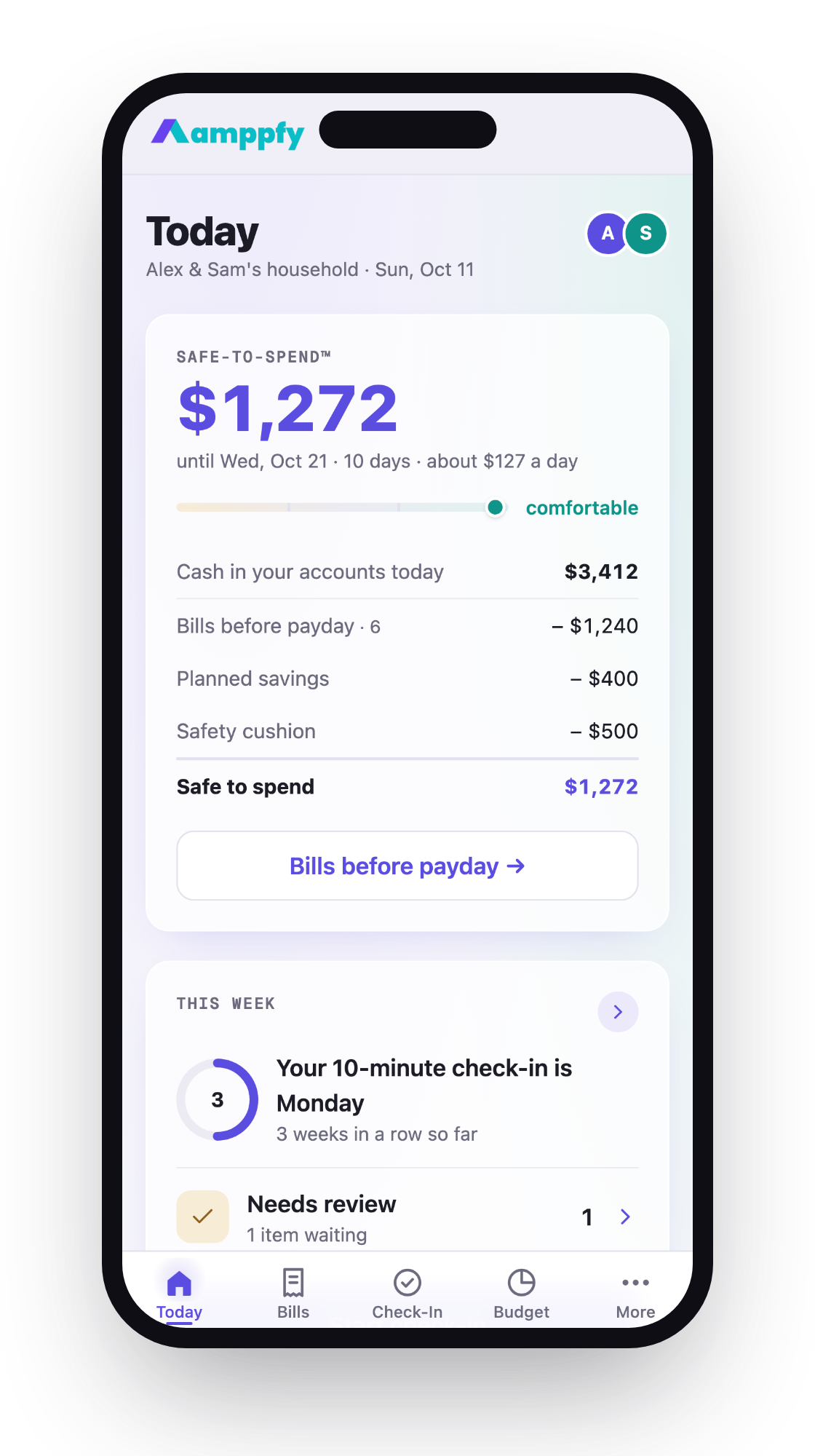
That’s it. No Venmo requests. No “you owe me for the electric bill” texts. If you want one place to see whether that shared account can cover everything before payday, Amppfy shows a single Safe-to-Spend™ number with the math printed underneath: cash minus bills due minus savings minus your chosen cushion. Both partners see the same number with their own login.
Once the system is running, you shouldn’t think about it more than ten minutes a week. The point is to set it and step away.
What to do when one partner’s income changes
A raise, a job loss, a side hustle that takes off, parental leave: income shifts happen. Your split should shift with it.
If you’re using the proportional method, the adjustment is straightforward. Recalculate each partner’s share of total household income. Apply the new percentages to shared expenses. Update the auto-transfers.
Say Partner B gets a raise from $3,000 to $4,000 a month. Household income goes from $8,000 to $9,000. Partner A now earns 55.6% instead of 62.5%. Partner B goes from 37.5% to 44.4%. On $4,200 in shared expenses:
- Partner A: $4,200 x 0.556 = $2,335 (down from $2,520)
- Partner B: $4,200 x 0.444 = $1,865 (up from $1,680)
When the change is temporary
A layoff or parental leave doesn’t require a permanent overhaul. Agree on a temporary arrangement: “For the next three months, I’ll cover 80% while you job search.” Put a date on it. Revisit on that date. Having a timeline prevents the temporary fix from becoming a source of tension.
When the change is a windfall
Bonuses, freelance windfalls, and tax refunds don’t need to change your monthly split. Those are one-time events. Keep the monthly system based on regular income. Use windfalls for shared goals, personal savings, or fun, but don’t recalculate your percentages every time someone picks up extra work.
The key habit: any time regular income changes by more than 10%, sit down for fifteen minutes and update the numbers. That’s the whole process.
Reviewing the split twice a year, not every month
Monthly reviews sound responsible. In practice, they’re exhausting. You end up relitigating the same numbers every four weeks, and it starts to feel like a chore neither of you wants.
Twice a year is enough. Pick two dates that are easy to remember: January and July, or the months after you file taxes and after summer. During each review, cover three things:
- Have either of your incomes changed since last time?
- Have shared expenses gone up or down? (Check for new subscriptions, rate increases on insurance, or a rent bump.)
- Does the current split still feel fair to both of you?
That third question matters most. Math can be correct and still feel wrong. If one partner is stressed about money and the other isn’t, the system needs a tweak regardless of what the percentages say.
Red flags that signal an off-schedule review
- One partner starts avoiding conversations about money
- A major life event: new baby, home purchase, job change
- Shared expenses jump by more than $500 a month
- One partner consistently dips into savings to cover their share
Don’t wait for January if any of these show up. A fifteen-minute conversation now prevents a much harder one later.
Between reviews, Amppfy can help you spot trouble early. The app marks the lowest-cash day on your month calendar and sends a heads-up the day before a bill hits. If your shared account is going to run thin, you’ll know before it happens, not after.
Frequently Asked Questions
Should we use a joint account or keep everything separate?
Either works. A joint account for shared bills, funded by each partner’s agreed contribution, is the simplest setup. You can keep personal accounts for everything else. The structure matters less than the agreement behind it. If you both know who pays what and when, the account type is just plumbing.
What counts as a “shared expense”?
Anything you both use or benefit from: housing, utilities, groceries, insurance, childcare, pet costs, streaming services, and household supplies. Personal expenses like individual hobbies, clothing, or gifts for friends stay separate unless you agree otherwise. Write the list together so there are no surprises.
How do couples split shared expenses when one person has debt?
The split covers shared costs, not personal debt. If one partner has student loans or credit card balances, those payments come from their personal income after their share of shared expenses. Some couples choose to help each other pay down debt, but that’s a separate conversation from the monthly split.
What if we disagree on what’s fair?
Start with the math. Run the proportional calculation and look at what each person has left after shared bills. If one partner has $200 for the month and the other has $1,500, the numbers tell the story. Adjust until both of you have enough room to breathe. If you can’t agree, a fee-only financial planner can help for a single session, with professional estimates for an hourly consultation spanning from $200 to $400 (https://www.financestrategists.com/financial-advisor/advisor-cost/[4]).
Build your system this week
The best approach to dividing shared costs is the one you set up once and barely think about. Pick a method, do the math, automate the transfers, and review twice a year. That’s the whole system.
You don’t need perfect. You need a plan that both partners understand and that adjusts when life changes. Take fifteen minutes this week to list your shared expenses, choose your split, and set up the transfers. If you want a single number that tells you both what’s safe to spend before payday, try Amppfy free. It takes about ten minutes to set up, and the weekly check-in keeps everything honest without the spreadsheet.