
Close Menu

    Subscribe to Updates

    Get the latest creative news from FooBar about art, design and business.

    What's Hot

    Social Security COLA 2027: What the 3.6% Raise Means for Your Monthly Plan

    November 6, 2026

    Best Free Budget Apps in 2026: iPhone, Android, and Web

    November 6, 2026

    Federal Pay Period Calendar for 2027: Every Pay Period and Payday

    November 6, 2026
    Facebook X (Twitter) Instagram
    Amppfy
    • Safe to Spend™ App
      • Amppfy on iPhone — one clear number with the status scale and the math under itYour number, in your pocketFree on iPhone and Android, with the same account on the web.
        • Download on the App Store
        • Get it on Google Play
        • Prefer the web? Sign up free ›
      • The app
        • OverviewOne clear number for what’s safe to spend before payday
        • Safe-to-Spend™The four-line math, always shown
        • Weekly check-inTen minutes a week keeps it honest
      • Features
        • Bills & paydaysEvery bill and payday on one calendar
        • GoalsSavings that fund themselves first
        • For couplesTwo logins, one number you both trust
        • SubscriptionsWhat you pay monthly, and what cancelling gives back
        • Calendar & heads-upsYour month at a glance, a heads-up before bills land
        • Net worth & payday nudgeThe whole picture, month by month
        • BudgetWhere the month’s money goes, month by month
      • Trust & help
        • Security & privacyJust your balances, optional two-step verification
        • Help centerSetup, the number, check-ins, FAQ
        • Open the web appSame account, any browser
    • Budget & Save
      • Budget & SaveOne number for what’s safe to spend before paydayBudgeting that starts from your balances, not a spreadsheet.Explore Budget & Save ›95 guides · 482 articles
      • Budgeting
        • Budgeting basics
        • Start a budget
        • Monthly budget
        • Budget methods
        • 50/30/20 budgeting
        • Zero-based budgeting
        • Budgeting mistakes
        • Budgeting tips
        • Budgeting tools
        • Couples budgeting
        • Family budgeting
        • Vacation budgeting
        • How to budget and save money
        • Common Budgeting Mistakes and How to Fix Them
        • 5 Steps to Stop Living Paycheck to Paycheck
        • Are You Living Paycheck to Paycheck?
        • How to Build a Simple Monthly Budget You’ll
        • Best Budgeting Apps Compared
        • Cut Recurring Costs
        • How to Track Every Dollar
        • 5 Easy Budgeting Apps You Need to Try
        • How to Cut Household Expenses Without Feeling
        • Budget Repair for Ages 18–28 with $30–50k Income
        • Beginner’s Guide to Creating a Monthly Budget
      • Saving
        • Savings
        • Savings goals
        • Savings plan
        • Savings buckets
        • Sinking funds
        • Cut expenses
        • Groceries savings
        • Smart saving strategies
        • Saving in a recession
        • Savings tips
        • Savvy saver
        • Maximize your savings
        • Debt-to-Income Ratio Calculator
        • Savings Calculator
        • Savings Goal Calculator to Help You Master Your
        • Monthly 50/30/20 Budget Calculator to Maximize
        • When to Use a High-Yield Savings Account vs
        • 14 Simple Ways to Cut Monthly Expenses
        • How to Set Up Savings Buckets in 20 Minutes
        • How to Create a Savings Plan
        • How to Build a 6-Month Savings Plan for Financial
        • How to Set Realistic Savings Goals and Hit Them
        • The 52-Week Savings Challenge
        • How to Maximize Savings
      • Emergency fund
        • Emergency fund
        • How much to save
        • Where to keep it
        • Rainy day fund
        • Emergency savings
        • Emergency buffer
        • Best emergency fund tips
        • Emergency Fund Calculator
        • Building a Rainy Day Fund
        • How to Calculate Your Emergency Fund
        • Sinking Funds vs. Emergency Fund
        • 5 Best High-Yield Savings Accounts for Emergency
        • Emergency Funds
        • Why an Emergency Fund Is Non-Negotiable
        • Why an Emergency Fund Is Crucial for Financial
        • Millions Can’t Cover an Emergency Expense. Here’s
        • 5 High-Liquidity Places to Park Your First $1,000
        • Saving Strategies for Emergency Funds and Retirement
        • Short-Term Savings Goals vs Emergency Fund
        • Emergency Fund Explained
        • Emergency Fund vs. Investing
        • Emergency Fund Guide
        • How Much Emergency Fund Do You Need?
        • Build Your Emergency Fund Fast
      • Money habits
        • Money management
        • Money management basics
        • Money habits
        • Money mindset
        • Money matters
        • Monthly financial reviews
        • Spend tracking
        • Smart spending
        • Cash flow
        • Net worth
        • Know your money
        • Financial literacy
        • Net Worth Calculator
        • How to Calculate Your True Debt-to-Income Ratio
        • What a Simple 7-Question Money Quiz Reveals About
        • Do Personal Money Management Tools Work?
        • The 3 Key Personal Finance Metrics Every Household
        • How to Build a Simple Monthly Financial Review Habit
        • Beginner’s Guide to Tracking Spending
        • Building a Savings Habit
        • What Is Financial Literacy?
        • Are Financial Advisor Fees Negotiable?
        • Psychology of Money Management
        • Should You Skip That Charitable Donation at the
      • Financial planning
        • Financial planning
        • Financial goals
        • Financial wellness
        • Financial freedom
        • Financial independence
        • Financial resilience
        • Financial self-assessment
        • Finance
        • Finance tips
        • Compound interest
        • Long-term wealth
        • Wealth building
        • Life-stage financial planning
        • Compound Interest Calculator
        • The Cashflow Calendar
        • What to Expect When Meeting with a Financial Advisor
        • How to Map Short, Medium, and Long Financial Goals
        • Financial Independence Roadmap
        • 50/30/20 Budget Rule
        • Personal Finance Mastery
        • How to Start a Budget
        • 5 Proven Saving Strategies to Reach Your Financial
        • Steps to Build Financial Resilience for Life Events
        • The Ultimate Guide to Financial Literacy
      • Income
        • Side hustles
        • Side hustle ideas
        • Side income
        • Extra income
        • Using extra income
        • Passive income
        • Gig economy
        • Gig work
        • Gig earnings
        • Freelance finance
        • Irregular income
        • Online income
        • Renting out assets
        • Selling unused items
        • Small business ideas
        • How to make money online
        • Salary
        • Selling Handmade Crafts Online
        • 10 Side Hustles You Can Start this Weekend
        • How to Start Freelance Writing
        • Budgeting for Irregular Income
        • Short-Term Income Boosters
        • Explore the Lucrative World of Delivery Driving
        • Building Your Credit as a Gig Worker
      • Family & life events
        • Family finance
        • Family costs
        • Family financial education
        • Teen money skills
        • New immigrant finance
        • Recovery after job loss
        • Healthcare costs
        • Healthcare savings
        • Cost of living
        • How to Rebuild Savings After a Job Loss
        • 529 Plans 101
        • How to Teach Financial Literacy to Teenagers
        • Real Cost of Raising Two Kids
        • Family Budgeting
        • Family of Four Budget
        • Winter Break Childcare
        • Thanksgiving Hosting on a Budget
        • Gifts for Kids on a Tight Pay Cycle
        • The Small Holiday Costs That Add Up
        • Holiday Gift Budget for Couples
        • Gift Cards After the Holidays
        • Holiday Returns and Refunds
        • Holiday Spending on a Pay Schedule
        • When Your Payday Moves Early
      • Big purchases & cars
        • Major money decisions
        • Major purchase planning
        • Major purchases
        • Buying a car
        • Buying a used car
        • Car buying
        • Moving expenses
        • How to Plan for a Major Purchase Without Going into
        • What to Check When Buying a Used Car
        • A Beginner’s Guide to Car Buying
        • Insurance in a Household Budget
        • Transportation Budget
        • First Paycheck, First Lease
        • Moving Without Draining Your Account
        • How Much Should You Keep for Car Repairs?
        • Saving for a Car Down Payment on a Paycheck Schedule
        • Moving In Together
        • Car Insurance Due in One Lump?
        • Should Your Car Count Toward Net Worth?
      • Money & the economy
        • The economy
        • Economic trends
        • Jobs report
        • U.S. financial system basics
        • Personal finance news
        • Free Interest Rate Calculator
        • Managing Your Savings During a Recession
        • Emergency Fund for a Recession
        • How to Navigate US Financial Systems as a New
        • How to Manage Your Savings During a Recession
        • Social Security COLA
        • Gig Economy Playbook
    • Debt & Credit
      • Debt & CreditPay it down, then make your score work for youPayoff plans that fit a pay cycle, and the credit moves that stick.Explore Debt & Credit ›36 guides · 109 articles
      • Pay off debt
        • Debt payoff
        • Debt-free journey
        • Credit card debt
        • Debt consolidation
        • HELOC payoff strategy
        • Debt as a single parent
        • Debt-Snowball vs. Debt-Avalanche
        • The Pros and Cons of Debt Consolidation
        • Debt Snowball vs Avalanche
        • Consolidating Debt
        • Saving for a Wedding Without Going Into Debt
        • Emergency Buffer While Paying Down Debt
        • How to Build a Realistic 6-Month Debt Payoff
        • Rolling Over a 401 to Pay Down Debt Without
        • Payoff Strategies for Single Parents with Multiple
        • How to Use Extra Cash to Crush Debt Fast
      • Loans
        • Student loans
        • Auto loans
        • Auto loan debt
        • Personal loans
        • Personal loan debt
        • Personal loan refinance
        • Refinancing a personal loan
        • Medical debt
        • How to Refinance a Personal Loan
        • Can You Refinance a Personal Loan?
        • What to Know Before Taking Out a Personal Loan
        • How to Deal With Personal Loan Debt
        • 5 Tips for Paying Off Your Auto Loan Early
        • Best Personal Loans
        • When to Refinance a Personal Loan
        • Student Loan Repayment Options
        • Medical Debt in America
        • Medical Debt Explained
        • Student Loans 101
        • Dealing With Student Loans
        • Auto Loans Explained
        • Budgeting with a High-Interest Personal Loan
        • Fast and Simple Auto Financing
        • Creating a Debt-Repayment Fund for Unexpected Loans
      • Credit score
        • Credit score
        • What credit scores mean
        • How credit scores are calculated
        • Checking your credit score
        • Improve your credit score
        • Build credit
        • Credit health
        • Credit reports
        • Credit basics
        • Credit for gig workers
        • How to Remove Negative Items from Your Credit Report
        • How to Build Credit
        • Understanding Credit Utilization
        • What Is Credit?
        • How to Build Credit From Scratch at Any Age and
        • How to Start or Rebuild Credit
        • Credit Utilization
        • How Long Do Negative Marks Stay on Your Credit
        • How to Read Your Credit Report and Dispute Errors
        • How to Check and Improve Your Credit Score
        • How Long Negative Items Stay on Your Credit Report
        • Credit Score 101
        • Dispute a Credit Report Item
        • Medical Bills on Your Credit Report
      • Credit cards
        • Credit cards
        • Credit cards for beginners
        • Credit card rewards
        • Balance transfer cards
        • Best Credit Cards to Build or Rebuild Credit and
        • Balance Transfers Explained
        • Best Starter Credit Cards for Building Credit
        • What to Do If Your Credit Card is Lost or Stolen
        • How to Pay Off Credit Card Debt Fast
        • How to Pick the Best Rewards Credit Card for
        • Best Practices for Responsible Credit Card Use
        • Using a Balance Transfer Credit Card to Pay Off
        • 10 Ways to Pay Off Credit Card Debt
        • Using a HELOC to Pay Off High-Interest Credit Card
        • Credit Card Hacks
        • Beginner’s Plan to Pay Off Credit Card Debt Fast
        • Financial Advice for Single Parents
        • How to Use Credit Cards Safely to Earn Rewards
        • Secured Credit Cards and Credit-Builder Loans
        • Credit Card Basics
        • Secured vs. Unsecured Credit Cards
        • AmEx and Fanatics to Partner on New Credit Card
        • American Express Gold Card Unveils New and Updated
        • 5 Things to Know About the Robinhood Platinum Card
      • Relief & protection
        • Debt relief
        • Bankruptcy
        • Negotiating with creditors
        • Predatory lenders
        • Wage garnishment
        • Credit freeze
        • Credit protection
        • Fraud awareness
        • Truth About Credit Freezes and When to Use One
        • How to Freeze and Unfreeze Your Credit with All 3
        • How to Negotiate with Creditors
        • Credit Freeze Guide
        • How to Avoid Predatory Lenders and Spot Scams
        • Personal Loan Debt Relief Options
        • How to Freeze and Thaw Your Credit Report
        • How to Freeze and Unfreeze Your Credit
        • When Bankruptcy Might be an Option
        • Budgeting Around Wage Garnishment
        • Identity Theft Checklist
        • Monitoring vs Freezes
    • Invest & Retire
      • Invest & RetireStart small, stay boring, retire on timeIndex funds, brokerages and retirement accounts without the jargon.Explore Invest & Retire ›54 guides · 168 articles
      • Start investing
        • Investing
        • How to start investing
        • Start investing with little money
        • Start investing with $100
        • Fear of investing
        • Brokerage setup
        • Investing risk
        • Investments
        • Investment Calculator
        • Why the Price-to-Earnings Ratio Matters
        • How to Start Investing with Little Money
        • Best Apps for Beginner Investors
        • Dollar-Cost Averaging Investing Strategy
        • Investing for Beginners
        • How to Build a Diversified Investment Portfolio
        • Investing Basics for Beginners
        • I’m 25. Here’s How I Got Started Investing
        • How to Start Investing While Paying Down Debt
        • How to Start Investing and Build Your Financial
        • How to Start Investing and Build Wealth
        • How to Start Investing if You’re Scared of the
      • Strategy
        • Investing strategy
        • Investment strategies
        • Your investing portfolio
        • Diversification
        • Diversifying your investments
        • Investing mistakes
        • Investing tips
        • Investment tips
        • Best investing tips
        • Risk management
        • Understanding Custodial Accounts
        • Recession-Proof Your Portfolio
        • How to Rebalance Your Portfolio
        • When to Use Dollar-Cost Averaging vs Lump Sum
        • 5 Simple Portfolios for New Investors
        • Diversification Strategies
        • Top 11 Investments to Consider
        • Asset Allocation for the Mid-Career Investor
        • How to Understand Investment Risk and Protect Your
        • 5 Smart Diversification Strategies to Spread Your
        • Behavioral Mistakes New Investors Make
        • Set-It-And-Forget It
        • Investing Mistakes New Investors Make and How to
        • Diversification Tips for High-Income Earners with
      • Stocks
        • Stock market
        • Stock market basics
        • How to start investing in stocks
        • Stock analysis
        • Stock trading
        • Stock trading strategies
        • S&P 500
        • Options trading
        • Margin trading
        • Short selling
        • How to Make Money in Stocks
        • How to Short a Stock in 5 Easy Steps
        • Bullish vs. Bearish
        • Top 8 Investment Account Options for Children
        • How to Read Stock Charts
        • How the Stock Market Works
        • Investing 101
        • How Stock Trading Works
        • Finding the Best Stocks to Weather Inflation
        • How to Start Investing in Stocks with Little Money
        • Beginner’s Guide to Analyzing Stocks in 5 Steps
        • How to Protect Your Investments in a Stock Market
        • Identify Recession-Resistant Stocks to Outperform
        • Margin Trading Explained
      • Funds & assets
        • Index funds
        • Index funds for beginners
        • Best S&P 500 index funds
        • ETFs
        • Dividend investing
        • Bonds
        • Bond investing
        • Crypto
        • Investment types
        • The 7 Best S&P 500 Index Funds
        • Index Funds vs. Actively Managed Funds
        • Beginner’s Guide to Index Funds
        • Choosing the Best S&P 500 Index Fund for Your
        • Mutual Funds vs. ETFs
        • The Best Low-Cost ETFs for Beginners to Buy Right
        • How to Start Investing in ETFs
        • Index Funds vs. ETFs
        • 7 Best Index Funds Beyond the S&P 500
        • How to Invest in Index Funds
        • Dividend Investing for Beginners
        • How Index Funds Track the S&P 500 Index
        • How to Start Investing in S&P 500 Index Funds
        • How Bond Index Funds Provide Stability and Income
        • Common Beginner Mistakes When Investing in ETFs
      • Platforms
        • Brokerages
        • Investment platforms
        • Stock brokerage platforms
        • Robo-advisors
        • Fidelity
        • Fidelity Go Review
        • Choosing between Vanguard and Fidelity for
        • Robinhood vs. E*TRADE
        • How to Manage Multiple Brokerage Accounts
        • Opening a Brokerage Account and Its Benefits
        • Fidelity vs. Schwab
        • Manage Multiple Brokerage Accounts
        • Robo-Advisors vs. Human Advisors
        • How Brokerage Fees and Commissions Affect Your
        • Robo-Advisors vs. Traditional Brokers
        • Maximizing Returns
        • Robo-Advisors vs DIY Investing
        • How to Choose the Best Brokerage Account for
      • Retirement
        • Retirement
        • Retirement planning
        • Retirement planning basics
        • Retirement saving
        • Retirement accounts
        • Retirement income
        • 401(k)
        • IRA
        • Social Security
        • Estate planning
        • Estate basics
        • Wealth transfer
        • Roth IRA vs. Traditional IRA
        • Target-Date Funds Explained and When to Use Them
        • Tax-Advantaged Accounts
        • How to Build a Simple, Low-Stress Retirement
        • Social Security Basics
        • How to Maximize Employer 401 Match
        • How to Choose the Right ETF for Your Goals
        • Stock Investing for Major Life Goals
        • Long-Term Care for Retirement
        • 401 Basics
        • Are You Making These Retirement Mistakes?
        • Retirement Planning Essentials
    • Home & Insurance
      • Home & InsuranceBuy, borrow and insure the biggest thing you ownFrom the first down payment to the policy that protects it.Explore Home & Insurance ›39 guides · 114 articles
      • Buying
        • Home buying
        • First-time home buyer
        • Home affordability
        • Home down payment
        • Down payment strategies
        • How Much House Can I Afford?
        • Buying a Fixer-Upper House?
        • What First-Time Home Buyers Need to Know About
        • Renting vs. Buying
        • How Much Home Can You Afford?
        • How to Save for a Home Down Payment Without
        • How Much Down Payment Do You Really Need to Buy a
        • Why Every First Time Home Buyer Should Attend a
        • Is Renting Better Than Buying?
        • Unlocking Down-Payment Assistance
        • Best Down Payment Strategies for First-Time Home
        • Understanding First-Time Home Buyer Loans and
        • 9 Steps to Successfully Buy a House
        • First-Time Home Buyers Top 21 Checklist
        • Saving for a Down Payment to Buy a House
        • From Pre‑Approval to Closing a New Home
      • Mortgage
        • Mortgage
        • Mortgage basics
        • Mortgage types
        • Adjustable-rate mortgages
        • Mortgage rates
        • Mortgage application
        • Mortgage payment
        • Mortgage payoff strategies
        • Mortgage refinance
        • Mortgage tips
        • How to Calculate the Debt-to-Income Ratio for a
        • Mortgage Amortization Calculator
        • How to Refinance a Mortgage with Low Credit
        • Refinance Your Mortgage
        • Free Mortgage Calculator To Estimate Your Monthly
        • First-Time Homebuyer Checklist
        • Fixed vs. Adjustable Mortgage
        • Leveraging Credit Score Improvements Before
        • Navigating Rising Mortgage Rates
        • Refinance, Rate Locks and More
        • Credit Scores to Closing Costs
        • The Mortgage Playbook
        • Understanding ARM Mortgage Outlook Homebuyers
        • Understanding Mortgages
      • Owning
        • Home ownership
        • Owning a home
        • Home equity
        • Home improvement
        • Home renovation
        • How to Cover the Cost of Emergency Home Fixes in 8
        • Hidden Costs of Home Ownership
      • Real estate
        • Real estate
        • Real estate investing
        • Getting started in real estate
        • Rental property
        • REITs
        • Evaluating Short-Term Rental Return on Investment
        • Investing in Real Estate Owned Properties
        • Analyzing Real Estate Investment Trusts for Passive
        • Calculating Rental Property Cash Flow Accurately
        • Building a Real Estate Investment Analysis
        • Evaluating a Multi-Family Real Estate Property
        • Evaluating Real Estate Crowdfunding Platforms
        • Estimating Real Estate Property Appreciation for
        • Starting a House Hacking Strategy
        • How to Use Real Estate Wholesaling Strategy for
        • Evaluating Fix-and-Flip Real Estate Opportunities
        • Using Leverage Wisely in Real Estate
        • Structuring a Real Estate Portfolio for Tax
        • Using a 1031 Exchange to Defer Capital Gains Taxes
        • Using Real Estate Syndications to Access Larger
      • Insurance
        • Home insurance
        • Best home insurance
        • Coverage basics
        • Home insurance deductibles
        • Home insurance rates
        • Home insurance claims
        • Policy add-ons
        • Home insurance tips
        • Best home insurance companies
        • How to choose a policy
        • Compare home insurance quotes
        • Instant home insurance quotes
        • Car insurance
        • Life insurance
        • Top 6 Home Insurance Companies
        • Understanding Your Home Insurance Deductible
        • Compare Home and Insurance Quotes
        • Get Your Free Home Insurance Policy Quotes Today
        • The Ultimate Guide to Homeowners Insurance
        • How to Get the Best Home Insurance Policy Quotes
        • Home Insurance Premiums Explained
        • How to Compare Term vs. Whole Life Insurance for
        • Instant Insurance Quotes for Your Home
        • How to Estimate True Homeownership Costs
    • Taxes
      • TaxesKnow what lowers your bill before April doesDeductions, credits and the forms behind them, in the order you meet them.Explore Taxes ›25 guides · 53 articles
      • Filing
        • How to file taxes
        • Tax filing basics
        • Your tax bill
        • Tax refunds
        • Adjusted gross income
        • Adjusted Gross Income Explained
        • Tax Prep Checklist
        • Free File Tax Program Remains Woefully Underused
        • How to File a Tax Extension Online
        • Tax Refund Loan
        • Georgia State Income Tax
        • 6 Smart Ways to Cut Taxes in Retirement and Keep
        • Handling Back Taxes
      • Deductions & credits
        • Deductions
        • Tax deductions, itemized
        • Tax credits
        • Deductions vs credits
        • Saver’s credit
        • Claiming Moving Expense Deductions
        • Understanding Tax Credits vs. Deductions
        • Tax Filing for Beginners
        • How to Lower Your Tax Bill
        • Tax Deductions 101
        • Tax Credit vs. Tax Deduction
        • Earned Income Tax Credit
        • Sales Tax Deduction
        • Mortgage Interest Tax Deduction
        • Itemized Deductions
        • Popular Tax Credits Explained
        • Popular Tax Deductions and Tax Breaks
        • Qualifying for and Claiming the Saver’s Credit
      • Family
        • Child tax planning
        • Child tax credit
        • Child care credit
        • Dependent care credit
        • Maximizing the Child and Dependent Care Credit
        • The Child Tax Credit
        • Child Tax Credit Explained
        • Child and Dependent Care Credit Explained
      • Situations
        • Freelance taxes
        • Gig work taxes
        • Investment taxes
        • Capital gains taxes
        • Retirement taxes
        • HSA
        • Health savings accounts
        • How to File Taxes if You’re Freelancing
        • Capital Gains Tax Rates
        • Understanding Capital Gains Taxes
        • Contributing to HSA
        • How Side-Gig Income Affects Your Taxes
        • Saver’s Credit Explained
        • Tax Strategies for Side Hustles and Gig Working
        • What to Consider Before Moving to a State With No
        • Massachusetts State Income Tax
        • How to Use Health Savings Accounts to Lower Your
      • Planning
        • Tax planning & strategies
        • Tax strategy
        • Tax savings
        • Tax tips
        • Tax Mistakes that Trigger Audits
        • Tax-Advantaged Accounts for Education
        • Wealth Transfer
        • What to Know About Changing Your Tax Withholding
        • How to Choose the Right Tax Software for Your Tax
        • Tax Basics for New Investors
        • How Federal Tax Brackets and Rates Work
        • California State Income Tax Guide
        • Colorado State Income Tax
        • What Is a Marginal Tax Rate?
        • Illinois State Income Tax
        • Year-End Tax Checklist
    • Banking
      • Start hereBanking, without the fees you forgot you payChecking, savings and CDs, explained the way you’d tell a friend.Explore Banking ›14 guides · 215 articles
      • Basics
        • Banking basics
        • Open your first account
        • How to choose a bank
        • Compare banks
        • Bank fees
        • Best Online Bank Accounts
        • How to Open Your First Bank Account
        • Wire Transfer Fees
        • Returned Deposit Fees Explained
        • Open a Bank Account Online
        • Chase Banking
        • How to Avoid Bank Fees
        • Online Bank vs. Brick-and-Mortar
        • Online vs. Traditional Banking
        • Truist Banking Review
        • Switching Banks?
        • Chase vs. Wells Fargo vs. Capital One
        • Credit One Banking
        • Can a Bank Reopen a Closed Account?
        • How to Read Your Bank Statement Like a Pro
        • Can Someone Steal Money With Your Routing Number?
        • How to Setup a Personal Bank Account Online in 5
        • PNC Banking
        • Regions Banking
      • Checking & debit
        • Checking accounts
        • Best checking accounts
        • Debit cards
        • Best Checking Accounts with No Monthly Fees
        • Best Checking Accounts for High-Interest Earnings
        • Understanding the Time It Takes for a Check to Clear
        • Beginner’s Guide to Overdraft Protection
        • How to Mobile Deposit Checks for Beginners
        • Best Checking Accounts with Overdraft Protection
        • Maximizing Rewards
        • When to Stop a Check Payment and the Fees Involved
        • Second Chance Checking vs. Regular Accounts
        • Where to Buy Cheap and Affordable Personal Checks
        • Best Checking Accounts for Joint Accounts
        • How to Choose the Right Checking Account for Your
        • Cashing Checks at Any Bank
        • Best Checking Accounts with Excellent Mobile
        • Two Checking Accounts at One Bank
        • How Much Cash Should You Keep in Each Checking and
        • Begin Anew With Second Chance Checking in the U.S
        • Switching Checking Accounts
        • Overdraft Fees
        • Online vs. Traditional Banks
        • Missing Debit Card?
      • Savings & CDs
        • Savings accounts
        • CD Calculator
        • Understanding the Basics of Savings Account Minimum
        • Money Market Account vs. Savings Account
        • Savings Accounts vs. CDs
        • 5 Common Savings Account Fees You Should Avoid
        • High-Yield vs. Traditional Savings
        • How to Choose the Best High-Yield Savings Account
        • Learn How to Open a Savings Account in Simple Steps
        • Emergency Fund Essentials
        • Maximizing Interest
        • How to Calculate Interest Earnings in Your Savings
        • High-Yield Savings Accounts Explained
        • Determining the Right Number of Savings Accounts
        • How to Use a Money Market Account vs. a Savings
        • Savings Account Hacks for Travel Goals
        • When to Save and When to Invest
        • What is a CD and When It Makes Sense for Your
        • From CDs to Treasurys, What Happens to Yields When
        • CD and HELOC Fees
        • PNC High-Yield Savings Account Interest Rate
        • How I Chased Savings Rates at the Same Bank
        • Bread Savings CD Rates
      • Deposits & joint accounts
        • Joint bank accounts
        • Chase Joint Bank Accounts Review
        • Discover Joint Bank Accounts Review
        • How to Set Up Direct Deposit in Minutes
        • Bank of America Joint Accounts
        • Capital One Joint Bank Accounts
        • Beginner’s Guide to Early Direct Deposit with Banks
        • Wells Fargo Joint Bank Accounts
        • When to Open a Joint Bank Account
        • How to Open a Joint Bank Account Online
        • Regions Joint Account
        • TD Bank Joint Account
        • What Time Does Citizens Direct Deposit Hit?
        • What Time Does Netspend Direct Deposit Hit?
        • How to Set Up Direct Deposit With Chase
        • How to Set Up Direct Deposit on Cash App
        • How to Set Up Direct Deposit for Social Security
        • How to Set Up Direct Deposit Without an Employer
        • How Long Does Direct Deposit Take to Set Up?
        • How to Set Up Direct Deposit
        • How to Set Up Chime Direct Deposit, With or Without
        • Truist Joint Account
        • What Time Does Truist Direct Deposit Hit?
        • Wells Fargo Joint Account
      • Smarter & safer
        • Digital banking
        • Financial safety
        • Banking how-to guides
        • Banking tips
        • Best Ways for Managing Multiple Bank Accounts
        • Stay Safe from Check Scams
        • How to Set Up Bank Account Alerts and Why They
        • How Many Savings Accounts Should You Have?
        • 5 Steps to Cancel a Lost Check Quickly and Easily
        • Cashier’s Check vs. Personal Check
        • Writing a Check From a Closed Account
        • Fake Check Scams Explained
        • How Many Checking Accounts Should You Have?
        • How to Build a Relationship with Your Bank for
        • Check Washing Scams
        • Bank Bonuses Funded My Christmas Shopping This Year
        • If the CFPB Can’t Help You, Here’s How You Can Help
        • How to Secure Your Digital Banking and Finances
    • Sign In
    • Sign Up
    Amppfy
    Home » Budgeting and Saving » Debt Payments in Your Budget: How Much Is Too Much?
    Budgeting and Saving

    Debt Payments in Your Budget: How Much Is Too Much?

    Pull debt payments out of your regular bills into their own category and check whether that share is squeezing everything else.
    Thomas T.By Thomas T.October 6, 2026Updated:October 6, 20269 Mins Read
    Facebook Twitter LinkedIn Email Copy Link
    Debt Payments in Your Budget: How Much Is Too Much?
    Share
    Facebook Twitter LinkedIn Email Copy Link
    This article contains sponsored links from Farmers Insurance. Amppfy may earn a commission if you buy through them. It never changes what we recommend.

    Every paycheck arrives with a job to do. Some of it covers rent. Some feeds the family. And some chunk goes straight to debt. The question isn’t whether you have debt: most people do. The real question is how large that chunk should be before it starts squeezing everything else. Understanding what portion of your income should go toward debt payments is one of the most practical things you can figure out for your household budget.

    Debt payments as their own group

    Most budgets lump debt payments in with other bills. Your car loan sits next to your electric bill, your student loan next to your phone plan. That makes them easy to ignore as just another line item. But debt payments deserve their own category because they behave differently from regular bills.

    A utility bill buys you something this month: lights, heat, water. A debt payment covers something you already bought. It’s backward-looking. That distinction matters because debt payments are the one budget category you can actually shrink to zero over time. Your electric bill won’t disappear, but your car payment will, if you keep paying.

    Amppfy app icon

    Amppfy

    Free on iPhone, Android, and the web

    Know what’s safe to spend before payday

    Your balances, bills, and payday. Ten minutes to one clear number, with the math shown under it. Learn more ›

    Download on the App Store Get it on Google Play

    Prefer the web? Sign up free ›

    Free  ·  No credit card  ·  Just your balances

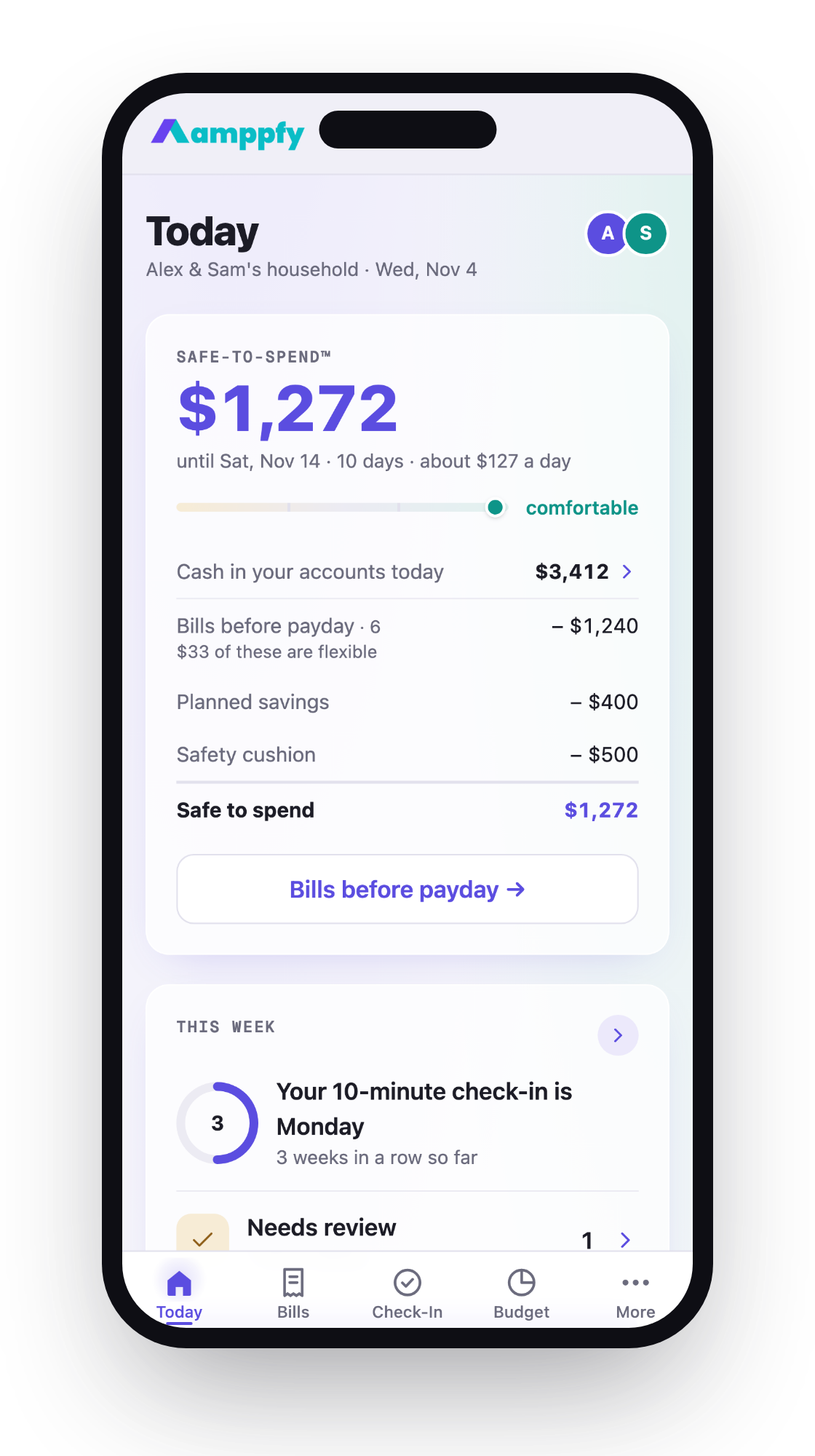
    Amppfy on an iPhone showing the Safe-to-Spend™ number with the status scale and the math under it

    Pull every debt payment into one group:

    • Mortgage or rent-to-own payments
    • Car loans
    • Student loans
    • Credit card minimums
    • Personal loans
    • Medical payment plans
    • Buy-now-pay-later installments

    Add them up. Write that single number down. Now compare it to your gross monthly income (before taxes) and your take-home pay. You need both numbers for what comes next.

    Seeing debt as its own slice of your budget changes how you think about it. It’s not just “bills.” It’s a temporary weight you’re carrying, and you can measure exactly how heavy it is. Amppfy’s Budget page breaks your month into four slices: Bills, Savings, Subscriptions, and Everyday spending. Dropping your debt payments into the Bills slice and watching that number shrink over time gives you a clear picture without guesswork.

    The debt-to-income ratio, explained

    Lenders use a simple formula to judge how much debt you can handle. It’s called the debt-to-income ratio, or DTI. The math looks like this:

    Total monthly debt payments ÷ Gross monthly income = DTI

    So if you pay $1,800 a month toward all debts and earn $5,000 before taxes, your DTI is 36%. That single percentage tells lenders, and you, how stretched your income really is.

    Here’s a quick reference for common thresholds:

    DTI Range What It Signals
    Under 20% Comfortable. Room for savings and goals.
    20%-35% Manageable. Payments fit, with some room left over.
    36%-43% Caution zone. Flexibility shrinks.
    44%-50% Stressed. Daily life feels tight.
    Over 50% Red flag. More than half your gross pay is spoken for before you buy groceries.

    The CFPB describes DTI as all your monthly debt payments divided by your gross monthly income, and notes that different loan products and lenders will have different DTI limits[1].

    Your debt payments as a percentage of income matter even if you’re not applying for a mortgage. A DTI above 40% means less room for an unexpected car repair or a medical bill. It also means less room for the things that make life worth living: a weekend trip, a birthday dinner, a hobby that costs a little money each month. Calculate your own DTI today. The number itself isn’t a judgment. It’s a starting point.

    Minimums as bills, extra payments as a goal

    Here’s a mental shift that helps: treat minimum payments as fixed bills and any extra payments as a savings goal. They belong in different mental buckets because they serve different purposes.

    Minimum payments keep you current. They prevent late fees and protect your credit score. They’re non-negotiable, like rent or insurance. Put them in your Bills category and forget about them: they’re due, you pay them, done.

    Extra payments are different. They’re how you actually get free. Paying $50 above the minimum on a high-interest credit card can save you hundreds in interest and months of payments. But that $50 has to come from somewhere, and it competes with other goals like building an emergency fund or saving for a vacation.

    A practical approach:

    1. List every debt’s minimum payment. That total is your fixed debt bill.
    2. Decide on a target for extra payments each month: even $25 counts.
    3. Direct the extra payment to your highest-interest debt first.
    4. When that debt is gone, roll its minimum into the next one.

    The key is treating that extra payment like a goal you fund on payday, not leftovers you scrape together at month’s end. If you wait until the end of the month, there’s rarely anything left. Fund it first. A household budget built from your plan makes this easier because the extra payment is baked into the structure before you spend a dollar on anything else.

    When debt crowds out savings

    There’s a tipping point where debt payments start eating into your ability to save. You know you’ve hit it when you can describe the feeling: you’re making all your payments on time, but your savings account hasn’t grown in months. Or you’re choosing between paying extra on a loan and putting money into an emergency fund.

    This tension is real, and it doesn’t have an easy answer. But here’s a useful framework:

    • If you have zero emergency savings, pause extra debt payments and build a small cushion first: $500 to $1,000.
    • If you have a small cushion, split your extra money: half to savings, half to debt.
    • If you have one month of expenses saved, shift more toward debt payoff.

    The reason is simple. Without any savings, one flat tire or one urgent care visit puts you right back on the credit card. You’d be paying off debt with one hand and adding new debt with the other. That’s a treadmill, not progress.

    National debt totals make headlines, but your number is the only one that matters. Calculate how much of your take-home pay goes to debt minimums. Then calculate how much goes to savings. If the debt slice is three or four times larger than the savings slice, it’s time to rebalance.

    The goal isn’t to stop paying debt. It’s to make sure debt payments don’t consume so much income that you can’t build any financial cushion at all. Even small savings: $50 a paycheck into a separate account: change the math over a few months.

    Auto insuranceSponsored
    Farmers Insurance
    Switch & save on auto
    $530 average savings could be yours.*
    Get a quote
    Quotes by Farmers Insurance. Amppfy may earn a commission. *Based on average nationwide annual savings of new customers surveyed, excluding HI, SC & Farmers GroupSelect®, from 2/1/23 to 9/19/2024 who switched their Auto insurance policy to a Farmers® branded policy, responded to the survey, and realized savings. Potential savings vary by customer and may vary by state and product. Coverage and prices vary by state.

    Watching the slice shrink month by month

    The most motivating thing about tracking your debt payments as a share of income isn’t the starting number. It’s watching that number drop. Every paid-off balance reduces your DTI. Every raise increases your income without adding debt. Both push the ratio in the right direction.

    Here’s a worked example. Say your gross monthly income is $5,500 and your total monthly debt payments are $1,650. Your DTI is 30%. You pay off a $200/month car loan in six months. Now your debt payments are $1,450, and your DTI drops to 26.4%. That freed-up $200 can go toward your next debt, your savings goal, or your everyday life.

    Track this quarterly. Write down three numbers every three months:

    • Total monthly debt payments
    • Gross monthly income
    • DTI percentage

    You’ll see the trend. And trends matter more than any single snapshot. A DTI that’s dropping by a point or two each quarter means you’re heading somewhere good, even if the current number still feels high.

    Amppfy tracks your net worth month by month, which captures the same idea from a different angle. As debt balances fall and savings grow, your net worth line moves up. That’s the slice shrinking, shown as a single trend you can check in about 30 seconds.

    Don’t obsess over hitting a specific DTI target by a specific date. Focus on direction. Are your debt payments taking a smaller share of your income this quarter than last quarter? If yes, you’re doing the work. If not, look at what changed and adjust.

    Frequently asked questions

    What’s a good debt payments percentage of income to aim for?
    There’s no single cutoff: the CFPB notes that DTI limits vary by lender and loan product. “Good” depends on your life. A 30% DTI with no savings is worse than a 38% DTI with three months of expenses in the bank. Use the ranges above as a reference point, not a hard rule. The real goal is a ratio that leaves room for savings and daily life.

    Should I include my mortgage in my debt-to-income calculation?
    Yes. Your mortgage is debt. Lenders include it, and you should too. Some loan programs look at housing debt on its own as well as total debt. If you rent, your rent payment typically isn’t included in DTI calculations by lenders, but you should still account for it in your personal budget.

    Is it better to pay off debt or save money first?
    Build a small emergency cushion of $500 to $1,000 first. Then split your extra money between debt payoff and savings. High-interest credit card debt deserves aggressive payments because the interest compounds fast. But having zero savings means any surprise expense goes right back on a card, undoing your progress.

    How often should I recalculate my DTI?
    Once a quarter works well for most people. Any time you pay off a debt, get a raise, or take on new debt, recalculate. The number itself is less important than the direction it’s moving. A quarterly check keeps you honest without turning into a chore.

    Watching your number, not just your debt

    Your income that goes toward debt is a ratio you can control. Not overnight, but steadily. Group your debts together. Know your DTI. Treat minimums as bills and extra payments as goals. Protect your savings even while paying down balances. And check the trend every few months.

    If you want a quick way to see what’s actually safe to spend after your debt payments, bills, and savings goals are covered, get Amppfy free. Enter your balances, bills, and payday once: about ten minutes: and your Safe-to-Spend™ number is always there, showing the math underneath. It’s one number that accounts for everything, so you stop guessing and start deciding.


    1. consumerfinance.gov

    Amppfy app icon

    Amppfy

    Free on iPhone, Android, and the web

    Know what’s safe to spend before payday

    Your balances, bills, and payday. Ten minutes to one clear number, with the math shown under it. Learn more ›

    Download on the App Store Get it on Google Play

    Prefer the web? Sign up free ›

    Free  ·  No credit card  ·  Just your balances

    Amppfy on an iPhone showing the Safe-to-Spend™ number with the status scale and the math under it
    Auto Loan Debt Budgeting Basics budgeting tips Credit Card Debt Debt Payoff Monthly Budget Personal Loan Debt Student Loan
    Share. Facebook Twitter LinkedIn Email Copy Link
    Previous ArticleInsurance in a Household Budget: Health, Auto, Home, and Life
    Next Article How to Group Your Bills So Every Month Makes Sense
    Thomas T.

    Thomas is a Personal Finance Writer and Financial Content Strategist with over 10 years of experience helping individuals make smarter financial decisions. He specializes in topics such as budgeting, debt management, saving strategies, and financial behavior, translating complex financial concepts into clear, actionable guidance. His work focuses on empowering readers to build sustainable financial habits and confidently navigate their financial lives, combining data-driven insights with practical, real-world advice.

    More Like This

    Social Security COLA 2027: What the 3.6% Raise Means for Your Monthly Plan

    By Thomas T.November 6, 2026

    Best Free Budget Apps in 2026: iPhone, Android, and Web

    By Thomas T.November 6, 2026

    Federal Pay Period Calendar for 2027: Every Pay Period and Payday

    By Thomas T.November 6, 2026
    Amppfy app icon

    Amppfy

    Free on iPhone, Android, and the web

    Know what’s safe to spend before payday

    Your balances, bills, and payday. Ten minutes to one clear number.

    Download on the App Store Get it on Google Play

    Prefer the web? Sign up free ›

    Amppfy dashboard on an iPhone showing the Safe to Spend number with the math under it
    Helpful Resources

    Social Security COLA 2027: What the 3.6% Raise Means for Your Monthly Plan

    November 6, 2026

    Best Free Budget Apps in 2026: iPhone, Android, and Web

    November 6, 2026

    Federal Pay Period Calendar for 2027: Every Pay Period and Payday

    November 6, 2026

    Fudget Budget App: Price, the Plus Plan, and Simpler Alternatives in 2026

    November 6, 2026

    Financial Clarity. Everyday Confidence.

    Facebook X (Twitter) YouTube TikTok
    Calculators

    Emergency Fund Calculator

    Compound Interest Calculator

    Interest Rate Calculator

    Net Worth Calculator

    Mortgage Calculator

    How Much Home Can I Afford

    Debt-to-Income Ratio Calculator

    Cost of Living Calculator

    Savings Calculator

    Savings Goal Calculator

    Monthly Budget Calculator

    Latest Resources

    Social Security COLA 2027: What the 3.6% Raise Means for Your Monthly Plan

    November 6, 2026

    Best Free Budget Apps in 2026: iPhone, Android, and Web

    November 6, 2026

    Federal Pay Period Calendar for 2027: Every Pay Period and Payday

    November 6, 2026

    Money Manager Expense & Budget App: Price, Ads, and Simpler Alternatives in 2026

    November 6, 2026
    About & Legal

    About Amppfy

    Documentation

    Advertise with Amppfy

    Editorial Policy

    EULA

    Terms of Use

    Acceptable Use Policy

    Privacy Policy

    Cookie Policy

    Disclaimer

    Do Not Sell or Share My Personal Information

    Acceptable Use Policy

    Disclaimer: Amppfy is committed to keeping its information transparent, accurate, and up-to-date. The information on Amppfy is provided for educational and informational purposes only and should NOT be considered financial, investment, tax, or legal advice. You should consult a qualified financial professional before making any financial decisions. This information may differ from what you find on the specific product or service provider’s website. All information, content, software, tools, products, or services on Amppfy are presented without warranty or guarantee. Please review the specific provider’s terms and conditions when evaluating products or services. By accessing Amppfy or using our AI generator tools, you acknowledge that you have read, understood, and agreed to our EULA, Terms of Use, Acceptable Use Policy, Privacy Policy, Cookie Policy, and Disclaimer. Amppfy.com uses cookies. For more information, visit Amppfy’s Cookie Policy. Amppfy may be compensated through third-party advertisers and affiliates. For more information, visit Amppfy’s Disclaimer.

    Copyright© 2026 Amppfy | All Rights Reserved

    Type above and press Enter to search. Press Esc to cancel.

    Advertiser Disclosure: Products may include affiliate links related to financial products or services. We may earn a commission at no additional cost to you. Our content remains independent and focused on helping you make informed financial decisions.
    Fact Checked
    Financial Disclaimer

    This content is for informational and educational purposes only and should not be considered financial advice. Personal finance decisions—including budgeting, saving, investing, credit, mortgages, taxes, and debt management—depend on your individual circumstances. Always consult a qualified financial professional before making financial decisions.

    Editorial Standards and Content Integrity

    Our editorial process ensures accuracy, clarity, and trust across all personal finance topics, including budgeting, saving, investing, and debt management. Content is created using credible sources such as government agencies, academic research, and established financial institutions, and may incorporate insights from industry experts when relevant. Each article is reviewed for accuracy, timeliness, and relevance before publication and updated as needed to reflect changes in financial guidelines and best practices, with the goal of providing clear, evidence-based information to help readers make informed financial decisions.

    Learn more about our editorial policy and guideline.
    Amppfy app icon

    Amppfy

    Free on iPhone, Android, and the web

    Know what’s safe to spend before payday

    Get the app on iPhone or Android and enter your balances, bills, and payday. About ten minutes to one clear number: what’s safe to spend before payday.Your balances, bills, and payday. Ten minutes to one clear number. Learn more ›

    Download on the App Store Get it on Google Play
    Scan with your phone to get the app

    Free  ·  No credit card  ·  Just your balances

    Prefer the web? Sign up free ›

    Amppfy app icon

    Amppfy

    Free on iPhone, Android, and the web

    Know what’s safe to spend before payday

    Enter your balances, bills, and payday once. About ten minutes to one clear number, with the math shown under it.

    Download on the App Store Get it on Google Play
    Scan with your phone to get the app

    Prefer the web? Sign up free ›

    Free  ·  No credit card  ·  Just your balances