Missing a bill by even a day can mean a late fee, a ding to your credit, and that sinking feeling when you open your bank app. A good bill tracker app takes that weight off your shoulders. It shows you what’s due, when it’s due, and whether you can actually cover it before your next paycheck. The right tool fits your routine instead of adding another chore. This guide breaks down what to look for, compares four solid options, and helps you pick the one that matches how you actually manage money.
What a bill tracker should do
A bill tracker needs to do more than list due dates. At minimum, it should tell you three things: what’s owed, when it’s owed, and whether your cash can handle it. If it can’t answer all three, you’re still guessing.
Here’s what separates a useful tracker from a glorified to-do list:
- Due-date visibility: Every bill, subscription, and recurring charge should appear on a calendar or timeline. You need to see the next two to four weeks at a glance.
- Reminders that arrive early enough: A notification on the due date is too late. You want a heads-up at least one day before so you can move money if needed.
- A clear picture of available cash: Knowing you owe $200 on Thursday means nothing if you don’t know your checking balance. Good trackers connect bills to your actual money.
- Recurring bill handling: Your rent, car payment, and streaming subscriptions repeat. The app should roll them forward automatically so you’re not re-entering the same bills every month.
- Subscription tracking: The average household carries multiple subscriptions. A tracker that lists next-charge dates for each one helps you spot charges you forgot about.
Some apps go further by showing your lowest-cash day in a given month. That’s the day you’re most likely to overdraft or miss a payment. Knowing that date in advance gives you time to adjust.
The real test is whether the app reduces your mental load. Much of the stress around bills comes from uncertainty. A tracker that shows the math, not just the dates, addresses the root cause.
Reminders vs. a bill calendar
Phone reminders and calendar alerts are the simplest approach. You set a recurring alarm for each bill and dismiss it when you pay. It works, but it breaks down fast.
Where Simple Reminders Fall Short
A reminder tells you “pay the electric bill.” It doesn’t tell you the amount, whether you’ve already paid it, or if your balance can cover it alongside three other bills due the same week. You’re still opening your bank app, doing mental math, and hoping you’re right.
Stack five or six bills in the same week and those reminders become noise. You start swiping them away without acting. That’s how late fees happen.
What a Calendar View Adds
A dedicated bill calendar shows all your obligations on a single screen. You see clusters of due dates, gaps between paydays, and the overall shape of your month. That visual context is something a list of reminders can’t provide.
Some calendar views also mark the day your balance dips lowest. If your rent, car insurance, and internet bill all land in the same three-day window, you can see the squeeze coming. If a biller lets you change a due date, that view tells you where to move it.
A calendar also creates a record. You can look back and confirm whether last month’s electric bill was paid. Reminders vanish once dismissed. A bill calendar keeps the history.
The short version: reminders work for one or two bills. Once you’re managing five or more recurring charges, a proper calendar inside a bill tracking app saves real time and real money.
The apps, compared
Four apps stand out for different reasons. Each handles bill tracking, but they differ in cost, approach, and who they’re built for. Prices and plans below come from each company’s own site as of October 2026.
| Feature | Rocket Money | Monarch Money | Simplifi by Quicken | Amppfy |
|---|---|---|---|---|
| Price | Free tier; Premium $7–$14/mo (you pick the price); Premium+ $15/mo | Core $14.99/mo or $99.99/yr (7-day trial); Plus $199.99/yr | $3.99/mo first year, then $6.99/mo; billed annually | Free; no paid tier |
| Bill tracking | Yes, upcoming bills; bill negotiation for a success fee | Yes, recurring charges; forecasting on Plus | Yes, upcoming bills and subscriptions | Yes, bills calendar with paydays |
| Bank sync | Yes | Yes | Yes | No: you enter balances manually |
| Subscription detection | Yes, finds them after you connect accounts | Yes | Yes | No auto-detection; you add them to a Subscriptions card with next-charge dates |
| Partner support | Account sharing on Premium | Invite a partner at no extra cost | Share with one other person | Invite a partner by email |
| Platforms | iOS, Android; web on paid tiers | iOS, Android, web | iOS, Android, web | iPhone and web |
Rocket Money
Rocket Money connects to your bank and scans transactions for recurring charges. The free tier tracks subscriptions and upcoming bills and includes up to two custom budgets. Premium, priced at $7–$14 a month on a pay-what-you-think-is-fair slider, adds unlimited budgets, account sharing, web access, and a concierge that cancels subscriptions for you. Its bill negotiation service charges a success fee of 35–60% of the first year’s savings on Free and Premium, and no fee on Premium+ ($15/month). It fits if you want the app to find bills for you rather than entering them yourself.
Monarch Money
Monarch offers a full financial dashboard: budgets, investments, net worth, and bill tracking all in one place. It detects recurring charges, and forecasting is part of the Plus plan ($199.99/year). Core costs $14.99/month or $99.99/year after a 7-day trial, and you can invite a partner at no extra cost. Best for households that want a single, comprehensive view.
Simplifi by Quicken
Simplifi focuses on spending plans rather than traditional budgets. It takes your income, subtracts bills and subscriptions, and shows what’s left, and it tracks upcoming due dates. It costs $3.99/month for the first year, then $6.99/month, billed annually, with no free tier, and you can share it with one other person. It sits between a simple tracker and a full financial planner.
Amppfy
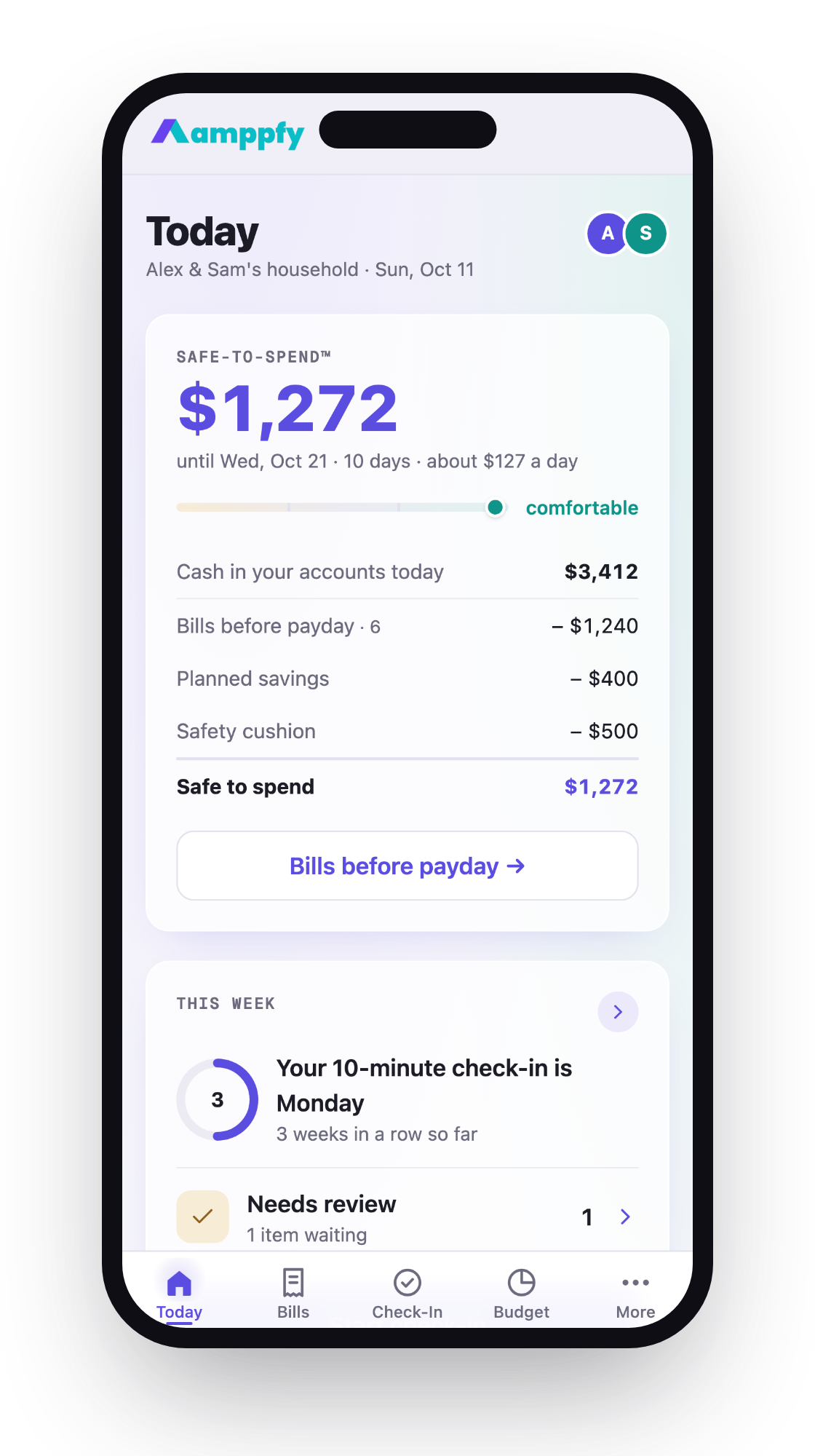
A different approach: you type in your balances yourself and enter your bills and payday once. The app then shows one Safe-to-Spend™ number: your available cash minus bills due before payday, minus planned savings, minus a safety cushion you choose. The math is always printed under the number. Bills project forward on the calendar next to your paydays, and calm heads-ups flag a bill that’s due soon or one that changed, with anything that needs a look gathered in a Needs Review queue. There’s no transaction import, so it won’t categorize your spending. But if your main question is “what can I actually spend before Friday,” it answers that in one glance. It’s free on iPhone and the web, and you can invite a partner by email: each of you gets your own login, shared bills show for both, and anything you keep private stays private.
Bills and paydays on one calendar
Tracking bills in isolation misses half the picture. The other half is when your money arrives. A bill calendar that also shows paydays lets you see whether you’re covered, not just whether something is due.
Here’s why that matters. Say you get paid on the 1st and 15th. Your rent hits on the 1st, car payment on the 5th, and insurance on the 12th. That first paycheck absorbs most of your fixed costs. Your second paycheck on the 15th might look free, but utilities, subscriptions, and groceries eat into it fast.
A combined view reveals these patterns. You can see which paycheck funds which bills. You can spot the gap between your last bill and your next deposit. That gap is where you either build savings or run short.
The math makes it concrete. If your first paycheck is $1,700 and bills from the 1st through the 14th total $1,300, you have $400 for everything else during that stretch. Subtract $150 for savings and a $100 cushion, and you’re working with $150. That’s the number that matters.
Some apps show this automatically and print the calculation: $1,700 cash − $1,300 bills − $150 savings − $100 cushion = $150. Others require you to set up income tracking separately.
Buy Now, Pay Later plans add another layer. If you’re splitting a purchase into four payments, each installment belongs on your bill calendar right next to your electric bill and car payment. Treat them as real obligations, because they are.
In the Federal Reserve’s survey of household finances in 2023, 17% of adults said they did not pay all their bills in full in the prior month[1]. A combined bills-and-paydays calendar won’t magically increase your income, but it removes the guesswork that leads to missed payments.
Choosing one
The right app depends on one question: how much do you want to automate?
If you prefer the app to find and categorize every charge, bank-synced options like Rocket Money or Monarch Money are built for that. You connect your accounts and the app pulls in transactions. The tradeoff is that synced connections can break, and you’re giving a third party access to your account data. Weighing convenience against data exposure is reasonable.
If you’d rather keep your bank login to yourself and spend a few minutes a week instead, a manual-entry tracker works. You trade automatic transaction import for simplicity and privacy.
Here’s a quick decision framework:
- You want auto-detection of subscriptions and bills: Rocket Money or Monarch Money
- You want a full financial dashboard with investments: Monarch Money
- You want a clean spending plan without complexity: Simplifi by Quicken
- You want one number that answers “what’s safe to spend” with no bank login: Amppfy
Couples should pay attention to partner features. Check whether a partner costs extra and what they’ll be able to see before you invite them.
Don’t overthink it. Pick the one that matches your tolerance for setup time and ongoing upkeep. A bill tracker you actually use beats a feature-rich app you abandon after two weeks.
Frequently Asked Questions
Can a bill tracker app actually prevent late fees?
Yes, if you use it. The app itself doesn’t pay your bills, but a heads-up the day before a due date gives you time to transfer money or schedule a payment. The key is choosing an app with reminders that arrive early enough to act on. One day before the due date is the minimum. Two or three days is better for bills that require a bank transfer.
Is it safe to connect my bank account to a bill tracker?
Bank-synced apps typically use encrypted, read-only connections. That said, any time you share credentials with a third party, you’re accepting some level of risk. If that concerns you, manual-entry apps let you track bills without linking your bank. You type in balances yourself. It takes a bit more effort but keeps your login credentials off external servers.
Do I need a paid app to track bills?
Not necessarily. Free tiers from several apps cover basic bill tracking and reminders. Paid plans usually add features like bill negotiation, investment tracking, or advanced reports. If your main need is knowing what’s due and whether you can cover it, a free option can handle that. Some manual-entry apps are free and include a bills calendar.
How do I handle bills that change every month, like utilities?
Most trackers let you update the amount each billing cycle. Some apps that sync with your bank pull in the exact amount automatically. With manual-entry apps, you update the bill when you receive the statement. It takes a few seconds. The due date stays the same; only the amount changes. Either way, the bill stays on your calendar so you don’t forget it exists.
Pick the App, Then Trust the System
The best bill tracker is the one you’ll open every week. Features matter less than fit. If setup takes 30 minutes and you never touch it again, that’s a failed experiment regardless of how many features it had.
Start small. Enter your bills, your paydays, and your current balances. See what the app tells you. If the number it shows matches your gut feeling, you’re on the right track. If it surprises you, that’s exactly why you needed it.
If you want to see your own Safe-to-Spend™ number before your next paycheck, Amppfy is free on iPhone and the web. Enter your balances, bills, and payday once, and update balances when they change. Get the app free and spend about ten minutes finding out what’s actually safe to spend this week.