

Most couples don’t fight about money itself. They fight about the gap between what each person thinks is left and what’s actually there. One partner checks the bank app and sees $2,400. The other remembers a car insurance payment hitting Friday. Neither is wrong, but neither has the full picture. That tension – two people guessing from different data – is how a simple “are we okay this month?” turns into a 45-minute argument. Roughly 37% of married Americans say money tension makes them feel more like roommates than partners[1], a feeling especially common among Millennials in 2025.
If you want to stop money fights as a couple, the fix isn’t agreeing on every purchase. It’s agreeing on one number before the conversation starts.
Why the question starts arguments: two ledgers, two guesses
“Are we okay this month?” sounds harmless. But it’s actually a loaded question because each partner answers it from a different mental spreadsheet.
You might be thinking about the checking account balance you saw this morning. Your partner might be thinking about the daycare payment due Thursday, plus the $87 streaming and subscription charges that hit next week. You’re both doing math in your heads, but you’re working with different inputs. The result is two confident answers that don’t match.
This isn’t a communication failure. It’s an information failure. Money stress between couples is often a timing issue rather than a lack of care[2], and it can be managed by proactive, scheduled conversations. The problem is that most couples skip the “proactive” part and jump straight to reactive mode: one person notices something alarming, the other gets defensive, and the conversation spirals.
There’s also a perception gap at play. Research shows fathers are significantly more likely to believe household mental labor is shared equally[3], while mothers report handling 60% more of those tasks. Money management is a big slice of that invisible work. When one partner carries the mental load of tracking bills and the other assumes everything is fine, the question “are we okay?” lands very differently for each person.
The fix isn’t better communication skills. It’s getting on the same page – literally – before anyone opens their mouth.
Start from the same number, not the same opinion
You don’t need to agree on spending philosophy. You need to agree on one fact: how much is actually safe to spend between now and the next paycheck.
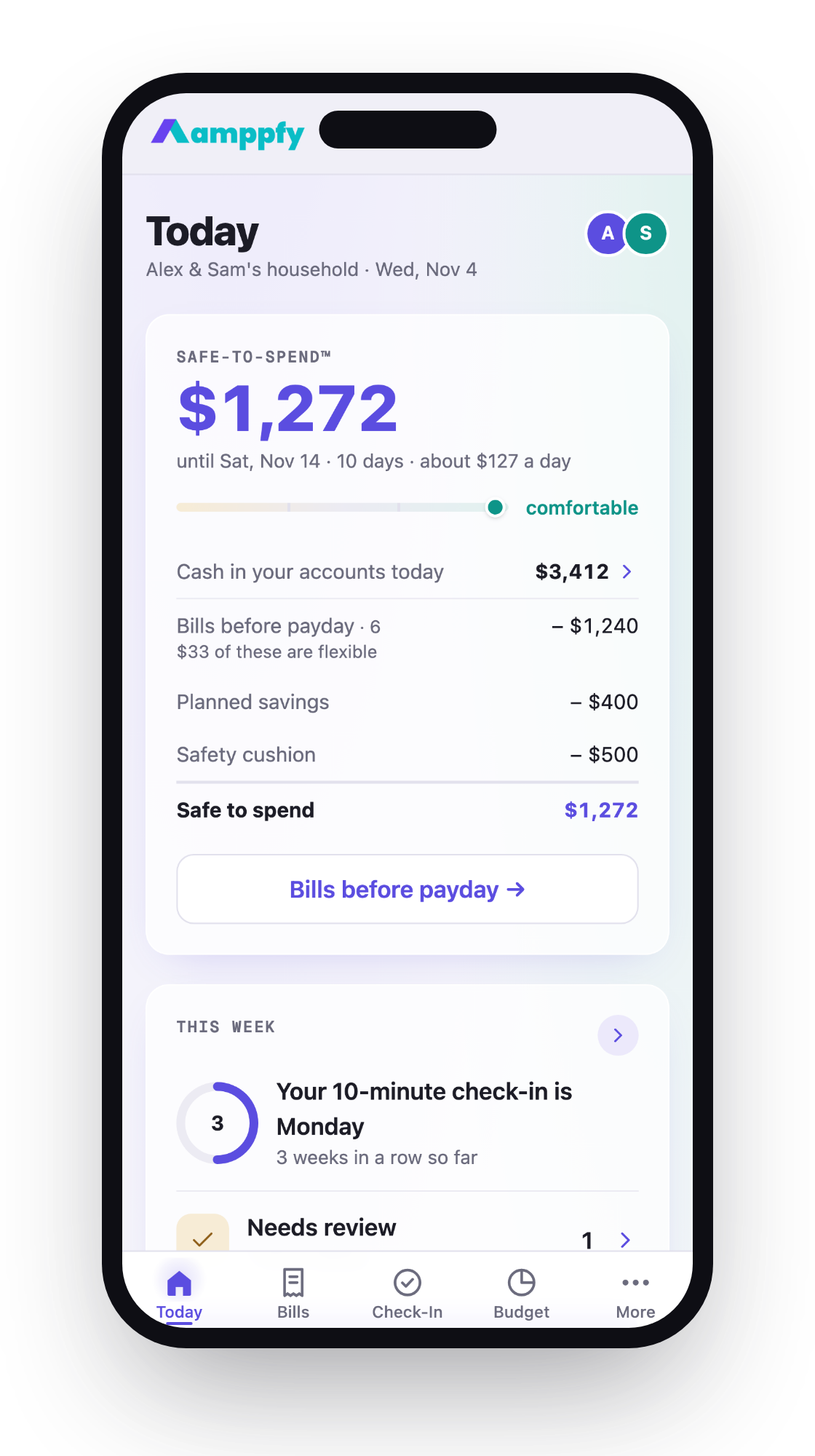
That’s a different number than your bank balance. Your balance doesn’t subtract the electric bill due in four days, the $200 you planned to move to savings, or the cushion you keep so you’re not living paycheck-to-edge. Your Safe-to-Spend™ number does. It’s your available cash, minus bills due before payday, minus planned savings, minus a safety cushion you choose.
Here’s the math laid out plainly:
| Line | Example |
|---|---|
| Checking balance | $3,100 |
| Bills due before payday | -$1,240 |
| Planned savings transfer | -$300 |
| Safety cushion | -$200 |
| Safe-to-Spend | $1,360 |
When both partners look at $1,360 instead of $3,100, the conversation changes. “Can we afford dinner out?” stops being a philosophical debate. You check the number. If it’s $1,360 and dinner costs $80, you’re fine. If it’s $140, you’re not. No opinions needed.
This is why couples who share a single reference number fight less about money. The argument isn’t about who’s right. There’s nothing to be right about. The number is the number.
Amppfy shows this Safe-to-Spend number to both partners from their own login, with the four-line math printed underneath. You type in your balances yourself – about 30 seconds per account – and each person’s private balances stay private. No bank login required to start.
What to look at together in ten minutes
A weekly check-in doesn’t need to be a summit meeting. Ten minutes, same day each week, same three questions. That’s it.
The three questions
- Is the Safe-to-Spend number where we expected it to be?
- What bills or charges hit before the next paycheck?
- Are we still on track for the savings goal we picked?
If the answer to all three is “yes,” you’re done. Close the app. Go watch something. The whole point is that most weeks are boring, and boring is good.
What to do when the number looks off
When the number is lower than expected, don’t ask “what did you buy?” Ask “what changed?” Maybe a bill was higher than usual. Maybe a subscription renewed early. Maybe someone forgot to update a balance. The question “what changed?” is neutral. “What did you buy?” is an accusation.
A simple check-in agenda
| Step | Time | Action |
|---|---|---|
| 1 | 2 min | Each partner updates their account balances |
| 2 | 3 min | Review bills coming due before next payday |
| 3 | 3 min | Check savings goal progress |
| 4 | 2 min | Decide: anything to adjust this week? |
Keep this on the same night every week. Pair it with something you already do – after the kids are in bed, before a show, during Sunday coffee. The habit sticks when it’s attached to an existing routine.
When one partner carries it all
In many households, one person handles nearly everything: paying bills, tracking due dates, remembering which subscriptions renew when, watching the balance so it doesn’t dip too low. Research from late 2024 found that mothers handle 71% of household mental load tasks[4], and financial management is a major piece of that work.
The partner who doesn’t carry this load often has no idea how heavy it is. They’re not being careless. They just don’t see the work because it’s invisible. The bill gets paid, the savings transfer happens, the subscription gets canceled before the price hike. It all looks automatic from the outside.
Signs you might be the “carrying” partner
- You know the exact date every recurring bill hits
- You feel a spike of anxiety when your partner mentions a purchase
- You’ve said “I already handled it” more than twice this week
- You check the bank balance daily, sometimes more
Signs you might be the “unaware” partner
- You assume things are fine unless someone says otherwise
- You don’t know when the car insurance renews
- You’ve said “just tell me what to do” about money
- You’re surprised when your partner seems stressed about a normal expense
The solution isn’t to dump half the bills on the other person overnight. It’s to give both partners the same view of the same information. When both people can see what’s due, what’s been paid, and what’s left, the carrying partner doesn’t have to translate everything into a verbal report. The data speaks for itself.
This is where a shared tool matters more than a shared spreadsheet. A spreadsheet requires the carrying partner to maintain it, which just adds another task. A tool that both partners can open on their own phone, see the same number, and update their own balances – that actually shifts the load.
Scripts for the hard version of the conversation
Not every money talk is a calm ten-minute check-in. Sometimes you need to say something difficult: “We can’t afford that trip.” “I found a charge I don’t recognize.” “I’ve been hiding a credit card balance.” Experts suggest that rebuilding trust after hidden spending requires full financial transparency and a commitment to teamwork[5].
Here are scripts for three hard conversations, written to be direct without being hostile.
“We need to cut back”
- “I ran our numbers for the next two pay periods. We have $X safe to spend. That’s tight. Can we pick two things to pause until next month?”
- Don’t say: “You spend too much on Y.” Do say: “Our number is lower than I’d like. What can we shift?”
“I found something I didn’t expect”
- “I saw a charge for $X on [date]. I don’t recognize it. Can you help me figure out what it is?”
- Keep the tone curious, not accusatory. Most mystery charges are forgotten subscriptions or auto-renewals, not secrets.
“I haven’t been honest about our money”
- “I need to tell you something that’s going to be hard to hear. I have a balance of $X that I haven’t told you about. I’m sorry. I want us to deal with it together.”
- Then stop talking. Let your partner respond. Don’t rush to fix it in the same conversation. The first conversation is for honesty. The second one is for the plan.
The common thread in all three scripts: lead with the number, not the emotion. Numbers are neutral. “We have $1,360 until Friday” is a fact. “You always spend too much” is a grenade.
You can’t control the cost of groceries or rent. But you can control your finances by starting with a clear goal and a shared reference point.
Frequently Asked Questions
How often should couples talk about money to avoid fights?
Once a week for about ten minutes is enough for most couples. Pick a consistent day and time. The goal is a quick check-in, not a deep financial review. Most weeks, you’ll confirm everything looks fine and move on. The weekly rhythm prevents small surprises from becoming big arguments.
What if my partner refuses to talk about money at all?
Start by removing the pressure. Don’t frame it as “we need to talk about money.” Frame it as “I want to show you one number so we’re both on the same page.” A single Safe-to-Spend figure is less intimidating than a full budget review. If your partner still resists, consider whether anxiety or shame is driving the avoidance – and approach with curiosity rather than frustration.
Should couples combine all their finances or keep them separate?
There’s no single right answer. Joint, separate, and hybrid setups all work. What matters is that both partners can see the shared obligations: rent, utilities, groceries, childcare. You don’t need to merge every account. You need to share one view of what’s due and what’s left.
How do we recover after a big money fight?
Acknowledge what happened without replaying it. Then agree on one concrete step: “Let’s set up a weekly check-in” or “Let’s both look at the same number before making purchases over $100.” Recovery comes from building a new pattern, not from promising to never fight again. One small system change does more than a dozen apologies.
Your Next Ten Minutes
Stopping couples’ money fights doesn’t require a personality change or a weekend retreat. It requires one shared number and ten minutes a week. Update your balances. Look at what’s due. Confirm what’s safe to spend. That’s the whole system.
If you don’t have a shared number yet, Amppfy is free and takes about ten minutes to set up. You enter your balances, your bills, and your paydays. Your partner gets their own login and sees the same Safe-to-Spend number. No bank login needed to start. Try it before your next “are we okay this month?” conversation – and see how different that question feels when you both already know the answer.