Someone in your household probably pays every bill, tracks every due date, and knows exactly how much is left before payday. The other person asks, “Are we good?” and trusts the answer. This setup works until it doesn’t: the money manager burns out, the other partner feels left out, and small resentments pile up. Roughly 53% of women now identify as the household CFO[1], up from 41% in 2021. But when one spouse handles all the finances alone, only 63% of those household CFOs feel financially secure[2] because of the emotional weight that comes with the role.
The hidden cost of being the household CFO
The partner who manages money carries more than a spreadsheet. They carry mental load: remembering when auto-insurance renews, whether the electric bill spiked, and how close you are to overdrafting before Friday. That weight doesn’t show up on a bank statement, but it shows up in your relationship.
Here’s what the solo money manager typically absorbs:
- Bill timing: Knowing which payments land before payday and which ones can wait.
- Cash-flow math: Subtracting upcoming bills, savings contributions, and a buffer from the checking balance – every few days.
- Conflict avoidance: Hesitating to bring up money because the conversation always feels like a lecture.
- Sole blame: If something slips, it’s their fault. If they raise a concern, they’re “nagging.”
The non-managing partner isn’t lazy. They just never built the habit. Maybe they tried once, got overwhelmed by the spreadsheet, and backed off. Or maybe the managing partner took over because they’re faster at it. Either way, the gap widens every month.
And the stakes keep rising. With 55% of Americans reporting moderate to severe financial hardship[3] from price increases in 2026, the CFO partner is making harder calls with less margin. That’s not a one-person job anymore. Splitting the load isn’t about fairness alone. It’s about keeping both people informed enough to make good decisions if life throws a curveball: job loss, illness, or an unexpected move.
Why “just look at the budget” doesn’t work
The managing partner eventually hits a wall and says, “The budget is right there. Just look at it.” This almost never fixes anything.
The problem isn’t access. It’s context. A spreadsheet full of numbers means nothing if you don’t know which row matters this week. The non-managing partner opens the file, sees 40 line items, and closes it. They’re not avoiding responsibility. They’re drowning in data they can’t prioritize.
Three reasons the “just look” approach fails:
- The budget answers the wrong question. Your partner doesn’t need to know you spent $312 on groceries last month. They need to know whether buying new running shoes today will cause a problem before payday.
- Budgets require maintenance. Categories drift. Subscriptions change. If the non-managing partner checks a budget that’s two weeks stale, they get bad information and lose trust in the system.
- It feels like a test. “Just look at it” implies they should already understand it. That creates shame, not partnership.
What your partner actually needs is one clear answer: how much can we spend right now without messing anything up? That’s it. Not a category breakdown. Not a pie chart. One number, updated, with the math visible so they can trust it.
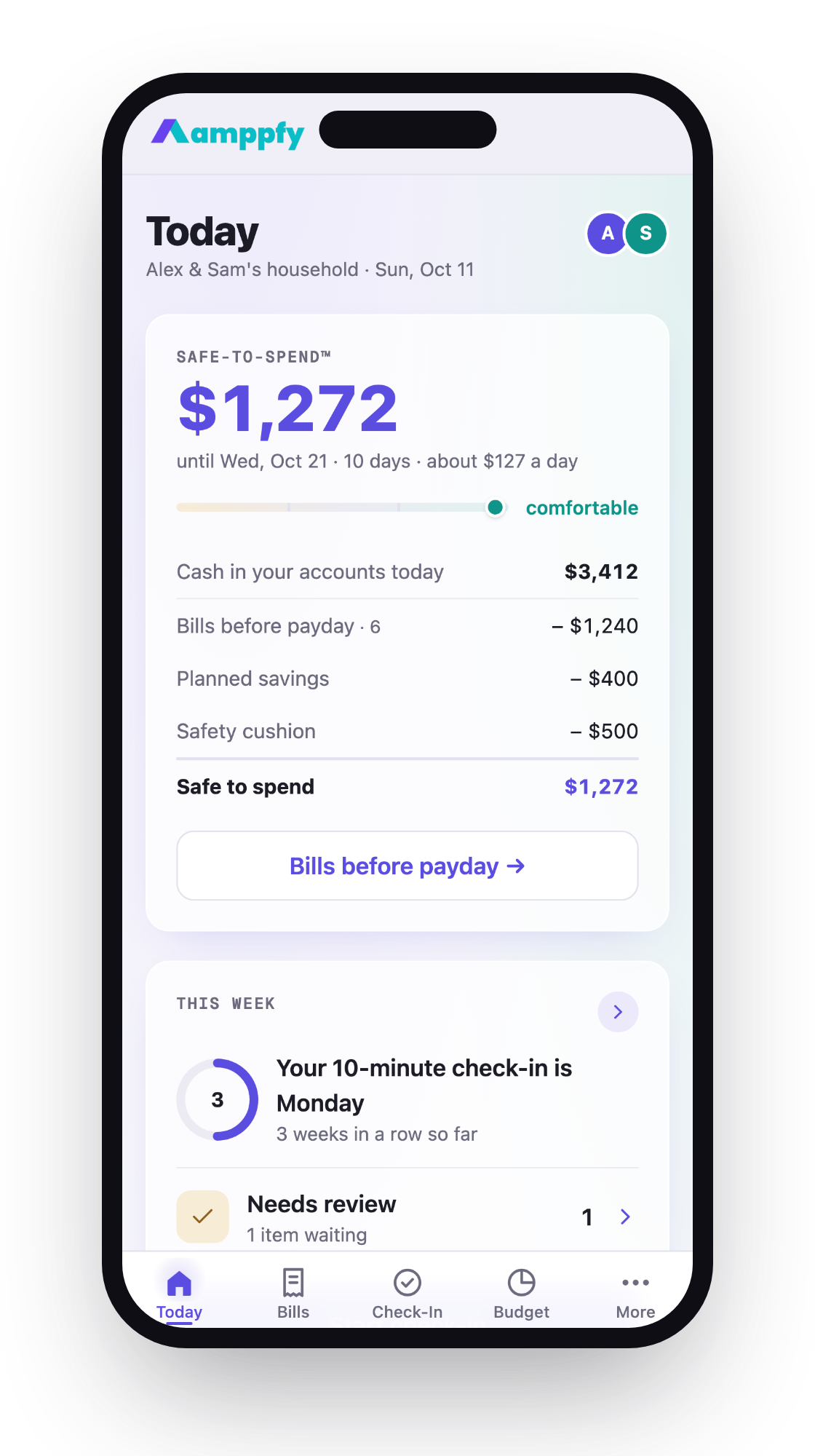
This is exactly what Safe-to-Spend™ means: available cash, minus bills due before payday, minus planned savings, minus a safety cushion. When both partners can see that single figure, the “just look at the budget” conversation becomes unnecessary.
Give your partner one number and one ten-minute job
You don’t need your partner to become a co-accountant. You need them to carry one small, repeatable task. Here’s a framework that works without a single lecture.
Pick one number to share
That number is your Safe-to-Spend. Not your checking balance. Not your net worth. Just the amount that’s genuinely available after bills, savings, and your cushion are subtracted. Write the math out so it’s transparent:
| Line | Example |
|---|---|
| Checking balance | $3,400 |
| Minus bills due before payday | -$1,850 |
| Minus savings set aside | -$300 |
| Minus safety cushion | -$200 |
| Safe-to-Spend | $1,050 |
Your partner sees $1,050 and knows: that’s the real number. No guessing.
Assign one ten-minute task
Pick one job from this list and hand it to your partner:
- Update account balances once a week. Open the banking app, type the current balances into your shared tool. Thirty seconds per account.
- Confirm subscriptions quarterly. Review the list of recurring charges and cancel anything nobody’s using.
- Check the calendar for the lowest-cash day. Flag it so neither of you schedules a big purchase that week.
Amppfy is built for exactly this kind of split. Both partners get their own login, see the same Safe-to-Spend number, and the weekly check-in takes about ten minutes. No bank login required: you type in balances yourself.
The point isn’t equal effort. It’s shared awareness.
What to share and what to keep private
Not every couple pools everything. In fact, only 42% of couples now fully combine their finances[4] into joint accounts. One in five keep finances completely separate. Most land somewhere in between.
The question isn’t whether to merge accounts. It’s what information each person needs to see.
What both partners should always know
- Total household bills and when they’re due
- How much is safe to spend before the next paycheck
- Progress toward shared savings goals (emergency fund, vacation, down payment)
- Any debt that affects both of you (mortgage, co-signed loans, shared credit cards)
What can reasonably stay private
- Personal spending from individual accounts
- Individual retirement account balances (unless you’re planning together)
- Gifts and surprise purchases
The line between privacy and secrecy matters here. Privacy is “I bought myself a $40 book and don’t need to report it.” Secrecy is hiding $8,000 in credit card debt. About 40% of adults living with a partner have hidden spending or secret debt[5], and 43% of U.S. adults consider financial secrets as harmful as physical infidelity.
A good rule: if it changes the Safe-to-Spend number, both people should know about it. If it doesn’t, it’s personal.
Making it a habit without making it a chore
The hardest part isn’t the first conversation. It’s week six, when the novelty wears off and someone forgets to update balances. Here’s how to make the new system stick without turning into a nag.
Anchor it to something you already do
Don’t create a new calendar event called “Finance Meeting.” That sounds miserable. Instead, attach the check-in to a habit that already exists:
- Sunday morning coffee: one person updates balances while the other makes breakfast.
- Payday routine: balances go in before you spend anything. Takes two minutes.
- Weekly grocery run: review the Safe-to-Spend number before you make the list.
Keep the conversation to three questions
- What’s our Safe-to-Spend number right now?
- Is anything unusual coming up before next payday?
- Are we on track for our savings goal this month?
That’s it. No deep audit. No blame. Three questions, ten minutes, done.
What to do when someone drops the ball
They will. You will too. The fix is simple: reset without commentary. “Hey, balances look a few days old. Can you update them tonight?” That’s a request, not a criticism. If the system keeps falling apart, simplify it further. Fewer accounts to update. Fewer goals to track. A system that’s 80% accurate and actually used beats a perfect one that collects dust.
Frequently Asked Questions
What if my partner refuses to participate in household finances at all?
Start smaller than you think. Don’t ask them to co-manage the budget. Ask them to do one thing: update one account balance once a week. If even that meets resistance, the issue may not be about money. It might be anxiety, past financial trauma, or a fear of judgment. A calm, blame-free conversation about why they avoid it usually reveals the real barrier. Offer to walk through the numbers together once, with no quiz at the end.
How do we handle it when one partner earns significantly more?
Income differences don’t change the core principle. Both people still need to know what’s safe to spend. Many couples contribute to shared bills proportionally (say, 60/40 based on income) and keep the rest separate. The key is that both partners see the same Safe-to-Spend number for shared expenses, regardless of who deposited more.
Should we have a joint account if one spouse manages all the finances?
A joint account for shared bills can simplify things, but it’s not required. What matters more is shared visibility into the numbers. If you each keep separate accounts but both see the same spending figure and bill calendar, you get the benefits of joint management without merging everything. About 68% of partners didn’t know their spouse’s full financial picture before moving in together. Visibility fixes that faster than a joint account does.
How often should we review finances together?
Once a week for the quick check-in (Safe-to-Spend number, upcoming bills, savings progress). Once a month for a slightly bigger picture: net worth changes, subscription review, any goal adjustments. Once a quarter for the real strategy talk: are we saving enough, do we need to adjust our cushion, are any big expenses on the horizon? Keep the weekly one short. Save the deeper stuff for monthly and quarterly.
A System That Runs on Trust, Not Control
Sharing the financial load isn’t about splitting a spreadsheet down the middle. It’s about giving both partners enough information to feel confident and enough responsibility to stay engaged. One number. One small task. One short weekly check-in.
If you want a tool that makes this split simple, Amppfy is free and shows both partners the same Safe-to-Spend number with the math printed right underneath. No bank login needed. You start with just your balances and build from there. Take ten minutes this week to set it up and hand your partner their own login. That’s the whole first step.