

Payday morning, you open the Ally app before coffee. Maybe the money is there. Maybe it isn’t. And if it’s missing, the next ten minutes can feel a lot longer than they should.
Here’s the calm version. Ally publishes clear rules about early pay, but it doesn’t publish one fixed clock time for every deposit. Once you know which parts are fixed and which depend on your employer, the morning check gets boring again. Boring is good. Boring means you can plan.
This guide covers what Ally actually says, what it doesn’t say, and how to handle the odd payday that doesn’t follow the pattern. It also covers the step most people skip: figuring out how much of that fresh deposit is really yours to spend before the next one arrives.
What time Ally posts direct deposits
Start with the honest answer. As of October 2026, Ally does not publish a specific posting time for direct deposits. There’s no “6 a.m. Eastern” promise on its pages. If you read a precise time online, it came from someone’s experience, not from Ally.
What Ally does publish is the idea of “early.” On a Spending Account, Ally says you can get your direct deposit up to 2 days early[1] (as of October 2026). Early is measured against your scheduled payday, not against a time of day.
The logic works like this:
- Your employer sends a payroll file to its bank ahead of payday.
- That file travels through the ACH network and reaches Ally with an effective date attached.
- If Ally gets the payment details early, it can release the money before that date.
- If the details arrive close to payday, the deposit posts on payday itself.
So your Ally direct deposit time is really set by two clocks. One is your employer’s payroll schedule. The other is Ally’s own processing, which it doesn’t publish. Watch your account for two or three pay cycles and you’ll usually see your own pattern. Write that pattern down. It’s more useful than any general answer.
Does Ally pay early? The policy as published
Yes, with conditions. Here’s the policy line by line, all as of October 2026, from Ally’s direct deposit page:
| Line | What it is |
|---|---|
| Account type | Spending Account |
| How early | Up to 2 days before your scheduled payday |
| Sign-up | None. It’s automatic |
| Number of early deposits | Up to eight per statement cycle |
| Size limit | Each deposit must be $10,000 or less |
| When it’s not early | Ally didn’t receive payment details early, or the deposit type isn’t eligible |
Two lines deserve a closer look.
The size limit applies per deposit. Say you get a $10,400 bonus check. Ally’s early direct deposit help page[2] explains that deposits over the cap don’t get the early treatment (as of October 2026). That check posts on the normal date. A regular $2,600 paycheck in the same cycle can still arrive early.
The eligibility line matters too. Ally gives a transfer between bank accounts as an example of a deposit type that doesn’t qualify. If you move money from another bank into Ally, don’t expect it to show up early. Early pay is built for real direct deposits like payroll.
Ally lists the reasons a deposit may not arrive early: your payment provider didn’t submit it early, you reached the transaction or monthly deposit amount limit, or the deposit type isn’t eligible[2] (as of October 2026). One late file from payroll means one on-time deposit, not early. That’s normal.
Weekends, holidays, and the first deposit from a new employer
Most “where’s my money” moments happen in one of three situations. Each has a plain explanation.
Weekends come first. ACH payments settle on business days. If your payday lands on a Saturday, your employer decides how to handle it. Many pay on the Friday before. Check your pay stub or ask HR, because that choice belongs to the employer, not to Ally.
Holidays work in a similar way. When a scheduled payday falls on a bank holiday, funds are typically made available on the prior business day. Early pay can still stack on top if the file arrives early. But the starting point moves, so your usual pattern may shift for that one week.
New employers take a little patience. Ally notes it can take one to two pay cycles[3] for a new direct deposit setup to settle in and qualify for early pay (as of October 2026). Some employers also send a prenote first. That’s a $0 test transaction that confirms your account and routing numbers work. It can push your first real deposit back one cycle, and you might get a paper check for that first paycheck instead.
So plan your first payday at a new job around the scheduled date, not the early one. Once you see a couple of early deposits land, you can start counting on the pattern.
Why a deposit shows as pending
A pending deposit looks like money that’s almost yours. That’s about right.
Generally, pending means Ally knows the payment is coming but hasn’t released it to your available balance yet. Think of it like a package marked “out for delivery.” It’s on the truck. It’s not on your porch. You can see it, but you can’t open it.
Ally doesn’t publish the exact moment a pending deposit becomes available, as of October 2026. So use a simple rule. Spend from your available balance, not your current or pending total. If the app shows a deposit but the available number hasn’t moved, treat that money as not here yet.
The gap is usually short. Still, the safe move costs nothing:
- Check the available balance before you pay a bill or make a big purchase.
- Don’t schedule autopays for the day you expect an early deposit. Set them for payday or after.
- Give a new deposit a day before moving it to savings, in case it’s still settling.
Ally’s deposits help section[4] covers how different deposit types work if you want more detail on a specific transfer or check.
What to do if payday passed and nothing landed
Nothing on the scheduled date is different from nothing early. Early can be skipped. The scheduled date shouldn’t be. If that date passes, work through this in order. The whole thing takes about 15 minutes.
- Confirm the date. Look at your pay stub or payroll portal. Make sure today really is payday and that it didn’t shift for a weekend or holiday.
- Check every Ally account. If you have savings and spending accounts, the deposit may have gone to the wrong one.
- Verify your account details with payroll. One wrong digit in your account or routing number sends the money back. This is the most common cause with new setups.
- Ask payroll for the trace details. They can confirm when the file was sent and the amount.
- Contact Ally. Share the expected amount, date, and sender name. Ally can see whether anything arrived on its side.
While you wait, stay calm about the bills. Call any company with a payment due in the next day or two. Ask for a short delay. Most will give you a few days when you explain a payroll error.
For a broader look at the timing factors behind this, see why your direct deposit lands early or late and how to plan around it. The short version: plan around the scheduled date, and treat early pay as a nice surprise.
The deposit landed. What is actually safe to spend?
Here’s where most people get tripped up. The deposit shows up, the balance jumps, and the bigger number feels like room to breathe. But a lot of that number already belongs to things you’ve committed to.
Look at the math with real figures. Say your balance after payday is $3,200. Before the next paycheck in two weeks, you have:
- Rent: $1,450
- Car payment: $310
- Phone and internet: $140
- A planned $200 transfer to savings
- A $250 cushion you want to keep for surprises
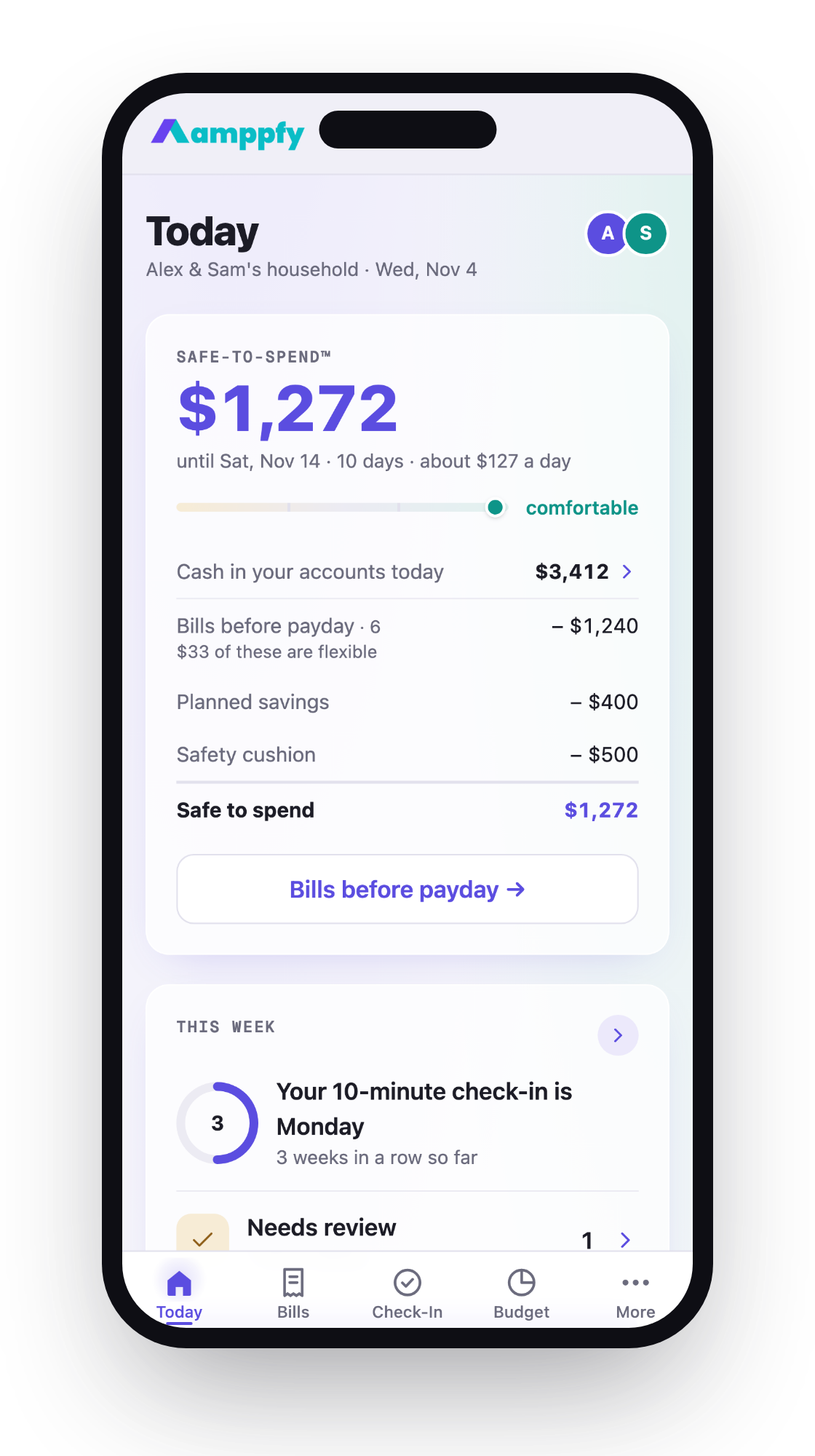
Now do the arithmetic. $3,200 minus $1,900 in bills leaves $1,300. Minus $200 in savings leaves $1,100. Minus the $250 cushion leaves $850. That’s your Safe-to-Spend™ number for the next two weeks, not $3,200.
Early pay makes this more important, not less. Getting paid two days sooner stretches the time until your next deposit by two days. Your groceries and gas still need to fit inside that $850. If you spend like it’s payday on Wednesday, the following Thursday can feel tight.
The fix is a quick glance after each deposit. Subtract the bills due before your next payday. Then subtract savings, then the cushion. The number that’s left is the one to watch.
FAQ
What time does Ally direct deposit post?
As of October 2026, Ally doesn’t publish a specific posting time. Your deposit can arrive up to 2 days before your scheduled payday if Ally receives the payment details early. Watch two or three pay cycles to learn your own pattern.
Why didn’t my deposit come early this time?
The most common reason is that your employer sent the payroll file later than usual. Ally states early access depends on when it receives the payment details. Deposits over $10,000, transfers between bank accounts, and new setups in their first cycle or two also may not arrive early.
Do I need to turn on early pay at Ally?
No. As of October 2026, early pay is automatic for Spending Accounts. There’s nothing to sign up for. You can get up to eight early deposits per statement cycle.
Is early pay available on Ally savings accounts?
Ally describes early direct deposit as a feature of its Spending Account, as of October 2026. Its help page adds that if part of your direct deposit goes into your Spending Account, early deposits show up early in all your accounts. Route at least part of your paycheck to your Spending Account, and move money to savings afterward.
Knowing your Ally direct deposit time is useful. Knowing what to do with the money is the part that changes your week. Once the deposit lands, the balance isn’t what’s safe to spend. Bills due before your next payday come out first. Then planned savings. Then a cushion you choose. Whatever’s left is yours.
You can do that math by hand after every paycheck. Or you can let Amppfy do it: type in your balances, add your bills and paydays, and see one Safe-to-Spend™ number with the four-line math printed right under it. It’s free on iPhone, Android, and the web. Take ten minutes this week and set up your number in Amppfy before your next deposit arrives.