Tiller feeds your bank transactions and balances into a Google Sheets or Excel spreadsheet you own, updated daily. If you’ve used it, you know the appeal: your money in rows and columns you control. You also know the upkeep that comes with a spreadsheet. If you’re weighing a switch, the question isn’t only which tool replaces Tiller: it’s whether the replacement needs to be another spreadsheet at all. What most people actually wanted from Tiller was a clear, honest picture of their cash before payday. That picture can come from a grid, an app, or a single number on your phone. This guide walks through the options that deliver that same clarity, what each one does well, and how to move your history forward without starting from scratch.
Why People Look for a Tiller Alternative
Tiller’s appeal is control. You own the spreadsheet. You write the formulas. You decide how to categorize a charge. That same control is why some people start looking elsewhere.
A few common reasons people search for alternatives to Tiller:
- The spreadsheet is the work. Tiller brings in the transactions, but reviewing categories, fixing formulas, and keeping templates tidy is still on you. Not everyone wants that job every week.
- A phone-first view. A spreadsheet is built for a laptop. Some people want an app on their phone that answers one question fast.
- A partner who doesn’t love spreadsheets. If one of you built the sheet, the other may never open it. A simpler shared view can keep both of you on the same page.
- Cost. Tiller is $99 a year after a 30-day free trial (as of October 2026). That’s fair for what it does, but some households would rather pay less or nothing.
Some Tiller users want another spreadsheet-style tool. Others are done with spreadsheets entirely. Both paths are valid. The real question is what you need to see each week to feel confident about your money.
What to Look for in a Replacement
Not every Tiller replacement needs to look like Tiller. Focus on what the spreadsheet actually gave you, then find that feature in whatever form it takes.
The Core Needs
- A clear cash picture. You want to know what’s safe to spend before your next paycheck. Tiller showed this through formulas. Other tools show it through dashboards or a single number.
- Low weekly effort. If a tool feels like a second job, you’ll stop opening it. Be honest about how much time you’ll actually give it.
- Partner access. If you share bills, your partner needs to see the same data. A spreadsheet can be shared like any other file. Apps handle it through shared accounts or partner invites.
- History and trends. Month-over-month net worth, spending patterns, and bill tracking matter to many people. Check how much history a replacement keeps.
Red Flags in a Replacement
Watch for these warning signs when evaluating any new tool:
- Mandatory bank login with no manual option. If the app can’t function without a bank feed, a broken connection leaves you with stale numbers.
- No export. If you can’t get your data out in CSV or spreadsheet format, you’re locked in.
- Price jumps after a trial. Check the post-trial cost before you invest time setting things up.
You have plenty of options. The trick is picking the one that matches your actual habits, not the one with the longest feature list.
The Alternatives, Compared
Here’s how the main options stack up for someone moving on from Tiller. Prices and features are as of October 2026, from each company’s own site.
| Feature | Monarch Money | Quicken Simplifi | YNAB | Amppfy |
|---|---|---|---|---|
| Price | $14.99/mo or $99.99/yr | $3.99/mo first year, then $6.99/mo (billed annually) | $14.99/mo or $109/yr | Free |
| Bank sync | Yes | Yes | Optional (select banks, file import, or manual entry) | No (manual balances) |
| Manual entry option | Manual accounts supported | Check their site | Yes | Yes (the only method) |
| Partner/couple support | Invite a partner at no extra cost | Share with one other person | YNAB Together, up to six people | Invite a partner by email |
| Looking ahead | Forecasting on the Plus tier ($199.99/yr) | Projected cash flow with what-if scenarios | Plan-based targets, not a forecast | Bills calendar with paydays |
| Platforms | Web, iOS, Android | Web, iOS, Android | Web, iOS, Android | iPhone, web |
Monarch Money
Monarch pulls transactions automatically from connected accounts, offers flexible budgets and customizable reports, and shows net worth over time. Core is $14.99 a month or $99.99 a year after a 7-day trial, and you can invite a partner at no extra cost. Forecasting sits on the Plus tier at $199.99 a year. A fit if you want automation and are comfortable with the price.
Quicken Simplifi
Simplifi’s projected cash flow, with what-if scenarios, is the feature most likely to appeal to spreadsheet fans: it looks ahead the way a well-built sheet does with formulas. It’s $3.99 a month for the first year, then $6.99 a month, billed annually, with no free tier.
YNAB
YNAB takes a different philosophy: every dollar gets a job before you spend it. It’s $14.99 a month or $109 a year after a 34-day free trial, and it asks for more hands-on attention than the others. If you liked Tiller because you’re detail-oriented, YNAB might fit. If you liked Tiller because it was low-maintenance, YNAB will feel like more work.
A manual-balance option
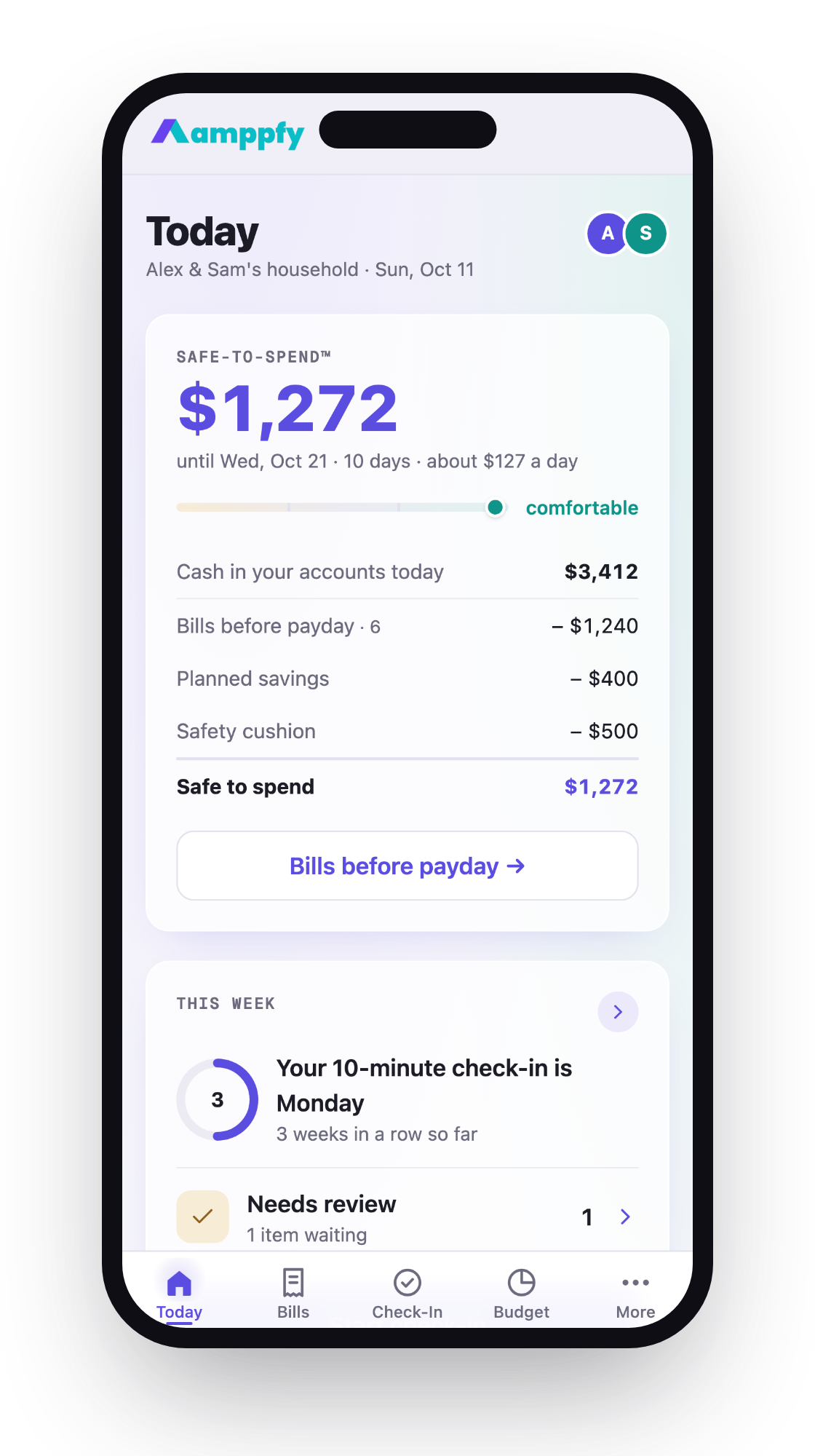
Amppfy skips bank sync entirely. You type in your balances yourself, and it shows one Safe-to-Spend™ number: your cash minus bills due before payday, minus savings, minus a cushion you choose. The math is printed underneath. It’s free on iPhone and the web, and you can invite a partner by email. Typing in a balance takes about 30 seconds per account, and the weekly check-in takes about ten minutes. It won’t import transactions, so if you want line-by-line spending data, pair it with a spreadsheet or another tool.
Which One Fits Which Household
The right pick depends on how you actually manage money, not how you think you should.
A dual-income couple splitting bills probably needs partner access and a shared view of upcoming expenses. Monarch includes partner access in its price; the manual-balance app above is free and lets you invite a partner by email, and each of you gets your own login. If one partner is on Android and the other on iPhone, Monarch has apps for both. The manual-balance app covers the Android partner through its web app.
A single parent juggling irregular expenses and a tight paycheck needs the clearest possible answer to one question: what can I spend right now without missing a bill? A single safe-to-spend number answers that directly. A projected cash flow chart (Simplifi) answers it too, but you have to read the chart and interpret the dips yourself.
Someone who quit a budgeting app because of upkeep should be honest about that. YNAB asks you to assign and review every dollar. Simplifi and Monarch do more of the tracking for you once accounts are connected. A manual-balance app asks only for balances and bills, but it also gives you the least granular data. That’s a trade-off, not a flaw.
If you’re a spreadsheet person who genuinely enjoys building formulas, you don’t have to give that up. Keep your sheet for monthly reviews and use an app for the day-to-day question. You don’t have to choose between an app and a spreadsheet.
How to Switch Without Losing Your History
The good news: Tiller puts your data in spreadsheets you own, so your history doesn’t disappear when you switch. Here’s how to carry it forward.
- Keep a copy of your spreadsheet. Your Tiller sheet lives in your own Google Sheets or Excel account. Make a copy, or download the tabs you care about as CSV files, and label each with the date range it covers.
- Standardize your categories. Before importing into a new tool, review your Tiller categories. Most apps use different names for the same buckets. Create a simple mapping: “Tiller: Groceries” becomes “New App: Food & Drink,” for example. A two-column spreadsheet is enough.
- Import selectively. If your new app accepts file imports, you don’t need to bring in five years of data on day one. Start with recent months and keep the rest in your sheet for reference.
- Set your baseline. In whatever new tool you choose, enter your current account balances, your recurring bills, and your next payday. That’s the foundation. Historical data is for reference; your current numbers are what drive decisions.
- Run both systems for one pay cycle. Keep your Tiller sheet open alongside the new tool for two to four weeks. If you’re still on a Tiller trial or subscription, decide before it renews. Compare the outputs. If the new tool’s “safe to spend” or cash flow number matches what your spreadsheet says, you’re good. Delete the training wheels.
Try to do the setup in one sitting so you don’t lose momentum halfway through.
Frequently Asked Questions
Can I use Google Sheets for budgeting without Tiller?
Yes. You just won’t have automatic transaction feeds. You can download CSVs from your bank and paste them into a sheet. It works, but it’s manual work that Tiller automates. Some people pair a simple manual sheet with an app for the day-to-day number and use the sheet for monthly reviews.
Can I rely on bank sync?
It works most of the time, but it’s not guaranteed. Bank connections depend on links between apps, data providers, and banks, and those links sometimes break or lag. Having a manual fallback is smart regardless of which app you pick.
Do any of these alternatives support custom spreadsheet formulas like Tiller does?
The apps listed here are built around their own screens and reports, not spreadsheet formulas. If custom formulas are essential, a spreadsheet, Tiller included, is still the right home for them.
What if my partner and I use different phones?
Monarch, YNAB, and Simplifi have apps for both iOS and Android plus the web. The manual-balance app above runs on iPhone and the web, so an Android partner can use the web app. Pick whichever tool matches your household’s devices without forcing anyone onto a platform they don’t use.
Finding Your Next System
The right Tiller alternative isn’t the one with the most features. It’s the one you’ll actually open every week. If you want automation with detailed reports, Monarch or Simplifi may feel familiar. If you loved the clarity of knowing your number, a simpler tool might serve you better.
Whatever you choose, keep a copy of your Tiller spreadsheet, set your current balances, and give the new system one full pay cycle before judging it.
If you want to see your own Safe-to-Spend™ number before your next payday, Amppfy is free on iPhone and the web. Enter your balances, bills, and payday, and update your balances when they change. Get Amppfy free and see if the clarity fits.