Your rent is due on the 1st. Your paycheck lands on the 1st. The money arrives and vanishes in the same breath, and you’re left wondering what just happened. This collision is one of the most common cash-flow headaches for people who get paid twice a month or biweekly. The good news: you can fix it without earning more money. You just need a better sequence. Below, you’ll find three practical methods to stop the pileup, a worked example you can copy, and a script for talking to your landlord about flexibility.
Why the 1st Is the Most Crowded Day of the Month
The 1st isn’t just rent day. It’s also the day car insurance auto-debits, streaming services renew, gym memberships charge, and student loan payments pull. According to the Consumer Financial Protection Bureau, most recurring consumer obligations default to the 1st or 15th of the month. Your landlord picked the 1st because that’s what leases have always done. Your employer picked the 1st (or the last business day before it) because payroll calendars favor month-end and mid-month cycles.
The result is a traffic jam. Your checking account spikes at 6 a.m. and drops by noon. If even one auto-pay fires before your direct deposit clears, you risk an overdraft. If two hit early, you’re stacking fees on top of fees.
This isn’t a spending problem. It’s a timing problem. Your income and your obligations are crashing into the same 24-hour window. The fix is to separate them, either by moving money earlier, moving the due date later, or restructuring which paycheck covers rent.
Here’s what a typical 1st-of-the-month collision looks like versus a staggered setup:
| Scenario | Checking balance at 5 a.m. | Deposits by 9 a.m. | Auto-pays by noon | Balance at 1 p.m. |
|---|---|---|---|---|
| Collision (all on the 1st) | $340 | +$2,800 | -$2,650 | $490 |
| Staggered (rent moved to 5th) | $340 | +$2,800 | -$850 | $2,290 |
That second row gives you four days of breathing room. Rent still gets paid. But your account doesn’t flatline before lunch.
Three Fixes: Pre-Fund, Move the Due Date, or Shift the Payday Bill
You have three realistic options. Pick the one that matches your pay cycle and your landlord’s flexibility.
Option 1: Pre-fund rent from the prior paycheck
Set aside rent money the paycheck before it’s due. If you’re paid biweekly, your mid-month check funds next month’s rent. The money sits in your account, already spoken for, before the 1st arrives.
Option 2: Ask your landlord to move the due date
Many landlords will shift rent to the 5th, 10th, or 15th if you ask. This creates space between your paycheck deposit and your largest bill. More on how to have that conversation below.
Option 3: Reassign which paycheck covers rent
If you’re paid on the 1st and 15th, stop treating the 1st paycheck as “rent money.” Instead, use the 15th paycheck to cover rent. Transfer rent into a separate holding spot on the 15th. By the time the 1st rolls around, the money is already waiting.
| Fix | Best for | Effort level | Landlord involved? |
|---|---|---|---|
| Pre-fund | Biweekly or semi-monthly pay | Medium (one-time setup) | No |
| Move due date | Any pay cycle | Low (one conversation) | Yes |
| Shift the payday bill | Semi-monthly (1st/15th) | Low (one-time setup) | No |
All three methods solve the same core issue: your rent and your paycheck shouldn’t compete for the same moment on the calendar.
The Pre-Fund Method with a Worked Example
Pre-funding means you treat rent like a bill you pay to yourself two weeks early. Here’s how the math works for someone earning $5,600 per month, paid biweekly, with $1,500 rent due on the 1st.
Step one: identify your “rent paycheck.” If you get paid on the 15th and the 1st, your rent paycheck is the 15th. That’s the check that will fund next month’s rent.
Step two: on the 15th, move $1,500 into a separate checking account or a clearly labeled savings bucket. Don’t touch it.
Step three: on the 1st, rent auto-pays from that bucket. Your main checking account receives your new paycheck without immediately losing $1,500.
Here’s the single-line math for what’s left after the 15th transfer:
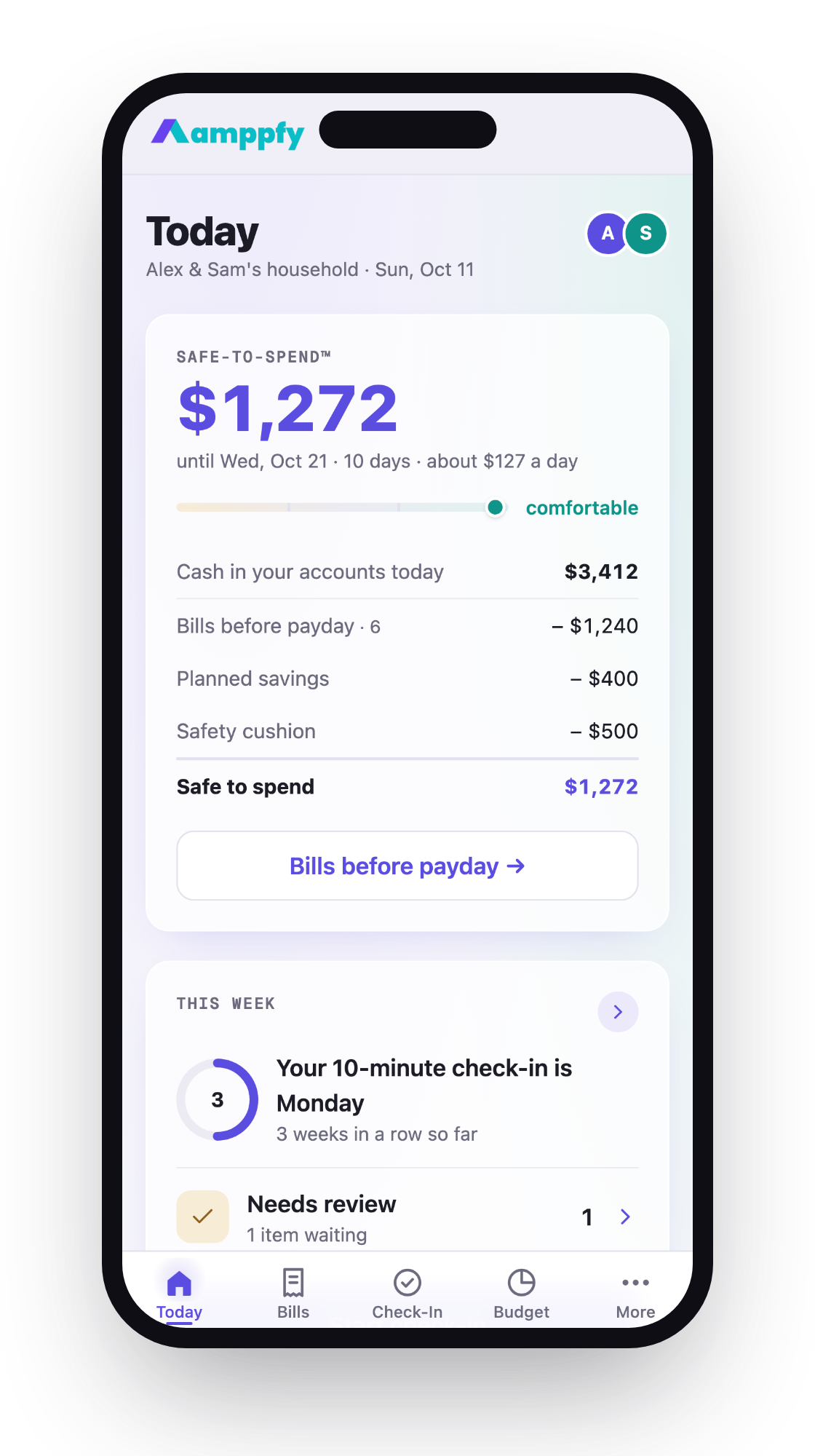
$2,800 paycheck − $1,500 rent set-aside − $200 savings goal − $150 cushion = $950 Safe-to-Spend™
That $950 covers groceries, gas, and discretionary spending until the next paycheck. You know the number before you spend a dime.
What if you’re paid biweekly instead of semi-monthly?
Biweekly pay means 26 checks a year, not 24. Two months will have three paydays. Use that third check as a buffer: split it between next month’s rent pre-fund and a savings goal. Don’t treat it as bonus money.
A common mistake to avoid
Don’t pre-fund rent and then dip into the set-aside for something else. The whole point is that the money is gone from your spending pool. If it’s sitting in the same account you use for groceries, you’ll spend it. A second free checking account at your bank takes ten minutes to open and solves this permanently.
Amppfy’s payday calendar can help here. It marks the lowest-cash day in your month and sends a heads-up the day before a bill hits. When your rent is due on the 1st and paid on the 1st, seeing that pinch point two weeks early changes the game from reactive to planned.
Talking to a Landlord About a Grace Period
Most leases include a grace period, but the length varies by state. Some states mandate it by law. Others leave it to the lease terms. Before you ask for anything, read your lease. You may already have three to five days of built-in flexibility.
How to ask: a simple script
Keep it short and professional. Here’s a template you can adapt:
- “Hi [landlord name], I’ve been paying on time for [X months]. My paycheck deposits on the 1st, and I’d like to shift my rent due date to the 5th so I can confirm the deposit clears before auto-pay fires. Would that work for you?”
That’s it. You’re not asking for a discount. You’re not asking to pay late. You’re asking to move the calendar date so the money flows more reliably.
What if they say no?
Some landlords won’t budge, especially property management companies with rigid billing systems. That’s fine. Fall back to the pre-fund method. You don’t need their permission to reorganize your own cash flow.
What about late fees?
If your lease has a five-day grace period and you pay on the 3rd, you’re not late. No fee applies. But confirm this in writing. A text or email from your landlord saying “paying by the 5th is fine” protects you if there’s ever a dispute.
| Grace period length | Common in | Late fee typically kicks in |
|---|---|---|
| 0 days | Some private landlords | Day 2 |
| 3-5 days | Most standard leases | Day 4 or 6 |
| 5-10 days | States with tenant protections (CA, NY, OR) | Day 6 or 11 |
Check your state’s tenant rights page for specifics. Don’t assume your grace period matches a friend’s lease in another state.
Seeing the 1st Coming on a Payday Calendar
A payday calendar does one thing well: it shows you which bills fall between which paychecks. When you can see that rent, car insurance, and your phone bill all cluster on the 1st, you can plan for it two weeks out instead of two hours before.
Build your own in a spreadsheet or use an app that does it for you. The key columns are: bill name, amount, due date, and which paycheck covers it. Once you assign each bill to a specific paycheck, you stop guessing whether you can afford dinner on the 2nd.
Amppfy shows this as a month calendar with every bill plotted and the lowest-cash day flagged. You enter your balances yourself, about 30 seconds per account, and the app calculates your Safe-to-Spend number: available cash minus bills due before payday, minus planned savings, minus a cushion you set. For couples splitting rent, both partners see the same number with their own login.
The weekly check-in takes about ten minutes. Update your balances, confirm upcoming bills, and glance at the number. That’s enough to catch a problem before it becomes a fee.
What to look for on your calendar
Scan for clusters. If three or more bills land on the same day, spread them out. Most billers let you choose your due date online. Credit cards, insurance, and subscriptions are usually flexible. Rent is the stubborn one, which is why the pre-fund method exists.
A 2024 Federal Reserve survey found that 37% of U.S. adults would struggle to cover an unexpected $400 expense. When your rent, insurance, and streaming all hit on the same morning, even a planned $400 expense can feel unexpected. Spacing your bills across the month turns a crisis into a calendar entry.
Frequently Asked Questions
Can I pay rent early, before the 1st, to avoid the collision?
Yes. Most landlords accept early payment. If you pre-fund rent from your mid-month paycheck and send it on the 28th or 29th, it clears before the 1st. Check whether your landlord’s portal processes early payments immediately or holds them until the due date. Some online portals queue the payment and don’t post it until the 1st regardless.
What happens if my paycheck deposits after my rent auto-pay fires?
Your bank may cover it through overdraft protection, or it may bounce the payment entirely. Either outcome costs you money: overdraft fees average around $35, and a bounced rent payment can trigger a late fee from your landlord. Set your rent auto-pay for late morning or afternoon if your portal allows timing control. Better yet, pre-fund so the money is already there.
Is it better to pay rent manually or set up auto-pay?
Auto-pay removes the risk of forgetting. Manual payment gives you control over timing. The best approach is auto-pay from a pre-funded account. You get reliability without the anxiety of wondering whether your deposit cleared first. If you pay manually, set a recurring reminder for the 28th to transfer rent money into position.
My partner and I split rent. How do we coordinate when it’s due on the 1st and we’re both paid on the 1st?
Decide which partner’s paycheck covers rent, or split the pre-fund. Each of you moves your half into a shared account on the 15th. By the 1st, the full amount is sitting there. Amppfy lets both partners see the same Safe-to-Spend number, so neither person has to ask “did you transfer your half yet?” The answer is visible to both of you.
Stop the Monthly Collision This Week
When your rent is due on the 1st and your paycheck arrives the same day, the fix isn’t earning more. It’s sequencing better. Pre-fund from your prior paycheck, ask your landlord about shifting the date, or reassign which check covers rent. Pick one method and set it up this week. The whole process takes less than 30 minutes.
If you want a single number that tells you what’s safe to spend after rent, bills, savings, and a cushion are accounted for, try Amppfy free at amppfy.com/app. Ten minutes a week keeps the math honest and the 1st stress-free.