Maybe Copilot Money’s subscription no longer feels worth it, or it simply stopped fitting the way you manage money. Whatever brought you here, plenty of budgeting apps are worth a look. Several alternatives to Copilot Money exist for iPhone, including free ones. This guide walks through what to look for, how the main options compare, and how to switch without losing the financial picture you’ve already built.
Why People Look for a Copilot Money Alternative
Copilot Money earned fans for its design and automatic transaction feeds. So why leave? A few patterns keep showing up.
Price is a common trigger. Copilot has no free tier: after a one-month trial it costs $13 a month or $95 a year, as of October 2026. If you mostly use it to see where your money went, that can start to feel like a lot.
Bank-sync frustration is another. Connections break, transactions categorize incorrectly, and you spend more time fixing data than reading it. That “automatic” promise turns into weekend maintenance.
Then there’s how couples share it. Copilot lets you share access with a partner through a Magic Link sign-in, and that person gets full control of the same account. There are no separate partner profiles, so if you’d rather each have your own view, that setup may not fit.
Some people also outgrow the tool. They want a clearer answer to one question: how much can I actually spend before payday? Copilot shows budgets, trends, and upcoming bills. Some people want those boiled down into one number that subtracts bills and savings from their cash, and that sends them searching for Copilot Money alternatives that answer the question directly.
What to Look For in a Replacement
Before you pick the next app, write down what actually failed in the last one. That list becomes your filter.
- Price and pricing model. Monthly, annual, lifetime, or free? Know the total cost over two years, not just the introductory rate.
- Couples support. Can you invite a partner, and does the app share one account or give each person their own access?
- Data entry method. Do you want automatic bank sync, manual entry, or a mix? Each has trade-offs: sync is hands-off until it breaks; manual is reliable but takes a few seconds per account.
- The core question it answers. Some apps answer “where did my money go?” Others answer “what’s safe to spend right now?” Pick the one that matches the question you actually ask yourself on a Tuesday afternoon.
- Platform coverage. Apple devices only, or does your partner need Android or web access too?
- Maintenance time. A budgeting app that takes 45 minutes a week will get abandoned by month three. Look for something you can keep current in ten minutes or less.
Write your top three deal-breakers from that list. They’ll cut the field fast.
The Alternatives, Compared
Here’s a side-by-side look at the main options available on iPhone. Prices are as of October 2026.
| Feature | Monarch Money | Simplifi by Quicken | Rocket Money | PocketGuard | Amppfy |
|---|---|---|---|---|---|
| Price | Core $14.99/mo or $99.99/yr; 7-day trial | $3.99/mo first year, then $6.99/mo, billed annually | Free; Premium $7–$14/mo; Premium+ $15/mo | No free tier; 7-day trial; Plus $12.99/mo, $74.99/yr, or $149.99 lifetime | Free |
| Bank sync | Yes | Yes | Yes | Yes (manual tracking also possible) | No: you type balances |
| Couples support | Invite a partner at no extra cost | Share with one other person | Account sharing on Premium | Not stated on its site | Invite a partner by email |
| Main focus | Budgets, net worth, investments | Spending Plan and projected cash flow | Subscriptions, bills, spending | What’s left after bills, debt, savings, goals | What’s safe to spend before payday? |
| Platform | iPhone, Android, web | iPhone, Android, web | iPhone, Android; web on paid tiers | iPhone, Android, web | iPhone and web |
Monarch Money
Monarch covers much of the same ground as Copilot. It connects to 13,000+ institutions, tracks net worth and investments, and lets you invite a partner at no extra cost. Core costs $14.99 a month or $99.99 a year after a 7-day trial, and the newer Plus tier is $199.99 a year. If price was your reason for leaving Copilot, Monarch doesn’t solve that problem.
Simplifi by Quicken
Simplifi focuses on a Spending Plan and projected cash flow, with what-if scenarios and a view of upcoming bills and subscriptions. The first-year rate of $3.99 a month (billed annually, then $6.99 a month) is the lowest paid price here. It connects to your accounts, and you can share it with one other person.
Rocket Money and PocketGuard
Rocket Money has a free tier that tracks subscriptions and upcoming bills but allows only two custom budget categories; Premium unlocks unlimited budgets, net worth, and cancellation help. PocketGuard has no permanently free tier: after a 7-day trial, PocketGuard Plus runs $12.99 a month, $74.99 a year, or $149.99 for lifetime access. Its “Leftover” figure shows what’s left after bills, debt, savings, and goals.
Amppfy
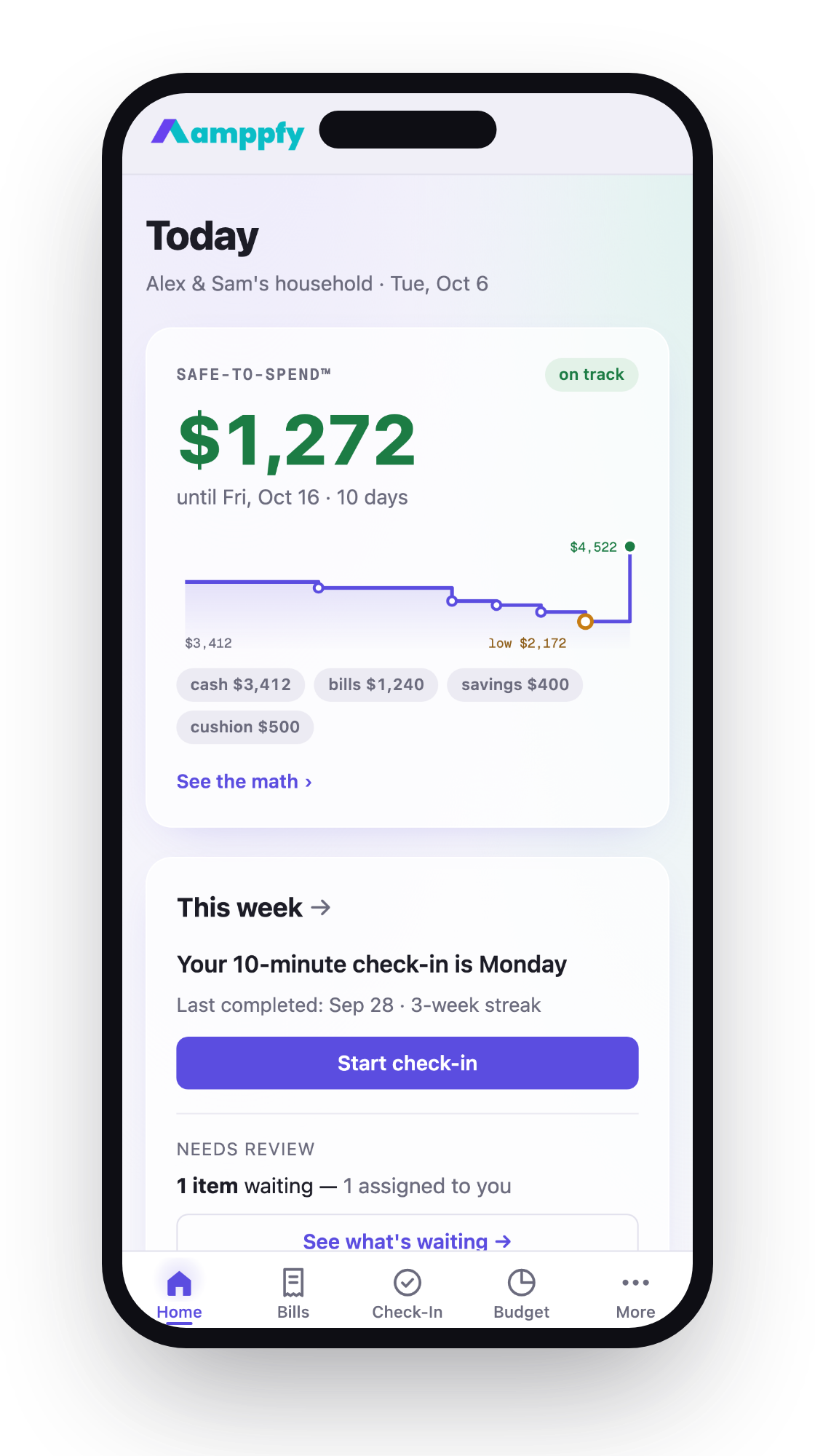
This one takes a different approach. There’s no bank login. You type in your balances, bills, paydays, and savings goals. The app returns one Safe-to-Spend™ number: your available cash minus bills due before payday, minus planned savings, minus a cushion you set. The math is printed right under the number so you can verify it yourself. Heads-ups give you a calm reminder when a bill is due soon or a bill changed. You can invite a partner by email to see the same number. It’s free on iPhone and the web, and it doesn’t import transactions or sync investments.
Which One Fits Which Household
The right app depends on your situation, not on a star rating.
You’re a single earner who loved Copilot’s transaction detail and doesn’t mind paying for it. Monarch Money covers similar ground: bank connections, budgets, net worth, and investments in one place.
You’re a couple on a hybrid money system: some shared bills, some separate accounts. Amppfy lets you invite a partner by email: each of you gets your own login, shared accounts and bills are visible to both, and anything you keep private stays private. No subscription cost, no sync to troubleshoot. Monarch (invite a partner at no extra cost) and Simplifi (share with one other person) also cover two people.
You’re mostly trying to cancel forgotten subscriptions. Rocket Money’s free tier tracks your subscriptions; having Rocket Money cancel them for you is a Premium feature. Use it as an audit tool, then decide if you need a full budgeting app at all.
You want to see projected cash flow ahead of time. Simplifi does this at a low first-year price, and you can share it with one other person.
You quit your last app because the upkeep was too much. Look for manual-entry tools or apps with a defined weekly check-in; the Safe-to-Spend™ app in the table builds in one that takes about ten minutes. A short routine that actually happens beats a “fully automatic” system you stop opening.
How to Switch Without Losing Your History
Switching apps feels risky because you don’t want to lose the picture you’ve already built. Here’s a clean process.
- Export what you can. Copilot lets you export your transactions as a CSV file on iPhone (Settings, then Export your transactions), iPad, Mac, and the web. Do this before you cancel. Save the file to iCloud or Google Drive.
- Screenshot your current state. Capture your account balances, recurring bills, and any savings goals. This takes two minutes and gives you a reference sheet for setting up the new app.
- Pick your switch date. The best time is right after payday. You’ll have a clean starting balance and a full pay cycle ahead to test the new tool.
- Set up the new app in one sitting. Enter your balances, bills, and payday. If the app supports savings goals, add those too. In a Safe-to-Spend™ app, an example looks like this: $4,200 cash − $1,800 bills due before payday − $300 savings − $400 cushion = $1,700.
- Run both apps for one pay cycle. Keep the old app installed but stop updating it. Use the new app as your primary. At the end of the cycle, compare: did the new app answer your core question faster?
- Cancel the old subscription. Once you’re confident, cancel and delete. Don’t let the old app auto-renew while you’re not using it.
Your transaction history from the old app lives in that CSV file. Some apps can import a file and some can’t, but you have it if you ever need to look something up for taxes or disputes.
Frequently Asked Questions
Is there a truly free alternative to Copilot Money for iPhone?
Yes. The manual Safe-to-Spend™ app in the table is free on iPhone and the web, and Rocket Money has a free tier with limits (two custom budget categories, no web access). PocketGuard has no permanently free tier. Goodbudget and EveryDollar also have free plans built on manual entry.
Can I use a budgeting app with my partner without sharing a login?
Yes. Monarch Money lets you invite a partner at no extra cost, Simplifi lets you share with one other person, and the manual app in the table lets you invite a partner by email for free. Copilot shares one account with full control rather than separate partner profiles.
What’s the biggest downside of manual-entry budgeting apps?
You have to update your balances yourself, which takes about 30 seconds per account in the Safe-to-Spend™ app in the table. That means opening your bank’s app, checking the number, and typing it in. The upside is that there’s no connection to break: no sync errors, no miscategorized transactions, no third-party access to your bank credentials.
How do I know which budgeting app is right for me?
Start with the question you’re trying to answer. If it’s “where did my money go last month,” pick an app with transaction categorization like Monarch or Simplifi. If it’s “what can I safely spend before Friday,” pick an app that calculates that number directly. The right tool matches your question, not someone else’s review score.
Making the Switch Count
The best budgeting app is the one you’ll actually open next Tuesday. That’s it. No feature list matters if the app sits unused on your second home screen. Pick the tool that answers your real question, fits your household setup, and takes less time than making coffee.
If your question is “what’s safe to spend before payday,” try seeing that number for yourself. Get Amppfy free on iPhone or the web: enter your balances, bills, and payday, update the balances when they change, and the math stays in view.