Military retired pay hits your bank account once a month, and knowing the exact deposit date for every month of 2027 keeps your bills, savings, and spending on track. The general rule is simple: pay lands on the first of the month. But weekends and federal holidays shift that date, sometimes forward, sometimes backward, depending on whether you’re a retiree or a Survivor Benefit Plan (SBP) annuitant. This guide lays out every 2027 pay date, explains the early-deposit months, and shows you how to plan your budget around a single monthly check.
When Retired and Annuitant Pay Is Deposited
The Defense Finance and Accounting Service (DFAS) follows a straightforward rule. Retired pay is due on the first of every month[1]. If the first falls on a regular business day, your deposit posts that morning.
The wrinkle shows up on weekends and holidays. When the first of the month lands on a Saturday, Sunday, or federal holiday, DFAS moves the retiree deposit to the last business day of the preceding month[2]. That means you get paid early, not late.
SBP Annuitant Pay Works Differently
SBP annuitant payments follow a separate rule. When the first falls on a non-business day, the annuitant deposit shifts to the first business day of that month rather than the last business day before it. This is the opposite direction from retiree pay. If you’re both a retiree and an annuitant, or if a household includes both, you could see deposits land on different days during the same pay cycle.
Why Your Bank Might Show It Earlier
Some banks and credit unions release direct deposits a day or two before the official DFAS date. Some members see funds a day or two before the official date. Don’t count on early release for bill-pay timing, but it’s a nice bonus when it happens.
Every 2027 Retired-Pay Date
Below is the complete schedule for military retirement pay dates in 2027. Each row shows the first of the month with its weekday, and the actual deposit date for both retirees and SBP annuitants.
| Month | The 1st | Retiree Pay Date | SBP Annuitant Pay Date |
|---|---|---|---|
| January | Fri, Jan 1 (New Year’s Day) | Thursday, December 31, 2026 | Monday, January 4 |
| February | Mon, Feb 1 | February 1 | February 1 |
| March | Mon, Mar 1 | March 1 | March 1 |
| April | Thu, Apr 1 | April 1 | April 1 |
| May | Sat, May 1 | Friday, April 30 | Monday, May 3 |
| June | Tue, Jun 1 | June 1 | June 1 |
| July | Thu, Jul 1 | July 1 | July 1 |
| August | Sun, Aug 1 | Friday, July 30 | Monday, August 2 |
| September | Wed, Sep 1 | September 1 | September 1 |
| October | Fri, Oct 1 | October 1 | October 1 |
| November | Mon, Nov 1 | November 1 | November 1 |
| December | Wed, Dec 1 | December 1 | December 1 |
| January 2028 | Sat, Jan 1, 2028 | Friday, December 31, 2027 (a federal holiday with banks open; DFAS may pay Thursday, December 30) | Monday, January 3, 2028 |
A few things to notice. Nine months in 2027 have the 1st on a regular business day, so both retirees and annuitants get paid on the first with no shift. January, May, and August are the months where the split matters: retirees get paid early, and annuitants get paid three or four days later. The payment for December 2027 also moves: January 1, 2028 is a Saturday, so retirees get it on Friday, December 31, 2027.
The 2027 COLA and Your First Adjusted Deposit
Your 2027 cost-of-living adjustment officially takes effect on December 1, 2026. That means the first COLA-adjusted deposit appears in your December 31, 2026 payment[3]. By the time January 2027 arrives, you’re already receiving the new rate. If you retired during 2026, your COLA is prorated based on the quarter you retired[4], so your increase will be smaller than the full percentage.
Months When the Deposit Comes Early
Four deposits in the 2027 schedule trigger the early-pay rule for retirees: January (paid Thursday, December 31, 2026, because January 1 is New Year’s Day), May, August, and the January 2028 payment (paid Friday, December 31, 2027). May and August matter most inside the year. These are the months worth circling on your calendar because they change your cash flow timing in ways that ripple into the following weeks.
In May, the first falls on a Saturday. DFAS pushes the retiree deposit back to Friday, April 30. That means you’ll go from April 30 to June 1 before seeing another deposit: a 32-day gap. Your May budget needs to stretch a full extra day compared to a normal cycle.
In August, the first is a Sunday. The deposit moves to Friday, July 30. Your next check arrives September 1, creating a 33-day gap. That’s three extra days of expenses covered by one deposit.
How to Handle the Longer Gaps
- Set aside a small buffer during the months before May and August. Even $100 to $200 carried forward covers the extra days.
- Schedule recurring bills for the middle of the month rather than the first. This gives you breathing room regardless of when the deposit lands.
- If you pay rent on the first, confirm with your landlord or property manager that an April 30 deposit still counts as on-time for May rent.
SBP annuitants face the opposite situation. In January, you won’t see your deposit until Monday, January 4. In May, it arrives Monday, May 3. In August, it arrives Monday, August 2. Plan any first-of-the-month bills around the delay, not the calendar date.
Budgeting a Single Monthly Deposit
Getting paid once a month is fundamentally different from a biweekly paycheck. You receive all your money on one day and need it to last 28 to 33 days. There’s no second check arriving mid-month to bail you out.
The Four-Line Spending Check
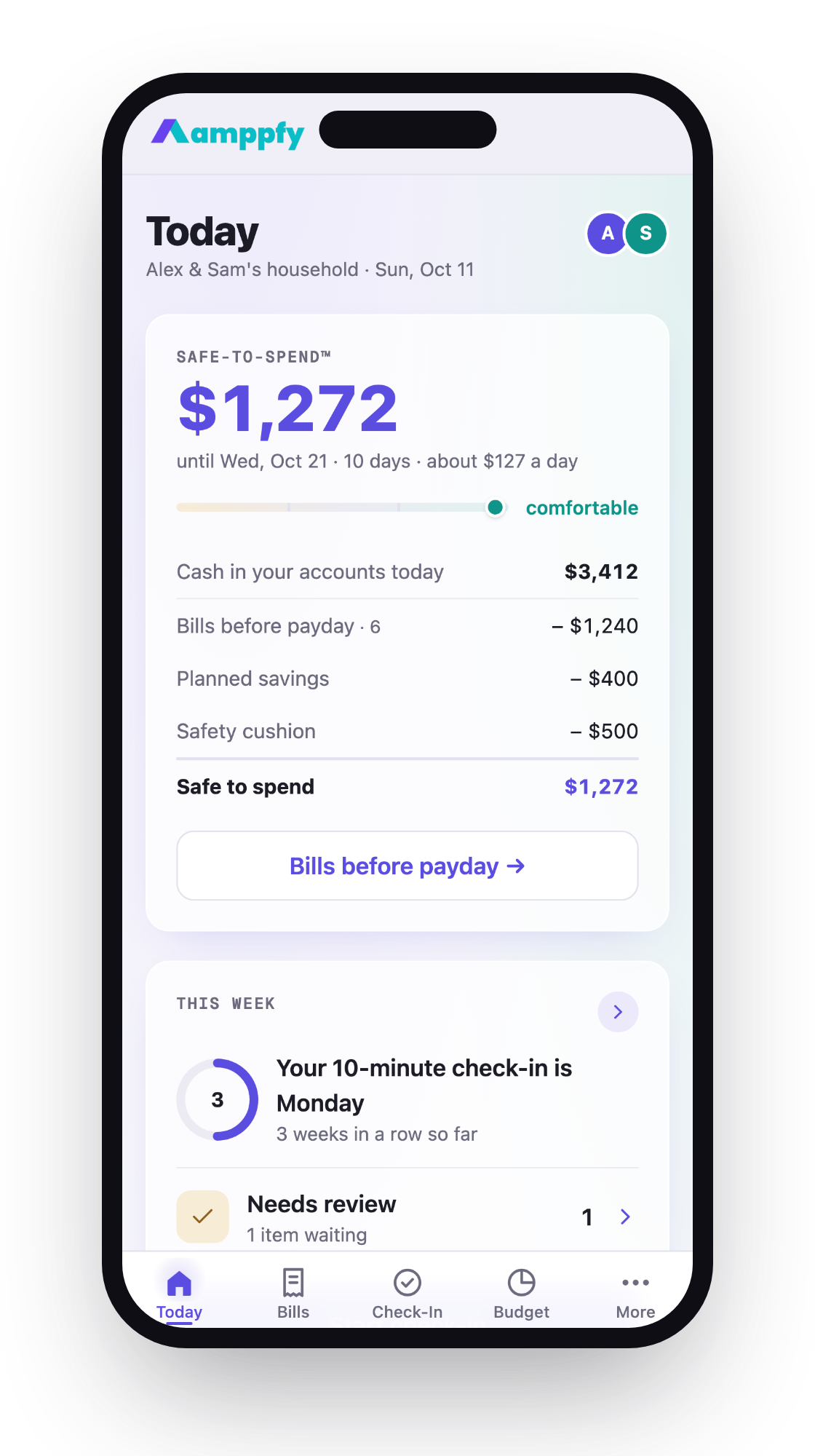
A quick formula keeps you grounded between deposits. Take your checking balance after the deposit clears, subtract bills due before the next payday, subtract what you want to save, and subtract a cushion for surprises. The remainder is what’s actually safe to spend.
Here’s a worked example for a retiree receiving $3,800 per month:
$3,800 cash – $2,100 bills – $300 savings – $400 cushion = $1,000
That $1,000 is your real spending money for the month. Divide by 30 days and you’ve got about $33 per day for groceries, gas, and everything else. On a 33-day month like August, it drops to roughly $30 per day. Small difference, but it adds up if you’re not watching.
Weekly Check-Ins Beat Daily Tracking
You don’t need to log every coffee. A 10-minute check once a week tells you whether you’re on pace or drifting. Update your checking balance, confirm upcoming bills haven’t changed, and glance at your remaining Safe-to-Spend™ number. Amppfy shows this number on one screen: your balance minus bills, savings, and cushion, with the math printed right underneath. It takes about 30 seconds to update a balance since you just type in the number.
Subscriptions: The Silent Budget Leak
Monthly subscriptions hit at random dates throughout the month. A streaming service on the 7th, a gym on the 15th, insurance on the 22nd. List every recurring charge with its next billing date so nothing catches you off guard. Knowing the exact day each charge hits lets you see the real shape of your monthly cash flow, not just the big bills.
Retired Pay Plus VA Compensation on One Calendar
Many retirees receive both military retired pay and VA disability compensation. These two deposits follow different schedules, which means your monthly income arrives in two waves rather than one.
VA compensation is also paid on the first of the month for the month before, and it follows the same early-pay rule for weekends and holidays. In 2027, both deposits land on the same dates, including the early ones on December 31, 2026, April 30, July 30, and December 31, 2027. Keeping both on a single calendar prevents you from spending money that hasn’t arrived yet.
Concurrent Retirement and Disability Pay (CRDP)
If you receive CRDP, your retired pay is reduced by your VA compensation amount, then restored dollar-for-dollar. The net effect is you receive your full retirement plus your full VA payment, but they come from two different sources on potentially two different dates. Track the combined total as your real monthly income.
Combat-Related Special Compensation (CRSC)
CRSC works differently. It replaces the VA offset with a tax-free payment from DFAS. This means part of your income comes from DFAS and part from the VA, each on its own schedule. Confirm which payments you’re receiving on myPay and eBenefits so your budget reflects reality.
Building One View of All Income
The simplest approach: list every expected deposit for the month with its date and amount, then subtract every bill and savings contribution. What remains is what you can spend. Whether you do this on paper, in a spreadsheet, or in an app like Amppfy that shows your Safe-to-Spend™ on one screen, the point is the same. One view of all money in, all money out, and what’s left.
Frequently Asked Questions
Does DFAS ever deposit retired pay late?
No. When the first of the month is a business day, the deposit posts on the first. When it’s a weekend or holiday, it moves to the last business day before the first. You’ll never receive retired pay after the first of the month. SBP annuitant pay is different: it moves to the next business day, so it can arrive on the second or third.
Will my 2027 COLA be the same percentage as the full published rate?
Only if you retired before 2026. If you retired during 2026, your COLA is prorated based on the quarter you separated. Someone who retired in Q3 of 2026 receives a smaller adjustment than someone who retired in Q1 of 2026. DFAS calculates this automatically.
Can I change my direct deposit bank for retired pay mid-year?
Yes. Update your banking information through myPay at any time. Changes typically take one to two pay cycles to process, so make the switch well before a month where you need the deposit in a specific account.
What happens if a federal holiday falls on the first of the month?
The same rule applies as weekends. Retiree pay moves to the last business day before the holiday. This is most relevant for January 1 (New Year’s Day). In 2027, January 1 falls on a Friday and is a federal holiday, so the January retiree payment arrives on Thursday, December 31, 2026.
Your 2027 Pay Calendar, Sorted
Four retiree deposits arrive early: December 31, 2026; April 30; July 30; and December 31, 2027. The rest land cleanly on the first. Print the table above, pin it where you pay bills, and mark the 33-day gap in August so it doesn’t surprise you. Knowing your exact pay dates for 2027 turns a once-a-month income into something predictable and manageable.
If you want a single number that tells you what’s safe to spend between deposits, get Amppfy free. Enter your balances, bills, and payday once, about ten minutes, and your Safe-to-Spend™ number stays current with a quick weekly update.