Most people who’ve tried to budget know the drill: save every receipt, log every coffee, categorize every swipe. It works for about two weeks. Then life gets busy, the spreadsheet goes stale, and guilt creeps in. The good news is you can budget without tracking spending on every single purchase. A better approach exists, and it takes about ten minutes a week.
Why Transaction Tracking Burns People Out
The idea sounds simple. Write down what you spend. But the reality is brutal. You’re logging dozens of transactions a day across cards, apps, cash, and subscriptions. Each one needs a category. Each category needs a limit. Miss a few days and the whole system collapses under its own weight.
This isn’t a willpower problem. Manual data entry creates a structural cognitive load that causes most users to quit within two weeks[1]. The friction of logging every purchase is completely out of step with how fast money moves in 2026. Tap-to-pay, one-click ordering, and auto-renewals mean you can spend money faster than you can write it down.
The dropout pattern looks the same almost every time:
- Week one: Motivated. Logging everything. Feels productive.
- Week two: A few missed entries. Guilt builds. Data gets unreliable.
- Week three: The app or spreadsheet sits unopened. Budget abandoned.
The core issue isn’t laziness. It’s that transaction-level tracking asks you to do the hardest possible version of budgeting. You don’t need to know that you spent $4.75 on a latte[2] last Tuesday. You need to know whether your money will last until payday. Those are two very different questions.
A system that answers the second question without requiring the first is what actually sticks. That’s the shift: stop tracking what already happened and start planning what’s ahead.
Plan the Bills and Savings, Let the Rest Be
Here’s the alternative. Instead of cataloging every purchase after the fact, you plan the big, predictable stuff up front. Bills and savings are mostly fixed. They don’t change much month to month. That makes them easy to plan and hard to forget.
The math is one line:
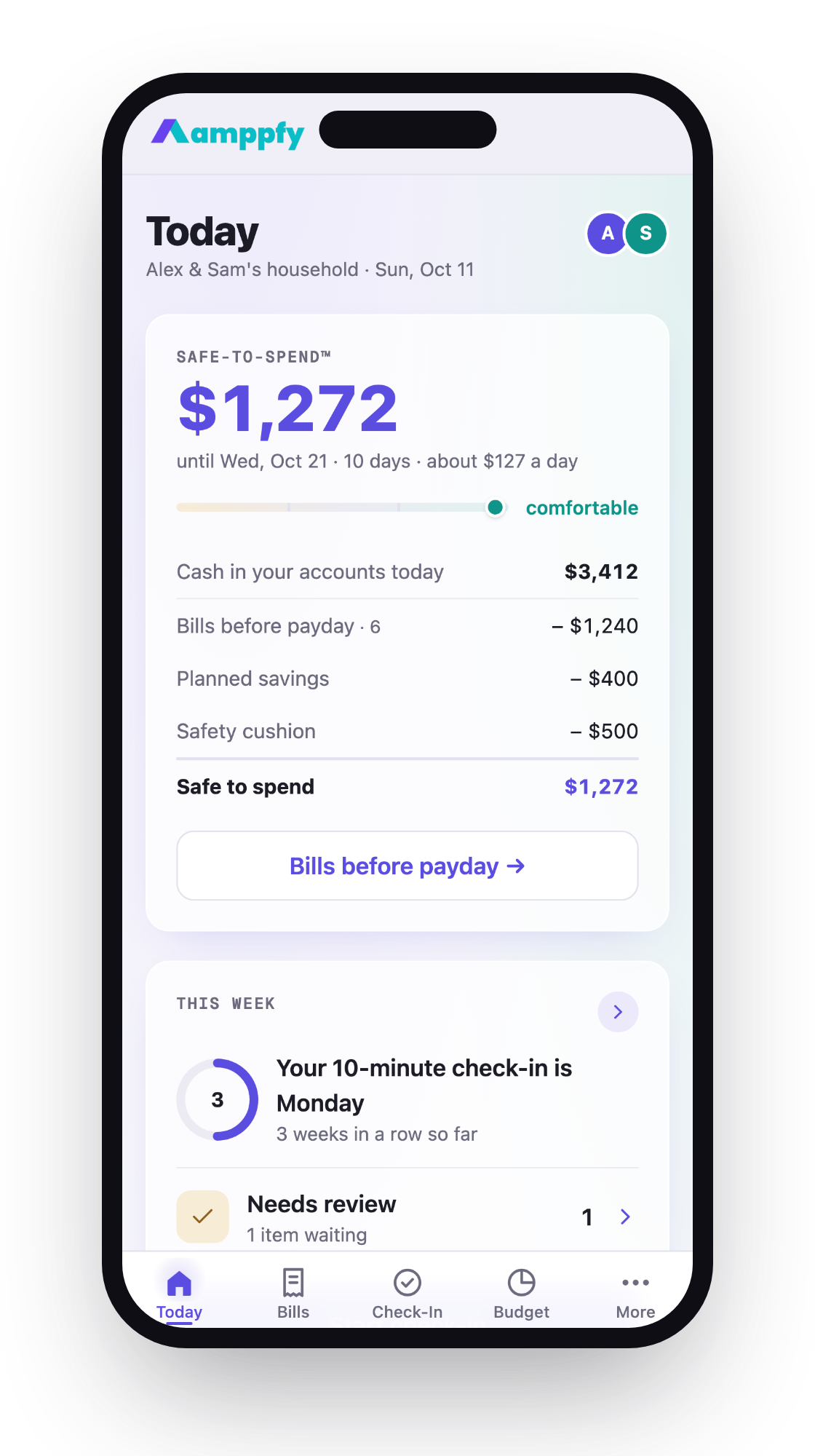
$3,412 cash − $1,240 bills − $400 savings − $500 cushion = $1,272
That $1,272 is what’s actually safe to spend before your next paycheck. Everything that isn’t a bill or a savings goal falls into everyday spending. You don’t need to split it into “dining out” versus “groceries” versus “entertainment.” You just need to keep your everyday spending within that number.
This is the concept behind what modern budgeting platforms call a “Safe to Spend” metric[3]: subtract bills and goals from income, and the remainder is yours to use freely. Amppfy calls it Safe-to-Spend™, and it shows the four-line math right under the number so you always know where it came from.
Setting Up the Plan
The setup takes about ten minutes:
- Enter your current account balances.
- Add your recurring bills with their due dates.
- Set your payday schedule.
- Pick a savings goal amount per pay period.
- Choose a safety cushion (a buffer you don’t touch).
That’s it. No bank login required. You type in your balances yourself, which takes about 30 seconds per account. From there, the Budget page shows your month in four slices: Bills, Savings, Subscriptions, and Everyday spending, all read from the plan you already entered.
Why This Holds Up
Bills don’t surprise you. Rent is rent. Insurance is insurance. By locking those in first, you’re handling most of your money with no daily effort. The remaining everyday spending takes care of itself because you already know the boundary.
What You Still Need to Know Each Week
Not tracking every purchase doesn’t mean ignoring your money entirely. You still need a pulse check. The difference is frequency and effort: a brief weekly look instead of daily logging.
The habit works because it catches small problems before they become big ones.
Your weekly check-in needs three things:
| What to check | Why it matters | Time needed |
|---|---|---|
| Current account balances | Updates your Safe-to-Spend™ number | 30 seconds per account |
| Upcoming bills this week | Confirms nothing slipped or changed | 1 minute |
| Safe-to-Spend™ vs. days until payday | Tells you if you’re on pace | Instant once balances are current |
That’s a ten-minute task, not a Sunday afternoon project. You’re not categorizing receipts. You’re not reconciling transactions. You’re updating a few numbers and confirming the plan still holds.
Weekly check-ins also benefit from what researchers call the “Fresh Start Effect,” a psychological reset that happens every seven days. Each week feels like a clean slate. A bad spending week doesn’t spiral into a bad month because you course-correct in days, not weeks.
Pick a consistent day. Many people use Sunday evening or Monday morning. Set a reminder. Open your accounts, update your balances, glance at the number. Done.
Checking the Month Without Receipts
At the end of each month, you want a slightly wider view. Not a forensic audit of every transaction, but a simple check: did the plan work?
The Three Questions
Ask yourself these three questions on the last day of the month:
- Did every bill get paid on time?
- Did savings hit the goal?
- Was there money left over, or did you dip into the cushion?
If all three answers are yes, the plan worked. No receipt review needed. If you dipped into the cushion, that’s useful information. It means either your everyday spending ran high or an unexpected expense hit. You don’t need to know exactly which coffees or takeout orders caused it. You just need to adjust next month’s cushion or trim the savings goal slightly.
Tracking Trends, Not Transactions
Over several months, patterns emerge without logging a single purchase. Your net worth either grows or shrinks. Your cushion either holds or gets tapped. These are the signals that matter.
A household budget built from your plan rather than from transaction history gives you the same directional insight with a fraction of the effort. You see whether your system is working by the outcomes, not by auditing the inputs.
For couples, this approach is especially useful. Partners see the same Safe-to-Spend™ number without needing to justify individual purchases to each other. Private balances stay private. The shared number handles the shared question: are we okay until payday?
Who This Works Best For
This approach isn’t universal. It works best for a specific set of people, and it’s worth being honest about who benefits most.
| Great fit | Less ideal fit |
|---|---|
| Salaried workers with regular paychecks | Freelancers with wildly variable income |
| Couples sharing bills | People in active debt payoff who need line-item control |
| People who quit a budgeting app | Anyone who genuinely enjoys detailed tracking |
| Parents juggling too many priorities | People with spending they’re actively hiding from themselves |
If you earn a predictable paycheck, pay roughly the same bills each month, and just want to know what’s safe to spend, this system fits you. It’s built for the person who checks their bank app three times a day but still can’t answer the question: can I afford this right now?
If you’re working through serious debt or have irregular income, you might need more granular control, at least temporarily. But even then, the planning-first approach can serve as a foundation you layer detail onto, rather than starting from scratch with every receipt.
The people who benefit most are the ones who’ve already tried the hard way. You downloaded the app. You linked your accounts. You categorized for a while. Then you stopped. That doesn’t mean budgeting isn’t for you. It means the method wasn’t right.
Frequently Asked Questions
Won’t I lose control of my spending if I don’t track purchases?
You’re not giving up control. You’re shifting it. Instead of controlling each transaction after it happens, you control the total amount available before you spend. Your Safe-to-Spend™ number acts as a guardrail. As long as you stay within it, the individual purchases don’t need policing. If you notice the number dropping faster than expected mid-pay period, that’s your signal to slow down, no receipt log required.
How do I handle irregular expenses like car repairs or medical bills?
Build them into your cushion. The safety buffer in your Safe-to-Spend™ calculation exists for exactly this reason. Some months you won’t need it. Other months it absorbs a $300 car repair[4]. If your cushion gets tapped two months in a row, increase it by $100-200 next cycle. Over time, you’ll find the right cushion size for your life.
What if my partner and I have different spending habits?
That’s normal. The planning-first approach works well here because you agree on the shared number, not on each other’s individual choices. Bills and savings goals get decided together. The remaining Safe-to-Spend™ amount covers both of your everyday spending. With Amppfy, each partner gets their own login and sees the same Safe-to-Spend™ number while keeping private balances separate.
How is this different from the envelope method or 50/30/20 rule?
The envelope method still requires you to sort spending into categories. The 50/30/20 rule gives you ratios but no real-time number to check against. A budget without tracking your spending gives you one number that updates as your balances change. It’s less about percentages and more about a live answer to “what can I spend right now?”
A Simpler Way Forward
Budgeting doesn’t require a receipt for every purchase. It requires a plan for the money that matters most: bills, savings, and a cushion. Everything else is yours to spend without guilt or a spreadsheet.
Update your balances once a week. Check three questions once a month. That’s the whole system.
If you want to see your own Safe-to-Spend™ number before your next payday, get Amppfy free on iPhone or the web. Enter your balances, bills, and payday once, about ten minutes, and the number stays current from there.