A household bringing home $4,500 a month has enough to cover the basics, save a little, and still have room to breathe. The trick is knowing where each dollar goes before the month starts. Most people skip this step and end up guessing whether a purchase is safe or not. This guide walks through a complete monthly plan, dollar by dollar, built for a small household of one or two adults. You’ll see exact numbers, not vague percentages, so you can adapt them to your own bills and goals.
The month at a glance
Here’s the full picture before we break it apart. This sample budget for $4,500 a month splits into four groups.
| Category | Monthly Amount | % of Income |
|---|---|---|
| Bills (housing, utilities, transport, insurance, debt) | $2,760 | 61% |
| Savings (emergency fund + one goal) | $350 | 8% |
| Subscriptions | $90 | 2% |
| Everyday spending (food, gas, personal) | $1,300 | 29% |
| Total | $4,500 | 100% |
The bills slice is the biggest, and that’s normal. Housing alone eats a large share of most household incomes. The key is that every dollar has a job before the month begins.
Notice there’s no “miscellaneous” line. Vague categories hide waste. If something doesn’t fit one of these four groups, it either belongs in everyday spending or it’s a subscription you forgot about.
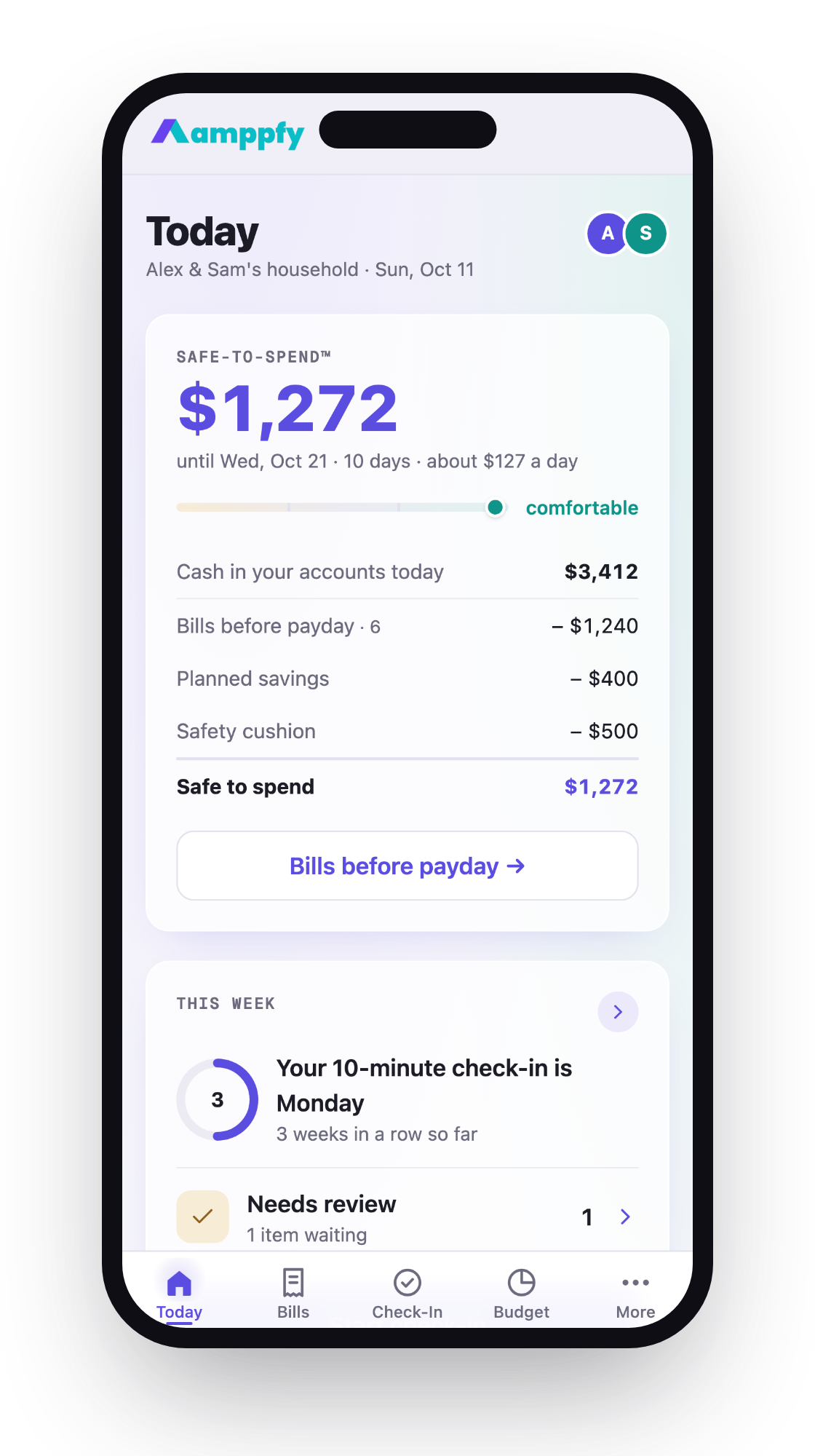
Amppfy’s Budget page shows the month in these same four slices: Bills, Savings, Subscriptions, and Everyday spending. You build the plan once, and the numbers update on their own each month.
Bills by group
Bills are the commitments you can’t skip without consequences. Group them by type so you can spot where the money actually goes.
Housing
Rent or mortgage payment is the single largest line. For this example, we’ll use $1,350. That’s 30% of take-home pay, a common target for housing costs.
Utilities
Average monthly utility costs in 2026, covering power, gas, water, trash, internet, and phone, run around $611 for a US household. Residential electricity rates have risen more than 5% between 2024 and 2025[1], and that trend hasn’t reversed. Budget $625 to give yourself a small buffer for seasonal spikes.
Transportation
Transportation is the second-largest household expense in the US, averaging $1,110 per month[2]. That average includes car payments, insurance, fuel, and maintenance. A small household on $4,500 can’t absorb that full number. If you own your car outright, you might spend $400 on insurance, gas, and upkeep. If you have a car payment, budget $600 to $700. We’ll use $585 here.
One way to trim this line: public transit fares dropped 0.3% in 2025[3] even as private fuel costs crept up. If transit works for part of your commute, the savings add up.
Insurance and minimum debt payments
Health insurance premiums (if not deducted from your paycheck), renter’s or homeowner’s insurance, and minimum debt payments round out the bills group. We’ll assign $200 here.
The bills total: $1,350 + $625 + $585 + $200 = $2,760.
Savings: emergency fund and one goal
Saving on $4,500 a month feels tight, but even a small amount compounds over time. The trick is picking just two targets: your emergency fund and one goal.
Emergency fund first
If you don’t have at least $1,000 set aside, that’s your only savings target right now. Put the full $350 toward it until you hit that floor. Once you reach $1,000, keep building toward one month of bills ($2,760). That takes about eight months at $350 per month.
Then add one goal
Once your emergency fund covers a month of bills, split the $350:
- $200 continues growing the emergency fund toward three months of bills
- $150 goes toward one specific goal: a vacation, a car repair fund, a holiday gift stash, whatever matters to you
Pick one goal at a time. Two or three competing goals dilute progress and make the whole effort feel pointless. You can always swap goals once you finish one.
Automate the timing
Move savings on payday, before you spend anything. The math for your Safe-to-Spend™ number works the same way: $4,500 income minus $2,760 bills minus $350 savings minus a cushion you choose equals what’s actually safe to spend. Amppfy calculates this automatically and shows the four-line math underneath so you always know where the number comes from.
A household budget built from your own plan works better than a template because the numbers are yours, not averages.
Subscriptions and everyday spending
These two categories share the remaining $1,390. They’re also where most budgets quietly fall apart.
Subscriptions: $90
List every recurring charge that isn’t a bill. Streaming services, app subscriptions, gym memberships, meal kit deliveries, cloud storage. Most people undercount these by two or three items.
A quick audit usually looks like this:
- Streaming (1-2 services): $25
- Music: $11
- Cloud storage: $3
- Gym or fitness app: $30
- Other (news, software, etc.): $21
Total: $90. If yours is higher, that’s fine, but it comes out of everyday spending. The two categories share the same pool.
Check the next charge date for each subscription. Canceling the day after a renewal wastes a full cycle. Knowing when each one bills lets you cancel before the charge hits.
Everyday spending: $1,300
This covers groceries, dining out, gas (if not already in your transport bill), household supplies, clothing, haircuts, and personal spending. It’s the most flexible category, which is why it’s also the easiest to blow through.
Break it down roughly:
| Item | Monthly Estimate |
|---|---|
| Groceries | $550 |
| Dining out / coffee | $200 |
| Gas / transit top-ups | $150 |
| Household supplies | $100 |
| Personal (clothing, grooming, fun) | $300 |
| Total | $1,300 |
You don’t need to track each sub-category to the penny. The point is knowing the total and checking in once a week to see how much is left. A ten-minute weekly check-in catches drift before it turns into a problem.
If you’re budgeting $4,500 monthly as a couple, decide together which everyday costs are shared and which are personal. Splitting groceries but keeping personal spending separate works well for many households.
Where the plan has room to move
No budget survives contact with real life without some flexibility. Here’s where this plan bends without breaking.
The everyday spending line is your biggest lever. If an unexpected car repair costs $400, you can absorb it by cutting dining out and personal spending for the rest of the month. You don’t need to touch savings or skip a bill.
The subscriptions line is your quickest win. Cutting two streaming services saves $25 to $30 a month. That’s $350 a year, which could fund an entire extra month of savings contributions.
The savings split is adjustable. During months with irregular expenses (back-to-school, holidays, annual insurance premiums), you can temporarily drop savings to $200 and redirect $150 to cover the spike. The key word is temporarily. Reset the next month.
Here’s what shouldn’t move:
- Your emergency fund contribution, until you hit at least one month of bills
- Your rent or mortgage payment
- Minimum debt payments
Everything else is negotiable on a month-by-month basis. The plan gives you a framework. Your weekly check-in tells you whether this month needs an adjustment.
If you share finances with a partner, both of you seeing the same Safe-to-Spend™ number prevents the “I thought we had more” conversation. Each person keeps their own login and private balances, but the shared number stays honest.
Frequently asked questions
What if my income varies and I don’t always bring home $4,500?
Use your lowest recent month as the baseline. If you brought home $4,200 last month and $4,800 the month before, build the plan around $4,200. Any extra goes straight to savings or debt. This keeps you from spending money you might not earn next month.
Should I use the 50/30/20 rule instead?
You can, but rigid percentage rules don’t account for real housing costs. At $4,500 a month, the 50/30/20 rule gives you $2,250 for needs, which may not cover rent plus utilities plus transport in many US cities. A dollar-amount plan built from your actual bills is more useful than a formula built from someone else’s averages.
How do I handle irregular bills like car insurance paid every six months?
Divide the total by six and set that amount aside each month. If your six-month premium is $780, save $130 per month in a separate line. Treat it like a bill, not a surprise. This prevents a single large payment from wrecking your plan.
Is $350 a month in savings enough?
It’s a solid start. That’s $4,200 a year. In about eight months, you’ll have a one-month emergency buffer. After two years, you’ll have enough for a meaningful goal plus a growing safety net. Consistency matters more than the dollar amount. If your income rises or a debt gets paid off, increase the savings line first.
Your next step
A $4,500 monthly budget works when every dollar has a clear assignment and you check in weekly to confirm reality matches the plan. The numbers above are a starting point. Your rent might be higher, your transport costs lower, your subscriptions fewer. Adjust the lines, keep the structure.
If you want to see your own Safe-to-Spend™ number before your next payday, get Amppfy free. Enter your balances, bills, and payday once (about ten minutes), and the number stays current from there.