Three thousand dollars a month doesn’t leave much room for guessing. You need a plan that accounts for every bill, every goal, and every grocery run before you spend a dime. The good news: a $3,000 monthly budget is entirely workable once you see the numbers laid out. This walkthrough gives you a complete, line-by-line example you can adapt to your own pay cycle and priorities.
The month at a glance
A common starting point for budgeting $3,000 a month is the 50/30/20 split: $1,500 for needs, $900 for wants, and $600 for savings and debt. That framework works as a rough guide, but $3,000 is tight enough that the lines between “need” and “want” blur fast. Here’s how the worked example breaks down across Amppfy’s four budget slices: Bills, Savings, Subscriptions, and Everyday spending.
| Category | Monthly Amount | % of $3,000 |
|---|---|---|
| Bills (housing, utilities, insurance, debt) | $1,650 | 55% |
| Savings (emergency fund, goals) | $200 | 6.7% |
| Subscriptions (streaming, apps, memberships) | $80 | 2.7% |
| Everyday spending (groceries, gas, personal) | $1,070 | 35.6% |
Notice savings sits at $200, not $600. That’s realistic at this income. Pushing too hard toward an ideal percentage often means pulling from groceries or gas, which just creates a different problem. The goal is a plan you can actually follow for months, not one that falls apart by week two.
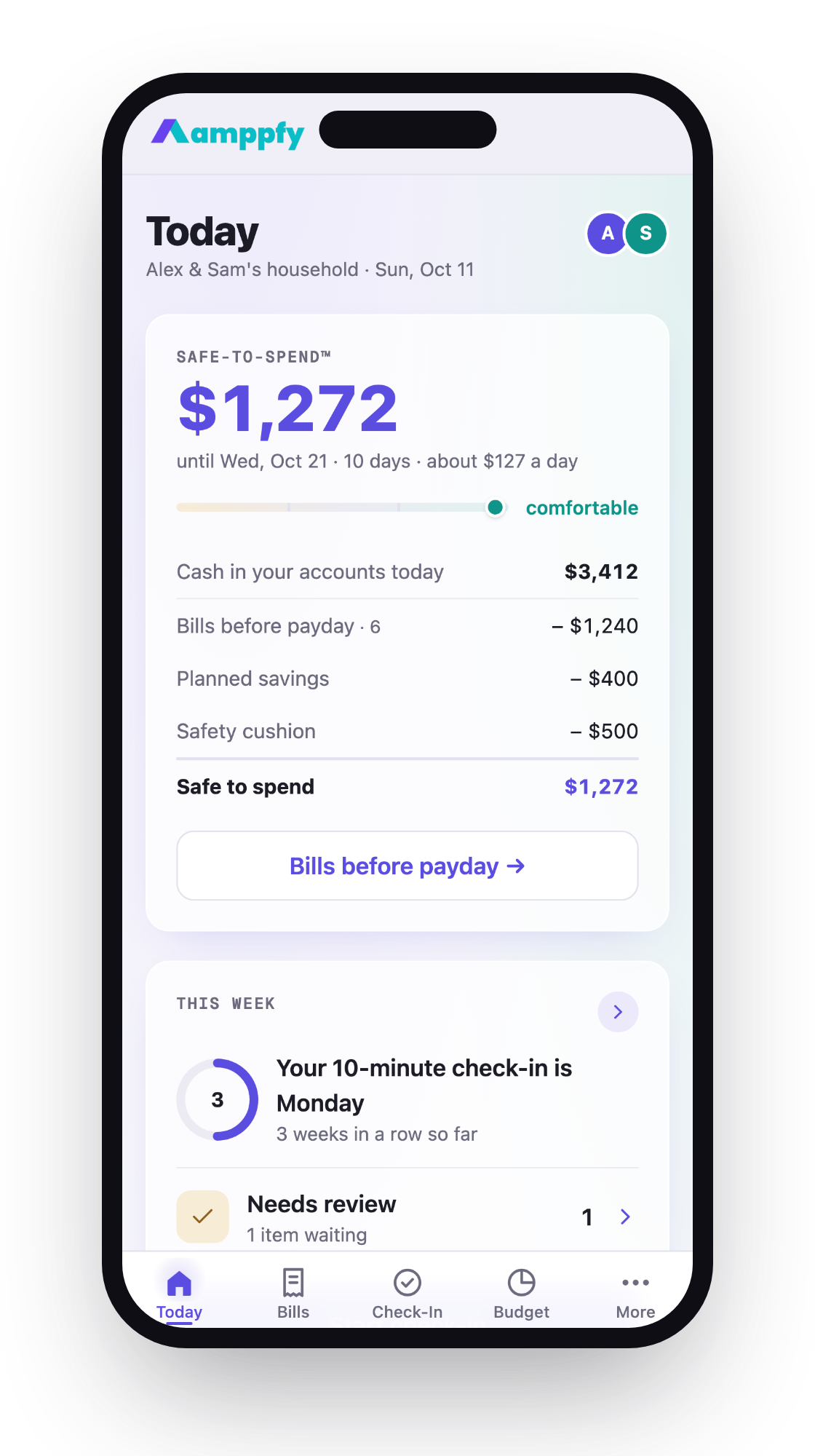
Your Safe-to-Spend™ number ties these pieces together. It’s your available cash minus bills due before payday, minus planned savings, minus a safety cushion you set. One number, one glance, no mental math at the register.
Bills by group
Bills eat the biggest slice of a $3,000 budget. Grouping them helps you see where the pressure is and where you might have options.
Fixed bills
These don’t change month to month:
- Rent: $950 (a studio or shared two-bedroom; a roommate or smaller unit keeps this manageable)
- Renter’s insurance: $20
- Car payment: $280
- Car insurance: $110
- Phone: $45
- Minimum student loan payment: $150
Fixed total: $1,555
Variable bills
These shift a bit each month:
- Electric/gas: $65 (seasonal average)
- Water/trash: $30
Variable total: $95
How to handle bill timing
Bills don’t all land on the first. Spread across two paydays, they’re easier to absorb. If you’re paid biweekly, assign each bill to the paycheck that falls closest to its due date. Amppfy’s Budget page shows the month in four slices and marks the lowest-cash day on a calendar, so you can spot a crunch before it hits.
The math for a mid-month check might look like this: $1,500 paycheck – $685 bills due before next payday – $100 savings – $150 cushion = $565 Safe-to-Spend™. That single number tells you what’s actually available without guessing.
Savings that still happen
Six percent of your income toward savings sounds small. It is small. But it’s real, and real beats aspirational every time.
Where the $200 goes
Split it simply:
- Emergency fund: $125
- Short-term goal (car repair fund, holiday gifts, etc.): $75
An emergency fund matters more than most people think. Only 63% of U.S. adults can cover a $400 emergency expense with cash[1], based on 2025 Federal Reserve data. At $125 a month, you’d cross that $400 mark in just over three months. In a year, you’d have $1,500 set aside. That’s not life-changing wealth, but it’s the difference between handling a flat tire and putting it on a credit card.
Making it automatic
Move the $200 on payday, before you spend anything else. If your bank lets you schedule a transfer, set it for the morning your check deposits. This isn’t about willpower. It’s about sequence. Pay yourself the same way you pay your landlord: first, on time, no debate.
If $200 feels like too much in a rough month, drop to $100. Don’t drop to zero. Restarting from nothing is harder than scaling back temporarily.
Subscriptions and everyday spending
Subscriptions are the slow leak in most budgets. U.S. households average $273 per month on subscriptions[2], and most people underestimate their total by about 2.5 times. On a $3,000 budget, you can’t afford that kind of blind spot.
Audit your subscriptions
List every recurring charge. Include streaming services, cloud storage, gym memberships, app subscriptions, and anything billed weekly, monthly, or annually. Here’s a sample trimmed list for this budget:
| Subscription | Monthly Cost |
|---|---|
| Streaming (one service) | $17 |
| Music | $11 |
| Cloud storage | $3 |
| Gym | $30 |
| News app | $10 |
| Miscellaneous (app subscriptions) | $9 |
| Total | $80 |
Keeping subscriptions under $80 means saying no to a second streaming service or rotating them seasonally. That’s a real trade-off, but it frees up almost $200 compared to the national average.
Everyday spending: $1,070
This is your groceries, gas, dining out, haircuts, household supplies, and personal spending. Here’s one way to slice it:
- Groceries: $310 (close to the USDA’s “Thrifty” plan for a single adult[3], which ranges from $247 to $309 as of August 2026; a small buffer accounts for food waste and single-household pricing)
- Gas/transportation: $200
- Dining out/coffee: $120
- Personal care and household: $80
- Clothing and miscellaneous: $60
- Unplanned small expenses: $300
That last line, unplanned small expenses, is your breathing room. It covers the co-pay you forgot about, the birthday gift, the parking ticket. Don’t think of it as fun money. Think of it as reality money.
Food costs deserve extra attention here. Eating out costs about 3.6% more than it did a year ago[4], outpacing grocery inflation. Shifting even two restaurant meals a month to home cooking can save $40 to $60 without much effort.
Where the plan has room to move
No budget survives contact with real life unchanged. The point isn’t perfection. It’s knowing where you can flex and where you can’t.
What’s locked
Rent, car payment, insurance, and loan minimums don’t bend. These total about $1,555 in our example. If that number is too high relative to your income, the fix isn’t budgeting harder. It’s changing the big number: finding a cheaper apartment, refinancing the car, or picking up extra hours.
What bends
- Groceries can shift $30 to $50 in either direction depending on meal planning.
- Dining out is the easiest line to cut when cash is tight. Drop it to $60 and redirect $60 to savings or a past-due bill.
- Subscriptions can rotate. Cancel one service, pick up another next month.
- The $300 unplanned line absorbs shocks. In a quiet month, move half of it to your emergency fund.
A monthly check-in
Spend ten minutes once a week updating your balances. That’s it. You’re not categorizing receipts or reconciling bank statements. You’re confirming that the numbers in your plan still match reality. If you use Amppfy, you type in your balances yourself, about 30 seconds per account, and your Safe-to-Spend™ number updates. The household budget view pulls from the plan you already entered, so there’s nothing extra to build.
A budget for $3,000 a month works when you treat it as a living document, not a contract. Adjust the flexible lines monthly. Protect the savings line. And check your Safe-to-Spend™ before any purchase over $50.
Frequently Asked Questions
Is $3,000 a month enough to live on?
It depends heavily on where you live and whether you have dependents. In lower-cost areas, $3,000 covers the basics with some room for savings. In expensive metro areas, it requires a roommate, a paid-off car, or both. The key is building a line-by-line plan so you know exactly where every dollar goes, rather than hoping it works out.
Should I use the 50/30/20 rule on a $3,000 budget?
You can use it as a starting framework, but don’t treat it as law. A strict 50/30/20 split assumes $600 for savings and debt, which may crowd out groceries or transportation at this income level. Start with your actual fixed costs, protect a smaller savings amount you can sustain, and let the percentages fall where they fall.
How much should I spend on groceries with a $3,000 monthly budget?
The USDA’s Thrifty food plan puts a single adult at roughly $247 to $309 per month. Add a small buffer for food waste and the premium of buying for one, and $300 to $330 is a reasonable target. Meal planning and a weekly grocery list keep this number honest.
What if I can’t save anything on $3,000 a month?
Start with $25. That’s not a typo. Even a tiny, consistent deposit builds the habit and creates a cushion over time. Once you’ve mapped out your bills and trimmed one subscription or two restaurant meals, you’ll likely find $50 to $100 you didn’t realize was available.
Your next step
A $3,000 monthly budget works when you can see the whole picture at once: bills, savings, subscriptions, and what’s left for daily life. The numbers in this example are a starting template. Yours will look different, and that’s fine. What matters is writing them down, checking them weekly, and adjusting when life shifts.
If you want one number that tells you what’s safe to spend before your next paycheck, get Amppfy free. Enter your balances, bills, and payday once, about ten minutes, and the number stays current with a quick weekly check-in.