Two paychecks hitting different dates, a shared rent payment, and separate spending habits: budgeting on $6,000 a month with a partner can feel like juggling two puzzles at once. The good news is that the math isn’t complicated once you lay it out. You just need a system both of you can see and trust. This guide walks you through splitting bills, setting savings goals, and keeping everyday spending in check, all without turning money into a nightly argument.
Two paychecks, one month
The first step in figuring out how to budget $6,000 a month is mapping your pay schedule. Most couples don’t get paid on the same day. One of you might be biweekly, the other semi-monthly. That mismatch matters because bills don’t wait for payday.
Write down every payday for the month. Then list every bill with its due date. Line them up side by side so you can see which paycheck covers which bill. Here’s a simplified example for a couple earning $3,200 and $2,800 after taxes:
| Pay Date | Amount | Bills Due Before Next Pay |
|---|---|---|
| Partner A: 1st & 15th | $1,600 each | Rent ($1,400), electric ($110) |
| Partner B: 7th & 21st | $1,400 each | Car payment ($380), insurance ($95), groceries ($200) |
The goal is balance. Neither paycheck should be wiped out while the other sits untouched. If one pay period is heavy, shift a bill’s payment date. Most utility companies and lenders let you pick a new due date with a phone call.
A practical check: subtract your bills and savings from each paycheck individually. If one paycheck leaves less than $100 of breathing room, move a bill to the other cycle. This keeps both of you from feeling broke half the month.
Couples who share some bills but keep separate accounts can still run this system. Each person owns specific bills. The key is that both people can see the full picture, not just their half.
Bills by group and who covers what
Sorting your bills into groups makes it obvious where $6,000 actually goes. Four groups cover almost everything: housing, transportation, food, and everything else.
Housing is typically the biggest slice. The BLS reports that housing accounts for 33.4% of total household spending[1], which on $6,000 would be about $2,004. That’s a ceiling, not a target. If your rent or mortgage is $1,400, you’re in better shape than most.
Transportation runs second. AAA puts the average monthly cost to own and operate a new vehicle at $1,071.92[2] when you include depreciation, fuel, insurance, and finance charges. Two cars at that rate would eat more than a third of your income. If you’re shopping for a car, the 20/4/7 rule is worth knowing: 20% down, a four-year loan, and a monthly payment under 7% of gross income.
Food is the third big line item. The USDA’s moderate-cost plan for two adults ages 19 to 50 runs about $808 per month[3]. That’s groceries only, no takeout.
Here’s a sample split for two people on $6,000:
| Category | Monthly Amount | Who Pays |
|---|---|---|
| Rent / Mortgage | $1,400 | Split from both accounts |
| Utilities (electric, water, internet) | $260 | Partner A |
| Car payments + insurance | $520 | Partner B |
| Groceries | $700 | Shared credit card |
| Gas / transit | $180 | Each covers their own |
Decide who covers what based on income proportion, not a 50/50 default. If Partner A earns 53% of the household income, they cover 53% of shared costs. That simple ratio prevents resentment.
Savings goals for two
Saving on $6,000 a month is tight but possible if you treat savings like a bill with a due date. Pay it the day you get paid, not with whatever’s left on the 30th.
Emergency fund first
Start with one shared target: $1,000 in a starter emergency fund. Set aside $100 per paycheck from each person. That’s $400 a month, and you’ll hit $1,000 in less than three months. After that, build toward one month of expenses ($4,000 to $5,000), then three months.
Goal stacking
Once the emergency fund has a floor, add one more goal at a time. Don’t try to save for a vacation, a car down payment, and a new couch simultaneously. Pick the goal with the nearest deadline and fund it first.
A worked example: you want $2,400 for a vacation in eight months. That’s $300 a month, or $150 from each person. Drop it into a separate savings account labeled “Trip” so it doesn’t blend with your emergency cushion.
The math in one line
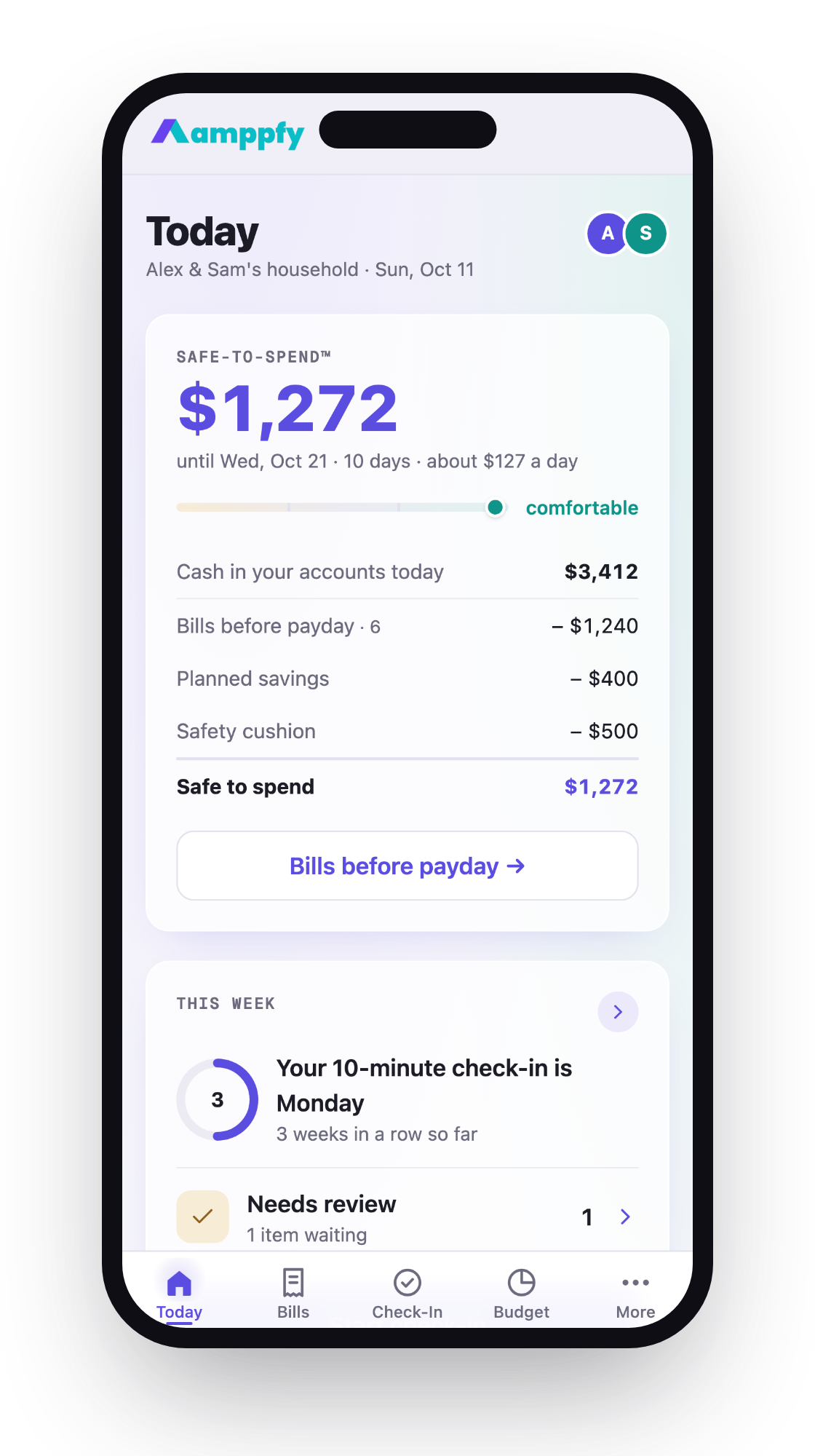
Here’s what your Safe-to-Spend™ number might look like after bills and savings:
$3,100 cash − $1,200 bills due before payday − $300 savings − $400 cushion = $1,200
That $1,200 is what you can actually spend without putting a bill at risk. Amppfy’s Budget page breaks the month into four slices: Bills, Savings, Subscriptions, and Everyday spending, so you see exactly where each dollar is assigned from the plan you already entered.
Subscriptions and everyday spending
Subscriptions are the slow leak in most budgets. They’re small enough to ignore individually but large enough to matter collectively. A streaming service here, a gym membership there, a meal kit you forgot to cancel: they add up fast.
Audit your subscriptions
Pull up your bank and credit card statements from the last 90 days. Flag every recurring charge. Sort them into three columns:
- Keep: you use it weekly or it saves you money elsewhere
- Pause: you haven’t used it in 30 days but might want it back
- Cancel: you forgot you had it, or it duplicates something else
Most couples find $40 to $80 a month in subscriptions they can cut or pause without noticing. That’s $480 to $960 a year redirected to a goal that actually matters.
Everyday spending without guilt
Groceries, gas, coffee, a lunch out: everyday spending is the category that feels hardest to control because it’s made up of dozens of small choices. Instead of policing every purchase, give the category a fixed monthly number and check it once a week.
For a household budgeting $6,000 a month, everyday spending (after bills, savings, and subscriptions) might land between $600 and $900. Split that between two people and you each have $300 to $450 for the month. That’s roughly $75 to $112 per week.
If you’re consistently running out before the month ends, look at the pattern. Is it dining out? Impulse Amazon orders? A $7 daily coffee habit is $210 a month for one person. You don’t have to cut it entirely. Just know what it costs and decide if it’s worth it.
Building a household budget from your actual plan rather than a generic template makes these numbers personal. Your spending won’t match a stranger’s pie chart, and it shouldn’t.
A ten-minute monthly check together
The best budget is the one both of you actually look at. A monthly check-in keeps small problems from becoming big ones. Pick a time that works: Sunday morning coffee, the first of the month, whatever sticks.
Here’s what to cover in ten minutes:
- Update account balances. This takes about 30 seconds per account.
- Confirm upcoming bills match what’s expected. Any new charges? Anything paid off?
- Check savings progress. Are you on pace for your current goal?
- Review the Safe-to-Spend™ number. Does it feel right for the rest of the pay period?
- Flag anything unusual. A medical bill, a car repair, a friend’s wedding.
That’s it. No spreadsheet deep-dive. No blame session. Just five quick items and you’re done.
The check-in works best when both partners can see the same numbers. Amppfy lets each person log in separately and see the same Safe-to-Spend™ number while keeping private balances private. No peeking at each other’s accounts, no arguments about who spent what on their own card.
If something’s off, agree on one adjustment. Just one. Maybe you pause a subscription, push a savings goal back two weeks, or shift a bill to the next pay cycle. Small corrections every month prevent the panicked “where did all the money go” conversation.
Frequently Asked Questions
What’s a realistic savings rate on $6,000 a month for two people?
Aim for 10% to start, which is $600 a month or $300 per person. If that’s too tight right now, begin with 5% ($300 total) and increase by $50 every few months. The percentage matters less than consistency. Saving $150 every two weeks, without skipping, builds more wealth over time than sporadic $500 deposits.
Should we combine bank accounts or keep them separate?
Either works. Many couples use a hybrid approach: one shared account for rent, utilities, and groceries, plus individual accounts for personal spending. The critical piece isn’t the account structure. It’s visibility. Both people need to see the full picture of household bills and goals, even if the money sits in different places.
How do we handle unequal incomes without it feeling unfair?
Split shared costs by income proportion, not 50/50. If one person earns 60% of the household total, they cover 60% of shared bills. Personal spending allowances can be equal regardless of income. This keeps the financial load proportional while giving each person the same freedom for their own purchases.
What if we can’t cover all our bills on $6,000?
List every bill by priority: housing, utilities, food, transportation, insurance, then everything else. If the total exceeds $6,000, look at the bottom of that list first. Can you reduce a car payment by refinancing? Drop a subscription bundle to a cheaper tier? Pick up a side gig for one month to close the gap? Start with the fastest fix and work your way up.
Make the plan, then let it work
Budgeting $6,000 a month on two incomes comes down to three things: know when each paycheck lands, assign every bill to a specific check, and save before you spend. The monthly check-in keeps you honest without turning money into a chore.
You don’t need a complicated system. You need one number that tells you what’s safe to spend right now. Get Amppfy free on iPhone or the web: enter your balances, bills, and payday once, about ten minutes, and your Safe-to-Spend™ number is always there when you need it.